

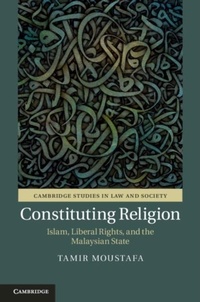
Constituting Religion
Islam, Liberal Rights, and the Malaysian State
Published on 26. July 2018
978-1-108-33443-3 (ISBN)
Description

Most Muslim-majority countries have legal systems that enshrine both Islam and liberal rights. While not necessarily at odds, these dual commitments nonetheless provide legal and symbolic resources for activists to advance contending visions for their states and societies. Using the case study of Malaysia, Constituting Religion examines how these legal arrangements enable litigation and feed the construction of a 'rights-versus-rites binary' in law, politics, and the popular imagination. By drawing on extensive primary source material and tracing controversial cases from the court of law to the court of public opinion, this study theorizes the 'judicialization of religion' and the radiating effects of courts on popular legal and religious consciousness. The book documents how legal institutions catalyze ideological struggles, which stand to redefine the nation and its politics. Probing the links between legal pluralism, social movements, secularism, and political Islamism, Constituting Religion sheds new light on the confluence of law, religion, politics, and society. This title is also available as Open Access.
Reviews / Votes
'Moustafa's fascinating book demonstrates that courts in Malaysia, as in many Muslim-majority polities, enable and catalyze as much as resolve ideological conflicts between proponents of Islamic religious principles and liberal rights. The author's sophisticated understanding of law's constitutive power makes the volume an important contribution to scholarship on legal mobilization, rights contestation, and popular legal consciousness. It is a brilliant achievement, and highly recommended!' Michael McCann, Gordon Hirabayashi Professor for the Advancement of Citizenship, University of Washington 'Constituting Religion offers a strikingly innovative approach to understanding the relationship between Islam and the liberal legal order. Rather than seeing them as inherently incompatible, the book shows through a case study of Malaysia that laws and legal cases generate contests that intensify ideological differences and construct a law/religion binary that polarizes popular legal consciousness. Tamir Moustafa creatively uses socio-legal theory to provide a refreshingly new perspective on a much debated issue.' Sally Engle Merry, New York University 'Tamir Moustafa has done his homework! Constituting Religion is teeming with insights for anyone interested in law, religion, and politics in Malaysia and beyond. He provides readers with a clear-eyed view of how 'rights versus religion' polemics are constructed, and why they matter. Moustafa does justice to an important and complex issue.' Zainah Anwar, co-Founder of Sisters in Islam and Musawah, The Global Movement for Justice and Equality in the Muslim Family 'The book is both slim and engaging enough to be quickly digested by policy-oriented readers as well as academics and deserves to be widely read by all those working in any form of interaction with the 'Islamic legal tradition' in Malaysia and elsewhere.' Amrita Malhi, Journal of Church and State 'Tamir Moustafa's book, Constituting Religion: Islam, Liberal Rights, and the Malaysian State, examines the complex intertwining of law, religion, and politics in Malaysia ... The book is a good example of how judicial actions continue to be explained, framed, and amplified by competing groups of political actors.' Nurfadzilah Yahaya, Reading Religion 'Moustafa provides a very interesting and detailed account of lived Islam and lived liberalism in a Muslim-majority but religiously diverse society.' Muqtedar Khan, Comparative Politics 'Constituting Religion provides a remarkable analytical model for how to study and make sense of this growing global phenomenon.' Doerthe Engelcke, Journal of Law and Religion '... [an] important book.' Spencer Dew, Religious Studies ReviewMore details
Series
Language
English
Place of publication
Cambridge
United Kingdom
Target group
Professional and scholarly
Illustrations
Worked examples or Exercises; 2 Tables, black and white; 9 Halftones, black and white; 4 Line drawings, black and white
File size
3,95 MB
ISBN-13
978-1-108-33443-3 (9781108334433)
Copyright in bibliographic data and cover images is held by Nielsen Book Services Limited or by the publishers or by their respective licensors: all rights reserved.
Schweitzer Classification
Other editions
Additional editions
Book
07/2018
Cambridge University Press
€135.60
Shipment within 15-20 days
Person
Tamir Moustafa is Professor of International Studies and Stephen Jarislowsky Chair at Simon Fraser University in Vancouver, Canada. His research stands at the intersection of law, religion, and politics. Among other work, he is the author of The Struggle for Constitutional Power: Law, Politics, and Economic Development in Egypt (Cambridge, 2007) and he is the co-editor of Rule by Law: The Politics of Law and Courts in Authoritarian Regimes with Tom Ginsburg (Cambridge, 2008).
Content
Introduction: constituting religion; 1. The constitutive power of law and courts; 2. The secular roots of Islamic law in Malaysia; 3. Islam and liberal rights in the federal constitution; 4. The judicialization of religion; 5. Constructing the political spectacle: liberal rights versus Islam in the court of public opinion; 6. The rights-versus-rites binary in popular legal consciousness; 7. 'Islam is the religion of the federation'; Conclusion; Appendix: religion of the state, source law, and repugnancy clause provisions among Muslim-majority countries; Bibliography; Index.
