

Persepolis
Description

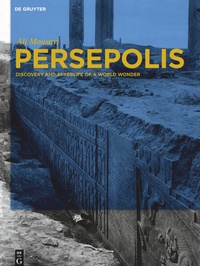
Persepolis: Discovery and Afterlife of a World Wonder presents the first full study of the history of archaeological exploration at Persepolis after its destruction in 330 BC. Based in part on archival evidence, anecdotal information, and unpublished documents, this book describes in detail the history of archaeological exploration, visual documentation, and excavations at one of the most celebrated sites of the ancient world. The book addresses a broad audience of readers ranging from students of the archaeology, history, and art history of ancient, medieval, and modern Iran to scholars in Classical Studies and Ancient Near Eastern Studies.
More details
Other editions
Additional editions
Person
Content
2 - List of figures and plates [Seite 12]
3 - Bibliographic abbreviations [Seite 20]
4 - Foreword by David Stronach [Seite 22]
5 - Introduction [Seite 28]
6 - I. Persepolis: A survey of the site, its chronology and function [Seite 34]
6.1 - The name [Seite 34]
6.2 - The city [Seite 35]
6.3 - The constructions on the Terrace [Seite 41]
6.4 - The constructions outside the Terrace [Seite 51]
6.5 - Problems of chronology [Seite 66]
6.6 - The architectural history [Seite 74]
6.7 - Function and other related problems [Seite 76]
7 - II. Persepolis in Flames [Seite 82]
7.1 - Textual evidence [Seite 82]
7.2 - Archaeological evidence [Seite 85]
7.3 - The burning of Persepolis: Facts, interpretations, and speculations [Seite 88]
7.4 - Subsequent destructions of Persepolis [Seite 95]
8 - III. From Parsa to Sad-Sotun: The Afterlife of Persepolis Begins [Seite 98]
8.1 - Persepolis in the "dark age" of Fars [Seite 98]
9 - IV. Takht-e Jamshid: The Transformation of a Historical Site into a Mythical Symbol [Seite 108]
10 - V. In search of Persepolis: Western travellers' explorations in Persia [Seite 120]
10.1 - Early journeys to the ruins of Chelmenar [Seite 120]
10.2 - The travellers of the Enlightenment [Seite 126]
10.3 - VI Persepolis and the puzzle of the cuneiform inscriptions [Seite 138]
10.4 - The query about the inscriptions at Chelmenar: Chardin and the Royal Society of England [Seite 138]
10.5 - Niebuhr's copies in Europe [Seite 142]
10.6 - Grotefend and the decipherment of the Persepolitan scripts [Seite 145]
11 - VII. The Nineteenth century and the emergence of archaeology [Seite 148]
11.1 - The hunt for knowledge and antiquities: British diplomats in quest of sculptures [Seite 148]
11.2 - Ker Porter, the romantic traveller [Seite 152]
11.3 - Other travellers' explorations of Persepolis in early Qajar Iran [Seite 156]
11.4 - Illustrating Persepolis [Seite 158]
11.5 - Photographing Persepolis [Seite 162]
11.6 - Curzon and the first modern description of the ruins [Seite 171]
11.7 - Weld-Blundell's exploration [Seite 174]
12 - VIII. Persepolis at the Dawn of Scientific Archaeology in Iran [Seite 180]
12.1 - Early steps in the archaeology of Iran: An overview [Seite 180]
12.2 - Persepolis in the early twentieth century [Seite 181]
12.3 - Erich Schmidt and the excavations at Persepolis (1935-1939) [Seite 209]
13 - IX. Forty Years of Research and Restoration at Takht-e Jamshid: 1939-1979 [Seite 218]
13.1 - Krefter and the model of Persepolis [Seite 224]
13.2 - Italian Restoration work and other surface studies at Persepolis 1964-1978 [Seite 227]
13.3 - Tadjvidi and the excavation of the City of Parsa [Seite 231]
14 - Afterword [Seite 240]
15 - Bibliography [Seite 246]
16 - Index [Seite 258]
17 - Plates [Seite 264]
