

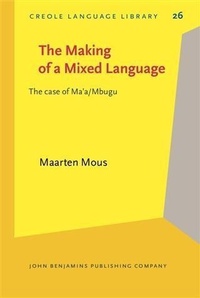
The Making of a Mixed Language
The case of Ma'a/Mbugu
1st Edition
Published on 19. December 2003
XX, 322 pages
978-90-272-7524-0 (ISBN)
Description

The Mbugu (or Ma'á) language (Tanzania) is one of the few genuine mixed languages, reputedly combining Bantu grammar with Cushitic vocabulary. In fact the people speak two languages: one mixed and one closely related to the Bantu language Pare. This book is the first comprehensive description of these languages. It shows that these two languages share one grammar while their lexicon is parallel. In the distant past the people shifted from a Cushitic to a Bantu language and in the process rebuilt a language of their own that expresses their separate ethnic identity in a Bantu environment. This linguistic history is explained in the context of the intricate history of the people. The discussion of the processes that were involved in the formation of Ma'a/Mbugu is extremely relevant for both creole studies and for contact linguistics in general.
More details
Other editions
Additional editions
Book
12/2003
John Benjamins Publishing Co
€137.80
Shipment within 10-15 days
Person
Content
- The Making of a Mixed Language
- Editorial page
- Title page
- Copyright page
- Dedication
- Table of contents
- LIST OF TABLES
- LIST OF FIGURES
- LIST OF ABBREVIATIONS
- Acknowledgements
- 1 INTRODUCTION
- 1.1 The people and their language
- 1.2 Earlier descriptions and history of Ma 'á studies
- 1.3 Source of data, fieldwork
- 1.4 Areas of settlement of the Ma 'á/Mbugu and clan affiliation
- 1.5 Multilingualism and language attitude
- 1.6 A sample of Mbugu language materia
- 1.7 Properties of the parallel lexicon
- 1.8 New insights in this work
- 1.9 Organisation of this book
- 2 HISTORICAL AND GEOGRAPHICAL BACKGROUND
- 2.1 Oral History
- 2.2 Historical information from the parallel lexicon
- 2.3 Usambara mountains: Shambaa, Seuta Bantu, Swahili
- 2.4 Maasai
- 2.5 Gorwaa and Mbugwe
- 2.6 Pare
- 2.7 The Taita connection
- 2.8 Old Kenyan Cushitic: Eastern Cushitic, Dahalo
- 2.9 Chronology through a study of lexical domains
- 2.10 Reconstructing the history: possible scenarios
- 3 LINGUISTIC HISTORY
- 3.1 The issues and the debate
- 3.2 Absence of drastic recent linguistic developments
- 3.3 History of the lateral fricatives in Ma'á (Inner Mbugu)
- 3.4 Truncation rule
- 3.5 Remnants of non-Bantu grammar
- 3.6 Ma' a non-Bantu causatives
- 3.7 Non-Bantu nominal endings
- 3.8 Locatives and other non-Bantu frozen grammatical elements
- 3.9 The origin off unction words
- 3.10 Shift or gradual bantuisation.
- 3.11 Code-switching as a model for Ma'á
- 3.12 Mixed languages as a challenge to historical linguistics
- 4 PHONOLOGY
- 4.1 Consonants
- 4.2 Spirantisation in velars
- 4.3 Prenasalised obstruents
- 4.4 Vowels
- 4.5 Tone
- 4.6 Syllable structure
- 4.7 Word structure and phonotactics
- 5 THE VERB
- 5.1 Overview
- 5.1.1 Vowel coalescence, i-initial stems, and morphotonology
- 5.1.2 Subject and object prefixes
- 5.1.3 Other verbal prefixes, "tense" and polarity
- 5.1.4 Relative marker
- 5.1.5 The inflectional final vowel
- 5.1.6 The a/e alternation
- 5.1.7 Imperatives
- 5.1.8 Clitics
- 5.2 The "tenses
- 5.3 Combinations of "tense" prefixes
- 5.4 The negative "tenses
- 5.5 Copula and verbs "to be
- 5.6 Verbal derivation
- 6 THE NOUN
- 6.1 The noun class system
- 6.2 The morphophonology of the noun class prefixes
- 6.3 Noun class pairings
- 6.4 Derivation
- 6.5 Frozen suffixes
- 6.6 Question nouns
- 6.7 Names
- 7 ADJECTIVES AND OTHER NOMINAL MODIFIERS
- 7.1 Adjectives
- 7.2 Genetive and relative pronouns
- 7.3 Possessives
- 7.4 Demonstratives
- 7.5 Quantifiers
- 8 INVARIABLES OR OTHER WORDS
- 8.1 Dependent invariables: Prepositions
- 8.2 Independent invariables
- 8.3 Independent personal pronouns
- 8.4 Higher numbers and other invariable modifiers
- 9 NOTES ON SYNTAX, CODE-SWITCHING AND TEXTS
- 9.1 Syntax
- 9.2 Set sentences
- 9.3 Code-switching
- 9.4 A sample of code-switching
- 9.5 Texts
- NOTES
- Notes to Chapter 1
- Notes to Chapter 2
- Notes to Chapter 3
- Notes to Chapter 4
- Notes to Chapter 5
- Notes to Chapter 6
- Notes to Chapter 7
- Notes to Chapter 9
- REFERENCES
- APPENDIX: MBUGU-ENGLISH ETYMOLOGICAL LEXICON
- ENGLISH INDEX TO THE LEXICON
- INDEX
