

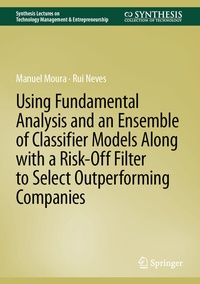
Using Fundamental Analysis and an Ensemble of Classifier Models Along with a Risk-Off Filter to Select Outperforming Companies
Description

This book develops a quantitative stock market investment methodology using financial indicators that beats the benchmark of S&P500 index. To achieve this goal, an ensemble of machine learning models is meticulously constructed, incorporating four distinct algorithms: support vector machine, k-nearest neighbors, random forest, and logistic regression. These models all make use of financial ratios extracted from company financial statements for the purposes of predictive forecasting. The ensemble classifier is subject to a strict testing of precision which compares it to the performance of its constituent models separately. Rolling window and cross-validation tests are used in this evaluation in order to provide a comprehensive assessment framework. A risk-off filter is developed to limit risk during uncertain market periods, and consequently to improve the Sharpe ratio of the model. The risk adjusted performance of the final model, supported by the risk-off filter, achieves a Sharpe ratio of 1.63 which surpasses both the model's performance without the filter that delivers Sharpe ratio of 1.41 and the one from the S&P500 index of 0.80. The substantial increase in risk-adjusted returns is accomplished by reducing the model's volatility from an annual standard of deviation of 15.75% to 11.22%, which represents an almost 30% decrease in volatility.
More details
Other editions
Additional editions
Persons
Manuel Moura is currently doing a MBA at London Business School. Prior to that he worked at LFO since 2019. He received a Master's Degree in Electrical Engineering and Computer Science with a specialization in Control Systems from Instituto Superior Técnico. At LFO, he worked as a quantitative researcher developing models to invest in the stock market and manage risk but also as a portfolio manager. He did internships in consulting at Bain & Company in Brussels and in private equity at Advent International in London.
Rui Ferreira Neves is a professor at Instituto Superior Técnico since 2005. He received the Eng -Diploma and the PhD degrees in Electrical and Computer Engineering from the Instituto Superior Técnico, Technical University of Lisbon, Portugal, in 1993 and 2001, respectively. In 2006 he joined Instituto de Telecomunicações (IT) as a research Associate. His research activity deals with evolutionary computation and pattern matching applied to the financial markets, sensor networks, embedded systems and mixed signal integrated circuits. He uses both fundamental, technical and pattern matching indicators to find the evolution of the financial markets. During his research activities he has collaborated/coordinated several EU and National projects. He supervised 50 MSc Theses. He published more than 60 works, respectively, 7 books, 4 book chapters, 20 journal papers and 30 conference papers.
Content
Introduction.- State-of-the-Art.- Methodology.- System Validation.- Conclusion.
