

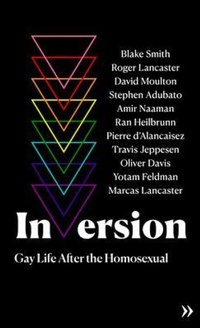
Inversion
Description

With contributions by Blake Smith, Roger Lancaster, David Moulton, Stephen Adubato, Amir Naaman, Ran Heilbrunn, Pierre d'Alancaisez, Travis Jeppesen, Oliver Davis, Yotam Feldman, and Marcas Lancaster.
Today's world of PrEP, Pride parades, and gay marriage eclipses the wildest dreams of the sexual revolution. While it was formerly deviant to promote gay lifestyles, it is now 'problematic' to suggest that not all departures from the norm are in the homosexual's best interest. Amidst this excess, a new wave of discontentment rises among the once-keenest proponents of sexual progress: gay men.
What happened in the transition from inversion to homosexuality, gayness, and queerness? Why do some gay men lament the freedoms afforded to them by sexual and social acceptance? Bold and daring, the essays in Inversion reflect on the vicious cycle of debasement, acceptance, sacrifice, and liberation that homosexuality has been stuck in for longer than it wishes to acknowledge.
As gay culture fails to confront its history, it adopts hollow narratives of struggle. Some gay men fear losing their freedoms, some advocate for sexual restraint, while others, lost in the ever-expanding LGBTQIA+ 'community,' continue to make maximalist ideological demands of those outside. These responses mark a fracture in gay life. If there is some essence to homosexual desire, how is it being served by today's gay culture and queer politics? Has the gay man¿-¿homosexual, queer, or inverted¿-¿rendered himself obsolete?
Bringing together contributions by eleven leading thinkers, theorists, and critics who examine the consequences of pink-washing history, denial of sexual realities, and the memetic nature of desire, Inversion reclaims homosexuality's lost depth in an era of profound discontent.
Fearless in its critique and challenging in its proposals, Inversion considers the cultural and political aspects of gay life after homosexuality as it battles with queerness and the allure of a reactionary return, pharmacologically fueled sexual degeneration, and existential dread.
More details
Content
Historian Blake Smith (Tablet, American Affairs) challenges today's sanitized narratives of gay history, urging a raw reclamation of the once-possible "gay world." Drawing on American gay literary culture of the 1970s, he proposes that articulating shared interests is the foundation for reclaiming homosexuality today.
The cultural anthropologist Roger N. Lancaster (Sex Panic and the Punitive State, The Struggle to Be Gay) considers the clash of gay identities, desire, and aspiration against the race-to-the-bottom progressive status stack. Referring to the working-class Mexican homosexual who "can only afford to be a faggot," Lancaster proposes that today's accounts of gayness have little political potency.
The literary critic David Moulton (Compact, Tablet) examines the complex relationship between the gay and queer cultural canons and the biopolitical regimes they give rise to. Contrasting the literary heroes of his adolescence, like Jean Genet or Péter Nádas, with today's supposedly emancipated, pro-queer literature, he finds little space for fantasy or dissent.
Cultural analyst Stephen G. Adubato (Compact, First Things) proposes reconsidering gay identities in explicitly sexual terms, suggesting that prohibitions and critiques that many today deem obsolete¿-¿such as Christian doctrine or Camille Paglia's brand of feminism¿-¿may shed new light on the gay problem.
Author Amir Naaman (The Hummingbirds) explores political radicalism and violence encroaching on the marketplace of gay desire. Between the six-pack abs of queer icon Luigi Mangione to the sexualised calls for "queering the intifada," moral signaling becomes a kink.
Essayist Ran Heilbrunn (American Affairs, Newsweek) calls for the abolition of queer theory on account of its catastrophic failure to account for the "sex" in homosexuality. Examining the lackluster culture birthed by queer analyses, he argues for the recentering of sexuality as the primary interest of critique.
Art critic Pierre d'Alancaisez (The Critic, ArtReview) tracks the realities of gay sex shaped by queer cultural artefacts on the one hand, and the widespread adoption of biotechnological controls on the other. What is the future of homosexual desire when Instagram brims with twinks for sale, straight women write gay coming out stories, and PrEP is every fag's breakfast?
Novelist Travis Jeppesen (Settlers Landing, The Suiciders) calls for a return to faggotry, recognizing as he does that this call might be mere fantasy. Ascribing the former aesthetic potential of gay culture to transgression, he charges the hipster pseud with inspiring today's flaccid and conformist gay lives, as well as culture's conservative turn.
The theorist Oliver Davis (Hatred of Sex) appraises the rightward turn in gay politics occasioned by the fear of replacement by novel forms of identity. Examining the trajectory of the French writer Renaud Camus from 1970s cult erotica author to anti-immigration conspiracy theorist, Davis contends with the reality of each homosexual being the end of his lineage.
Filmmaker and neo-decadent writer Yotam Feldman (The Lab, The Solar Mind) finds the gay man lost in the dystopian metropolis, no longer able to trade in word or image. Calling on the latter work and thoughts of director Pier Paolo Pasolini, Feldman considers the growing allure of fascism as the homosexual's second nature.
The self-proclaimed "failed gay" Marcas Lancaster delves into the depths of the homosexual's self-destructive narcissism, narrating the disaster of the AIDS crisis in florid, viral detail reminiscent of de Sade. Lancaster paints the sorry end of today's homosexuality as the direct and inevitable consequence of Libertine disinhibition at the foundations of Modernity.
