

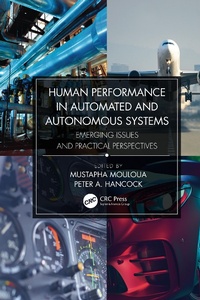
Human Performance in Automated and Autonomous Systems
Emerging Issues and Practical Perspectives
1st Edition
Published on 19. September 2019
334 pages
978-0-429-85739-3 (ISBN)
Description

This book is devoted to the examination of emerging practical issues related to automated and autonomous systems. The book highlights the significance of these emergent technologies that determine the course of our daily lives. Each unique chapter highlights human factors and engineering concerns across real-world applications, including matters related to aviation and healthcare, human-robot interaction, transportation systems, cybersecurity and cyber defense. This book also depicts the boundaries that separate humans from machine as we continue to become ever more immersed in and symbiotic with these fast-emerging technologies.
Automation, across many occupations, has transitioned the human to a role of monitoring machines, presenting challenges related to vigilance and workload. This book identifies the importance of an approach to automated technology that emphasizes the "human user" at the center of the design process.
Features
Provides perspectives on the role of the individual and teams in complex technical systems such as aviation, healthcare, and medicine
Presents the development of highly autonomous systems related to human safety and performance
Examines solutions to human factors challenges presented by modern threats to data privacy and cybersecurity
Discusses human perceptual and cognitive capabilities underwriting to the design of automated and autonomous systems
* Provides in-depth, expert reviews of context-related developments in automation and human-robot teaming
Human Performance in Automated and Autonomous Systems: Emerging Issues and Practical Perspectives applies scientific theory directly to real-world systems where automation and autonomous technology is implemented.
Automation, across many occupations, has transitioned the human to a role of monitoring machines, presenting challenges related to vigilance and workload. This book identifies the importance of an approach to automated technology that emphasizes the "human user" at the center of the design process.
Features
Provides perspectives on the role of the individual and teams in complex technical systems such as aviation, healthcare, and medicine
Presents the development of highly autonomous systems related to human safety and performance
Examines solutions to human factors challenges presented by modern threats to data privacy and cybersecurity
Discusses human perceptual and cognitive capabilities underwriting to the design of automated and autonomous systems
* Provides in-depth, expert reviews of context-related developments in automation and human-robot teaming
Human Performance in Automated and Autonomous Systems: Emerging Issues and Practical Perspectives applies scientific theory directly to real-world systems where automation and autonomous technology is implemented.
More details
Edition
1. Auflage
Language
English
Place of publication
London
United Kingdom
Publishing group
Taylor & Francis Ltd
Target group
College/higher education
Illustrations
5 Tables, black and white; 54 Line drawings, black and white; 6 Halftones, black and white; 60 Illustrations, black and white
ISBN-13
978-0-429-85739-3 (9780429857393)
Copyright in bibliographic data and cover images is held by Nielsen Book Services Limited or by the publishers or by their respective licensors: all rights reserved.
Schweitzer Classification
Other editions
Additional editions
Mustapha Mouloua | Peter A. Hancock
Human Performance in Automated and Autonomous Systems
Emerging Issues and Practical Perspectives
Book
10/2019
1st Edition
CRC Press
€193.13
Shipment within 10-20 days
Persons
Dr. Mouloua is Professor of Psychology at the University of Central Florida, Orlando, Florida and was the Director (2009 -2017) and Associate Director (2006-2009) of the Applied/Experimental and Human Factors Psychology Doctoral Program, Director and Chief Scientist (2001-2014), Associate Director and Senior Research Scientist (1998-2001) of the Center for Applied Human Factors in Aviation, and Associate Director Human Factors Research at the Center for Advanced Transportation Systems Simulation (2001-2003). Dr. Mouloua has over 30 years of experience in the field of Human Factors and Ergonomics. His research interests include human-automation interaction, attention and workload, assessment of older drivers and pilots, UAS operation, selection, training, and simulation technologies across a variety of transportation systems. Dr. Mouloua is the editor or co-editor of several books including Human Performance in Automated Systems: Current Research and Trends (1994, Erlbaum Press), Human-Automation Interaction: Research and Practice (1997, Erlbaum Press), Automation and Human Performance: Theory and Applications (1996, Erlbaum Press), Automation Technology and Human Performance: Current Research and Trends (1999, Erlbaum), Human Factors in Simulation and Training (2009, Taylor & Francis Group), Automation and human performance: Theory, research, and practice (2004, Volumes I & II; Lawrence Erlbaum Associates), and Proceedings of the 2nd ACM Symposium on Computer Human Interaction for Management of Information Technology (ACM, CHIMIT, 2008). Dr. Mouloua published over 190 papers and scientific reports and made over 300 presentations at various national and international meetings. Dr. Mouloua was the recipient of the prestigious Jerome Ely (1997) and the Tidewater (1999) Awards from the Human Factors and Ergonomics Society. At UCF, Dr. Mouloua received eight prestigious Teaching and Research Awards including the recent Teaching Incentive Program Award (2015) and Research Incentive Award (2019) for his outstanding teaching and research contributions. Similarly, he was also a recipient of the UCF International Golden Key and Honorary Award (2011) and the UCF "Twenty Years of Service" Award (2014) for his dedicated work and commitment to students. Dr. Mouloua is currently the Director of the Neurolinguistics, Aviation, and Driving Research Laboratories at UCF.
P.A. Hancock is Provost Distinguished Research Professor in the Department of Psychology and the Institute for Simulation and Training at the University of Central Florida (UCF) and is the author of over nine hundred refereed scientific articles. He has written and edited more than twenty-five books including Human Performance and Ergonomics (1999), Stress, Workload, and Fatigue (2001) and Performance under Stress (2008). He is a Fellow and past President of the Human Factors and Ergonomics Society, the Society of Engineering Psychologists as well as being a former Chair of the Board of the Society for Human Performance in Extreme Environments.
P.A. Hancock is Provost Distinguished Research Professor in the Department of Psychology and the Institute for Simulation and Training at the University of Central Florida (UCF) and is the author of over nine hundred refereed scientific articles. He has written and edited more than twenty-five books including Human Performance and Ergonomics (1999), Stress, Workload, and Fatigue (2001) and Performance under Stress (2008). He is a Fellow and past President of the Human Factors and Ergonomics Society, the Society of Engineering Psychologists as well as being a former Chair of the Board of the Society for Human Performance in Extreme Environments.
Content
Chapter 1. Human Monitoring of Automated Systems. Chapter 2. Motor Performance Assessment and Its Implication for Display and Control Systems. Chapter 3. The Role of Automation in Aviation Weather: Product Development and General Aviation Pilot Performance. Chapter 4. A Playbook-Based Interface for Human Control of Swarms. Chapter 5. Human-Machine System Performance in Spaceflight: A Guide for Measurement. Chapter 6. Decision Support in Medical Systems. Chapter 7. Creating and Evaluating Human-Machine Teams in Context. Chapter 8. 20 Years of Automation in Team Performance. Chapter 9. Automation Trust and Situational Experience: Theoretical Assumptions and Experimental Evicdence. Chapter 10. Human Performance with Autonomous Robotic Teammates: Research Methodologies and Simulations. Chapter 11. Organizational and Safety Factors in Automated Oil and Gas Pipeline Systems. Chapter 12. Cybersecurity in Organizations: A Sociotechnical Systems Approach. Chapter 13. Evolution of Phishing Attacks: Challenges and Opportunities for Humans to Adapt to the Ubiquitous Connected World. Chapter 14. Teleology for Technology. Chapter 15. The Axial Age of Artificial Autonomy.
