

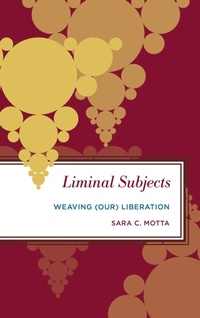
Liminal Subjects
Weaving (Our) Liberation
1st Edition
Published on 31. August 2018
252 pages
978-1-78660-812-3 (ISBN)
Description

Through the stories of women in movement in the Americas, Europe and Australasia, this book explores a decolonising and feminised politics of liberation which is being weaved through the words and worlds of black, colonised and subaltern women. These stories demonstrate the complex and multiple forms of critique as practice that are being developed by women in movement in multiple sites of the Global South.
Written through story, prose, poetry, analysis and offering case-studies, methodologies, practices and generative questions the book expresses and contributes to the (co) creation of a new language of liberation. This is an enfleshed language in which there is a return of the world to the word, of the body to the text, and of the heart/womb to thought. This is a language of the political in which a new political subjectivity that is multiple, deeply relational and becoming is formed.
The book offers a window onto the complexities and depths of the wounding enacted by patriarchal capitalist coloniality through these stories but it also offers, through sharing and conceptualising prefigurative and dialogical co-creation of critique, the gift of practices of healing as emancipation, and the conditions of possibility for our collective liberation.
Written through story, prose, poetry, analysis and offering case-studies, methodologies, practices and generative questions the book expresses and contributes to the (co) creation of a new language of liberation. This is an enfleshed language in which there is a return of the world to the word, of the body to the text, and of the heart/womb to thought. This is a language of the political in which a new political subjectivity that is multiple, deeply relational and becoming is formed.
The book offers a window onto the complexities and depths of the wounding enacted by patriarchal capitalist coloniality through these stories but it also offers, through sharing and conceptualising prefigurative and dialogical co-creation of critique, the gift of practices of healing as emancipation, and the conditions of possibility for our collective liberation.
Reviews / Votes
Lyrical, tough, eloquent, honest, generous, and, above all, wise. Sara Motta spells out the embodied material ground of our political struggles like no other. Here is a book to bring feminism back to its senses - a book that may even touch the hearts of men. In line with the creative, theoretical, and critical projects of trailblazer women of color like Gloria Anzaldua and Cherrie Moraga, and in conversation with an ample array of voices that include influential academics, activists, and artists, Sara Motta takes us through a path of reflection that is also a search for a decolonized voice, knowledge, praxis, spirituality, and selfhood. The text introduces the reader to provocative and insightful analyses that combine different currents of decolonial and anti-colonial thinking in different parts of the world. Motta also offers concepts and archetypes that promise to facilitate the connection between parts of the self and the world, as well as between the self, others, and the world, that have been torn apart by modernity/coloniality. This is a profound text and an important contribution to various forms of anti-colonial and decolonial feminisms as well as to decolonial and anti-racist thought at large. In her visionary, transformational book, Sara C. Motta risks the personal, birthing new-yet-ancient (ancestral) modes of knowing, being, and becoming that profoundly challenge conventional western epistemology, ontology, and metaphysics. Using poetry, prose, prayers, conversations, guided visualizations, ceremonies, rituals, case studies, and more, she offers a revolutionary, heretical alternative to modernity's spirit phobia. Her embodied wor(l)ds demonstrate the generative power of multiplicity, interconnectivity, and the erotic. Liminal Subjects invites readers to fully embrace our enfleshed, trauma-inflected, bruised-yet-becoming-whole selves; listen with raw openness to our exiled inner and outer selves; access our bodies' sacred wisdom; speak new stories into existence; and enact radical modes of decolonial love.More details
Series
Edition
1. Auflage
Language
English
Place of publication
London
United Kingdom
Target group
Professional and scholarly
Illustrations
16 b/w illustrations;
ISBN-13
978-1-78660-812-3 (9781786608123)
Copyright in bibliographic data and cover images is held by Nielsen Book Services Limited or by the publishers or by their respective licensors: all rights reserved.
Schweitzer Classification
Other editions
Additional editions
Book
08/2018
Rowman & Littlefield International
€151.60
Shipment within 3-4 weeks
Person
Sara Catherine Motta currently works in the Discipline of Politics at the University of Newcastle, NSW, Australia. She has published over 30 academic articles, edited 8 academic journal special issues since 2010, the most recent of which is (2017) Feminised Resistances with Tiina Seppaelae for the Journal of Resistance Studies, and her most recent book is (2014) Constructing 21st Century Socialism in Latin America: The Role of Radical Education with Mike Cole (Palgrave Macmillan Press). See attached CV for further details.
Content
Part One: Speaking the Silence(d) / Chapter One: Untameable Women / Chapter Two: Silence / Part Two: Becoming Woman / Chapter Three: Knowing (Our) Selves / Chapter Four: Our Serpents' Tongues / Chapter Five: Sacred Erotics / Part Three: The Black Mothers / Chapter Six: The Storyteller-Medicine Woman / Chapter Seven: The Guardian-Garderner / Chapter Eight: The Priestess-Shamanka / Part Four: Homecoming / Chapter Nine: Liminal Subjects / Chapter Ten: For You / Bibliography / Index
