


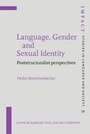
Language, Gender and Sexual Identity
Poststructuralist perspectives
1st Edition
Published on 11. November 2010
XI, 209 pages
978-90-272-8750-2 (ISBN)
Description

This book makes an innovative contribution to the relatively young field of Queer Linguistics. Subscribing to a poststructuralist framework, it presents a critical, deconstructionist perspective on the discursive construction of heteronormativity and gender binarism from a linguistic point of view. On the one hand, the book provides an outline of Queer approaches to issues of language, gender and sexual identity that is of interest to students and scholars new to the field. On the other hand, the empirical analyses of language data represent material that also appeals to experts in the field. The book deals with repercussions of the discursive materialisation of heteronormativity and gender binarism in various kinds of linguistic data. These include stereotypical genderlects, structural linguistic gender categories (especially from a contrastive linguistic point of view), the discursive sedimentation of female and feminine generics, linguistic constructions of the gendered body in advertising and the usage of personal reference forms to create characters in Queer Cinema. Throughout the book, readers become aware of the wounding potential that gendered linguistic forms may possess in certain contexts.
More details
Other editions
Additional editions
Book
11/2010
John Benjamins Publishing Co
€104.94
Shipment within 10-15 days
Person
Content
- Language, Gender and Sexual Identity
- Editorial page
- Title page
- LCC data
- Dedication page
- Table of contents
- Introduction
- Overview of the Book
- Queer Linguistics
- 2.1. Locating Queer Linguistics theoretically
- 2.2. Heteronormativity concerns everybody
- 2.3. Political agency as a point of controversy
- Queer approaches in linguistic research
- 3.1. Sociolinguistics
- 3.2. Corpus Linguistics
- 3.3. Historical Linguistics
- 3.4. Contrastive Linguistics
- 3.5. Semantics
- 3.6. Pragmatics
- 3.7. Foreign language teaching
- 3.8. Critique of heteronormative language use
- 3.9. Conclusion
- Redefining Genderlects
- 4.1. Early linguistic folklore: 'women's/men's language'
- 4.2. The traditional genderlect concept
- 4.3. Postmodernist conceptualisations of gender
- 4.4. Linguistic genderisation as style
- 4.5. Linguistic genderisation in advertising discourse
- 4.6. Hegemonic and non-hegemonic gender styles
- 4.7. Conclusion: a re-definition of the genderlect concept
- The sedimentation of structural gender categories
- 5.1. Introduction
- 5.2. A deconstructionist view of binarisms
- 5.3. Linguistic categories of gender construction
- 5.3.1 Lexical gender
- 5.3.2 Social gender
- 5.3.3 Grammatical gender
- 5.3.4 Referential gender
- 5.4. Scrutinising mechanisms of linguistic gender construction
- 5.4.1 Scrutinising lexical gender
- 5.4.2 Scrutinising social gender
- 5.4.3 Scrutinising grammatical gender
- 5.4.4 Scrutinising referential gender
- 5.5. Gendered linguistic structures and performative materialisation
- 5.6. Conclusion
- The discursive materialisation of feminine and female generics
- 6.1. Introduction
- 6.2. False generics
- 6.3. Markedness, gender and personal reference forms
- 6.4. Types of female/feminine generics
- 6.4.1 Systematic feminine bias
- 6.4.2 Grammatically feminine epicenes
- 6.4.3 Double gender nouns with female/feminine satellite forms
- 6.4.4 Female personal nouns used generically
- 6.4.5 People=female bias
- 6.4.6 Generic uses of feminine/female forms in morphologically complex formations
- 6.4.7 Use of female/feminine generics in specific communities
- 6.4.8 Female-based naming practices
- 6.5. Conclusion
- The discursive construction of the gendered body
- 7.1. Introduction
- 7.2. Gender construction via body-part vocabulary
- 7.3. Gender, discourse and linguistic performativity
- 7.4. Methodology
- 7.5. Body-Part Vocabulary as a Means of Gendering Advertising Texts
- 7.5.1 Gendered body ideals in advertising
- 7.5.2 Linguistic gendering via body-part vocabulary
- 7.5.3 Summary of findings
- 7.6. Conclusion
- Linguistic identity construction in queer cinema
- 8.1. But I'm a cheerleader
- 8.2. Linguistic identity construction in But I'm a cheerleader
- 8.3. Looking at personal names more closely
- 8.4. Boys Don't Cry
- 8.5. Linguistic identity construction in Boys Don't Cry
- 8.6. Linguistic construction of Brandon Teena
- 8.7. Conclusion
- Thinking Further: Language, Gender and Wounding
- 9.1. Viewing Gender in the Light of Politeness Theories
- 9.2. Poststructuralist Discussions of Linguistic Wounding
- Language index
- Subject index
- The series IMPACT: Studies in language and society
