

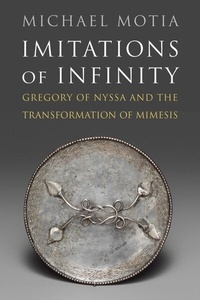
Imitations of Infinity
Gregory of Nyssa and the Transformation of Mimesis
1st Edition
Published on 26. November 2021
312 pages
978-0-8122-9961-8 (ISBN)
Description

We do not have many definitions of Christianity from late antiquity, but among the few extant is the brief statement of Gregory of Nyssa (335-395 CE) that it is "mimesis of the divine nature." The sentence is both a historical gem and theologically puzzling. Gregory was the first Christian to make the infinity of God central to his theological program, but how could he intend for humans to imitate the infinite? If the aim of the Christian life is "never to stop growing towards what is better and never to place any limit on perfection," how could mimesis function within this endless pursuit?
In Imitations of Infinity, Michael A. Motia situates Gregory among Platonist philosophers, rhetorical teachers, and early Christian leaders to demonstrate how much of late ancient life was governed by notions of imitation. Questions both intimate and immense, of education, childcare, or cosmology, all found form in a relationship of archetype and image. It is no wonder that these debates demanded the attention of people at every level of the Roman Empire, including the Christians looking to form new social habits and norms. Whatever else the late ancient transformation of the empire affected, it changed the names, spaces, and characters that filled the imagination and common sense of its citizens, and it changed how they thought of their imitations.
Like religion, imitation was a way to organize the world and a way to reach toward new possibilities, Motia argues, and two earlier conceptions of mimesis-one centering on ontological participation, the other on aesthetic representation-merged in late antiquity. As philosophers and religious leaders pondered how linking oneself to reality depended on practices of representation, their theoretical debates accompanied practical concerns about what kinds of objects would best guide practitioners toward the divine. Motia places Gregory within a broader landscape of figures who retheorized the role of mimesis in search of perfection. No longer was imitation a marker of inauthenticity or immaturity. Mimesis became a way of life.
In Imitations of Infinity, Michael A. Motia situates Gregory among Platonist philosophers, rhetorical teachers, and early Christian leaders to demonstrate how much of late ancient life was governed by notions of imitation. Questions both intimate and immense, of education, childcare, or cosmology, all found form in a relationship of archetype and image. It is no wonder that these debates demanded the attention of people at every level of the Roman Empire, including the Christians looking to form new social habits and norms. Whatever else the late ancient transformation of the empire affected, it changed the names, spaces, and characters that filled the imagination and common sense of its citizens, and it changed how they thought of their imitations.
Like religion, imitation was a way to organize the world and a way to reach toward new possibilities, Motia argues, and two earlier conceptions of mimesis-one centering on ontological participation, the other on aesthetic representation-merged in late antiquity. As philosophers and religious leaders pondered how linking oneself to reality depended on practices of representation, their theoretical debates accompanied practical concerns about what kinds of objects would best guide practitioners toward the divine. Motia places Gregory within a broader landscape of figures who retheorized the role of mimesis in search of perfection. No longer was imitation a marker of inauthenticity or immaturity. Mimesis became a way of life.
Reviews / Votes
"Michael Motia has convincingly proved that the transformative mimesis in Gregory is open-ended...Motia's book can captivate readers across all humanities disciplines, in which mimesis-especially under the influence of continental philosophy and critical theory-stands among the key concepts." (Journal of Ancient Christianity) "One of the most beautiful features of the volume reviewed here is that its writing expresses the very message it wants to convey. In fact, the text, which is very easy to read because it is very well written, is 'not imitable.' The subject of the research conducted with great accuracy and depth by Michael Motia is the re-comprehension of mimesis by Gregory of Nyssa, who fits into the philosophical and theological tradition, which sees imitation as the path to divinization, but at the same time, because of the centrality of the infinitude of the triune God that characterizes his thought, he also points out how the Christian God is inimitable because He is infinite." (Catholic Historical Review) "This beautifully written, theoretically sophisticated, and wonderfully convincing book marries a lucid analysis of the usually inaccessible ontological mimesis of philosophy to the more intimate transformation of names, spaces, and characters that governed Christian imitation. The casual reader should not be intimidated; in revealing how mimetic relationships structure the world and stretch the Christian toward new possibilities, Michael Motia makes the transcendent approachable, the familiar divine, and Gregory of Nyssa profoundly relevant." (Candida Moss, University of Birmingham) "Michael A. Motia shows how Gregory of Nyssa joined the aesthetic and ontological approaches to mimesis in order to convey the paradox of a finite being imitating what is inimitable and infinite. One comes away from this book with the satisfaction of having learned something new about Gregory, but also with gratitude for being furnished with the tools to perceive the relevance of Motia's arguments regarding mimesis across a range of other texts from classical and late antiquity (and beyond)." (Alexis Torrance, University of Notre Dame)More details
Series
Language
English
Place of publication
Pennsylvania
United States
Target group
College/higher education
File size
3,11 MB
ISBN-13
978-0-8122-9961-8 (9780812299618)
Copyright in bibliographic data and cover images is held by Nielsen Book Services Limited or by the publishers or by their respective licensors: all rights reserved.
Schweitzer Classification
Other editions
Additional editions
Book
12/2021
University of Pennsylvania Press
€65.00
Shipment within 10-20 days
Person
Michael A. Motia is Associate Lecturer in Religion at the University of Massachusetts.
Content
Introduction. The Mimetic Life
Chapter 1. Two Tracks of Mimesis
Chapter 2. Crossing Tracks: Mimesis in Neoplatonism
Chapter 3. Early Christian Mimesis
Chapter 4. Mimetic Names
Chapter 5. Mimetic Spaces
Chapter 6. Mimetic Characters
Conclusion. Mimesis and Mystery
List of Abbreviations
Notes
Bibliography
Index
Acknowledgments
Chapter 1. Two Tracks of Mimesis
Chapter 2. Crossing Tracks: Mimesis in Neoplatonism
Chapter 3. Early Christian Mimesis
Chapter 4. Mimetic Names
Chapter 5. Mimetic Spaces
Chapter 6. Mimetic Characters
Conclusion. Mimesis and Mystery
List of Abbreviations
Notes
Bibliography
Index
Acknowledgments
