

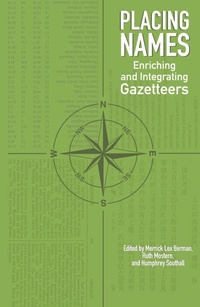
Placing Names
Enriching and Integrating Gazetteers
1st Edition
Published on 8. August 2016
272 pages
978-0-253-02256-1 (ISBN)
Description

Well before the innovation of maps, gazetteers served as the main geographic referencing system for hundreds of years. Consisting of a specialized index of place names, gazetteers traditionally linked descriptive elements with topographic features and coordinates. Placing Names is inspired by that tradition of discursive place-making and by contemporary approaches to digital data management that have revived the gazetteer and guided its development in recent decades. Adopted by researchers in the Digital Humanities and Spatial Sciences, gazetteers provide a way to model the kind of complex cultural, vernacular, and perspectival ideas of place that can be located in texts and expanded into an interconnected framework of naming history. This volume brings together leading and emergent scholars to examine the history of the gazetteer, its important role in geographic information science, and its use to further the reach and impact of spatial reasoning into the digital age.
Reviews / Votes
Placing Names should be on every digital scholar's bookshelf for its concepts, suggestions, intellectual history, and warnings to newcomers in the digital humanities. It announces the arrival of digital gazetteers as intellectual products to be understood and reckoned with by anyone who deals with history and place. * Journal of Interdisciplinary History * Those working in computing-related aspects of geographer will find a useful primer in all things gazetteer-related, with special focus on cultural aspects of this emerging and very important sub-field. * Journal of Historical Geography *All prices
More details
Language
English
Place of publication
Bloomington, IN
United States
Target group
Professional and scholarly
US School Grade: College Graduate Student and over
Illustrations
11 Tables, black and white; 10 Halftones, black and white
File size
20,98 MB
ISBN-13
978-0-253-02256-1 (9780253022561)
Copyright in bibliographic data and cover images is held by Nielsen Book Services Limited or by the publishers or by their respective licensors: all rights reserved.
Schweitzer Classification
Other editions
Additional editions
Book
08/2016
Indiana University Press
€47.80
Shipment within 10-20 days
Persons
Merrick Lex Berman is Web Services Manager and GIS Specialist at the Center for Geographic Analysis, Harvard University. Berman has developed (with Bill Hays) a Temporal Gazetteer web service, and was the project manager for the China Historical GIS.
Ruth Mostern is Associate Professor in the School of Social Sciences, Humanities and Arts at the University of California, Merced. Mostern developed (with Elijah Meeks) the Digital Gazetteer of the Song Dynasty and is author of Dividing the Realm in Order to Govern: The Spatial Organization of the Song State.
Humphrey Southall is Professor of Historical Geography at University of Portsmouth (UK). He developed the Great Britain Historical GIS, and the website Vision of Britain. He has been extensively involved with historical gazetteers in the context of GIS and spatial statistics and is now working on PastPlace, a linked data gazetteer of historical place names.
Ruth Mostern is Associate Professor in the School of Social Sciences, Humanities and Arts at the University of California, Merced. Mostern developed (with Elijah Meeks) the Digital Gazetteer of the Song Dynasty and is author of Dividing the Realm in Order to Govern: The Spatial Organization of the Song State.
Humphrey Southall is Professor of Historical Geography at University of Portsmouth (UK). He developed the Great Britain Historical GIS, and the website Vision of Britain. He has been extensively involved with historical gazetteers in the context of GIS and spatial statistics and is now working on PastPlace, a linked data gazetteer of historical place names.
Content
Acknowledgements
Preface / Peter K. Bol
Introduction / Ruth Mostern, Humphrey Southall, and Merrick Lex Berman
Section 1: What is a Gazetteer
1. Gazetteers Past: Placing Names from Antiquity to the Internet / Ruth Mostern and Humphrey Southall
2. Gazetteers Present: Spatial Science and Volunteered Geographical Information / Michael F. Goodchild
3. Gazetteers Global: United Nations Geographical Names Standardization / Helen Kerfoot
4. Gazetteers Enriched: A Conceptual Basis for Linking Gazetteers with Other Kinds of Information / Ryan Shaw
Section 2: Using Gazetteers in Combination
5. International Standards for Gazetteer Data Structures / Raj Singh
6. Place, Period, and Setting for Linked Data Gazetteers / Karl Grossner, Krzysztof Janowicz, and Carsten Kessler
7. The Pleiades Gazetteer and the Pelagios Project / Rainer Simon, Leif Isaksen, Elton Barker, and Pau de Soto Canamares
8. Historical Gazetteer System Integration: CHGIS, Regnum Francorum, and GeoNames / Merrick Lex Berman, Johan Ahlfeldt, and Marc Wick
Section 3: Exemplars
9. Building a Gazetteer for Early Modern London, 1550-1650 / Janelle Jenstad
10. Digitally Exposing the Place Names of England and Wales / Paul Ell, Lorna Hughes, and Humphrey Southall
11. Standardizing Names Nationally: The Work of the United States Board on Geographic Names / Michael Fournier
12. The Yeosi Project: Finding a Place in Northeast Asia Through History / Youcheol Kim, Byungnam Yoon, Jonghyuk Kim, and Hyunjong Kim
Section 4: Doing History with Gazetteers
13. Mapping Religious Geographies in Chinese Muslim Society / Mark Henderson and Karl Ryavec
14. Core-Periphery Structure of the Nobi Region, Central Japan, With Reference to the Work of G. William Skinner / Tsunetoshi Mizoguchi
15. Gazetteer GIS and the Study of Taiwan Local Society and its Transition / Pi-ling Pai and I-Chun Fan
References
List of Contributors
Index
Preface / Peter K. Bol
Introduction / Ruth Mostern, Humphrey Southall, and Merrick Lex Berman
Section 1: What is a Gazetteer
1. Gazetteers Past: Placing Names from Antiquity to the Internet / Ruth Mostern and Humphrey Southall
2. Gazetteers Present: Spatial Science and Volunteered Geographical Information / Michael F. Goodchild
3. Gazetteers Global: United Nations Geographical Names Standardization / Helen Kerfoot
4. Gazetteers Enriched: A Conceptual Basis for Linking Gazetteers with Other Kinds of Information / Ryan Shaw
Section 2: Using Gazetteers in Combination
5. International Standards for Gazetteer Data Structures / Raj Singh
6. Place, Period, and Setting for Linked Data Gazetteers / Karl Grossner, Krzysztof Janowicz, and Carsten Kessler
7. The Pleiades Gazetteer and the Pelagios Project / Rainer Simon, Leif Isaksen, Elton Barker, and Pau de Soto Canamares
8. Historical Gazetteer System Integration: CHGIS, Regnum Francorum, and GeoNames / Merrick Lex Berman, Johan Ahlfeldt, and Marc Wick
Section 3: Exemplars
9. Building a Gazetteer for Early Modern London, 1550-1650 / Janelle Jenstad
10. Digitally Exposing the Place Names of England and Wales / Paul Ell, Lorna Hughes, and Humphrey Southall
11. Standardizing Names Nationally: The Work of the United States Board on Geographic Names / Michael Fournier
12. The Yeosi Project: Finding a Place in Northeast Asia Through History / Youcheol Kim, Byungnam Yoon, Jonghyuk Kim, and Hyunjong Kim
Section 4: Doing History with Gazetteers
13. Mapping Religious Geographies in Chinese Muslim Society / Mark Henderson and Karl Ryavec
14. Core-Periphery Structure of the Nobi Region, Central Japan, With Reference to the Work of G. William Skinner / Tsunetoshi Mizoguchi
15. Gazetteer GIS and the Study of Taiwan Local Society and its Transition / Pi-ling Pai and I-Chun Fan
References
List of Contributors
Index

