
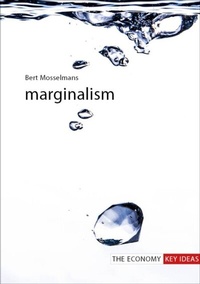
Marginalism
Description
Alles über E-Books | Antworten auf Fragen rund um E-Books, Kopierschutz und Dateiformate finden Sie in unserem Info- & Hilfebereich.
The notion of marginalism is central to modern economic theory. Its emergence, in the 1870s, underpinned the change from classical economics to modern (micro)economics, described by Schumpeter as a "revolution". This book explores the origins of the concept, its development and role in modern economics and shows why the marginalist approach is much more than a set of mathematical rules.
The book examines how marginalism and its development of calculus came about in a variety of different arenas, including as a reaction to Ricardo's dominant theory of rents, in von Thunen's location model, in the writings of German and French authors, both within the mainstream and outside it, before going on to look in detail at the work of Jevons, Walras and Menger, the economists most closely associated with the marginal revolution.
By exploring the origins and development of the marginalist approach within the history of economic thought, rather than seeking to explain it in forbidding formal terms, the book is better able to show students the wider importance of the marginalist approach in economic theory and its far-reaching societal implications in terms of the distribution of wages and capital. For anyone who has struggled with the technicalities of microeconomic theory, this approach will be warmly welcomed.
All prices
More details
Other editions
Additional editions
Person
Bert Mosselmans is Professor of Economics at University College Roosevelt, Middelburg. His books include William Stanley Jevons and the Cutting Edge of Economics (2007).
Content
1. Value, cost and price: a historical introduction to marginalism2. Supply-side marginalism: Ricardo and the theory of rent3. Demand-side marginalism: Gossen as a forerunner of marginalism4. Jevons: mathematics, mechanics and marginalism5. Walras and general equilibrium theory6. Carl Menger, Friedrich von Wieser and the Austrian approach7. Alfred Marshall, John Bates Clark and the marginalist synthesis8. Marginalism in the twentieth century

System requirements
File format: ePUB
Copy protection: Adobe-DRM (Digital Rights Management)
System requirements:
- Computer (Windows; MacOS X; Linux): Install the free reader Adobe Digital Editions prior to download (see eBook Help).
- Tablet/smartphone (Android; iOS): Install the free app Adobe Digital Editions or the app PocketBook before downloading (see eBook Help).
- E-reader: Bookeen, Kobo, Pocketbook, Sony, Tolino and many more (not Kindle).
The file format ePub works well for novels and non-fiction books – i.e., „flowing” text without complex layout. On an e-reader or smartphone, line and page breaks automatically adjust to fit the small displays.
This eBook uses Adobe-DRM, a „hard” copy protection. If the necessary requirements are not met, unfortunately you will not be able to open the eBook. You will therefore need to prepare your reading hardware before downloading.
Please note: We strongly recommend that you authorise using your personal Adobe ID after installation of any reading software.
For more information, see our ebook Help page.
File format: ePUB
Copy protection: Watermark-DRM (Digital Rights Management)
System requirements:
- Computer (Windows; MacOS X; Linux): Use a reading software that can process the file format ePUB: e.g., Adobe Digital Editions or FBReader – both free (see eBook Help).
- Tablet/Smartphone (Android; iOS): Before downloading, install the free app Adobe Digital Editions (see eBook Help).
- E-reader: Bookeen, Kobo, Pocketbook, Sony, Tolino and many more (not Kindle).
The file format ePUB works well for novels and non-fiction books – i.e., „flowing” text without complex layout. On an e-reader or smartphone, line and page breaks automatically adjust to fit the small displays.
This eBook uses Watermark-DRM, a „soft” copy protection. This means that there are no technical restrictions to prevent illegal distribution. However, there is a personalised watermark embedded in the eBook that can be used to identify the purchaser of the eBook in the event of misuse and to provide evidence for legal purposes.
For more information, see our eBook Help page.