

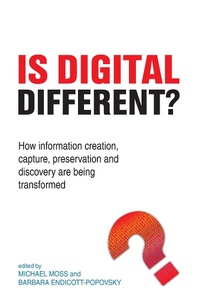
Is Digital Different?
Description

This edited collection brings together global experts to explore the role of information professionals in the transition from an analogue to a digital environment.
The contributors, including David Nicholas, Valerie Johnson, Tim Gollins and Scott David, focus on the opportunities and challenges afforded by this new environment that is transforming the information landscape in ways that were scarcely imaginable a decade ago and is challenging the very existence of the traditional library and archive as more and more resources become available on line and as computers and supporting networks become more and more powerful.
By drawing on examples of the impact of other new and emerging technologies on the information sciences in the past, the book emphasises that information systems have always been shaped by available technologies that have transformed the creation, capture, preservation and discovery of content.
Key topics covered include:
- Search in the digital environment
- RDF and the semantic web
- Crowd sourcing and engagement between institutions and individuals
- Development of information management system
- Security: managing online risk
- Long term curation and preservation
- Rights and the Commons
- Finding archived records in the digital age.
Is Digital Different? illustrates the ways in which the digital environment has the potential to transform scholarship and break down barriers between the academy and the wider community, and draws out both the inherent challenges and the opportunities for information professionals globally.
Readership: This book will be of particular to students, particularly those on information studies programs, and academics, researchers and archivists globally.
More details
Other editions
Additional editions
Persons
Barbara Endicott-Popovsky, Ph.D., is Executive Director of the Center for Information Assurance and Cybersecurity at the University of Washington, Director of the Master of Cybersecurity and Leadership program, Academic Director for the Masters in Infrastructure Planning and Management in the Urban Planning Department of the School of Built Environments and was named Department Fellow at Aberyswyth University Wales (2012). Michael Moss is professor of archival science at the University of Northumbria. Previously, he was research professor in archival studies in the Humanities Advanced Technology and Information Institute at the University of Glasgow, where he directed the Information Management and Preservation MSc programme. He is a non-executive director of the National Records of Scotland and until 2014 a member of the Lord Chancellor's Advisory Council on National Archives and Records. In 2015 he was Miegunyah distinguished fellow at the University of Melbourne. Marc J. Dupuis, Ph.D., is a researcher and lecturer with the University of Washington as well as the Director of Human Factors for the Center for Information Assurance and Cybersecurity (CIAC). His main focus is on understanding the information security behaviour of individuals, including issues related to decision making and the user experience.
Content
Introduction and acknowledgements - Michael Moss and Barbara Endicott-Popovsky
1. What is the same and what is different - Michael Moss
2. Finding stuff - David Nicholas and David Clark
3. RDF, the Semantic Web, Jordan, Jordan and Jordan - Norman Gray
4. Crowd sourcing - Ylva Berglund Prytz
5. Pathways to integrating technical, legal and economic considerations in the design, development and deployment of trusted IM systems - Scott David and Barbara Endicott Popovsky
6. Finding archived records in a digital age - Tim Gollins and Emma Bayne
7. Security: managing online risk - Barbara Endicott-Popovsky
8. Rights and the Commons: navigating the boundary between public and private knowledge spaces - Gavan McCarthy and Helen Morgan
9. From the Library in Alexandria to the Google Campus: has the digital changed the way we do research? - David Thomas and Valeria Johnson
