

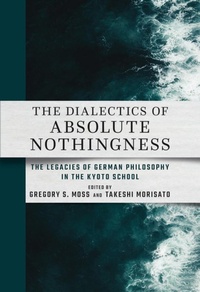
The Dialectics of Absolute Nothingness
The Legacies of German Philosophy in the Kyoto School
Published on 15. February 2025
326 pages
978-1-5017-7900-8 (ISBN)
Description

The Dialectics of Absolute Nothingness investigates the appropriations, critiques, and innovative interpretations of German philosophy by the Kyoto School, showing how central concepts of German philosophical traditions found a place within non-Western frameworks such as Zen and Pure Land Buddhism, thereby transcending the original Western context.
Kyoto School philosophers critically engaged with their own tradition and grappled with classical German philosophy from Kant to German Idealism and from Neo-Kantianism to German phenomenology. Far from mimicking the Western tradition, Nishida, Tanabe, Nishitani and other Japanese philosophers overcame their sense of alienation from European philosophy by making its concepts their own and advancing their ideas as a hybrid of European and Japanese philosophy through which they developed their own world historical perspective.
Showcasing the ways that Kyoto School philosophers internalized German philosophy and generated their own original perspectives, The Dialectics of Absolute Nothingness demonstrates the Kyoto School's potential for culturally diversifying the study of German philosophy and paves the way for the comprehensive study of Asian philosophy in European and global contexts.
Kyoto School philosophers critically engaged with their own tradition and grappled with classical German philosophy from Kant to German Idealism and from Neo-Kantianism to German phenomenology. Far from mimicking the Western tradition, Nishida, Tanabe, Nishitani and other Japanese philosophers overcame their sense of alienation from European philosophy by making its concepts their own and advancing their ideas as a hybrid of European and Japanese philosophy through which they developed their own world historical perspective.
Showcasing the ways that Kyoto School philosophers internalized German philosophy and generated their own original perspectives, The Dialectics of Absolute Nothingness demonstrates the Kyoto School's potential for culturally diversifying the study of German philosophy and paves the way for the comprehensive study of Asian philosophy in European and global contexts.
More details
Language
English
Place of publication
United States
Publishing group
Cornell University Press
Product notice
Reflowable
File size
0,97 MB
ISBN-13
978-1-5017-7900-8 (9781501779008)
Copyright in bibliographic data and cover images is held by Nielsen Book Services Limited or by the publishers or by their respective licensors: all rights reserved.
Schweitzer Classification
Other editions
Additional editions
Gregory S. Moss | Takeshi Morisato
The Dialectics of Absolute Nothingness
The Legacies of German Philosophy in the Kyoto School
Book
02/2025
Cornell University East Asia Program
€66.00
Shipment within 15-20 days

Gregory S. Moss | Takeshi Morisato
The Dialectics of Absolute Nothingness
The Legacies of German Philosophy in the Kyoto School
Book
02/2025
Cornell East Asia Series
Unfortunately, price unknown
Available (delivery time upon request)
Persons
Gregory S. Moss is Associate Professor of Philosophy at the Chinese University of Hong Kong. He is the author of Hegel's Foundation Free Metaphysics.
Takeshi Morisato is a Lecturer in Non-Western Philosophy at the University of Edinburgh. He is the author of Tanabe Hajime and the Kyoto School.
Takeshi Morisato is a Lecturer in Non-Western Philosophy at the University of Edinburgh. He is the author of Tanabe Hajime and the Kyoto School.
Content
Introduction
1. The Logic of Reality in Nishidian Philosophy, Inoue Katsuhito, Kansai University, Translated by Dennis Prooi, Hong Kong Universityof Science and Technology
2. Nishidian Philosophy in theGenealogy of Groundless Will,Itabashi Yjin, Rissh University,Translated by Takeshi Morisato,University of Edinburgh
3. The Legacy of German Idealismin F. H. Bradley and His Influenceon the Early Nishida, Dennis Prooi,Hong Kong University of Science and Technology
4. Absolute Critique in TanabeHajime's Philosophy as Metanoetics,Gregory S. Moss, The ChineseUniversity of Hong Kong
5. Tanabe Hajime and Hegel's Dialectic: A Negative Ground forthe Birth of Tanabean Philosophy,Takeshi Morisato, The University ofEdinburgh
6. Philosophical Religion and Absolute Nothingness: Nishitaniand Schelling, Realization andRevelation, Jason M. Wirth, Seattle University
7. On the "European Form ofBuddhism": The Kyoto Schooland German Philosophy againstthe Background of ReligiousNihilism, Raquel Bouso, University ofPompeu Fabra
8. Transmysticism: Ueda Shizuteruon Zen after Meister Eckhart,Bret W. Davis, Loyola UniversityMaryland
1. The Logic of Reality in Nishidian Philosophy, Inoue Katsuhito, Kansai University, Translated by Dennis Prooi, Hong Kong Universityof Science and Technology
2. Nishidian Philosophy in theGenealogy of Groundless Will,Itabashi Yjin, Rissh University,Translated by Takeshi Morisato,University of Edinburgh
3. The Legacy of German Idealismin F. H. Bradley and His Influenceon the Early Nishida, Dennis Prooi,Hong Kong University of Science and Technology
4. Absolute Critique in TanabeHajime's Philosophy as Metanoetics,Gregory S. Moss, The ChineseUniversity of Hong Kong
5. Tanabe Hajime and Hegel's Dialectic: A Negative Ground forthe Birth of Tanabean Philosophy,Takeshi Morisato, The University ofEdinburgh
6. Philosophical Religion and Absolute Nothingness: Nishitaniand Schelling, Realization andRevelation, Jason M. Wirth, Seattle University
7. On the "European Form ofBuddhism": The Kyoto Schooland German Philosophy againstthe Background of ReligiousNihilism, Raquel Bouso, University ofPompeu Fabra
8. Transmysticism: Ueda Shizuteruon Zen after Meister Eckhart,Bret W. Davis, Loyola UniversityMaryland
