

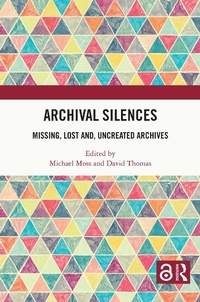
Archival Silences
Missing, Lost and, Uncreated Archives
1st Edition
Published on 10. May 2021
272 pages
978-1-000-38523-6 (ISBN)
Description

Archival Silences demonstrates emphatically that archival absences exist all over the globe. The book questions whether benign 'silence' is an appropriate label for the variety of destructions, concealment and absences that can be identified within archival collections.
Including contributions from archivists and scholars working around the world, this truly international collection examines archives in Australia, Brazil, Denmark, England, India, Iceland, Jamaica, Malawi, The Philippines, Scotland, Turkey and the United States. Making a clear link between autocratic regimes and the failure to record often horrendous crimes against humanity, the volume demonstrates that the failure of governments to create records, or to allow access to records, appears to be universal. Arguing that this helps to establish a hegemonic narrative that excludes the 'other', this book showcases the actions historians and archivists have taken to ensure that gaps in archives are filled. Yet the book also claims that silences in archives are inevitable and argues not only that recordkeeping should be mandated by international courts and bodies, but that we need to develop other ways of reading archives broadly conceived to compensate for absences.
Archival Silences addresses fundamental issues of access to the written record around the world. It is directed at those with a concern for social justice, particularly scholars and students of archival studies, history, sociology, international relations, international law, business administration and information science.
Including contributions from archivists and scholars working around the world, this truly international collection examines archives in Australia, Brazil, Denmark, England, India, Iceland, Jamaica, Malawi, The Philippines, Scotland, Turkey and the United States. Making a clear link between autocratic regimes and the failure to record often horrendous crimes against humanity, the volume demonstrates that the failure of governments to create records, or to allow access to records, appears to be universal. Arguing that this helps to establish a hegemonic narrative that excludes the 'other', this book showcases the actions historians and archivists have taken to ensure that gaps in archives are filled. Yet the book also claims that silences in archives are inevitable and argues not only that recordkeeping should be mandated by international courts and bodies, but that we need to develop other ways of reading archives broadly conceived to compensate for absences.
Archival Silences addresses fundamental issues of access to the written record around the world. It is directed at those with a concern for social justice, particularly scholars and students of archival studies, history, sociology, international relations, international law, business administration and information science.
More details
Edition
1. Auflage
Language
English
Place of publication
London
United Kingdom
Publishing group
Taylor & Francis Ltd
Target group
College/higher education
Professional and scholarly
Product notice
Reflowable
Illustrations
5 Tables, black and white; 3 Line drawings, black and white; 3 Halftones, black and white; 6 Illustrations, black and white
File size
4,59 MB
ISBN-13
978-1-000-38523-6 (9781000385236)
Copyright in bibliographic data and cover images is held by Nielsen Book Services Limited or by the publishers or by their respective licensors: all rights reserved.
Schweitzer Classification
Other editions
Additional editions
Book
05/2021
1st Edition
Routledge
€206.60
Shipment within 15-20 days
Book
05/2021
1st Edition
Routledge
€62.00
Shipment within 15-20 days
Persons
Michael Moss was professor emeritus of archival science at the University of Northumbria, he was previously research professor in archival studies in the Humanities Advanced Technology and Information Institute at the University of Glasgow, where he directed the Information Management and Preservation MSc programme.
David Thomas was employed at the UK National Archives for most of his career, acting as Director of Technology from 2005 until his retirement in 2013. Subsequently he was a visiting professor at Northumbria University.
David Thomas was employed at the UK National Archives for most of his career, acting as Director of Technology from 2005 until his retirement in 2013. Subsequently he was a visiting professor at Northumbria University.
Content
Introduction; 1. Theorising the Silences; 2. What are silences: the Australian example; 3. Silent contemporary records: access to the archives of Special Investigation Commission in Iceland, 2010-2019; 4. Noises in the Archives: Acknowledging the Present Yet Silenced Presence in Caribbean Archival Memory; 5. Silenced and Unsilenced Memories: Archival Fonds of Brazil's Political Police, 1964-1985; 6. Uncovering Archival Silences Through Photographs and Listening: Envisioning Archives as a Democratic Space; 7. Silences in Malawi's Archives; 8. Perceived Silence in the Turkish Archives: from the Ottoman Empire to Modern Republic; 9. Silenced Archives and Archived Voices: Archival Resources for a History of Post-Independence India; 10. The Voices of Children and Adolescents in the Archives; 11. Diaries and Silence; 12. Filling the Gaps; Afterword: Tales from the Sometimes 'Silent' Archives
