

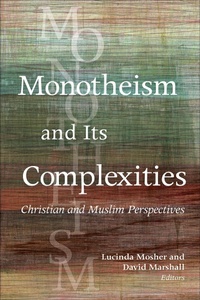
Monotheism and Its Complexities
Description

Conventional wisdom would have it that believing in one God is straightforward; that Muslims are expert at monotheism, but that Christians complicate it, weaken it, or perhaps even abandon it altogether by speaking of the Trinity. In this book, Muslim and Christian scholars challenge that opinion. Examining together scripture texts and theological reflections from both traditions, they show that the oneness of God is taken as axiomatic in both, and also that affirming God's unity has raised complex theological questions for both. The two faiths are not identical, but what divides them is not the number of gods they believe in.
The latest volume of proceedings of The Building Bridges Seminar-a gathering of scholar-practitioners of Islam and Christianity that meets annually for the purpose of deep study of scripture and other texts carefully selected for their pertinence to the year's chosen theme-this book begins with a retrospective on the seminar's first fifteen years and concludes with an account of deliberations and discussions among participants, thereby providing insight into the model of vigorous and respectful dialogue that characterizes this initiative.
Contributors include Richard Bauckham, Sidney Griffith, Christoph Schwöbel, Janet Soskice, Asma Afsaruddin, Maria Dakake, Martin Nguyen, and Sajjad Rizvi. To encourage further dialogical study, the volume includes those scripture passages and other texts on which their essays comment. A unique resource for scholars, students, and professors of Christianity and Islam.
More details
Other editions
Additional editions
Persons
Lucinda Mosher is Assistant Academic Director of the Building Bridges Seminar; Faculty Associate in Interfaith Studies, Hartford Seminary; and Center for Anglican Communion Studies Fellow in World Anglicanism, Virginia Theological Seminary, Alexandria, Virginia.
David Marshall is Academic Director of the Building Bridges Seminar; Senior Research Fellow of the Berkley Center for Religion, Peace, and World Affairs; and Associate Professor in the Theology Faculty of Georgetown University, Washington, DC.
Content
Participants in Building Bridges Seminar 2016
Preface: Fifteen Years of Construction: a retrospective on the first decade-and-a-half of the Building Bridges Seminar
Lucinda Mosher
Introduction
Part I: The Oneness of God in the Biblical Witness
Complexities Surrounding God's Oneness in Biblical Monotheism
Richard Bauckham
Bridging the Chasm between the Divine and the Human: A Muslim Response to Richard Bauckham
Maria Massi Dakake
Texts from the Bible
Part II: The Oneness of God in the Qur'an and Hadith
Monotheism in Islam
Asma Afsaruddin
The Complexity of Monotheism in Islam: A Christian Response to Asma Afsaruddin
Sidney Griffith
Texts from the Quran and Hadith
Part III: Grappling With the Unity Question in the Elaboration of Christian Doctrine
The One and the Three in Christian Worship and Doctrine: Engaging with the Question of Divine Unity in the Elaboration of Christian Doctrine
Christoph Schwöbel
Of Storytellers and Storytelling: A Muslim Response to Christoph Schwöbel
Martin Nguyen
Texts from the Christian Tradition
Part IV: Safeguarding Tawhid in the Elaboration of the Islamic Tradition
God is One but Unlike Any Other: Theological Argumentation on Tawhid in Islam
Sajjad Rizvi
Christianity, Trinity, and the One God: A Response to Sajjad Rizvi
Janet Soskice
Texts from the Islamic Tradition
Part V: Reflections
Dialogue in Northern Virginia: Reflections on Building Bridges Seminar 2016
Lucinda Mosher
Index
About the Editors
