

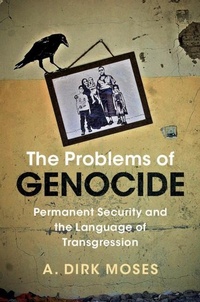
The Problems of Genocide
Permanent Security and the Language of Transgression
Published on 24. February 2021
978-1-009-02860-8 (ISBN)
Description

Genocide is not only a problem of mass death, but also of how, as a relatively new idea and law, it organizes and distorts thinking about civilian destruction. Taking the normative perspective of civilian immunity from military attack, A. Dirk Moses argues that the implicit hierarchy of international criminal law, atop which sits genocide as the 'crime of crimes', blinds us to other types of humanly caused civilian death, like bombing cities, and the 'collateral damage' of missile and drone strikes. Talk of genocide, then, can function ideologically to detract from systematic violence against civilians perpetrated by governments of all types. The Problems of Genocide contends that this violence is the consequence of 'permanent security' imperatives: the striving of states, and armed groups seeking to found states, to make themselves invulnerable to threats.
Reviews / Votes
'This refreshingly original book turns the problem of genocide on its head. Contrariwise to international law and the dominant memory regimes, Moses points at the aspiration for permanent security as the crux of the matter. Passionate and historically sweeping.' Maria Maelksoo, author of The Politics of Becoming European: A Study of Polish and Baltic Post-Cold War Security Imaginaries 'A pioneer of genocide studies, A. Dirk Moses has written a terrific, transgressive book destined to upend the field he has helped to define. Uncomfortable with morality tales, Moses is intent on smashing the hierarchy of international crimes established in the aftermath of World War II. A gut punch to conventional wisdom, this is critical global history at its best.' Jens Meierhenrich, author of Lawfare: A Genealogy (forthcoming) 'This brilliant, closely argued, and exhaustively referenced book makes a deeply persuasive case for replacing the prism of genocide with the crime of permanent security, calling out the multiple standards at play in the global order. A seminal paradigm-changer.' Nandini Sundar, author of The Burning Forest: India's War Against the Maoists 'Dirk Moses is the most original and provocative scholar writing on the problem of genocide. At its core deeply humanitarian, his book challenges every comfortable assumption of the meaning of genocide. This is essential reading for everyone concerned with human rights and mass atrocities.' Eric D. Weitz, author of A World Divided: The Global Struggle for Human Rights in the Age of Nation-States 'The Problems of Genocide can be strongly recommended to readers of this journal who have an interest in the macro-issues relating to criminal law and criminal justice, broadly conceived.' David O. Friedrichs, Rutgers 'Highly recommended.' A. Kolin, Choice Magazine '... The Problems of Genocide is possibly one of the most signi?cant works on the intellectual history of genocide ever since the notion entered the realm of the history of ideas.' Dimitrios A. Kourtis, Journal of Con?ict and Security Law 'Moses' study makes numerous contributions to various literatures and disciplines ... The author postulates a paradigm shift in genocide research, security studies and international law ... [His] book is necessary and admirable.' Norbert Finzsch, H-Soz-Kult 'What's in a name? Why and how does it matter whether a particular situation is designated a genocide? And why is it problematic for us to categorise mass violence in this way? Dirk Moses' important new book ... addresses these questions head on with an elegantly argued and intricate treatment of the problems at the heart of what he terms the 'language of transgression' - the concept and discourse of genocide ... a rich, satisfying and provocative read.' Rachel Kerr, International Journal of Military History and Historiography '... [a] masterful genealogy of the concept [of genocide]' G. Daniel Cohen, American Historical ReviewMore details
Series
Language
English
Place of publication
Cambridge
United Kingdom
Target group
College/higher education
Professional and scholarly
Illustrations
Worked examples or Exercises
File size
9,13 MB
ISBN-13
978-1-009-02860-8 (9781009028608)
Copyright in bibliographic data and cover images is held by Nielsen Book Services Limited or by the publishers or by their respective licensors: all rights reserved.
Schweitzer Classification
Other editions
Additional editions
Book
02/2021
Cambridge University Press
€129.50
Shipment within 15-20 days
Person
Content
Introduction: The Problems of Genocide; Part I. The Language of Transgression: 1. The Language of Transgression, 1500s to 1890s; 2. The Language of Transgression, 1890s to 1930s; 3. Raphael Lemkin and the Protection of Small Nations; 4. The Many Types of Destruction; 5. Inventing Genocide in the 1940s; Part II. Permanent Security: 6. Permanent Security in History: Empire and Settler Colonialism; 7. The Nazi Empire as Illiberal Permanent Security; 8. Human Rights, Population 'Transfer', and the Foundation of the Postwar Order; 9. Imagining Nation-Security in South Asia and Palestine: Partition, Population Exchange, and Communal Hostages; Part III. The Language of Transgression, Permanent Security, and Holocaust Memory: 10. Lemkin, Arendt, Vietnam, and Liberal Permanent Security; 11. Genocide Studies and the Repression of the Political; 12. Holocaust Memory, Exemplary Victims, and Permanent Security Today.
