

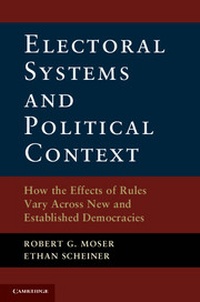
Electoral Systems and Political Context
How the Effects of Rules Vary Across New and Established Democracies
1st Edition
Published on 17. October 2012
303 pages
978-1-139-57527-0 (ISBN)
Description

Electoral Systems and Political Context illustrates how political and social context conditions the effects of electoral rules. The book examines electoral behavior and outcomes in countries that use 'mixed-member' electoral systems - where voters cast one ballot for a party list under proportional representation (PR) and one for a candidate in a single member district (SMD). Based on comparisons of outcomes under the two different rules used in mixed-member systems, the book highlights how electoral systems' effects - especially strategic voting, the number of parties and women's representation - tend to be different in new democracies from what one usually sees in established democracies. Moreover, electoral systems such as SMDs are usually presumed to constrain the number of parties irrespective of the level of social diversity, but this book demonstrates that social diversity frequently shapes party fragmentation even under such restrictive rules.
Reviews / Votes
"This is the most important study to date on the most widespread electoral reform phenomenon of the 1990s and the first decade of this century - mixed-member systems. Moser and Scheiner take nothing for granted. They subject everything we thought we knew about the effects of electoral rules to renewed scrutiny. In the process, they turn much of the conventional wisdom on its head, and they set a new standard for scholarship on institutional design in new democracies." - John Carey, Dartmouth College "Electoral Systems and Political Context makes a profound contribution to the advancement of the electoral systems literature. Moser and Scheiner adroitly take advantage of the unique natural experiment that exists within many of the world's diverse population of mixed-member electoral systems to better understand how the political context within which electoral rules operate influences their impact on key aspects of the political system such as party fragmentation and women's representation." - Mark P. Jones, Rice University "In a series of impressive chapters, Moser and Scheiner show how political and social contexts shape the effects of electoral rules on the number of parties, the disproportionality of vote-seat representation, strategic voting, women's representation, and other political outcomes. They show that many of the generalizations in the current literature hold only in particular conditions. In other conditions we expect and find different outcomes. I expect Electoral Systems and Political Context to become a classic." - G. Bingham Powell, Jr., University of Rochester "Moser and Scheiner force us to reconsider the conditions under which electoral system expectations to play out in practice. The book's scope is global and its quantitative analysis is at the level of individual districts and legislators - the level at which many key hypotheses about electoral systems logically should be tested, but seldom are. This book will be of interest not only to specialists in electoral systems but also to a broader readership in comparative politics." - Matthew S. Shugart, University of California, San DiegoMore details
Language
English
Place of publication
Cambridge
United Kingdom
Publishing group
Cambridge University Press
Target group
Professional and scholarly
Illustrations
22 Tables, unspecified; 29 Line drawings, unspecified
File size
3331,51 MB
ISBN-13
978-1-139-57527-0 (9781139575270)
Copyright in bibliographic data and cover images is held by Nielsen Book Services Limited or by the publishers or by their respective licensors: all rights reserved.
Schweitzer Classification
Other editions
Additional editions
Robert G. Moser | Ethan Scheiner
Electoral Systems and Political Context
How the Effects of Rules Vary Across New and Established Democracies
Book
09/2012
Cambridge University Press
€103.00
Shipment within 15-20 days
Persons
Robert G. Moser is Associate Professor of Government at the University of Texas and the author of Unexpected Outcomes: Electoral Systems, Political Parties, and Representation in Russia (2001). He has co-edited (with Zoltan Barany) Russian Politics (2001), Ethnic Politics after Communism (2005) and Is Democracy Exportable? (2009). His articles have appeared in World Politics, Comparative Politics, Comparative Political Studies, Legislative Studies Quarterly, Electoral Studies and Post-Soviet Affairs. Ethan Scheiner is Professor of Political Science at the University of California, Davis. He is the author of Democracy without Competition in Japan. His articles have appeared in the American Political Science Review, the Annual Review of Political Science, the British Journal of Political Science, Comparative Political Studies, Electoral Studies, the Japanese Journal of Political Science, the Journal of Japanese Studies and Legislative Studies Quarterly.
Content
1. Introduction: why don't electoral rules have the same effects in all countries?; 2. When do the effects of electoral systems diverge from our expectations?; 3. Mixed-member electoral systems: how they work and how they work for scholars; 4. How democratic experience and party system development condition the effects of electoral rules on disproportionality and the number of parties: theory, measurement, and expectations; 5. How democratic experience and party system development condition the effects of electoral rules on disproportionality and the number of parties: what we actually see; 6. Political context, electoral rules, and their effects on strategic and personal voting; 7. How democratic experience and party system development condition the effect of electoral rules on strategic defection; 8. Social diversity, electoral rules, and the number of parties; 9. How political context shapes the effect of electoral rules on women's representation; 10. Conclusion: why and how political context matters for electoral system effects.
