

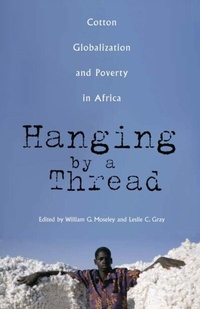
Hanging by a Thread
Cotton, Globalization, and Poverty in Africa
1st Edition
Published on 1. April 2008
277 pages
978-0-89680-461-6 (ISBN)
Available for download
Description

The textile industry was one of the first manufacturing activities to become organized globally, as mechanized production in Europe used cotton from the various colonies. Africa, the least developed of the world's major regions, is now increasingly engaged in the production of this crop for the global market, and debates about the pros and cons of this trend have intensified.
Hanging by a Thread: Cotton, Globalization, and Poverty in Africa illuminates the connections between Africa and the global economy. The editors offer a compelling set of linked studies that detail one aspect of the globalization process in Africa, the cotton commodity chain.
From global policy debates, to impacts on the natural environment, to the economic and social implications of this process, Hanging by a Thread explores cotton production in the postcolonial period from different disciplinary perspectives and in a range of national contexts. This approach makes the globalization process palpable by detailing how changes at the macroeconomic level play out on the ground in the world's poorest region. Hanging by a Thread offers new insights on the region in a global context and provides a critical perspective on current and future development policy for Africa.
Contributors: Thomas J. Bassett, Jim Bingen, Duncan Boughton, Brian M. Dowd, Marnus Gouse, Leslie C. Gray, Dolores Koenig, Scott M. Lacy, William G. Moseley, Colin Poulton, Bhavani Shankar, Corinne Siaens, Colin Thirtle, David Tschirley, and Quentin Wodon.
Hanging by a Thread: Cotton, Globalization, and Poverty in Africa illuminates the connections between Africa and the global economy. The editors offer a compelling set of linked studies that detail one aspect of the globalization process in Africa, the cotton commodity chain.
From global policy debates, to impacts on the natural environment, to the economic and social implications of this process, Hanging by a Thread explores cotton production in the postcolonial period from different disciplinary perspectives and in a range of national contexts. This approach makes the globalization process palpable by detailing how changes at the macroeconomic level play out on the ground in the world's poorest region. Hanging by a Thread offers new insights on the region in a global context and provides a critical perspective on current and future development policy for Africa.
Contributors: Thomas J. Bassett, Jim Bingen, Duncan Boughton, Brian M. Dowd, Marnus Gouse, Leslie C. Gray, Dolores Koenig, Scott M. Lacy, William G. Moseley, Colin Poulton, Bhavani Shankar, Corinne Siaens, Colin Thirtle, David Tschirley, and Quentin Wodon.
Reviews / Votes
"Moseley and Gray have assembled a uniquely comprehensive picture of the way cotton connects poor farmers, wealthy consumers, activist organizations, industrial giants, and agronomic laboratories. Contributors use commodity chain analysis, national case histories, community scale studies, household production research, and examples of both successes and failures to point to ongoing changes among people, soil, crops, and companies in the global economy. This is more than a book for specialists on Africa; it provides a kaleidoscopic window into the pressing complexities of environment and development." "Drawing on data from several African countries and localities, the editors should be lauded for the way in which they tie this information into a coherent volume.... I would warmly recommend this book to any student or scholar who is interested in commodity production and livelihoods that are dependent on commodity production." (The Professional Geographer) "This book illuminates key points of power, contention, and uncertainty in African cotton and commodity chains.... (T)hese essays are designed to promote debate, and will be particularly useful for teaching." (International Journal of African Historical Studies) "Because it documents extensively the benefits and drawbacks of cotton for rural areas across Africa, this book will be of great value to students from a variety of disciplinary backgrounds who have an interest in cotton, small-holders, and rural livelihoods." (African Studies Review) "This collection illuminates the connection between Africa and the global economy in a compelling set of linked studies that detail a crucially important aspect of the globalization process in Africa, the cotton commodity chain." (APADE, Indiana University) "Hanging by a Thread makes a significant contribution to the literature on cotton production in postcolonial Africa. The authors explore the complex and uneven social, economic, and environmental consequences of cotton in locales as different as rural Mali and KwaZulu-Natal. The interdisciplinary essays move beyond the countryside to examine national and global discourses on cotton and development and show how cotton is embedded in international circuits of power and trade. Moseley and Gray have crafted an excellent introduction which launches the study in important new directions." "This informative and insight-filled collection provides a comprehensive overview of the political economy of African cotton. It clearly demonstrates how local livelihoods depend on the fluctuations of global markets and explains why African smallholders continue to grow cotton despite falling prices. This is important reading for students and scholars of globalization."More details
Series
Language
English
Place of publication
Athens
United States
Target group
Professional and scholarly
ISBN-13
978-0-89680-461-6 (9780896804616)
Copyright in bibliographic data and cover images is held by Nielsen Book Services Limited or by the publishers or by their respective licensors: all rights reserved.
Schweitzer Classification
Other editions
Additional editions
Book
04/2008
Ohio University Press
€26.99
Shipment within 3-4 weeks
Persons
William G. Moseley is associate professor of geography at Macalester College. He is the author of Taking Sides: Clashing Views on African Issues and coeditor of The Introductory Reader in Human Geography: Contemporary Debates.
Leslie C. Gray is an associate professor of environmental studies at Santa Clara University. She has published articles on environment and development in journals such as World Development, Africa, African Studies Review, Development and Change, Geoforum, and Geographical Journal.
Leslie C. Gray is an associate professor of environmental studies at Santa Clara University. She has published articles on environment and development in journals such as World Development, Africa, African Studies Review, Development and Change, Geoforum, and Geographical Journal.
Content
- Intro
- Cover
- Half title
- Title
- Copyright
- Contents
- Preface and Acknowledgments
- Contributors
- Introduction Cotton, Globalization, and Poverty in Africa
- Part I Global Cotton, Local Crises
- Chapter One Producing Poverty: Power Relations and Price Formation in the Cotton Commodity Chains of West Africa
- Chapter Two Cotton Production in Burkina Faso: International Rhetoric versus Local Realities
- Chapter Three Mali's Cotton Conundrum: Commodity Production and Development on the Periphery
- Chapter Four The Decline of Bt Cotton in KwaZulu-Natal: Technology and Institutions
- Part II Organizing Cotton: National-Level Reforms and Rural Livelihoods
- Chapter Five The Many Paths of Cotton Sector Reform in East and Southern Africa: Lessons from a Decade of Experience
- Chapter Six Cotton Production, Poverty, and Inequality in Rural Benin: Evidence from the 1990s
- Chapter Seven Rural Development Is More Than Commodity Production: Cotton in the Farming System of Kita, Mali
- Chapter Eight Cotton Casualties and Cooperatives: Reinventing Farmer Collectives at the Expense of Rural Malian Communities?
- Part III Alternate Futures: Genetically Engineered and Organic Cotton
- Chapter Nine Genetically Engineered Cotton: Politics, Science, and Power in West Africa
- Chapter Ten Organic Cotton in Sub-Saharan Africa: A New Development Paradigm?
- Conclusion Hanging by a Thread: The Future of Cotton in Africa
- Index

