

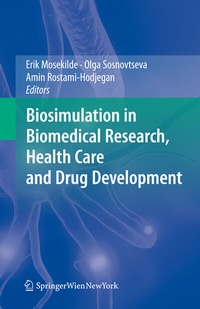
Biosimulation in Biomedical Research, Health Care and Drug Development
Description

Biosimulation is an approach to biomedical research and the treatment of patients in which computer modeling goes hand in hand with experimental and clinical work. Constructed models are used to interpret experimental results and to accumulate information from experiment to experiment.
This book explains the concepts used in the modeling of biological phenomena and goes on to present a series of well-documented models of the regulation of various genetic, cellular and physiological processes. The way how the use of computer models allows optimization of cancer treatment for individual patients is discussed and models of interacting nerve cells that can be used to design new treatments for patients with Parkinson's disease are explained. Furthermore this volume provides an overview on the use of models in industry, and presents the view of regulatory agencies on the topic.
More details
Other editions
Additional editions
Persons
Content
1. Modeling in Biomedical Research and Health Care (Steen G. Dawids, Jakob L. Laugesen and Erik Mosekilde)
2. Concepts in Mechanism Based Modeling (Ole Lund, Jakob L. Laugesen and Erik Mosekilde)
3. The Approach to Model Building (Jeppe Sturis, Jakob L. Laugesen and Erik Mosekilde)
4. Emergence of oscillatory dynamics (Jakob L. Laugesen and Erik Mosekilde)
5. Conductance-Based Models for the Evaluation of Brain Functions, Disorders, and Drug Effects (Svetlana Postnova, Christian Finke, Martin T. Huber, Karl Voigt and Hans A. Braun)
6. Functional modeling of neural-glial interaction (Dmitry E. Postnov, Nadezda A. Brazhe and Olga V. Sosnovtseva)
7. Activity-related structural changes in the myelinated nerve fiber (Alexey R. Brazhe and Georgy V. Maksimov)
8. Closed-Loop Control of BrainRhythms (Anne Beuter and Julien Modolo)
9. Modeling Ca 2+ microdomains (Jens C. Brasen, Jens C. B. Jacobsen and Niels-Henrik Holstein-Rathlou)
10. Synchronization of Cellular Contractions in the Arteriolar Wall (Jens C. B. Jacobsen, Bjørn O. Hald, Jens C. Brasen and Niels-Henrik Holstein-Rathlou)
11. Microvascular Plasticity (Jens C. B. Jacobsen, Niels E. Olesen and Niels-Henrik Holstein-Rathlou)
12. Bifurcations and Multistability in Periodically Stimulated Cardiac Cells (Elena Surovyatkina)
13. Synchronization: A case in biological studies (Olga V. Sosnovtseva, Dmitry E. Postnov, Natalia B. Janson and Alexander G. Balanov)
14. Multilevel-modeling, core predictions, and the concept of final conclusions (Elin Nyman, Peter Strålfors and Gunnar Cedersund)
15.Absorption Kinetics of Insulin Mixtures after Subcutaneous Administration (Christian H. Rasmussen, Tue Søeborg, Erik Mosekilde and Morten Colding-Jørgensen)
16. Physiologically-Based Pharmacokinetics (Masoud Jamei, Karen R. Yeo, Trevor Johnson, Cyrus Ghobadi, Manoranjenni Chetty, Khaled Abduljalil, Gaohua Lu, Farzaneh Salem, Adam Darwich and Amin Rostami-Hodjegan)
