

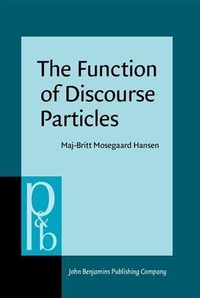
The Function of Discourse Particles
A study with special reference to spoken standard French
1st Edition
Published on 15. March 1998
XII, 418 pages
978-90-272-8259-0 (ISBN)
Description

This monograph aims to contribute to linguistic knowledge about the distribution and function of discourse particles, particularly with respect to a small group of particles which are highly frequent in contemporary spoken standard French.
The book is divided into two parts. Part 1 (Theory) defines discourse particles as such, and gives a dynamic global approach to their description. Matters such as previous research on discourse particles, related categories of particles, instructional semantics, the difference between speech and writing, the delimitation of discourse units, competing approaches to discourse structure and to coherence, and methodology are discussed extensively.
Part 2 (Description) offers in-depth corpus-based analyses of six French discourse particles, namely bon, ben, eh bien, puis, donc, and alors, as used in non-elicted native-speaker interaction.
The book is of interest to linguists doing research in semantics, pragmatics and discourse studies.
The book is divided into two parts. Part 1 (Theory) defines discourse particles as such, and gives a dynamic global approach to their description. Matters such as previous research on discourse particles, related categories of particles, instructional semantics, the difference between speech and writing, the delimitation of discourse units, competing approaches to discourse structure and to coherence, and methodology are discussed extensively.
Part 2 (Description) offers in-depth corpus-based analyses of six French discourse particles, namely bon, ben, eh bien, puis, donc, and alors, as used in non-elicted native-speaker interaction.
The book is of interest to linguists doing research in semantics, pragmatics and discourse studies.
More details
Other editions
Additional editions
Maj-Britt Mosegaard Hansen
The Function of Discourse Particles
A study with special reference to spoken standard French
Book
03/1998
John Benjamins Publishing Co
€132.50
Shipment within 10-15 days
Person
Content
- THE FUNCTION OF DISCOURSE PARTICLES
- Editorial page
- Title page
- Dedication
- Copyright page
- Table of Contents
- Transcription conventions
- Preface and acknowledgements
- PART 1: THEORY
- 1. Introduction
- 2. Previous Studies
- 1 Macro-Syntax: Elisabeth Gülich
- 2 Integrated Pragmatics
- 2.1 Outline of Argumentation Theory
- 2.2 Critique of IP
- 3 The Geneva School: a Discourse-Structural Framework
- 4 Deborah Schiffrin: Interactional Sociolinguistics
- 5 Diane Blakemore: Relevance Theory
- 5.1 Grice's theory of meaning and of implicature
- 5.2 Outline of Relevance Theory
- 5.2.1 Pros and cons of Relevance Theory
- 5.3 Blakemore's semantic constraints
- 6 Conclusion
- 3. Particle Research
- 1 Interjections
- 2 Modal Particles
- 3 Focus Particles
- 4 Conjunctions
- 5 Sentence Adverbials
- 6 Conclusion
- 4. Discourse Markers
- 1 Defining Discourse Markers
- 1.1 The problem
- 1.2 Previous definitions of discourse markers
- 1.3 A revised definition
- 2 Instructional Semantics
- 3 Minimalism/Maximalism - and a Possible Alternative
- 5. Spoken vs Written Language
- 1 Speech vs Writing: Dichotomy or Continuum?
- 2 The Closeness-Distance Continuum
- 3 Linguistic Correlates
- 4 Towards an Explanation
- 4.1 Nature of the modes
- 4.2 Characteristic structures
- 4.2.1 Complex utterances
- 4.2.2 Informational incrementation and topic-comment structure
- 4.2.3 Repetition
- 4.2.4 Incompletion
- 4.2.5 Markers
- 6. Discourse Units
- 1 Form-Based Units
- 1.1 Sentences and clauses
- 1.2 Turns, tone groups, and utterances
- 2 Content-Based Units: Propositions
- 3 Action-Based Units: Speech Acts and Communicative Acts
- 3.1 Turn-constructional units
- 3.2 Discourse acts
- 7. Discourse Structure
- 1 Linguistic Models
- 1.1 The Birmingham approach
- 1.1.1 Critique of the Birmingham model
- 1.2 Edmondson
- 1.3 The Geneva approach
- 1.3.1 Critique of the Geneva School
- 2 Conversation Analysis
- 3 Conclusion
- 8. Cohesion and Coherence
- 1 Definitions
- 1.1 Cohesion
- 1.1.1 Discourse markers and cohesion
- 1.2 Coherence
- 1.2.1 Two types of coherence
- 2 The Relationship between Cohesion and Coherence
- 3 Theories of Coherence
- 3.1 Local coherence
- 4 Discourse Markers and Coherence
- 9. Data and Methodology
- 1 Data
- 1.1 Description of the corpora
- 1.2 Corpus-based research vs intuition
- 1.3 Audio-vs video-recordings
- 2 Transcription
- 2.1 The system used here
- 3 Heuristics
- 3.1 Accountability
- 4 Prediction vs Explanation
- PART 2: DESCRIPTION
- 10. Bon and ben
- 1 Origin and Development
- 1.1 Grammaticalization
- 2 Bon
- 2.1 Interjective uses
- 2.1.1 Partial conclusion
- 2.2 Discourse marking uses
- 2.2.1 Turn-final bon
- 2.2.2 Bon between two utterances by the same speaker
- 2.2.3 Intra-sentential bon
- 2.3 Conclusion
- 3 Ben
- 3.1 Ben marking inaccuracy or lack of importance
- 3.2 Ben marks the obvious
- 3.3 Proactive ben
- 3.4 Conclusion
- 11. Eh bien
- 1 Introduction
- 2 Previous Descriptions
- 3 The Function of eh bien in Spoken Discourse
- 3.1 Intra-sentential eh bien
- 3.2 Eh bien between two utterances by the same speaker
- 3.3 Eh bien introducing a turn at talk
- 3 4 Eh bien itself constitutes a turn at talk
- 4 Conclusion
- 12. Puis
- 1 Origin, Development, and Syntax of puis
- 2 Semantic-Pragmatic Properties of puis
- 3 Puis in Contemporary Spoken French
- 3.1 Puis connects two utterances by the same speaker
- 3.2 Puis introduces a turn at talk
- 3.3 Puis connects constituents of a single utterance
- 4 Conclusion
- 13. Donc and alors
- 1 Origin and Development
- 2 Donc: Marker of Manifestness
- 3 Alors: a Radial Category
- 3.1 Alors marks re-perspectivization or reorientation
- 3.2 Alors marks foregrounding
- 3.3 Alors marking results or conclusions
- 3.4 The semantic network of alors
- 4 Conclusion
- 14. Conclusion
- 1 Summary
- 2 Retrospects and Prospects
- Notes
- 1 Introduction
- 2 Previous studies
- 3 Particle research
- 4 Discourse markers
- 5 Spoken vs written language
- 6 Discourse units
- 7 Discourse structure
- 8 Cohesion and coherence
- 9 Data and methodology
- 10 Bon and ben
- 11 Eh bien
- 12 Puis
- 13 Donc and alors
- 14 Conclusion
- References
- Author index
- Subject index
