

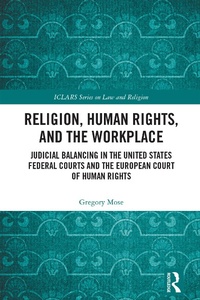
Religion, Human Rights, and the Workplace
Judicial Balancing in the United States Federal Courts and the European Court of Human Rights
1st Edition
Published on 4. August 2023
292 pages
978-1-000-92106-9 (ISBN)
Description

Religious freedom is a fundamental and relatively uncontested right in both the United States and Europe. But other values like equality, justice, and the right to a private life are just as precious. Managing such conflicts has become a highly contested and politicized area of law and nowhere are such conflicts more evident - or more challenging - than those arising in the workplace.
By comparing United States Federal Courts' approach to free exercise in the workplace with that of the European Court of Human Rights, this book explores two very different methodologies for adjudicating rights conflicts. In examining methods and results, case by case, issue by issue and addressing each step of the analytical processes taken by judges, it becomes apparent that the United States has lost its way in the quest for equality and justice. It is argued here that while the European approach has its own flaws, its proportionality approach may offer vital lessons for United States practice.
The book will make compelling reading for researchers, academics, and policy-makers working in the areas of law and religion, human rights law, constitutional law, and comparative law.
By comparing United States Federal Courts' approach to free exercise in the workplace with that of the European Court of Human Rights, this book explores two very different methodologies for adjudicating rights conflicts. In examining methods and results, case by case, issue by issue and addressing each step of the analytical processes taken by judges, it becomes apparent that the United States has lost its way in the quest for equality and justice. It is argued here that while the European approach has its own flaws, its proportionality approach may offer vital lessons for United States practice.
The book will make compelling reading for researchers, academics, and policy-makers working in the areas of law and religion, human rights law, constitutional law, and comparative law.
More details
Series
Edition
1. Auflage
Language
English
Place of publication
London
United Kingdom
Publishing group
Taylor & Francis Ltd
Target group
College/higher education
ISBN-13
978-1-000-92106-9 (9781000921069)
Copyright in bibliographic data and cover images is held by Nielsen Book Services Limited or by the publishers or by their respective licensors: all rights reserved.
Schweitzer Classification
Other editions
Additional editions
Gregory Mose
Religion, Human Rights, and the Workplace
Judicial Balancing in the United States Federal Courts and the European Court of Human Rights
Book
12/2024
1st Edition
Routledge
€63.60
Shipment within 10-20 days
Gregory Mose
Religion, Human Rights, and the Workplace
Judicial Balancing in the United States Federal Courts and the European Court of Human Rights
Book
08/2023
1st Edition
Routledge
€205.90
Shipment within 10-20 days
Person
Gregory Mose is a professor of international law and politics at the American College of the Mediterranean in Aix-en-Provence, France.
Content
Table of cases
Acknowledgments
Introduction: two traditions of balancing rights
PART I
Freedom of religion in the United States and the European Court of Human Rights
1 The first freedom: religious free exercise in US federal courts
2 Tiered review in US free exercise cases
Rational basis scrutiny and the emerging MFN standard
The mechanics of strict scrutiny
Determining "substantial burden"
Determining "compelling state interest"
Narrow tailoring and the "least restrictive means" test
Intermediate scrutiny as an ad hoc range of standards
Balancing as a misnomer as applied in US courts
3 Religious freedom in the European Court of Human Rights
The Convention system
The protection of religious freedom
Religious symbols and clothing
Conscientious objection
Autonomy and liberty of religious institutions
4 The mechanics of European proportionality analysis
The traditional test
Determining the legitimacy of aims
Determining suitability of limitations on free exercise
Determining necessity
Proportionality stricto sensu
The ECtHR's modified approach to proportionality
Legitimate aim
Necessary in a democratic society and the final balance
PART II
Religion in the workplace
5 Religious conflicts in the workplace: symbols, speech, and moral complicity
Common challenges and diverging approaches to accommodation
The debate over religion versus other beliefs: is religion special?
The role of the judiciary in granting exemptions for religion or belief
Contrasting approaches to religious accommodation in the workplace
The treatment of religious adornment: clothing, grooming, and symbols
Adornment cases involving the public image of the employer
The fact-sensitive approach to health and safety issues
A trend towards convergence in religious adornment cases?
Proselytism and religious opinions at work
Compelled expression and complicity claims
Contrasting traditions of compelled expression
Complicity and the behavior of third parties
A disparity in focus in regard to complicity
Convergence and polarization in the types of claims
6 Religious freedom and three types of employer
Cases involving government or government-mandated employers
Cases involving religious employers
Religious employers and the ministerial exception in the US
Additional protections for US religious employers
The European focus on church autonomy
Religious employer cases compared
Religion in the for-profit workplace
Debates over corporate personhood in the US courts
The European Court of Human Rights' context-sensitive balancing approach
The cases compared: similar reasoning, differing preoccupations
Similar challenges and diverging approaches in specific workplace environments
7 Assessing religious burdens and state interests
Evaluating the infringement and burden
US courts and the contentious "substantial burden" test
ECtHR and the flexible concept of "interference"
Comparing the roles of religious burden
Evaluating the legitimacy of state interest
ECtHR's conception of "legitimate aims" in the workplace: a permissive approach to a restricted range of objectives
The de-emphasized role of legitimacy in US courts
Comparing the two approaches to legitimate state interests
Measuring the importance of the state interest
ECtHR's minimalist review of state interests
US courts and the tiered review of state interests
Contrasting approaches with some common ground
8 Balancing religious imperatives and secular rights
Assessing the means/ends relationship
ECtHR's deferential stance regarding the means/ends relationship
The means/ends fit in US courts: a wide range of standards
Comparing the review of the means/ends relationship: a mutual concern for context
Assessing the means/ends/burden relationship as an overall balance
The ECtHR's decisive application of holistic balancing
The US courts' evasion of genuine balancing
9 Conclusion: The price of free exercise
Index
Acknowledgments
Introduction: two traditions of balancing rights
PART I
Freedom of religion in the United States and the European Court of Human Rights
1 The first freedom: religious free exercise in US federal courts
2 Tiered review in US free exercise cases
Rational basis scrutiny and the emerging MFN standard
The mechanics of strict scrutiny
Determining "substantial burden"
Determining "compelling state interest"
Narrow tailoring and the "least restrictive means" test
Intermediate scrutiny as an ad hoc range of standards
Balancing as a misnomer as applied in US courts
3 Religious freedom in the European Court of Human Rights
The Convention system
The protection of religious freedom
Religious symbols and clothing
Conscientious objection
Autonomy and liberty of religious institutions
4 The mechanics of European proportionality analysis
The traditional test
Determining the legitimacy of aims
Determining suitability of limitations on free exercise
Determining necessity
Proportionality stricto sensu
The ECtHR's modified approach to proportionality
Legitimate aim
Necessary in a democratic society and the final balance
PART II
Religion in the workplace
5 Religious conflicts in the workplace: symbols, speech, and moral complicity
Common challenges and diverging approaches to accommodation
The debate over religion versus other beliefs: is religion special?
The role of the judiciary in granting exemptions for religion or belief
Contrasting approaches to religious accommodation in the workplace
The treatment of religious adornment: clothing, grooming, and symbols
Adornment cases involving the public image of the employer
The fact-sensitive approach to health and safety issues
A trend towards convergence in religious adornment cases?
Proselytism and religious opinions at work
Compelled expression and complicity claims
Contrasting traditions of compelled expression
Complicity and the behavior of third parties
A disparity in focus in regard to complicity
Convergence and polarization in the types of claims
6 Religious freedom and three types of employer
Cases involving government or government-mandated employers
Cases involving religious employers
Religious employers and the ministerial exception in the US
Additional protections for US religious employers
The European focus on church autonomy
Religious employer cases compared
Religion in the for-profit workplace
Debates over corporate personhood in the US courts
The European Court of Human Rights' context-sensitive balancing approach
The cases compared: similar reasoning, differing preoccupations
Similar challenges and diverging approaches in specific workplace environments
7 Assessing religious burdens and state interests
Evaluating the infringement and burden
US courts and the contentious "substantial burden" test
ECtHR and the flexible concept of "interference"
Comparing the roles of religious burden
Evaluating the legitimacy of state interest
ECtHR's conception of "legitimate aims" in the workplace: a permissive approach to a restricted range of objectives
The de-emphasized role of legitimacy in US courts
Comparing the two approaches to legitimate state interests
Measuring the importance of the state interest
ECtHR's minimalist review of state interests
US courts and the tiered review of state interests
Contrasting approaches with some common ground
8 Balancing religious imperatives and secular rights
Assessing the means/ends relationship
ECtHR's deferential stance regarding the means/ends relationship
The means/ends fit in US courts: a wide range of standards
Comparing the review of the means/ends relationship: a mutual concern for context
Assessing the means/ends/burden relationship as an overall balance
The ECtHR's decisive application of holistic balancing
The US courts' evasion of genuine balancing
9 Conclusion: The price of free exercise
Index
