

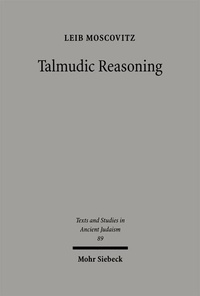
Talmudic Reasoning
From Casuistics to Conceptualization
1st Edition
Published on 31. August 2020
403 pages
978-3-16-158737-5 (ISBN)
Description

Dieser Band bietet die erste systematische Untersuchung der Entwicklung von Abstraktion und Konzeptualisierung im rabbinischen Rechtsdenken. Leib Moscovitz analysiert die wichtigsten Aspekte und Methoden der juristischen Argumentationsweise in den Hauptwerken der rabbinischen Literatur und zeigt die kritische und einzigartige Rolle, die die Konzeptualisierung im talmudischen Denken spielt.
More details
Other editions
Additional editions
Book
01/2002
1st Edition
Mohr Siebeck
€134.00
Article exhausted; check different version
Person
Author
Born 1955; 1977 B.A. at Yeshiva University (NY); 1979 M.A. at Yeshiva University; 1988 Ph.D. (Hebrew University of Jerusalem); doctoral and post-doctoral fellowships from Memorial Foundation for Jewish Studies; 1985-89 Lecturer at Hebrew University Talmud Department; since 1997 Senior Lecturer at Bar-Ilan University, Talmud Department.
Content
- Cover
- Titel
- Preface
- Table of Contents
- Abbreviations
- Chapter 1 Introduction
- Basic Concepts
- The Significance of Rabbinic Conceptualization
- Previous Scholarship
- Methodological Considerations
- Dating the Sources
- The Periodization of Rabbinic Literature
- General Methodological Problems
- Considerations Specific to the Study of Conceptualization
- Conceptualism and Functionalism
- Implicit Conceptualization
- Rabbinic Conceptualization and Related Disciplines
- Conceptualization and Biblical Exegesis
- The Present Study
- Desiderata
- Chapter 2 Casuistics and Generalizations: Tannaitic Beginnings
- Tannaitic Casuistics
- Explicit Tannaitic Generalizations
- Introduction
- Generalizations Introduced by Special Terminology
- Principles Without Special Terminology
- Implicit Conceptualization: Methodological Considerations
- Non-Principled Tannaitic Thought
- Implicit Principles: Extrapolation
- Implicit Principles: Induction
- Problematic Induction
- Plausible Induction
- Why Casuistics?
- Amoraic Casuistics and Generalizations
- Conclusions
- Chapter 3 Classification and Legal Definition
- Introduction
- Tannaitic Classification
- Legal Definitions
- Implicit Classification
- Subsumptive Classification
- Comparison-Based Classification
- Post-Tannaitic Subsumptive Classification
- Post-Tannaitic Comparison-Based Classification
- Linguistic Aspects
- Conceptual Aspects
- Comparison-Based Classification with Conceptual Analogues
- "Code Word" Classification
- Reductionist Classification
- Introduction
- In Tannaitic Literature
- In PT
- In BT
- Classification and Biblical Hermeneutics
- Conclusions
- Chapter 4 Legal Fictions
- Introduction
- Legal Fictions and Referential Classification
- Conceptual and Non-Conceptual Fictions
- Implicit Fictions
- The Present Study
- Tannaitic Fictions
- Post-Tannaitic Fictions
- Introduction
- Stylistic Aspects
- Hermeneutic Character
- Types of Post-Tannaitic Fictions
- Multiple Application of Post-Tannaitic Fictions
- Conclusions
- Chapter 5 Aspects of Rabbinic Explanation
- Introduction
- Superfluous Explanation
- Tannaitic Explanation
- Enthymematic Explanation
- Conceptual Character
- Post-Tannaitic Explanation
- General Observations
- Exegetical Validity
- Chapter 6 Legal Analogy
- Introduction
- Principled and Non-Principled Analogies
- The Present Study
- Tannaitic Legal Analogy
- Introduction
- Ordinary Tannaitic Analogies
- Problematic Tannaitic Analogies
- Post-Tannaitic Legal Analogy: Introduction
- Terminology
- Between Analogy and Explicit Principles
- Conceptually Trivial Post-Tannaitic Analogies
- Post-Tannaitic Analogies of Uncertain Conceptual Character
- Non-Principled Post-Tannaitic Analogy
- Identification
- Functions
- Justification
- Conclusions
- Chapter 7 Association and Conceptual Citations
- Introduction
- Conceptual Citations
- Associations
- Chapter 8 Post-Tannaitic Concepts and Legal Principles
- Introduction
- Linguistic Aspects
- Introductory Terminology
- Nominalization
- Terminology for Abstract Concepts
- Fixed Formulations
- Between Anonymous and Attributed Principles
- Types of Concepts and Principles
- Tannaitic Concepts vs. Post-Tannaitic Concepts
- Types of Post-Tannaitic Principles
- Contextual Considerations
- Analogical Extension of Legal Principles
- Multiple Application
- Exceptions
- The Influence of Legal Principles
- Conclusions
- Chapter 9 Coda
- Introduction
- Rabbinic Conceptualization: A Chronological Perspective
- Tannaitic Conceptualization
- Amoraic Conceptualization (PT and BT)
- The Anonymous Stratum in BT
- Between PT and BT
- Abstraction and Abstract Issues
- Broader Conclusions
- Rare and Missing Types of Conceptualization
- The Sources of Rabbinic Concepts
- Rabbinic Attitudes Toward Conceptualization
- The Impact of Rabbinic Conceptualization
- Conclusion
- Bibliography
- Index of Sources
- Index of Modern Authors
- Index of Hebrew and Aramaic Terms
- Subject Index
