

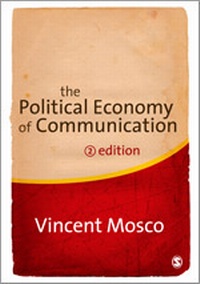
The Political Economy of Communication
2nd Edition
Published on 23. April 2009
280 pages
978-1-4462-0494-8 (ISBN)
Description

"A masterpiece... the one single indispensable book that all media students and scholars need to read to understand this vital and growing area of research."
- Robert W. McChesney, University of Illinois at Urbana-Champaign
"A contemporary classic of media studies. Vincent Mosco, among the leading media scholars of our or any time, brings his searing insights and crystal prose to bear on the latest issues and debates of the field... An indispensable resource for researchers, activists, and students everywhere."
- Toby Miller, University of California, Riverside
Since publication of its first edition, The Political Economy of Communication has established itself as a true classic and one of the most important contributions to the field. This second edition has been thoroughly restructured, updated and expanded to make it an indispensable text for students and scholars alike. Putting the student at the centre of its updates, this book:
Maps the definitions and foundations of political economy
Adds 3 new chapters to explore current trends, from feminism and labour to new media, forms of resistance, media reform and democracy
Illustrates throughout how power operates across the 21st century media landscape
Explores key issues in how media power intersects with globalization, social class, race, gender and surveillance
Shows media students why it is essential to understand political economy and its application to media and communication.
Combining penetrating theoretical analysis with passionate commitment, Vincent Mosco once again gives readers an indispensable introduction to the field.
- Robert W. McChesney, University of Illinois at Urbana-Champaign
"A contemporary classic of media studies. Vincent Mosco, among the leading media scholars of our or any time, brings his searing insights and crystal prose to bear on the latest issues and debates of the field... An indispensable resource for researchers, activists, and students everywhere."
- Toby Miller, University of California, Riverside
Since publication of its first edition, The Political Economy of Communication has established itself as a true classic and one of the most important contributions to the field. This second edition has been thoroughly restructured, updated and expanded to make it an indispensable text for students and scholars alike. Putting the student at the centre of its updates, this book:
Maps the definitions and foundations of political economy
Adds 3 new chapters to explore current trends, from feminism and labour to new media, forms of resistance, media reform and democracy
Illustrates throughout how power operates across the 21st century media landscape
Explores key issues in how media power intersects with globalization, social class, race, gender and surveillance
Shows media students why it is essential to understand political economy and its application to media and communication.
Combining penetrating theoretical analysis with passionate commitment, Vincent Mosco once again gives readers an indispensable introduction to the field.
Reviews / Votes
Vincent Mosco's heavily revised and thoroughly updated Political Economy of Communication is a masterpiece. (It) is the one single indispensable book that all media students and scholars need to read to understand this vital and growing area of researchRobert W. McChesney
University of Illinois at Urbana-Champaign
Mosco has done all students of communication a great service by updating this book. It captures, summarizes and illustrates an important set of voices and arguments, key interlocutors in the ongoing effort to construct a critical theory and analytic of contemporary communication and culture
Lawrence Grossberg
University of North Carolina at Chapel Hill
The Political Economy of Communication is a contemporary classic of media studies. Now, in this comprehensively revised second edition, Vincent Mosco, among the leading media scholars of our or any time, brings his searing insights and crystal prose to bear on the latest issues and debates of the field... An indispensable resource for researchers, activists, and students everywhere. It is a classic all over again
Toby Miller
University of California, Riverside
The new edition is updated throughout with an expansive bibliography and insights into the intersections between political economy and other disciplines such as sociology, geography, cultural studies, public choice theory and science and technology studies, among others...Mosco's The Political Economy of Communication, second edition, is a very important resource for scholars, providing a critical and updated review of the field while proposing a forward-looking vision. The book highlights fresh potentials and the continuous relevance of the political economy approach to the study of communication. I would also recommend this as a textbook for graduate courses.
International Journal of Media and Cultural Politics
All prices
More details
Edition
Second Edition
Language
English
Place of publication
London
United Kingdom
Target group
College/higher education
ISBN-13
978-1-4462-0494-8 (9781446204948)
Copyright in bibliographic data and cover images is held by Nielsen Book Services Limited or by the publishers or by their respective licensors: all rights reserved.
Schweitzer Classification
Other editions
Additional editions
Vincent Mosco
The Political Economy of Communication
Book
04/2009
2nd Edition
SAGE Publications Inc
€224.70
Shipment within 10-20 days
Vincent Mosco
The Political Economy of Communication
Book
04/2009
2nd Edition
SAGE Publications Inc
€104.20
Shipment within 10-20 days
Person
Vincent Mosco is Canada Research Chair in Communication and Society and Professor of Sociology at Queen's University, Canada
Content
Overview of the Political Economy of Communication
What is Political Economy? Definitions and Characteristics
What is Political Economy? Schools of Thought
The Development of a Political Economy of Communication
The Political Economy of Communication: Building a Foundation
The Political Economy of Communication Today
Commodification: Content, Audiences, Labour
Spatialization: Space, Time, and Communication
Structuration: Class, Gender, Race, Social Movements, Hegemony
Challenges on the Borders ... and Beyond
What is Political Economy? Definitions and Characteristics
What is Political Economy? Schools of Thought
The Development of a Political Economy of Communication
The Political Economy of Communication: Building a Foundation
The Political Economy of Communication Today
Commodification: Content, Audiences, Labour
Spatialization: Space, Time, and Communication
Structuration: Class, Gender, Race, Social Movements, Hegemony
Challenges on the Borders ... and Beyond
