

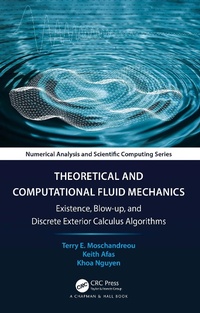
Theoretical and Computational Fluid Mechanics
Existence, Blow-up, and Discrete Exterior Calculus Algorithms
1st Edition
Published on 25. January 2024
338 pages
978-1-003-82855-6 (ISBN)
Description

Theoretical and Computational Fluid Mechanics: Existence, Blow-up, and Discrete Exterior Calculus Algorithms centralizes the main and current topics in theoretical and applied fluid dynamics at the intersection of a mathematical and non-mathematical environment. The book is accessible to anyone with a basic level of understanding of fluid dynamics and yet still engaging for those of a deeper understanding.
The book is aimed at theorists and applied mathematicians from a wide range of scientific fields, including the social, health, and physical sciences. It provides a step-by-step guide to the construction of solutions of both elementary and open problems of viscous and non-viscous models, and for the applications of such models for the functional analysis and real analysis of data.
Features
Offers a self-contained treatment that does not require a previous background in fluid dynamics.
Suitable as a reference text for graduate students, researchers, and professionals, and could easily be used as a teaching resource.
Provides various examples using Maple, Mathematica, and to a lesser extent Matlab programming languages.
The book is aimed at theorists and applied mathematicians from a wide range of scientific fields, including the social, health, and physical sciences. It provides a step-by-step guide to the construction of solutions of both elementary and open problems of viscous and non-viscous models, and for the applications of such models for the functional analysis and real analysis of data.
Features
Offers a self-contained treatment that does not require a previous background in fluid dynamics.
Suitable as a reference text for graduate students, researchers, and professionals, and could easily be used as a teaching resource.
Provides various examples using Maple, Mathematica, and to a lesser extent Matlab programming languages.
More details
Series
Edition
1. Auflage
Language
English
Place of publication
London
United Kingdom
Publishing group
Taylor & Francis Ebooks
Target group
College/higher education
Illustrations
39 Line drawings, black and white; 39 Illustrations, black and white
ISBN-13
978-1-003-82855-6 (9781003828556)
Copyright in bibliographic data and cover images is held by Nielsen Book Services Limited or by the publishers or by their respective licensors: all rights reserved.
Schweitzer Classification
Other editions
Additional editions
Terry E. Moschandreou | Keith Afas | Khoa Nguyen
Theoretical and Computational Fluid Mechanics
Existence, Blow-up, and Discrete Exterior Calculus Algorithms
Book
01/2024
1st Edition
Chapman & Hall/CRC
€167.60
Shipment within 10-20 days
Persons
Dr. Terry Moschandreou teaches mathematics at the University of Western Ontario in the School of Mathematical and Statistical Sciences. He received his PhD in Applied Mathematics from the same university in 1996.
The greater part of his professional life has been spent at the University of Western Ontario (teaching 8 years mathematics and fluid dynamics courses) and Fanshawe College in London (where he has taught physics courses), Ontario, Canada. Dr. Moschandreou is also currently working for Thames Valley District School Board in London Ontario Canada, where he teaches elementary and high school students Mathematics and Science. He worked at the National Technical University of Athens, Greece for a short period.
Dr. Moschandreou is the author of several research articles on blood flow and oxygen transport in microcirculation, general fluid dynamics, and the theory of differential equations. Also, he has contributed to the field of finite element modeling of the upper airways in sleep apnea as well as surgical brain deformation modeling. More recently, he has been working with the partial differential equations of multiphase flow and level set methods as used in fluid dynamics.
Finally, Dr. Moschandreou and Keith C. Afas from the School of Biomedical Engineering at the University of Western Ontario propose to have a solution to the Millennium Prize Problem (main findings submitted in the period 2018- 2022) for the breakdown of solutions to the Periodic Navier Stokes Equations on the 3-Torus.
Mr. Keith Afas is a graduate researcher at the University of Western Ontario (UWO), who has been engaged in applied mathematics and mathematical modelling research since 2014, leading to multiple first-author and co-author publications, posters, conference presentations, and book chapters in a variety of topics.
He received his Masters's degree in Biomedical Engineering from the University of Western Ontario in 2022, and Bachelor's degrees in Medical Biophysics and Medical Cell Biology from the University of Western Ontario in 2021 and 2019, respectively. Currently, Mr. Afas is pursuing a Biomedical Engineering PhD at the University of Western Ontario.
Mr. Afas' primary research interests are multiscale mathematical modeling of the circulatory system, and differential geometric models explaining the genesis of cell shape. Mr. Afas' past work includes the analysis of partial differential equations governing intraluminal arteriolar O2 and bulk-tissue skeletal muscle O2 transport. Mr. Afas' past work also includes creating a differential geometry framework to develop tensor-invariant models for lipid membrane deformation.
Mr. Afas' current work involves applying soft condensed matter field theory to determine erythrocyte (red blood cell) membrane geometry to theoretically characterize the release of adenosine triphosphate from erythrocytes undergoing shear, with the goal of uncovering mechanisms behind microcirculatory blood flow regulation.
Dr. Khoa Nguyen has been teaching applied mathematics at Western University in London, Ontario, Canada since 2001. Most of his students are engineering and science students. His interests vary from physics to engineering, mathematics, and applications of mathematics to these fields. He has had two publications on Physical Review D with his collaborators and a book on numerical methods in C and Matlab with his colleague.
The greater part of his professional life has been spent at the University of Western Ontario (teaching 8 years mathematics and fluid dynamics courses) and Fanshawe College in London (where he has taught physics courses), Ontario, Canada. Dr. Moschandreou is also currently working for Thames Valley District School Board in London Ontario Canada, where he teaches elementary and high school students Mathematics and Science. He worked at the National Technical University of Athens, Greece for a short period.
Dr. Moschandreou is the author of several research articles on blood flow and oxygen transport in microcirculation, general fluid dynamics, and the theory of differential equations. Also, he has contributed to the field of finite element modeling of the upper airways in sleep apnea as well as surgical brain deformation modeling. More recently, he has been working with the partial differential equations of multiphase flow and level set methods as used in fluid dynamics.
Finally, Dr. Moschandreou and Keith C. Afas from the School of Biomedical Engineering at the University of Western Ontario propose to have a solution to the Millennium Prize Problem (main findings submitted in the period 2018- 2022) for the breakdown of solutions to the Periodic Navier Stokes Equations on the 3-Torus.
Mr. Keith Afas is a graduate researcher at the University of Western Ontario (UWO), who has been engaged in applied mathematics and mathematical modelling research since 2014, leading to multiple first-author and co-author publications, posters, conference presentations, and book chapters in a variety of topics.
He received his Masters's degree in Biomedical Engineering from the University of Western Ontario in 2022, and Bachelor's degrees in Medical Biophysics and Medical Cell Biology from the University of Western Ontario in 2021 and 2019, respectively. Currently, Mr. Afas is pursuing a Biomedical Engineering PhD at the University of Western Ontario.
Mr. Afas' primary research interests are multiscale mathematical modeling of the circulatory system, and differential geometric models explaining the genesis of cell shape. Mr. Afas' past work includes the analysis of partial differential equations governing intraluminal arteriolar O2 and bulk-tissue skeletal muscle O2 transport. Mr. Afas' past work also includes creating a differential geometry framework to develop tensor-invariant models for lipid membrane deformation.
Mr. Afas' current work involves applying soft condensed matter field theory to determine erythrocyte (red blood cell) membrane geometry to theoretically characterize the release of adenosine triphosphate from erythrocytes undergoing shear, with the goal of uncovering mechanisms behind microcirculatory blood flow regulation.
Dr. Khoa Nguyen has been teaching applied mathematics at Western University in London, Ontario, Canada since 2001. Most of his students are engineering and science students. His interests vary from physics to engineering, mathematics, and applications of mathematics to these fields. He has had two publications on Physical Review D with his collaborators and a book on numerical methods in C and Matlab with his colleague.
Content
1. Introduction to Fluid Dynamics. 2. Geometric Algebra. 3. Compressible Navier Stokes equations. 4. Hydrodynamic Stability and Maple. 5. Mathematics Preliminaries. 6. Simplified Periodic Navier-Stokes (PNS) and Rayleigh-Plesset (RP) Equations. 7. Introduction to Flows and Dynamical Systems. 8. Numerical Analysis of 3D Periodic Navier Stokes equations and the Maple Environment. 9. Introduction to Fractional Calculus. 10. Introduction to Simplicial Complexes, and Discrete Exterior Calculus (DEC). 11. Applications of Discrete Exterior Calculus (DEC) to Fluid Mechanics and Fluid-Structure Interactions.
