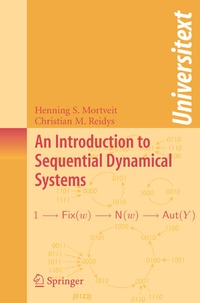
An Introduction to Sequential Dynamical Systems
Description

Sequential Dynamical Systems (SDS) are a class of discrete dynamical systems which significantly generalize many aspects of systems such as cellular automata, and provide a framework for studying dynamical processes over graphs.
This text is the first to provide a comprehensive introduction to SDS. Driven by numerous examples and thought-provoking problems, the presentation offers good foundational material on finite discrete dynamical systems which leads systematically to an introduction of SDS. Techniques from combinatorics, algebra and graph theory are used to study a broad range of topics, including reversibility, the structure of fixed points and periodic orbits, equivalence, morphisms and reduction. Unlike other books that concentrate on determining the structure of various networks, this book investigates the dynamics over these networks by focusing on how the underlying graph structure influences the properties of the associated dynamical system.
This book is aimed at graduate students and researchers in discrete mathematics, dynamical systems theory, theoretical computer science, and systems engineering who are interested in analysis and modeling of network dynamics as well as their computer simulations. Prerequisites include knowledge of calculus and basic discrete mathematics. Some computer experience and familiarity with elementary differential equations and dynamical systems are helpful but not necessary.
Reviews / Votes
From the reviews:
"By a sequential dynamical system (SDS), Mortveit (Virginia Polytechnic Institute and State Univ.) and Reidys (Nankai Univ., China) mean a certain type of mathematical model. . Summing Up: Recommended. Upper-division undergraduate through professional collections." (D. V. Feldman, CHOICE, Vol. 45 (10), June, 2008)
"A comprehensive introduction to sequential dynamical systems (SDS), i.e. a class of dynamical systems defined over graphs where the dynamics arise through functional composition of local dynamics. . The book will be useful to graduate students and researches in discrete mathematics, dynamical systems, theoretical computer science, and systems engineering . ." (Georgy Osipenko, Zentralblatt MATH, Vol. 1135 (13), 2008)
More details
Other editions
Additional editions