

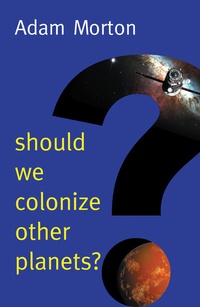
Should We Colonize Other Planets?
Description

Adam Morton examines extra-terrestrial colonization plans with a critical eye. He makes a strong case for colonization - just not by human beings. Humans live relatively short lives and, to survive, require large amounts of food and water, very specific climatic conditions and an oxygen-rich atmosphere. We can create colonists that have none of these shortcomings.
Reflecting compassionately on the nature of existence, Morton argues that we should treat the end of the human race in the same way that we treat our own deaths: as something sad but ultimately inevitable. The earth will perish one day, and, in the end, we should be concerned more with securing the future of intelligent beings than with the preservation of our species, which represents but a nanosecond in the history of our solar system.
More details
Other editions
Additional editions
Content
1 Escape from Earth? 1
2 The Colony Solution 22
3 Problems with Colonies 40
4 Costs of Colonization 57
5 Colonization without Humans 78
Conclusion: Why Human Colonization is a Bad Idea 99
Further Reading 103
Index 121
One
Escape from Earth?
The aim of this book is to look critically at some of the arguments for thinking that human beings should travel and colonize beyond the earth. Why should we want to leave this beautiful planet to which we are so well adapted? Some of these arguments suggest escapes from dangers facing the human species, and others are driven by scientific curiosity and the love of adventure. This chapter describes the dangers, chapter 2 the proposed solutions, chapter 3 problems with these solutions, chapter 4 their monetary and opportunity costs, and chapter 5 alternatives to the standard colonization proposals. At the end there is a very short conclusion drawing some general morals. I argue that the dangers to a colony are greater than we often suppose, that the costs are likely to be higher, and that we are ignoring serious alternatives and possibilities. Moreover, there are hard questions about the desirability of colonization. The first topic - dangers and costs - is a matter of finding the right facts. This is not always easy, but it is common in discussions of topics like this. The second topic - which alternatives we want - is a matter of making readers confront what on reflection they value. These are moral arguments and work by setting up suitable reflection. They are not common in this kind of topic, and it is a novel aspect of this book to give them equal weight. We begin with the dangers. What are they?
Earth is not heaven. Many things go badly on our planet: some of these are old, by earthly standards, some are new, some are less than they used to be, and some we are making worse. The Four Horsemen of the Apocalypse - traditionally Conquest, War, Famine, and Death, though more modern names are enslavement/inequality, war, environmental damage, and murderous hatred - are still on the horizon and have the capacity to extinguish the human species. War and environmental damage are the species killers, but they are abetted by inequality and hatred. Inequality and famine promote hatred and raise the risk of war. (We have dodged nuclear war for seventy years, for reasons that no longer seem clear, but have substituted a large number of terrible but less catastrophic conflicts.)* The number of nuclear nations has grown, and some of them have fanatical and irresponsible rulers. The dangers to human life are not confined to the destruction from the bombs themselves: fallout, destruction of crops, and nuclear winter would kill far more, possibly all of us.
Hatred can obviously lead to war. But private hatred can be large-scale also. The greatest danger exploits biotechnology. Viruses can be designed, manufactured, and targeted to order these days. A variant of the Ebola virus, for example, that spread not just via blood and other fluids but also through the air, perhaps on people's breath, would have catastrophic possibilities. Most viruses have reservoirs in animal populations from which they can mutate and find ways of infecting humans. With greater density of human population, diseases spread more readily; we use more intensive farming methods, and in some parts of the world we hunt and eat animals to which we did not pay much attention before. People travel more readily in the contemporary world, and air travel is so rapid that a person can get on a flight showing no signs of a disease and be highly infectious when they arrive at their destination. The great danger is of a mutation in a virus with the terrible combination of three factors. It would come to be transmitted readily from person to person; it would become more deadly by finding a chink in human immune defences; and it would have an incubation period between infection and presentation of symptoms which allowed it to spread by air travel around the globe before governments realized what was going on. Such a disease could take an enormous toll of human life and might set civilization back for centuries. It could threaten the survival of the species. It could happen as a result of bad luck plus modern conditions of life. But it could also happen by deliberate design, through the targeting of some nation or ethnic group, and then spread to cover the globe and all of humanity.
These are the evils that our species brings upon itself. There are also evils that come from outside. The threat most often mentioned is an asteroid strike. It has features in common with other catastrophes, so I will give it perhaps disproportionate attention. Asteroids are big chunks of rock which are numerous in the outer reaches of the solar system and occasionally wander inwards, where they can strike planets. The surfaces of other rocky planets are pitted with craters from the impact of asteroids. They are also visible on Earth to those who know what to look for, showing past asteroid strikes on this planet, but they are less obvious because of oceans, vegetation, and the constant churning of the earth's surface associated with continental drift. The best-known asteroid impact is the one that many believe to have played a role in the extinction of the dinosaurs (except for birds). The theory is that, around 66 million years ago, an asteroid as large as 15 km across struck the earth at the coast of Yucatán. It would have created a worldwide cloud that lasted a year and was thick enough to inhibit photosynthesis, thus depriving animals of food and extinguishing many species. Fate is chancy: an impact in the deep ocean which covers most of the earth, or in less sulphur-rich rock, might have been less devastating. If something similar happened tomorrow, the survival of the human species would be far from guaranteed.
There are many other cases; asteroids strike Earth regularly. Most of them are small and burn up in the earth's atmosphere. If they reach the surface they do minimal damage. But not all of them are like this. There is an impact with the force of a small atomic bomb every ten years or so. Luckily most of these are dissipated in the upper atmosphere. But if an impact of a size that happens every few centuries struck a populated area the result would be a catastrophe. It would be much more serious than most wars or terrorist incidents. The explosive impact itself is only one of the sources of destruction. There would likely be effects on the earth's climate for a good while. We are lucky to have an atmosphere that mitigates the danger, but it is not enough to make us safe.
There have been a variety of proposals for reducing or eliminating the danger of a catastrophic asteroid strike. We can often detect asteroids when they are very distant and predict their danger to Earth. With advances in telescopes, particularly telescopes orbiting the earth - significantly for our purposes, telescopes located on the moon or at the gravitationally stable Lagrange points - we can increase our warning time. As an asteroid approaches, we can refine our predictions and eventually foretell where on Earth it should strike. We could then evacuate vulnerable areas of the planet. The amount of warning we have is crucial.
A more active response would be to deflect or destroy the asteroid. Some of these responses are rather science-fictional, involving astronauts on rockets and nuclear explosions. Deflection of the asteroid from its fatal course could be managed in a number of ways. We might exploit the gravitational tug of an object made to orbit the asteroid, or we might play cosmic billiards using a different asteroid or other body directed towards the one headed towards us. It has even been suggested that we could focus light from the sun at the asteroid, producing a subtle pressure that, given enough time, would change its course. NASA has announced plans for a fairly simple deflection strategy, the DART plan (Double Asteroid Redirection Test!), which involves impacting the asteroid with a spacecraft whose momentum would change the asteroid's trajectory. The deflection strategies typically require more advance knowledge than the fragmentation strategies, which are risky and fall into the category of last resort. No one has begun to construct the hardware that any of these require. But a lot of effort from many astronomers and others is going into locating and predicting "heavenly" bodies that might be threats.
There are other dangers in the earth's cosmic environment. Cosmic rays from outer space are variable, and we do not know all the sources of their variation. The movement of the solar system through the galaxy may be one source. Supernovas - exploding stars at the end of their lives - could have bad effects by destroying the earth's ozone layer with X-rays and gamma rays, thus allowing ultraviolet light from the sun to damage life on Earth. And, for reasons that are still very obscure, there seems to be a mass extinction of life on Earth every 27 million years or so. Supervolcanoes may be one explanation and volcanic activity remains a major threat. It may be as great a threat as asteroids, though it does not get as much discussion. We do not now have the capacity to mitigate any of these further dangers. As science and technology progress, we may come to understand and even to take protective measures against some of these. But not immediately, and perhaps not for centuries.
All these hazards can interact and amplify one another's effects. Some of them are very likely to do this. We are now seeing the first effects of global warming. It will become worse in the coming years and poses a great threat to human life. The resulting climate changes make war and disease more likely, as does...
