

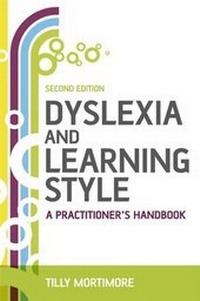
Dyslexia and Learning Style
Description

More details
Other editions
Additional editions
Person
Content
Advanced organiser.
Part One: Learning Style.
Chapter 1 Different ways of seeing.
Introduction.
What are cognitive or learning styles?
Models of cognitive or learning style.
Simplifying the picture - two inclusive approaches.
Should style theory go out the window.
Chapter summary.
Chapter 2 Different ways of learning.
Introduction.
Concept maps a visuo-spatial tool.
Helping students cope with the teaching methods of secondary school.
Matching the mode to the style.
Identifying cognitive or learning style.
A caution.
Chapter summary.
Part Two: Dyslexia.
Chapter 3 The 3 `D's: Dyslexia, Definitions and Diagnosis.
Introduction: What is dyslexia?
Defining dyslexia.
Definitions and differences.
How can dyslexia be diagnosed or identified?
Chapter summary.
Chapter 4 Dyslexia - curse or blessing?
Introduction: What impact does dyslexia have on daily life?
The pattern of difficulties.
Dyslexia at home.
Dyslexia at school.
Learning difficulties sometimes related to dyslexia.
Self-esteem and dyslexia - the effects of early negative experiences.
Dyslexia in adults.
Chapter summary.
Chapter 5 Strengths and talents.
Introduction: Does dyslexia bring special talents?
The research background.
Conclusions.
Chapter summary.
Part Three: "It's No Use If You Can't Use It."
Chapter 6 Applying learning style theory to learning.
Introduction: Recap: learning style and dyslexia.
Learning styles and learning strategies.
What theories underpin these strategies?
Schema theory - its role in learning.
Memory function - its role in learning.
Dyslexia and memory.
What are the most effective ways of providing this support for a vulnerable student?
Summary.
Chapter summary.
Part Four: Strategies for Wholistic and Analytic Learners.
Chapter 7 Wholistic approaches.
Introduction: What types of behaviour and approaches to learning might be characteristic of a wholistic learner?
The learning implications for people with dyslexia.
What strategies can teachers use to help learners with wholistic learners preferences?
Getting students ready to learn.
Teaching and learning strategies to help wholistic learners.
Strategies for getting the information in modes of presentation.
Strategies for processing, storing and revising.
Strategies for getting information out- modes of expression.
Wholistic examination and revision techniques.
Chapter summary.
Chapter 8 Analytical approaches.
Introduction: What types of behaviour and approaches to learning might be characteristic of an analytical learner?
The learning implications for people with dyslexia of adopting an analytical style.
Getting students ready to learn.
Teaching and learning strategies to help analytical learners.
Strategies for getting information in- modes of presentation.
Strategies for processing, storing and revising.
Strategies for getting information out- modes of expression.
Examination and revision techniques for analytics.
Chapter summary
Part Five: Words or Pictures?
Chapter 9 Images and visualisation.
Introduction: The power of images.
Teaching and learning strategies to help imagers.
Strategies for getting information in- modes of presentation.
Strategies for processing, storing and revising- turning words into pictures.
Getting information out- modes of expression: oral and written.
Examination and revision techniques for imagers.
Spelling techniques for imagers.
Chapter summary.
Chapter 10 Verbal strategies.
Introduction: The power of the word.
Teaching and learning strategies to help verbal learners.
Strategies for getting information in - modes of presentation.
Strategies for processing, storing and revising.
Strategies for getting information out-creating text writing frames for verbalisers.
Developing phonological awareness.
Using phonological awareness to improve proofreading skills.
Examination and revision techniques for verbalisers.
Spelling techniques for verbalisers.
Chapter summary
Part Six: What Were Those Last Ten Chapters About?
Chapter 11 Helping students to remember.
Introduction: Dyslexic students and memory.
Learning style and memory.
Making things easier to remember - key memory aids.
Useful techniques.
Chapter summary.
Last words: a caution.
Appendices.
Appendix 1: Assessing the reading level of texts.
Appendix 2: Strategies for kinesthetic learners.
Appendix 3: Visual processing deficit checklist.
Appendix 4: A Common Sight Word list.
Appendix 5: Case studies.
Appendix 6: The thirteen style constructs explored by the report of Coffield and his team (2004).
References.
Further reading.
Index.
