

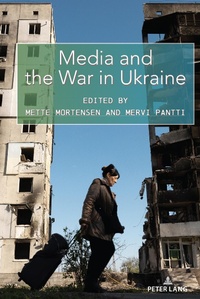
Media and the War in Ukraine
Description

This volume aims to deepen our understanding of the dynamic intersections of war and media in the rapidly transforming media ecology and the reordered geopolitical context. Since Russia's fullscale invasion of Ukraine in February 2022, a new set of media practices and actors have entered the field of contemporary war. The volume examines the ways in which the digital media and communication environment is involved in and shape the war in Ukraine. The chapters in the volume analyse the expanding mesh of media-from mainstream broadcasting and press to social media platforms, and the latest digital technologies-and address four key themes: media infrastructures and the interplay between platforms, technologies, institutions and civic actors; open-source intelligence contributing to (dis)information about the war; the everyday life of war performed and documented on social media; and different interplays between the local and the global in the news coverage of the war.
Open Access Chapter 8 is available here.
More details
Other editions
Additional editions
Persons
Mette Mortensen is Professor at the Department of Communication, University of Copenhagen. Her research is concerned with media and confl ict, visual media studies, and popular culture and populism.
Mervi Pantti is Professor in Media and Communication at the Faculty of Social Sciences, University of Helsinki. Her research is concerned with confl ict and disaster journalism, emotion in media, media and immigration, digital platforms, disinformation and media accountability.
Content
Simon Cottle: Series Editor's Foreword - Acknowledgements - Introduction - Göran Bolin/Per Ståhlberg: Understanding the Ukrainian Informational Order in the Face of the Russian War - Kateryna Boyko/Roman Horbyk: Swarm Communication in a Totalising War: Media Infrastructures, Actors and Practices in Ukraine during the 2022 Russian Invasion - Mervi Pantti/Matti Pohjonen: Social Media Platforms Responding to the Invasion of Ukraine - Jamie Matthews: Open-Source Actors and UK News Coverage of the War in Ukraine: Documenting the Impacts of Conflict and Incidents of Civilian Harm - Marc Tuters/Boris Noordenbos: Faking Sense of War: OSINT as Pro-Kremlin Propaganda - Tom Divon/Moa Eriksson Krutrök: TikTok(ing) Ukraine: Meme-Based Expressions of Cultural Trauma on Social Media - Marja Lönnroth-Olin/Satu Venäläinen/Rusten Menard/Teemu Pauha/Inga Jasinskaja-Lahti: 'Grandma Warriors' on YouTube: Negotiating Intersectional Distinctions and De/legitimisations of the War in Ukraine - Johana KotiSová: The Emotional Gap? Foreign Reporters, Local Fixers and the Outsourcing of Empathy - Antal Wozniak/Zixiu Liu: Indian Press Coverage of Russia's Invasion of Ukraine - Simon Cottle: Reporting the War in Ukraine: Ecological Dissimulation in a Dying World - Andrew Hoskins: Participative War: The New Paradigm of War and Media - Notes on Contributors - Index.
