

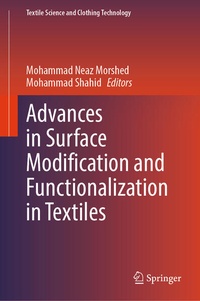
Advances in Surface Modification and Functionalization in Textiles
Description

This book provides a comprehensive overview of the fundamentals and recent advances in textile surface modification and functionalization. Addressing both established theories and cutting-edge developments, the book brings together a wide spectrum of techniques and perspectives essential for modern functional textile engineering.
.
More details
Other editions
Additional editions
Persons
Dr. Mohammad Neaz Morshed, PhD, is a researcher at the Department of Textile Technology under the Faculty of Textiles, Engineering, and Business (including The Swedish School of Textiles) at the University of Borås, Sweden. Dr. Morshed is a recognized expert in material chemistry, focusing on surface modification and functionalization of textiles, with an emphasis on eco-friendly, resource-efficient preparation methods. He teaches textile chemistry, textile biotechnology, textile functionalization, and textile science courses in various capacities at the University of Boras.
Dr. Mohammad Shahid, PhD, is an assistant professor at the Department of Chemistry, Koneru Lakshmaiah Education Foundation, India. He received his M.Sc. from Shibli National College, Azamgarh, and Ph.D. in Chemistry from Jamia Millia Islamia, New Delhi. He has held academic positions at Jamia Millia Islamia, Soochow University (China), University of Glasgow (UK), ICT Mumbai, Dr. K. N. Modi University, and Mewar University. His research has been supported by UGC, China Postdoctoral Fellowship, EU Marie Curie Fellowship, and Dr. D. S. Kothari Fellowship. He has published over 50 articles (~4600 citations, h-index 27) and edited/authored multiple books with international publishers .
Content
Chapter 1. Theory and Principle of Textile Functionalization.- Chapter 2. Surface Chemistry and Physics in Textile Surface Functionalization.- Chapter 3. Physicochemical techniques for textile surface modification and functionalization.- Chapter 4. Oxidative Surface Modification of Textiles.- Chapter 5. Resource-Efficient Processes for Textile Functionalization.- Chapter 6. Supercritical CO2 Process for Surface Modification and Functionalization of Textiles.- Chapter 7. 2D and 3D Printing Technologies for Textile Surface Functionalization.- Chapter 8. Emerging Nanomaterials in Surface Modification and Functionalization of Textiles.- Chapter 9. Instrumental Analysis and Characterization Techniques in Textile Surface Modification.- Chapter 10. Machine Learning (ML) and Artificial Intelligence (AI) in Textile Surface Modification.
