

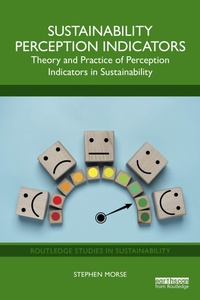
Sustainability Perception Indicators
Theory and Practice of Perception Indicators in Sustainability
Published on 6. April 2026
206 pages
978-1-040-50101-6 (ISBN)
Description

This book offers a comprehensive analysis of the background, practice, potential and challenges associated with developing and using perceptual indicators for assessing sustainability.
Sustainability indicators (SIs) are usually described and portrayed as quantitative metrics that rest above the human realm of subjectivity, opinion and bias. Thus, they are the basis for objectively measuring progress towards the attainment of targets in sustainable development. Unlike the 'hard' metrics described above, the way in which we experience the world and frame our personal decisions based on that experience, past and present, is founded on perceptions and these can be inherently subjective. This book argues that perception-based indicators are an important subset of sustainability indicators in assessing sustainability, environmental quality and well-being. The chapters draw upon examples such as the Corruption Perception Index (CPI) produced by Transparency International, and a variety of happiness indices amongst many others. Divided into two parts, the first section provides a broad review of the field of SIs, addressing the challenges involved in identifying, defining and populating SIs, especially for countries in the Global South. The second part of the book summarises the range of participatory approaches that have often been used to develop perception-based indicators of sustainability, along with their respective pros and cons.
This book will be useful for students studying social sciences, economics, environmental studies, human geography, politics and international development. The book may also appeal to students taking courses in business studies.
Sustainability indicators (SIs) are usually described and portrayed as quantitative metrics that rest above the human realm of subjectivity, opinion and bias. Thus, they are the basis for objectively measuring progress towards the attainment of targets in sustainable development. Unlike the 'hard' metrics described above, the way in which we experience the world and frame our personal decisions based on that experience, past and present, is founded on perceptions and these can be inherently subjective. This book argues that perception-based indicators are an important subset of sustainability indicators in assessing sustainability, environmental quality and well-being. The chapters draw upon examples such as the Corruption Perception Index (CPI) produced by Transparency International, and a variety of happiness indices amongst many others. Divided into two parts, the first section provides a broad review of the field of SIs, addressing the challenges involved in identifying, defining and populating SIs, especially for countries in the Global South. The second part of the book summarises the range of participatory approaches that have often been used to develop perception-based indicators of sustainability, along with their respective pros and cons.
This book will be useful for students studying social sciences, economics, environmental studies, human geography, politics and international development. The book may also appeal to students taking courses in business studies.
More details
Series
Language
English
Place of publication
London
United Kingdom
Publishing group
Taylor & Francis Ltd
Target group
College/higher education
Illustrations
25 Tables, black and white; 22 Line drawings, black and white; 4 Halftones, black and white; 26 Illustrations, black and white
File size
4,38 MB
ISBN-13
978-1-040-50101-6 (9781040501016)
Copyright in bibliographic data and cover images is held by Nielsen Book Services Limited or by the publishers or by their respective licensors: all rights reserved.
Schweitzer Classification
Other editions
Additional editions
Stephen Morse
Sustainability Perception Indicators
Theory and Practice of Perception Indicators in Sustainability
Book
approx. 04/2026
1st Edition
Routledge
€201.50
Not yet published
Stephen Morse
Sustainability Perception Indicators
Theory and Practice of Perception Indicators in Sustainability
Book
approx. 04/2026
1st Edition
Routledge
€64.40
Not yet published
Person
Stephen Morse holds the position of Chair in Systems Analysis for Sustainability in the Centre for Environment and Sustainability, University of Surrey. Steve has a background in applied ecology and the environment, and his research and teaching interests are broad spanning both the natural and social sciences. These interests include methods for the assessment of sustainability (e.g. indicators and indices) to help guide intervention. He has also helped pioneer some participatory methodologies for sustainability assessment. He has been involved in research and sustainable development projects across Europe, the Mediterranean, Africa and Asia.
Content
1. Introduction 2. Sustainability Indicators 3. Indicators Based on Perception: A New Frontier to Assessing Sustainability? 4. Participatory Approaches to Developing Sustainability Indicators 5. Communicating and Using Perception-Based Indicators of Sustainability 6. The Future of Perception-Based Indicators of Sustainability
