

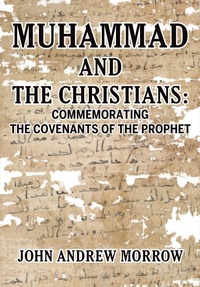
Muhammad and the Christians
Commemorating the Covenants of the Prophet
Published on 26. June 2025
284 pages
978-1-68053-387-3 (ISBN)
Description

Intriguing, innovative, and meticulously documented, Muhammad and the Christians pierces through veils of dogmatic darkness, theological accretions, political propaganda, and religious obfuscation in search of the historical Prophet of Islam. Sound in its premise, major arguments, and methodology, respected scholar John Andrew Morrow's pathbreaking work evaluates the authenticity of the covenants of the Prophet with the Christians from an objective, impartial, and neutral perspective. Seeking solely the facts, and relying only on the evidence, Morrow set off on a quest to unveil the earliest understanding of the Qur'an and the original teachings of the Prophet Muhammad and the prophetic Islam that existed prior to the Umayyads, 'Abbasids, and others. Muhammad and the Christians answers two questions of paramount and existential importance then and today: do the covenants of the Prophet with the Christians represent the primordial teachings of the Muhammad and, if so, are they still obligatory and binding upon believers?
More details
Other editions
Additional editions
Book
06/2025
Academica Press
€101.50
Shipment within 3-4 weeks
Person
John Andrew Morrow is a graduate of the University of Toronto, where he completed his bachelor's, master's, and doctoral degrees. He is also the product of several decades of Islamic seminary studies. A polymath and a prolific author, Professor Morrow has published hundreds of academic articles and several dozen scholarly books in a wide array of specialized fields. Dr. Morrow is an award-winning educator, lecturer, and administrator, as well as a geo-political analyst, a best-selling author, and an activist for peace and justice. He has received an interfaith service award from the Islamic Society of North America, a certificate of recognition from the United States Congress, and recognition from the Interfaith Institute of Long Island as one of the most influential American Muslim scholars.
Content
- MUHAMMAD AND THE CHRISTIANS:
- Commemorating the Covenants of the Prophet
- John Andrew Morrow
- MUHAMMAD AND THE CHRISTIANS:
- Commemorating the Covenants of the Prophet
- John Andrew Morrow
- Academica PressWashington
- Library of Congress Cataloging-in-Publication Data
- Names: Morrow, John Andrew (author)
- Title: Muhammad and the Christians: Commemorating the Covenants of the Prophet | John Andrew Morrow
- Description: Washington: Academica Press, 2025. | Includes references.
- Identifiers: LCCN 2025939426 | ISBN 9781680533866 (hardcover) | 9781680533873 (e-book)
- Copyright 2025 John Andrew Morrow
- "Those who break the covenant of God after ratifying it, and sever that which God ordered to be joined, and (who) make mischief in the earth: Those are they who are the losers." (Qur'an 2:27)
- /
- (Figure 1: P. Nessana 77. Dated 60 AH / 680 CE, this is currently the oldest papyrological reference to the dhimmat Allah wa dhimmat rasulihi or "the protection of God and the protection of His messenger." It was offered to the majority Christian population of Nessana in the southwestern Negev desert on the border of what is now Israel and Egypt. Reproduced with permission)
- /
- (Figure 2.1: Jerusalem 32. Dated 32 AH / 652 CE. The oldest attestation of the dhimmat Allah wa daman rasulihi or "the protection of God and the security and guarantee of His messenger" discovered to date. It was offered to the people of Jerusalem. Reproduced with permission)
- /
- (Figure 2.2: Jerusalem 32. Dated 32 AH / 652 CE. The oldest attestation of the dhimmat Allah wa daman rasulihi or "the protection of God and the security and guarantee of His messenger" discovered to date. It was offered to the people of Jerusalem. Reproduced with permission)
- /
- (Figure 2.3: Jerusalem 32. Dated 32 AH / 652 CE. The oldest attestation of the dhimmat Allah wa daman rasulihi or "the protection of God and the security and guarantee of His messenger" discovered to date. It was offered to the people of Jerusalem. Reproduced with permission)
- Contents
- Also by John Andrew Morrow................ xvii
- Words of Praise........................ xix
- Acknowledgments.......................... xxi
- Foreword........................... xxiii
- Preface.......................... xxv
- Chapter 1The Qur'anicity of the Prophet's Covenants............. 1
- 1.1 Introduction 1
- 1.2 The Qur'an and the Covenants of the Prophet 2
- 1.3 The Desolation of Abrogation 30
- 1.3 Conclusions 34
- Chapter 2Muhammad, Mount Sinai, and the Mystical Eagle:Unearthing the Mythic Substrata................. 39
- 2.1 Introduction 39
- 2.2 The Account 39
- 2.3 The Legend of Pachomius 46
- 2.4 The Zoological Eagle 49
- 2.5 The Symbolic Eagle 50
- 2.6 The Satanic Verses 56
- 2.7 Jibril or Israfil? 57
- 2.8 Of Angels, Messengers of the Gods,and Bird-Headed Divinities 64
- 2.9 Conclusions 69
- Chapter 3Gabriel Sionita and the Covenant at the University of Cambridge.... 73
- 3.1 Introduction 73
- 3.2 The Supporters 74
- 3.3 The Opponents 75
- 3.4 The Manuscript Evidence 75
- 3.5 The Covenant at the University of Cambridge 77
- 3.6 The Cambridge Covenant in Arabic and English 82
- 3.7 Commentary on the Cambridge Covenant 87
- 3.8 Conclusions 89
- Chapter 4The Arabic Garshuni Covenant of the Prophetfrom Mar Behnam Monastery in Iraq............... 91
- 4.1 Introduction 91
- 4.2 The Manuscript of the Covenant of the Prophet 93
- 4.3 The Arabic Garshuni Covenant of the Prophet Muhammad 100
- 4.4 Critical Insights on the Arabic Garshuni Covenant 102
- 4.5 Objections to the Contentof the Arabic Garshuni Covenant of the Prophet 103
- 4.7 Conclusions 120
- Chapter 5The Art of the Covenant:Symbolic Representations and their Significance.......... 123
- 5.1 Introduction 123
- 5.2 The Compendium of Chronicles 124
- 5.2 The Covenants of the Prophet 131
- 5.3 The Hand of the Prophet 132
- 5.4 The Covenant of the Prophet Muhammadfrom the Monastery of Simonopetra in Mount Athos, Greece 142
- 5.5 The Covenant of the Prophet Muhammadfrom the Monastery of St. Catherine in Egypt 144
- 5.6 The Covenant of the Prophetfrom the Monastery of St. George al-Humayra' in Syria 150
- 5.7 The Covenant of 'Umar 152
- 5.13 Conclusions 155
- Chapter 6The Christians of Najran:Two Conflicting, Incompatible, and Irreconcilable Portraits..... 157
- 6.1 Introduction 157
- 6.2 Sunni and Shiite Sources 161
- 6.3 Modern Interfaith Efforts 165
- 6.4 The Najran Covenant in Muslim Sources 166
- 6.5 The Exordium 175
- 6.6 Art Depicts Reality: A Testimony to Truth 183
- 6.6 Conclusions 186
- Chapter 7Were the Covenants of the Prophet Ever Negated? Imamal-Shafi'i's Covenant of Protection and The Covenant of the Prophet.. 195
- 7.1 Introduction 195
- 7.2 Honor thy Mother 197
- 7.3 Imam al-Shafi'i 202
- 7.4 The Covenant of Protection by Imam al-Shafi'i translatedby Dr. John Andrew Morrow, Dr. Ibrahim Zein, and Ahmed El-Wakil 202
- 7.5 Commentary 206
- 7.6 Conclusions 210
- General Conclusions..................... 213
- Permissions........................ 221
- Photographs 221
- Lengthy Citations 223
- Works Cited.......................... 225
- Index............................. 239
- Also by John Andrew Morrow
- W.D. Fard: The Man, Myth, and Mystery Behind the Nation of Islam
- Hijab: Word of God or Word of Man?
- Islam & Slavery
- The Legacy of Louis Riel: Leader of the Métis People
- Controversies in Islam: Religious Law,Qur'anic Ethical Imperatives, and Higher Moral Objectives
- The Islamic Interfaith Initiative: No Fear Shall Be Upon Them
- Shi'ism in the Maghrib and al-Andalus (2 vols.)
- The Messenger of Mercy:The Covenants of Coexistence from the Prophet of Pluralism
- The Most Controversial Qur'anic Verse: Why 4:34 Does Not Promote Violence Against Women
- Perjanjian Nabi Muhammad dengan Penganut Kristen Dunia
- Les paroles d'Allah au Prophète Muhammad: quarante traditions sacrées
- Las palabras de Allah al Profeta Muhammad: cuarenta dichos sagrados
- Finding W.D. Fard:Unveiling the Identity of the Founder of the Nation of Islam
- Islam and the People of the Book:Critical Studies on the Covenants of the Prophet (3 vols.)
- 'Uhud al-nabi li-masihiyyi al-'alam
- I Patti del Profeta Muhammad con i cristiani del mondo
- Restoring the Balance: Using the Qur'anand Sunnah to Guide a Return to the Prophet's Islam
- El minarete y el campanario:los pactos del Profeta Muhammad con los cristianos del mundo
- The Words of God to Prophet Muhammad: Forty Sacred Sayings
- Six Covenants of the Prophet Muhammadwith the Christians of His Time: The Primary Documents
- (published in Arabic, Spanish, Italian, Portuguese, French, Dutch, Russian, Turkish, Persian, Azeri, Urdu, Indonesian, Tamil, and Armenian)
- The Covenants of the Prophet Muhammad with the Christians of the World
- Islamic Images and Ideas: Essays on Sacred Symbolism
- Religion and Revolution: Spiritual and Political Islam in Ernesto Cardenal
- Islamic Insights: Writings and Reviews
- Encyclopedia of Islamic Herbal Medicine
- Amerindian Elements in the Poetry of Ernesto Cardenal:Mythic Foundations of the Colloquial Narrative
- Kitab al-Tawhid: The Book of Divine Unity(with 'Ali Rizvi and Barbara Castleton)
- El islam shiíta: ¿ortodoxia o heterodoxia? (with Luis Alberto Vittor)
- Amerindian Elements in the Poetry of Rubén Darío:The Alter Ego as the Indigenous Other
- Arabic, Islam, and the Allah Lexicon:How Language Shapes Our Conception of God
- Shi'ite Islam: Orthodoxy or Heterodoxy? (with Luis Alberto Vittor)
- Words of Praise
- "Dr. John Andrew Morrow's latest book, Muhammad and the Christians: Commemorating the Covenants of the Prophet is a continuation of the monumental research on the covenants of the Prophet Muhammad which he pioneered. His discoveries have filled gaps in our knowledge of early Islam for which we are eternally grateful. The new insights and findings that he has documented in this volume constitute yet another important contribution to the study of the covenants of the Prophet." Ibrahim Mohamed Zein
- "Covenants are central to the Qur'anic narrative of human existence and coexistence and were the basis of Prophet Muhammad's intercommunity and interreligious relations. Yet covenants have been underrepresented in the study of Islam, leaving significant gaps in knowledge. Dr. John Andrew Morrow's pioneering work on the covenants of the Prophet has been instrumental in filling these gaps. This book is accessible for readers new to the study of the Prophet's covenants and provides important new in
- "When it comes to Prophet Muhammad's covenants with the Christians of his time, there are few -- if any -- scholars in the world that have matched Dr. John Andrew Morrow's impressive body of scholarship. In this book, Dr. Morrow has outdone himself. The level of historical detail and religious insight he provides makes for an enriching and fruitful read. Highly recommended." Dr. Craig Considine, Senior Lecturer, Rice University
- "Dr. John Andrew Morrow is an authority on the covenants of the Prophet Muhammad. In Muhammad and the Christians: Commemorating the Covenants of the Prophet, he offers additional material of enduring interest, including a study on 'The Art of the Covenant.' I am particularly drawn in by his demonstration of the purpose and function of art to communicate religious beliefs, the protection of Christians, and the fostering of interfaith dialogue. I highly recommend the book for religious leaders, di
- "The texts of the Ahdnames form the basis for the peaceful coexistence of Christians and Muslims and the development of constructive relations between Christianity and Islam. Respect for the other person, whoever he may be, which in Christianity was expressed in the Golden Rule of the Gospel, 'Whatever you will that men should not do to you, do not do to them
- for this is the law and the prophets' (Mt 7:12), is also the basis of the text of the Ahdname. Only on such a basis is it possible for Ch
- The usefulness of the Ahdnames for this purpose was also proven in practice, as they formed the basis for the foundation of the special status by which the Orthodox Church and the Orthodox Ecclesiastical Institutions and Monasteries, as well as Mount Athos, were recognized by the Ottoman State during the many centuries of Ottoman rule, a regime which, despite the problems in its implementation and the complications that occasionally arose, ensured their survival in extremely difficult and compli
- It is therefore crucial for our days that Dr. John Andrew Morrow tries to bring out the writings of the Ahdnames and to spread their spirit in the tragically divided modern world, demonstrating that the 'other,' the one who does not belong to our religion, our nation, our race, our social class, and so forth, should not be treated as our enemy or our competitor, but as a brother who deserves at least our respect and, why not, our love." Monk Kosmas Simonopetritis, Holy Monastery of Simonopetra a
- Acknowledgments
- I wish to extend words of gratitude to all the scholars, academics, and authors who peer-reviewed this publication and provided words of support, including, but not limited to, Dr. Ibrahim Mohamed Zein and Ahmed El-Wakil, Dr. Halim Rane, Dr. Craig Considine, Dimitrios Kalomirakis, Father Francis Afu, and Monk Kosmas Simonopetritis. I would like to express my deepest appreciation to Ahmed El-Wakil for his drive and determination to improve this work in all aspects. The time and energy he selfless
- I am also extremely grateful to Dr. Marianne Farina, who, along with being an academic, professor, author, and administrator, happens to be a Roman Catholic nun, for gracing this work with its foreword. A great deal of gratitude is due to all the fine and professional people at Academica Press for publishing this piece. This endeavor would not have been possible without them. Special thanks are extended to all the parties that granted permission to reproduce the photographs and lengthy citations
- Last, but not least, words cannot express my gratitude to the Greek Orthodox Church, its ecclesiastic leaders and its clerics, including Father Justin, Father Hareth, Father Kosmas, and many others, for supporting the research of scholars on the covenants of the Prophet Muhammad. Despite historical distortions to the Qur'anic and prophetic message, along with an inordinate amount of religious and political pressure, the Greek Orthodox Church has stood its ground for the past fourteen hundred yea
- Foreword
- By Dr. Marianne Farina CSCProfessor of Philosophy and TheologyDominican School of Philosophy and TheologyBerkeley, CA
- Muhammad and the Christians: Commemorating the Covenants of the Prophet is the latest volume in the ongoing study of treaties (ahdnames) that shaped relations between Muslims and Christians in the formative years of the Islamic tradition. The Prophet's pledges to protect Christians included commitments with secular and religious communities and local and regional governing bodies, promises from the seventh century until today.
- The data collected in this text is substantial, and it illustrates how Christian communities received the covenants and how the Prophet and his community implemented them. This heritage spreads across several geographic areas, much like how Islam influenced Western philosophy, art, architecture, and, in general, all cultures across the globe. The artwork and symbolism that adorn these documents displayed in monasteries and other venues reveal the solemnity with which Christians received them and
- Dr. John Andrew Morrow's research on these documents began over a decade ago with his project on The Covenants of the Prophet Muhammad with the Christians of the World (2013). Since then, the rigor with which Dr. Morrow and his colleagues have documented various discoveries of the covenants in libraries, monasteries, and other secular and religious settings, has enriched research and teaching about Christian-Muslim relations for many colleges and universities worldwide.
- Circling these studies have been questions regarding the authenticity of the ahdnames. In this new volume, Dr. Morrow provides conclusive evidence of the genuineness of the covenants. He brings forward an integral historical account of the origins and use of these documents as Christians and Muslims encountered one another face to face.
- An integral history is a disciplined investigation that brings into the conversation various resources only sometimes included when historians document manuscripts. This fuller approach helps researchers study documents contextually, focusing more on the lived experiences of communities throughout history. Thus, we see in Dr. Morrow's study a polyhedric approach composed of analyses of the mythic substrata, descriptions of the different artwork that decorated the covenants and their fuller displ
- In this volume, Dr. Morrow addresses perceptively complex questions that emerge from looking at the covenants produced in various languages and the politics of interpretation regarding the purpose of these historic agreements. To this end, in chapter six, he offers two contrasting portraits or purposes of these covenants. He raises the question as to whether these documents are seeking to promote peace between Muslims and Christians or are seeking to substantiate the burden of the authoritarian
- Though such polemical questions continue to arise in studies about Muslim-Christian relations, this work's comprehensive study not only authenticates the genuineness of the covenants but also serves to foster additional inquiries capable of showcasing the rich and complex history of Christian and Muslim encounters and traditions. Three possibilities are worth noting.
- First, Christian and Muslim scholars will benefit from this material, especially those interested in comparative studies of symbolic art and ritual between the traditions. Such studies, exemplified in chapters two, "Muhammad, Mount Sinai, and the Mystical Eagle," and five, "The Art of the Covenant," in the book, help us to appreciate how these artifacts and practices reveal essential information concerning the social history of the regions.
- Second, the discussion in chapter four of the Arabic Garshuni Covenant and the chapter six account of the Christians of Najran provide a foundation for exploring ways Christians and Muslims understood social responsibility when forming several types of covenants, treaties, and agreements. We too often limit our study of such documents to the legal or political aspects, yet they possess deeper meaning when exploring the sacred foundations of these commitments based on linguistic studies and commu
- Finally, Dr. Morrow's research on the covenants is a critical companion to the twenty-volume bibliographic history of Christian-Muslim Relations published by E.J. Brill. The type of investigations that could emerge from the interface of these two projects provides a scholarly matrix for understanding the complex and extensive history Christians and Muslims encounters.
- Preface
- "In 628 AD, the Prophet Muhammad issued a decree known as 'The Covenant of Protection to Those who Adopt Christianity' (The Covenant of Muhammad) which commands his followers to protect Christians until the end of days. The authenticity of this Islamic lawhas been sustained throughout the ages by Islamic scholars." Constantine G. Caras, Archon, Skevophylax
- By John Andrew Morrow
- Muhammad and the Christians is yet another link in a solid scholarly chain that has seen phenomenal growth since the publication of The Covenants of the Prophet Muhammad with the Christians of the World in 2013. Within a span of ten years, the work motivated two exhibits -- one by the Ahmadiyya World Community, and the other by the International Museum of Muslim Cultures in Jackson, Mississippi.
- The Covenants of the Prophet Muhammad inspired numerous academic books by Ibrahim Zein, Ahmed El-Wakil, and Craig Considine, and scores of scholarly articles in peer-reviewed journals. It was cited over a thousand times in scholarly and popular sources within ten years of its publication in 2013. It mobilized diplomats and politicians. It galvanized diplomatic and interfaith efforts. It became a core component in combating radicalization and violent extremism. It was also instrumental in saving
- This current book, Muhammad and the Christians, is sound in its premise, major arguments, and methodology. It is intended to be concise, accessible, and more affordable than some of the other works on the subject. It continues to build upon the groundwork of previous studies and opens new avenues of research. The work does not address doubts from scholars who disbelieve in the covenants of the Prophet as these have been addressed in meticulous detail in numerous previous publications, including
- Prior to passing judgement, neutral, objective, and impartial readers, who are not motivated by ideology, spin, agenda, geo-politics, and propaganda, should become well-versed with the scholarship in the field and become familiar with both the primary and secondary sources on the subject. Required reading includes, but is not limited to, the following essential works: Majmu'ah al-Watha'iq al-siyasiyyah fi al-'ahd al-nabawi wa al-khalifah al-rashidah [Collection of Political Documents of the Prop
- This list also includes my works, namely, The Covenants of the Prophet Muhammad with the Christians of the World, Restoring the Balance: Using the Qur'an and Sunnah to Guide a Return to the Prophet's Islam, Islam and the People of the Book, in three volumes, The Islamic Interfaith Initiative: No Fear Shall be Upon Them, as well as The Messenger of Mercy: The Covenants of Coexistence from the Prophet of Pluralism. In addition, readers who wish to evaluate both sides of the story should read the p
- The opponents of the covenants of the Prophet are almost invariably Islamists or Islamophobes. They are either Muslim fundamentalists who follow in the footsteps of ISIS, al-Qaeda, Hamas, Islamic Jihad, the Muslim Brotherhood, and their extremist predecessors, or they are Zionists, Christian fundamentalists, or secular atheists. Either way, they share the same violent and intolerant vision of Islam and reinforce each other's narrative. They are two sides of the same coin. Prejudiced, biased, and
- No scholar has claimed that the ashtiname from St. Catherine's is a seventh century original. The monastery has a large body of copies dating back as far as the sixteenth century. The most widely disseminated one, the one with the emblematic gold palm print, and the set of stairs, dates from 1638. Many of these documents clearly state that they are copies of the original and some include the date they were copied, the names of the scribes who copied them, and the names and seals of the Islamic j
- When scholars speak of the covenants of the Prophet, they are referring to the body of official letters, treaties, edicts, compacts, correspondence, and other documents that Muhammad, the Messenger of God, composed over the course of his twenty-three-year mission, the first of which was the Covenant of Medina which is widely accepted as historically authentic even by the most stringent of scholars due to its content and archaic features.
- The documents in question, which number in the hundreds, are found scattered throughout the vast canonical Islamic corpus of the Sunnis and Shiites. When compiled, they fill several encyclopedic size volumes. These precious texts, which, in the view of many scholars, represent the real and representative prophetic sunnah, and which are drawn from scores of authoritative Muslim sources, were finally compiled by Muhammad Hamidullah (d. 2002), Hasan Shirazi (d. 1980), and 'Ali Ahmadi Miyanji (d. 20
- The existing collections of prophetic covenants, which were published together for the first time in the twentieth century, are supplemented by other documents rediscovered in archives by researchers in the twenty-first century. These include the six manuscripts that were brought to light in The Covenants of the Prophet Muhammad with the Christians of the World in 2013, along with numerous others that were rediscovered in the years that followed. The documents in question were never accepted pri
- The covenants of the Prophet contained in 'Ali Ahmadi Miyanji's Makatib al-Rasul have been subjected to critical discourse analysis (Athari, Khosravi Varmakani, and Sohrabi). Unlike the hadith literature, which was transmitted orally for centuries, before being committed to writing three hundred to a thousand years after the passing of the Prophet, and which, in many cases, was copied from canonical and apocryphal Jewish, Christian, and Zoroastrian sources, and even concocted outright, much of t
- Comically, and dishonestly, critics initially claimed that the covenants of the Prophet were seventeenth century frauds. When earlier copies surfaced, they moved the goalposts and pretended that they were sixteenth century forgeries from the time of Sultan Selim I (d. 1520). When this was debunked, they claimed that they were "late medieval forgeries," namely, between the years 1300-1500. When this was dismissed by documentary evidence, they pretended that the covenants of the Prophet were "earl
- The fact of the matter, however, is that the Covenant of the Prophet acted as a precedent for Fatimid decrees which date from 965, 1024, 1109, 1110, 1135, 1154, and 1156. Caliph al-Mu'izz (953-974), Caliph al-'Aziz (975-996), Caliph al-Hakim (996-1021), Caliph al-Zahir (1024), Vizier al-Afdal ibn Badr al-Jamali (1094-1121), and Caliph al-Hafiz (1134) all extended their protection to their Christian subjects based on the Covenant of the Prophet.
- Since the Covenant of the Prophet clearly does not date from the time of al-Hakim (d. 1021), will cynics, dissenters, doubters, scoffers, and pseudo-scholars postulate that the covenants of the Prophet are ninth century forgeries? Indeed, they have! In fact, when presented the evidence that Habib the Monk found a Covenant of the Prophet in the 'Abbasid archives in 878/879, these pettifoggers and quibblers claimed that it was a ninth century Christian forgery. Will these carpers now claim that th
- If the paper trail of the covenants of the Prophet, in terms of actual physical evidence and palpable, datable documents, currently traces as far back as Fatimid times, namely, the 900s, the literary trail dates to the dawn of Islam. For a full picture of the genealogy of these documents from the twenty-first century back to the seventh century, readers should consult the following: Morrow, John Andrew. "The Provenance of the Prophet's Covenants." Islam and the People of the Book: Critical Studi
- All historical works that have come down to us inform us that the Prophet Muhammad wrote documents to Jews and Christians or give descriptions of their contents that are in harmony with the covenants. Isho'yahb III (d. 659), Sebeos (d. after 661), John Bar Penkaye (d. 687), Musa ibn 'Uqbah (d. 758), Ibn Ishaq (d. 761 or 770), Ibn Hisham (d. 833), Muqatil (d. 767), Abu Yusuf (d. 798), al-Bakri (d. 9th c.), al-Shaybani (d. 805), Yahya ibn Adam (d. 818), Abu 'Ubayd (d. 825), al-Waqidi (d. 822), al-
- This list of transmitters, which is not even exhaustive, continues into present times. Unless a person has a doctorate in ignorance, no credible scholar can claim that there are no documents or teachings of the Prophet that can persuasively be traced back to the seventh century -- in content and principles -- if not in form. That requires deliberately and consciously ignoring a massive, staggering, and impressive body of historical, literary, and epigraphic evidence. That is the antithesis of sc
- As far as serious literary and textual critics are concerned, those who trace the history of ideas over time, the principles contained in the covenants of the Prophet are real or genuine according to their historical context. Their meaning matches the message of Muhammad who provided protection or dhimmah to the people under his authority. Their authenticity is determined by their genuineness and truthfulness. As Ahmed El-Wakil, Ibrahim Zein, and Halim Rane have noted,
- It is generally agreed in Muslim and non-Muslim sources that the Prophet Muhammad. and the first caliphs of Islam issued treaties of protection to the non-Muslim communities of their time, leaving little room to doubt that authentic historical agreements once existed. As these treaties generally had few provisions, their laissez-faire approach permitted the development of a living tradition that allowed non-Muslim communities to carry out their activities without interference from the Islamic go
- The polemicists who oppose the covenants of the Prophet claim that the Pact of 'Umar, which was reportedly decreed in 637, is much earlier that Muhammad's "so-called covenant," a work that paints a very different picture of how Muslims are supposed to treat Christians. All real historians, like A.S. Tritton and Mahmood al-Denawy, among others, are aware that the Pact of 'Umar is a fake and a fraud. Its textual history proves that if was false from the start, a literary forgery from the ninth cen
- As Ahmed El-Wakil, Ibrahim Zein, and Halim Rane have observed, the initial treaties that Muslims made with non-Muslim "were non-intrusive, with few, if any restrictions" (2024: 405). Importantly, "some of these agreements even conform to the Covenants attributed to the Prophet Muhammad, presenting a self-image of the nascent Muslim community as rulers committed to justice who were religiously bound to protect different faith communities" (El-Wakil 2024: 406).
- "Over time," however, "more and more restrictions were placed on the local non-Muslim populations, beginning with the decrees of the Umayyad Caliph 'Umar ibn 'Abd al-'Aziz and culminating with the edicts of the 'Abbasid caliph al-Mutawwakil, after which the Pact of 'Umar took its final form" (El-Wakil 2024: 405). As much as some Muslim jurists attempted to be practical, accommodating, and pragmatic,
- the trajectory of imperial policy -- shaped by the enactments of rulers and the selective emphasis on certain Islamic texts over others -- ultimately led to the curtailment of the laissez-faire approach. This shift altered interreligious dynamics, prompting Muslim authorities to devise treaties that prioritized the rights of Muslims over those of non-Muslims. (El-Wakil 2024: 422)
- The Pact of 'Umar, which was a fluid text, does not disprove the covenants of the Prophet, which remained remarkably stable during the early centuries of Islam. In fact, it proves their existence. For a counter-narrative to exist, an original narrative must exist as well. The Pact of 'Umar was an act of protest directed at the covenants of the Prophet. As Ahmed El-Wakil, Ibrahim Zein, and Halim Rane, conclude:
- The Covenants legitimized a level of religious freedom that did not resonate with the norms, regulations, and religious sensitivities of the 'Abbasid cultural milieu. The imperial policy of Muslim caliphs towards local communities coupled with the issuance of treaties with new provisions facilitated shifting legal boundaries, resulting in the formulation of a text first attributed to Abu 'Ubaydah b. al-Jarrah, and then, at a secondary stage, after the reign of al-Mutawakkil, to 'Umar b. al-Khatt
- Every single argument that skeptics and naysayers have advanced to oppose the covenants of the Prophet has been decisively and definitively debunked in peer-reviewed publications. Issues of authenticity, historicity, and reliability, have all been meticulously investigated with academic rigor and objectivity following a sound historical-critical, scientific, and scholarly methodology. Be that as it may, disbelievers will disbelieve, and haters are going to hate.
- Although this scholarly work is original, in that it engages with primary sources, weighing competing and supportive evidence against each other
- rigorous, in maintaining fidelity to the moral message of the Qur'an
- and impactful, in inspiring better relationships between different faiths
- it does not, and cannot, explore any and every issue. Criticism about the covenants of the Prophet, the views of Christian scholars, complex issues like the jizyah, and the variety of interpretations found in
- Academic scholarship cannot remain stuck, nor can it retrogress. It must move forward. Critics of the covenants of the Prophet, however, prefer to tell tales, and chase their own tails, seeking to keep scholars running in circles and repeating themselves. Since they refuse to reason, are intellectually inflexible, religiously committed, and politically motivated, adversarial and activist skeptics are fixated on opposing the message of peace, coexistence, and religious tolerance that are conveyed
- They have hearts wherewith they understand not, they have eyes wherewith they see not, and they have ears wherewith they hear not (the truth). They are like cattle, nay even more astray
- those! They are the heedless ones. (7:179)
- "As for those who persist in disbelief," the Qur'an acknowledges, "it is the same whether you warn them or not -- they will never believe" (2:6). It is a pointless endeavor. Critics accuse the advocates of the covenants of the Prophet of ignoring all counter evidence to advance their own narrative when they do the same thing themselves. In truth, it is the opponents of the covenants of the Prophet that embrace, disseminate, and amplify anything and everything that is damaging to Islam. They seek
- The partisans of the covenants of the Prophet acknowledge and oppose evil, deviant, and damaging interpretations of the Qur'an and Islam. They recognize that the Qur'an and the message of Muhammad was, in some, but not all instances, misinterpreted, misapplied, manipulated, and corrupted. Those who are committed to the covenants are not apologists. They are originalists. They include the fiercest critics of radical Islam.
- As for this ambitious book, Muhammad and the Christians, which hopes to bring peace to a troubled world, it features seven seminal chapters that focus on specific topics that increase our understanding of the covenants of the Prophet and their socio-historical context. Published in 2013, the Covenants of the Prophet Muhammad with the Christians of the World provided a broad and comprehensive panorama. Subsequent works, including this one, consist of fine and detailed strokes. As our knowledge of
- The first chapter, "The Qur'anicity of the Prophet's Covenants" establishes the scriptural foundation of the pledges and promises that the Messenger of God made with the Christians. Critics have complained that the covenants of the Prophet contradict the Qur'an. This study shows that the covenants are completely consonant with the Qur'anic cosmovision. In fact, they clarify the text and its tolerant and inclusive context.
- The second chapter, "Muhammad, Mount Sinai, and the Mystical Eagle" unearths the mythic substrata that surrounds the ashtiname, the Covenant of the Prophet Muhammad that has been preserved by the monks from St. Catherine's Monastery in Egypt. It sieves through legends and symbols across the ages, cultures, and religions, in search of original truth. It distinguishes between historical events, texts, and the traditions surrounding them. The covenants of the Prophet do not hinge on the historicity
- The third chapter, "Gabriel Sionita and the Covenant at the University of Cambridge" discusses the Covenant with the Christians of the World published in 1630 by Gabriel Sionita. It makes the case that the text Sionita copied was reproduced from an official Ottoman document analogous to MS 831 at the John Rylands Library in Manchester and MS Add. 1901 at the University of Cambridge, which is here brought to the attention of readers for the first time.
- The fourth chapter, "The Arabic Garshuni Covenant of the Prophet from Mar Behnam Monastery in Iraq" examines an early twentieth century copy of the ashtiname written in Arabic using the Syriac script. What was the source of this document? Was it transcribed from Arabic or was it a translation into Arabic from a Syriac original? Could the Prophet Muhammad have corresponded in Syriac with Christian ecclesiastic leaders in the Middle East? The provenance of this document is intriguing.
- The fifth chapter, "The Art of the Covenant," analyses the significance of the artistic symbolism found in approximately twenty covenants. The imagery in the covenants of the Prophet is worth a thousand words. They are aesthetic tools of communication. With their written content and artwork, the covenants of the Prophet are literary and artistic masterpieces that form an integral part of world heritage and should be cherished as such. Bringing together history, religion, and art adds richness, c
- The sixth chapter addresses "The Christians of Najran," their encounter with the Prophet Muhammad, its outcome, and its symbolism. It exposes and examines two conflicting and incompatible portraits: one of mutual recognition and peaceful coexistence on the part of an Islam of love, mercy, kindness, and compassion, and the other of humiliation and subjugation on the part of an imperialist and supremacist Islam. One's vision and understanding of the meeting between the Prophet Muhammad and the Chr
- The seventh and final chapter asks the critical question. Were the covenants of the Prophet ever categorically negated? They may have been marginalized, ignored, cast aside, or suppressed, but were they ever definitively debunked and denounced as frauds by Muslim authorities? A cross-comparison between the Covenant of Protection of Imam al-Shafi'i and the Covenant of the Prophet convincingly shows that this was not the case. The Prophet's covenants could never be completely circumvented.
- Truth be told, some bonds and chains need to be broken. Yet others are ties that bind people and communities positively and that need to be strengthened. May Muhammad and the Christians be a worthy link in that chain, one that fortifies faith, stands for justice, and calls for compassion, mercy, and, most centrally, love. As Fakhr al-Din 'Iraqi (1213-1289), the Persian Sufi poet, philosopher, and mystic, asserted, "there is no God but Love," and "there is no love but Love." Not only is God, the
- Consequently, one can only hope and pray that Muhammad and the Christians will become a key resource for those interested in the history of religious harmony and dialogue. As Jesus states in the Gospel of Matthew, "Blessed are the peacemakers, for they will be called children of God" (5:9). And as God states in the Qur'an, "the believers are but one brotherhood, so make peace between your brothers" (49:10). Let us therefore "come to a common word between us and you: that we shall worship none bu
- Muhammad and the Christians does not endeavor to persuade readers of an alternate Islamic history. It does not pretend that Islam is and has always been a tolerant religion despite competing discourses and opposing realities. No religion can make such claims: not Judaism, not Christianity, and not Islam. It does not feign that Islam has been merely misunderstood by many. Muhammad and the Christians does not deny the horrors of the past and the present. However, neither does it deny its glories.
- Chapter 1 The Qur'anicity of the Prophet's Covenants
- 1.1 Introduction
- 1.2 The Qur'an and the Covenants of the Prophet
- 1.3 The Desolation of Abrogation
- 1.3 Conclusions
- "Lo! this (Qur'an) is a conclusive word." (Qur'an 86:13)
- The authenticity of the covenants of the Prophet Muhammad with the Christians has been at the center of passionate debate and heated dispute since the dawn of Islam. Some Muslims and Christians stood by them as sound and stressed the need to honor, respect, and implement them. Others dismissed them as dubious and duplicitous, fakes and frauds, a public relations campaign, a political ploy, and a strategy to improve the status of Christians as second-class citizens under Islam. The duration of th
- For Ibrahim Mohamed Zein and Ahmed El-Wakil, the veracity of the Prophet's covenants relies on the following ten criteria: 1) their confirmation in contemporary historical writings from the first century of Islam
- 2) their structure and format
- 3) the accurate date to the day of the week on the Hijri calendar confirming when they were drafted
- 4) archeological evidence supporting their historicity
- 5) textual parallelism between covenants given to different religious communities
- 6) textual para
- If the Qur'an is the criteria for distinguishing the genuine from the counterfeit, the covenants of the Prophet must be consistent with the revealed text of the Islamic faith and cannot contradict it in any form or fashion. For rationalist, Qur'an-centric, scholars, the sources of laws, morals, and ethics in Islam should not be 1) the Qur'an, 2) the sunnah of the Prophet 3) and consensus, as the Sunnis would have it, or 1) the Qur'an, 2) the sunnah of the Prophet and the Imams, 3) consensus, and
- If we implement the principles of the Mu'tazila, who were Islam's early rationalists, then in addition to our natural inclination (al-fitrah), the faculty of reason (al-'aql) ought to be the primary determinant in our understanding of divine revelation (al-wahy). If we are then to apply a rationalist approach to the hadith literature, which was transmitted orally, and then textually, by fallible men, many of whom had ideological, theological, sectarian, political, social, and economic agendas, t
- the precedent of classifying the Qur'an as prima scriptura is supported by . reports attributed to the Prophet, such as: "There will be people after me who will narrate hadiths, therefore assess what they narrate in relation to the Qur'an taking from them whatever agrees with it and rejecting whatever does not agree with it." Another tradition states: "O people! Whatever reaches you from me that agrees with the Book of God, I have said. Whatever disagrees with it, I have not said."
- The methodology of rejecting traditions which contradict the Qur'an was outlined by the Imams of ahl al-bayt. The famous jurist Ja'far al-Sadiq is reported to have said: "Whatever tradition reaches you, regardless of whether it be from a righteous man or from a reprobate, and it agrees with the Book of God, take it. Whatever contradicts the Book of God, be it be from a righteous man or from a reprobate, reject it." He also said: "Whatever ?adith reaches you on our authority and which cannot be v
- Let us, then, subject the covenants of the Prophet to the Qur'anic test and see where they stand, relying upon the translation of the critical edition of the Prophet's Covenant with the Christians of Najran, completed by Ibrahim Zein and Ahmed El-Wakil, and based on ten Arabic versions of this text that they consulted in chapter three of their book, The Covenants of the Prophet Muhammad: From Shared Historical Memory to Peaceful Co-Existence. The authors kindly shared with me the Arabic typescri
- The Covenant
- In the name of God, the Most Gracious the Most Merciful, [whose help we seek (wa bihi al-'awn)].
- The Qur'an
- The formula, "In the Name of God, the Most Compassionate, the Most Merciful" is present at the beginning of one hundred and thirteen out of the one hundred and fourteen chapters in the Qur'an. To all appearances, all one hundred and thirteen chapters of the earliest Qur'anic manuscripts begin with this formula, including the Sana'a Palimpsest, "the only known extant copy from a textual tradition beside the standard 'Uthmanic recension" (Sadegui and Goudarzi 1). The letter of Prophet Solomon to t
- It is difficult to say for sure if the expression "whose help we seek" would have been present in the original. It is certainly a possibility as the concept of seeking help from God is not foreign to the Qur'an. The opening chapter of the Qur'an, al-Fatihah, reads "It is You we worship, and You we ask for help" (1:5). On another occasion, the Qur'an asks its community "to seek help from God" (7:128).
- The Covenant
- This is a writ that Muhammad ibn 'Abd Allah ibn 'Abd al-Muttalib, the Messenger of God, wrote to all people as a warner and bearer of glad tidings, as a safeguard that will ensure their safety and well-being.
- The Qur'an
- Muhammad is the name of chapter forty-seven of the Qur'an. He is mentioned by name in 47:2. The Qur'an states that "Muhammad is the Messenger of God" (48:29). It stresses that "Muhammad. is the Messenger of God and the seal of the prophets" (33:40). It asserts that "Muhammad is no more than a messenger" (3:144). The Qur'an stipulates that Muhammad was sent with the truth "as a bearer of glad tidings and a warner" (2:119). It indicates that "for every nation is a messenger" (10:47)
- "there was no
- The Covenant
- It is presented as "evidence to all humanity that there be no excuse before God after the coming of the messengers. And God is All-Mighty and All-Wise."
- The Qur'an
- The above phrase in the Prophet's covenant is drawn directly from the Qur'an when it states that it was revealed "so that humanity may have no excuse before God after the coming of the messengers. And God is All-Mighty and All-Wise ('Azizan Hakiman) (4:165)." The names of God, "the All-Mighty" and "the All-Wise" appear concurrently in the Qur'an as the phrase "al-'Aziz al-Hakim" on twenty-nine occasions. Far from being simply formulaic or pietistic, it calls upon believers to adopt, acquire, and
- The Covenant
- To al-Sayyid ibn al-Harith ibn Ka'b and the people of his creed and those who profess the Christian religion (da'wat al-nasaraniyah) in the East and in the West, near and far, be they Arabs or non-Arabs, known or unknown.
- The Qur'an
- Following the structure of standard letters, the covenant's identification of the sender is followed by that of the recipient who in this instance is al-Sayyid ibn al-Harith ibn Ka'b, the leader of the Christians in Najran. Although al-Sayyid ibn al-Harith ibn Ka'b was most probably affiliated to the Church of the East, through the process of synecdoche, in which the part represents the whole, it is lucid that the terms and conditions of the covenant apply to Christians of all denominations. Th
- They are called nasara (Christians) because the word itself. is either derived from the verb nasara [which] means to help... or they lived in a land called Nasarah (Nazareth), the town of Jesus, and he himself was called nasiri. It might be because when he said: "Who will be my helpers (ansari) to (the work) of God 61:14," they replied, "we are God's helpers (ansaru Allahi)." (42, note 109)
- It is possible that the origin of the word nasara was linked to the Nazarenes, namely Judeo-Christians who believed in the divinity of Christ while strictly observing Jewish law. The term could have evolved and become conflated with similar groups, like the Ebionites, who denied Christ's divinity and the virgin birth of Jesus, while emphasizing asceticism, holy poverty, and adhering to the laws of the Torah, or the Arians, who believed that Jesus was a semi-divine being who was of a like-nature
- Overall, it appears that the Qur'an uses the term nasara in reference to all Christian denominations the Prophet encountered in the seventh century. The Christians are considered ahl al-kitab, or "People of the Book," an expression that appears thirty-one times in the Qur'an. As the identity of the nasara and ahl al-kitab is an intriguing topic that can fill volumes, readers may refer to Mustafa Aykol's The Islamic Jesus: How the King of Jews Became a Prophet of the Muslims, in which he examines
- For Mahmoud M. Ayoub (d. 2021), the Lebanese Islamic scholar, "the Qur'an not only affirms the validity of the faith of the People of the Book, and especially the Christians, but sets them up as an example of fervent worship, sincere faith, and humility before God for Muslims to emulate" (qtd. al-Denawy 30). Rather than relegate them to the rank of minorities, the Qur'an speaks honorably about them,
- those among them who are well grounded in knowledge. believe in what has been revealed to you and was revealed before you: and those who establish regular prayer and practice regular charity and believe in God and in the Last Day: to them shall We give a great reward. (4:162)
- Other designations include the expression al-ladhina 'utu al-kitab or "those who have received the book" which appears fifteen times in the Qur'an (e.g. 3:131
- 5:5
- 74:31), and ahl al-dhikr or "the people of the remembrance" which occurs twice (16:43
- 21:7). The Qur'an also describes them as al-ladhina 'utu al-'ilm, "those who were given knowledge" (17:107) and al-ladhina yaqra'una al-kitab min qablika, "those who have been reading the Book before you" (10:94). Finally, the Christians are addres
- The Qur'an designates God as "Lord of the East and the West" (73:9). It stresses that "all the children of Adam have been honored equally" (17:70). It emphasizes human equality: "We have created you from male and female and made you peoples and tribes that you may know one another. Indeed, the most noble of you in the sight of God is the most righteous of you" (49:13). It insists that "the diversity of your languages and your colors. are signs for people of knowledge" (30:22). The Covenant of th
- They say, "Become Jews or Christians, and you will be rightly guided." Say, "No, [ours is] the religion of Abraham, the upright, who did not worship any god besides God." So, say, "We believe in God and in what was sent down to us and what was sent down to Abraham, Ishmael, Isaac, Jacob, and the Tribes, and what was given to Moses, Jesus, and all the prophets by their Lord. We make no distinction between any of them, and we devote ourselves to Him." (2:135-136)
- And yet again:
- They also say, "No one will enter Paradise unless he is a Jew or a Christian." This is their own wishful thinking. Say, "Produce your evidence, if you are telling the truth." In fact, any who direct themselves wholly to God and do good will have their reward with their Lord: no fear for them, nor will they grieve. The Jews say, "The Christians have no ground whatsoever to stand on," and the Christians say, "The Jews have no ground whatsoever to stand on," though they both read the Scripture, and
- In sum, the content of the covenantal clause in question, in which the term nasara makes a reference to all Christians, is completely Qur'anic.
- The Covenant
- This is a binding covenant, an authoritative decree, a sunnah that serves the precepts of justice, and an everlasting protection. He who observes it holds to the religion of Islam and characterizes its noble virtues. As for he who violates and invalidates the covenant by changing and opposing it, transgressing what I have commanded, he has broken the covenant of God (kan li-'ahd Allah nakithan), denied His pledge (li-mithaqihi naqidan), made a mockery of the covenant of protection (bi-dhimmatihi
- The Qur'an
- The words 'ahd, mithaq, and dhimmah all appear in this passage of the covenant. The words 'ahd and mithaq appear over eighty times in the Qur'an. The Qur'an warns against breaking God's covenant after it is ratified (2:27). It commands Muslims to keep their promises, fulfil their oaths, and honor their covenants (2:40
- 3:110-112
- 9:3
- 9:8
- 13:20
- 13:25
- 16:91-92
- 16:95
- 17:34). It states that "shame is pitched over" the People of the Book "except when under a covenant (of protection) from God an
- According to Ibn Kathir (d. 1373), the Qur'anic exegete, historian, and scholar, the "covenant from God" refers to "the dhimmah or covenant of protection from God" while the "covenant from men" refers to "pledges of protections and safety offered to them by Muslim men and women" (Qur'an.com). For Ibn 'Abbas (d. 687), the cousin of the Prophet, and a renowned exegete of the Qur'an, it refers to a covenant of protection from God and a pledge of safety from the people (Qur'an.com).
- The Qur'an also condemns the pagans who "respect not in you the ties of either kinship or of covenant?" (9:8). For Ibn Kathir, this verse indicates that polytheists "do not deserve to enjoy covenant of peace" (Qur'an.com) In his view, dhimmah is synonymous with covenant. Modern scholarship has also confirmed that "aman/amana, 'ahd, dhimmah, and jiwar are synonyms in the Prophet's documents" (Mirza 102). In other words, security, covenant, protection, and neighborly duties of hospitality compleme
- The Qur'an praises those who enter alliances, treaties, and covenants (4:14
- 5:2
- 4:86
- 4:135, 5:89
- 16:90
- 17:34
- 49:9, 60:8-9
- 61:2-3). It condemns those who violate them, warning that "they have incurred the wrath of God. because of their transgression and rebellion" (3:112). In fact, the Qur'an warns repeatedly against incurring God's wrath (1:7
- 2:61
- 3:112
- 4:93
- 6:148
- 7:152
- 8:16
- 16:106
- 24:9
- 42:16
- 48:6
- 58:14
- 60:13).
- The Covenant of the Prophet is not only the sunnah of the Prophet, but also the sunnah of God, an expression found several times in the Qur'an (33:38
- 33:62
- 35:43
- 40:85
- 48:23). Its purpose is to establish justice. As the Qur'an asserts: "God loves those who are just" (60:8) and "God loves those who act justly" (5:42
- 49:9
- 60:8). After all, God calls upon believers to "stand firmly for justice" (4:135). So central is justice to the 'Ibadis, the Zaydis, the Ismailis, the Imamis, and the Mu'taz
- The Covenant
- I take it upon myself to give them the covenant of God and His pledge, as well as the protection of His prophets, His chosen ones, and His saints, from among the believers and the Muslims, and for it to be binding upon the first and the last one of them.
- The Qur'an
- The term wali and its plural awliya' occur over ninety times in the Qur'an. God is referred to as al-Wali, namely the Helper, Friend, Guardian, and Protector. The Qur'an asserts that "God is the protector" and that "Gabriel and the righteous of believers and the angels. are [his] assistants" (66:4). It affirms that "Your guardian is only God, His messenger, and the faithful who maintain the prayer and give the zakat while bowing down" (5:55).
- The Qur'an speaks of the fellowship of the "prophets, the sincere, the witnesses, and the righteous" (4:69). The term awliya' can mean friends, close servants of God, or saints. The Qur'an asserts that "the believers, both men and women, are allies of one another" (9:71). It promises that "there will certainly be no fear for the close servants of God, nor will they grieve" (10:62).
- According to the Qur'an, God communicates directly or indirectly to humankind by means of prophets, messengers, and the friends of God to whom he speaks "from behind a veil" (42:51). It defines the awliya' as "those who are vested with authority" (4:59). After all, "God knows best where to place His message" (6:124) namely, His apostleship and mission. Once again, the Covenant of the Prophet is intimately in-tune with the Qur'an and its spiritual message.
- The Covenant
- My protection and pledge are the most stringent that God has taken from a prophet that has been sent (nabi mursal) or an angel who is stationed near [the divine throne] (malak muqarrab). It is therefore an obligation to obey Him, to fulfill one's duties toward Him, and to abide by the covenant of God. I hereby protect those of them who are far away by the frontiers from their enemies with my horses, my men, my weapons, all my strength, and my followers from among the Muslims in every region, nea
- The Qur'an
- The Qur'an calls upon Muhammad to "draw near" to God (96:19). The angels that draw nigh, namely, al-mala'ika al-muqarrabin, may refer to the cherubin or archangels. The identity of these archangels varies in Judaism, Christianity, and Islam. In the Muslim tradition, they include Gabriel, Michael, Seraphiel, and Azrael, the Power of El, the Gift of El, the Seraph of El, and the Help of El.
- The nabi mursal or "prophet sent" also appears in numerous exegeses of the Qur'an. What is more, the prophetic tradition, "I have a moment with God in which no angel drawn near (malak muqarrab) or prophet sent (nabi mursal) rivals me" is frequently referenced in Sufi literature (Bowering 9, note 2) while similar traditions are cited in Shiite sources (Morrow 2019).
- Many companions of the Prophet and their followers, including Ka'b al-Ahbar, a seventh century Yemenite Jewish Muslim, who was close to caliph 'Umar (d. 644), spoke of the malak muqarrab wa nabi mursal, the archangel and the prophet sent, as we see in al-Tabari's (d. 923) Tafsir (Lambden). Clearly, this terminology has deep roots in Qur'anic commentaries. The final part of this clause from the Covenant of the Prophet echoes the Qur'an: "Prepare whatever forces you [believers] can muster, includi
- The Covenant
- I protect them and grant security to their churches, places of worship, chapels, monasteries, and cells, wherever they may be found, in the mountains, valleys, caves, inhabited regions, plains, and deserts. I extend my protection over their religion and creed wherever they may be, on land or at sea, in the East or in the West. I protect them, with my seal, as well as the Muslims who follow my creed.
- The Qur'an
- According to the Qur'an, "Permission is granted to those who are fighting because they have been oppressed. those who have been expelled from their homes without any just cause" (22:39-40). The Qur'an, like the Covenant of the Prophet, grants Muslims the right to defend themselves and those who are oppressed, including Christians. It allows the Muslims and their allies to "Fight in the way of God those who are fighting against you
- and do not exceed (the limits). Verily God does not love those w
- As the Qur'an commands: "fight them until there is no persecution and religion should be only for God
- but if they desist, then there should be no hostility except against the oppressors" (2:193). "So let those fight in the way of God who are willing to sell this world's life for the hereafter," states the Qur'an, "and whoever fights in the way of God, then be he slain or be he victorious, We shall grant him a mighty reward" (4:74). As it asks:
- What is the matter with you that you do not fight in the way of God for [the sake of] the oppressed men, women, and children who pray: "Our Lord, take us out of this town whose people are oppressors, and appoint for us from you a guardian and give us from you a helper." (4:75)
- The Qur'an is quite explicit that one of the purposes of war is to protect Jews, Christians, and Muslims: "Had there not been God's repelling some people by others, certainly the monasteries, churches, synagogues, and mosques in which God's name is mentioned would have been demolished" (22:40). Protecting monasteries and churches, and other places of worship where God is praised, is therefore profoundly Qur'anic. "While Islamic covenants establish a principle of nonviolence," observes Halim Rane
- The Arians, and other Christian sects who did not adhere to the imposed orthodoxy of the Roman Empire, including the Docetists, the Ebionites, the Gnostics, the Marcionites, the Montanists, and many others, were regarded as heretics and persecuted accordingly. Some of these sects held views that were like those espoused by the Qur'an. Many of them seem to have fled to Arabia, settled there, and spread their teachings. These People of the Book are portrayed in Islamic sources as being proto-Musli
- The Messenger of God warned Heraclius (r. 610-641) in writing that if he refused to submit to God, he would "bear the sins of the Arisiyin," namely, he would be held responsible for the persecution that befell the Arians (Qadi). He then quoted the verse: "Say, 'O People of the Book! Let us come to common terms: that we will worship none but God, associate none with Him, nor take one another as lords instead of God. But if they turn away, then say, 'Bear witness that we have submitted [to God alo
- Now, the term arisiyun is not an Arabic word. So scholars struggled: what did the Prophet mean by this? Most of them say he must have meant "the peasants" or "the masses." But in our times, a famous scholar from India, Abul Hasan Ali Hasani Nadwi (d. 1999 CE), propounded an opinion that makes a lot more sense. He said, "Arisiyun means the followers of Aris. And Aris is the Arabic of Arius." And Arius is an infamous Christian theologian who died 336 CE. Arius preached a very different version of
- The fact that the Prophet is writing two and a half centuries later referring to Christians as arisiyin (the followers of Arius) is very profound, because no Arab in central Arabia at the time could have known about arisiyun. And Sh. Abul Hasan's opinion seems to be the correct opinion. Why? For three reasons: i) Arisiyin is not a term for "peasants" in the Arabic language
- it's not an Arabic word
- ii) Arisiyun is exactly what you would call in Arabic "the followers of Aris (Arius)." In fact, ea
- It's as if the Prophet is saying, "Look. The arisiyun are the closest to Islam out of all the groups of Christianity
- if you allow them to hear my message, they will embrace it. But if you deny my message to them, then the group that will for sure convert, you will be responsible for them on the Day of Judgment." And to give you an idea how close Islam is to the belief of Arius: Peter the Venerable, who was the abbot of Cluny, and the first person to study Islam academically to refute it and tra
- The theme of protecting those being persecuted on account of their religion, as was the case in the seventh century for all Christian sects that were deemed heretical by the Roman empire, is fully concordant with the Qur'an.
- The Covenant
- I place them under my protection, and I give them my pledge to always secure them. I defend them from every harm, mischief, and reprisal, and I am behind them along with my helpers and supporters who follow my creed from anyone who wishes them wrong.
- The Qur'an
- The Qur'an warns against spreading corruption on earth: "Do no mischief on the earth, after it hath been set in order, but call on Him with fear and longing (in your hearts)
- for the mercy of God is (always) near to those who do good" (7:56). It asserts that "God guides all who seek His good pleasure to ways of peace and safety" (5:16). It promises that those whom God wills "are delivered into safety" (12:110). The Qur'an states that
- God turned with favor to the Prophet, the Emigrants, and the Helpers,-- who followed him in a time of distress, after that the hearts of a part of them had nearly swerved (from duty)
- but He turned to them (also): for He is unto them Most Kind, Most Merciful. (9:117)
- According to the Qur'an, God relented towards the helpers and supporters of the Prophet, favored them, forgave them, and turned in mercy towards them. It is only natural that they would be expected to show their gratitude by guarding those that the Prophet Muhammad promised to protect. As the Qur'an states: "My Lord has forbidden. all harm" (7:33). It also urges people to "abandon all harm" (6:120). The Covenant of the Prophet's commitment to protect the People of the Book conspicuously conveys
- The Covenant
- I extend my governance over them, and I protect them from all harm so that it does not reach them unless it reaches me and my companions who with me defend the heartlands of Islam.
- The Qur'an
- The Qur'an commands believers to "return evil with kindness" (13:22
- 23:96
- 41:34
- 28:54
- 42
- 40), and to "do good to parents, kinsfolk, orphans, the poor, the neighbor who is near of kin, the neighbor who is a stranger, the companion by your side" (4:36). The Qur'an requires Muslims to protect the heartland of Islam, including its allies: "Fight them," it commands, "until there is no more persecution, and all worship is devoted to God alone" (8:39). The Covenant of the Prophet, like the Qur'an a
- The Covenant
- I remove from them all mischief and that which subjects must bear of supplies, which they give as loaned goods from land taxes to their rulers, except what they voluntarily consent to. They should not be forced to suffer any kind of economic injustice in this matter.
- The Qur'an
- As the Qur'an establishes, "no bearer of burden shall bear the burden of another" (6:164). It stresses that God "has not placed upon you in the religion any difficulty" (22:78). "Establish weight with justice," counsels the Qur'an, "and fall not short in the balance" (55:9). Once again, the Covenant of the Prophet is consistent with the Qur'an.
- The Covenant
- It is not permitted to remove a bishop from his bishopric, a monk from his monastic life, or a hermit from his hermitage. It is also not permitted to destroy any of their churches or to take any of their houses and convert them into mosques or homes for the Muslims. Whoever does such a thing has violated the covenant of God, opposed his Messenger, and betrayed the protection of God, which he was supposed to uphold.
- The Qur'an
- Converting to Islam involves a pledge to not steal (60:12). The Qur'an prohibits theft: "O believers! Do not devour one another's wealth illegally" (4:29). It urges Muslims to be honest: "O my people! Give full measure and weigh with justice. Do not defraud people of their property, nor go about spreading corruption in the land" (11:85). The Qur'an also threatens thieves with punishment (5:38). What is more, it warns believers:
- Do not enter other people's houses until you have asked permission to do so and greeted those inside. If you find no one in, do not enter unless you have been given permission to do so. If you are told, "Go away," then do so -- that is more proper for you. God knows well what you do. (24:27-28)
- As can be appreciated, this clause from the Covenant of the Prophet is deeply grounded in the Qur'an.
- The Covenant
- It is not permitted to impose the jizyah and land taxes on monks, bishops, and those who wear woolen clothing, having devoted their lives to worship in the mountains and places far away from human habitation. As for those Christians who have not devoted their lives to worship and who are neither monks nor hermits, they shall need to pay the jizyah at the rate of four dirhams per year or to provide either a decorated garment of cotton or a valuable textile from Yemen to support the Muslims and to
- The Qur'an
- The Covenant of the Prophet alludes to the following Qur'anic verse:
- Fight those who believe not in God nor the Last Day, nor hold that forbidden which hath been forbidden by God and His messenger, nor acknowledge the religion of Truth, (even if they are) of the People of the Book, until they pay the jizyah with willing submission and feel themselves subdued. (9:29)
- This meaning of saghirun, which was translated by Yusuf Ali as "subdued," is contentious, as it has over a dozen definitions. As al-Denawy observes,
- Jurists and exegetes disagree on the exact meaning of the word saghirun. Abu 'Ubayd states that it either means in cash, or they should pay it while they are standing which would mean humiliation. This word gave rise to both stringent and lenient interpretations in both hadith and juristic books. Al-Shafi'i argues that the word saghar (the infinitive of saghirun) means submission. to. Muslim rule. Ibn Hazm asserts that the word saghar means that they should abide by Islamic law and that they sho
- Tabari adds. that the payment of the jizyah is a symbol of humiliation. Al-Mawardi maintains that the jizyah is to be levied as punishment for. unbelief. Al-Tusi [also] believes that the jizyah is a kind of punishment because they do not believe in the Prophet Muhammad and do not follow the laws that God imposed. Al-Razi argues. that the People of the Book must be rebuked while paying the jizyah by hitting them on their napes or by pulling their beards strongly. Al-Nasafi maintains that. the Peo
- Both al-Mawardi and Ibn al-Qayyim affirm that the last part of the verse does not indicate humiliation. They argue that there is no tangible evidence to show any of these practices took place during Prophet Muhammad's lifetime or his companions. Al-Qasimi maintains that the last part of the verse does not indicate humiliation
- rather it means submission to the will of Islam. He affirmed that neither the practices of the Prophet Muhammad nor the behavior of his companions proved any kind of humil
- The phrase either means "resigned or humiliated" or "subject to Islamic law." The point upon which there has been disagreement is the world saghirun, which linguistically means either to abide by Muslim rules or humiliation and injustice. The majority of the exegetes stated that the verse does not imply humiliation but that the People of the Book should follow Islamic rule. They must be treated with leniency and must not be oppressed by a ruler or be taxed beyond their capacity. Ahmad state[s] t
- The Covenant of the Prophet is emphatic that the payment of the jizyah is not a sign of being subdued, subjugated, or humiliated
- rather, it symbolizes membership in the ummah, the community of believers. It stands for alliance and unity. The Qur'an reminds Muslims that the most gracious towards them are the Christians "because there are priests and monks among them and because they are not arrogant" (5:82). The Qur'an acknowledges that
- Some of the People of the Book believe in God, in what has been sent down to you and in what was sent down to them: humbling themselves before God, they would never sell God's revelation for a small price. These people will have their rewards with their Lord: God is swift in reckoning. (3:199-200)
- The Qur'an recognizes that the People of the Book "are not alike:"
- There are some among the People of the Book who are upright, who recite God's revelations during the night, who bow down in worship, who believe in God and the Last Day, who order what is right and forbid what is wrong, who are quick to do good deeds. These people are among the righteous and they will not be denied [the reward] for whatever good deeds they do: God knows exactly who is conscious of Him. (3:113-115)
- The Qur'an notes that "whoever works evil will be requitted accordingly" (4:123) irrespective if they are Muslim or Christian. In fact, "We have directed the People of the Book before you, and you (o Muslims), to fear God" (4:131). After all, judgment is best left for God. As the Qur'an expresses, "Those who believe, those who follow the Jewish (scriptures), and the Sabians, Christians, Magians, and polytheists -- God will judge between them on the Day of Judgment" (22:17). "Remarkably," notes a
- The Qur'an commands Christian subjects to pay the jizyah (9:29) in currency or property as a form of taxation. Although many classical jurists, including Ibn 'Atiyyah al-Andalusi (d. 1146), ruled that Christians should be forced to pay the jizyah, and attacked if they refused to do so, Rashid Rida (d. 1935), the intellectual and reformer, believed they could only be fought if they waged war against Muslims or aided and abetted their military enemies (al-Denawy 163-164). What is more, he stressed
- For Abu Bakr ibn al-'Arabi (d. 1148), the jurist, who should not be confused with Ibn 'Arabi (d. 1240), the mystic, they should only pay the tax if they can afford it. If not, they should commit to paying it later (163). After all, as the Qur'an teaches, "if the debtor is in difficulty, grant him time until it is easy to repay. But if you remit it by way of charity that is best for you if you only knew" (2:280). And while many classical jurists ruled that Christians had to pay the jizyah in curr
- Classical Muslim jurists differed as to whom was exempt from paying the jizyah. As al-Denawy notes,
- The Hanbali school argues that. the jizyah is not to be taken from young boys not yet at maturity, women, those who have chronic mental diseases, the blind, old people. poor people, monks who dedicate their entire time to worship, and the Christians of Banu Taghlid. Al-Shafi'i agrees but argues that the jizyah should be taken from monks and old people. Al-Mawardi, a Shafi'i jurist, maintains that all four Muslim schools of law agreed that those who have chronic mental diseases should not pay the
- As for monks, in agreement with the same school, if they communicate with people and do not dedicate their time for worship, they should pay it
- otherwise, they are to be exempted. The Maliki jurist Ibn Rushd states that there is disagreement about categories such as the insane, the crippled, and monks. These cases should be left to the discretion of the imam as they are a matter of ijtihad. Al-Kasani, a Hanafi jurist, asserts that the jizyah is not to be collected from women, young men who have
- As far as the covenants of the Prophet are concerned, clergy, monks, priests, and monasteries fall into a tax-exempt category. As for the jizyah itself, "['Abdur Rahman] Doi states that this tax is not obligatory, and it could be waived whenever it is necessary" (al-Denawy 190). In other words, it could be replaced by other forms of taxation. Not only does the Covenant of the Prophet point to the Qur'an but it protects its proper interpretation from the prevarication of the powerful and the inte
- The Covenant
- The taxes on agricultural lands, the property of estates, and large businesses that operate on land and at sea, and which include those businesses that exploit precious stones [at sea] and which mine [the land] for gold or silver, shall not be taxed more than twelve [silver] dirhams per year. This is to apply on Christians who are business owners and who are inhabitants of the land.
- The Qur'an
- The amount of the jizyah is disputed among Islamic jurists. It is reported that 'Umar II (d. 720), the eighth Umayyad caliph, taxed the poor at a rate of twelve dirhams per year (Denawy 180). Al-Kasani (d. 1191) and Abu Yusuf (d. 798) both agreed on this rate (Denawy 182). Dennet, however, maintains that the rate of twelve dirhams per year was imposed on all males between the age of twenty and fifty (Denawy 182-183). Initially, reports Mahmood Hassaan al-Denawy, "this tax was estimated at one di
- The Covenant
- Travelers, foreigners, and visitors who are not residents in the land are not liable to pay the kharaj or the jizyah except for those who have inherited land over which the one who holds authority has a monetary right. They must pay the same amount in taxes as others from their own creed without the Muslims abusing any of their rights. Taxation must be according to their ability and without being burdensome on them. Land taxes should only be levied on the land, its estates, and cultivated areas.
- The Qur'an
- The term kharaj appears twice in the Qur'an in the form of rhetorical questions: "Are you [Muhammad] asking them for a reward (kharaj) while the reward (kharaj) of your Lord is better and He is the best provider?" (23:72)
- and "Shall we then render tribute in order that you might erect a barrier between us and them" (18:94).
- According to the Encyclopedia of Islam, the term came into Arabic via Syriac from the Greek (Denawy 194). Muhammad Husayn Tabataba'i (d. 1981), who was not a linguist, claims it comes from the Persian language via Akkadian, through Persian from Aramaic, or from Greek through the Syriac language (Denawy 197). Either way, it refers to a tax on wealth, a tribute, a land tax, rent on land, or a tax on produce. For some jurists, it was synonymous with fay, tax, and jizyah (Denawy 198). According to I
- The Covenant of the Prophet paraphrases the Qur'anic verse: "no bearer of burden shall bear the burden of another" (6:164) while alluding to several others, including: God "has not placed upon you in the religion any difficulty" (22:78). It also echoes the Qur'anic call to moderation: "do not exceed the limits" (2:190
- 5:77). After all, "We have made you a justly balanced community that you will be witnesses over the people" (2:143). Muslims are supposed to "follow a middle way" (25:67) and "be
- The Covenant
- The people under our protection are not required to go to war with the Muslims to face their enemies and to fight them. They have been discharged of this obligation because they are under our protection, which is precisely why they were given the covenant in the first place.
- The Qur'an
- While jihad is obligatory upon a portion of male, adult Muslims, who are fit to serve, as it is fard al-'ayn, an individual obligation, as opposed to fard kifayah, or a collective obligation, it is not mandatory for women, children, the elderly, or the infirm. Likewise, it is not required of Christian subjects. As the Qur'an asserts, "God burdens not a person beyond his scope" (2:286). History has shown, however, that many Jews and Christians volunteered to fight with their Muslim friends and a
- The Covenant
- The Muslims will be responsible for defending them and repelling all harm from them. The Christians shall not be forced to equip any of the Muslims for their wars against those who are not their enemies by means of weapons and horses unless they decide to voluntarily do so, and only if it is within their capabilities. Whoever of them makes a voluntary donation to the Muslims will be praised for it and will be acknowledged and rewarded for his goodwill.
- The Qur'an
- The Qur'an encourages charity. It could be monetary or material. It could be by means of service. It encourages believers to "practice regular charity" (2:43
- 2:83
- 2:277). It calls upon them to "spend what is good" (2:215). It stresses that "charity is for those in need" (2:273). It promises that "those who in charity spend of their goods by night and by day, in secret and in public, have their reward with their Lord: on them shall be no fear, nor shall they grieve" (2:274). It encourages peopl
- The Covenant
- No one who professes the Christian creed shall be forced to embrace the Islamic creed. Dispute not with them except in a kindly manner. They must be covered by the wing of mercy and protected from all mischief and harm wherever they may be and wherever they may reside.
- The Qur'an
- "There shall be no compulsion in religion" (2:256) commands the Qur'an: "whoever wills, let him believe, and whoever wills, let him disbelieve" (18:29). "Invite to the path of your Lord with wisdom and kind enlightenment," says the Qur'an, "and debate with them in the best possible manner" (16:125).
- While it is true that the verse la ikraha fi al-din was viewed as abrogated by many Muslim authorities throughout the ages, who did not view it as a call for religious freedom, as has been demonstrated by Sami Aldeeb in No Compulsion in the Religion: Interpretation of the Qur'anic Verse 2:256 through the Centuries, the literal and original meaning is inescapable and cannot be rendered obsolete through casuistry. If people misinterpret the Qur'an, to subvert its meaning, the text is not culpable:
- As for "dispute not with them except in a kindly manner," it is either a variant of 29:46 or has been paraphrased. It reads: "Argue only in the best way with the People of the Book, except with those of them who act unjustly. Say, 'We believe in what was revealed to us and in what was revealed to you
- our God and your God are one
- we are devoted to Him.'"
- This clause from the Covenant of the Prophet could also be alluding to 16:125-126: "Call to the way of your Lord with wisdom and good teaching. Argue with them in the most courteous way, for your Lord knows best who has strayed from His way and who is rightly guided." The Covenant of the Prophet could also be alluding to 3:20, which, according to al-Tabari (d. 923), was given in response to the Christians of Najran:
- If they dispute with you, say: "I have submitted my whole self to God and so have those who follow me." And say to the People of the Book and to those who are unlearned: "Do you submit yourselves?" If they do, they are in right guidance, but if they turn back, your duty is to convey the message.
- Finally, the Qur'an commands the Prophet Muhammad to "lower your wing [in mercy and forgiveness] for those who follow you of the believers" (26:215). Like the Qur'an, the Covenant of the Prophet is a mercy to a world that prizes religious pluralism and opposes religious fundamentalism, exceptionalism, supersessionism, and radicalism. In the minds of moderate Muslims, it expresses the original meaning and message of the Qur'an.
- The Covenant
- If a Christian commits a crime or causes an injury, then the Muslims must stand by his side to remove unfair reprisals that he may incur by supporting and protecting him. They must offer compensation for the damage he has done, and they need to intervene to find a resolution [that is suitable to both parties]. Although the one who has been harmed is free to either forgive or demand compensation, the Muslims must not let the Christian down so that he feels rejected and abandoned.
- The Qur'an
- As the Qur'an establishes, it is not permissible to reveal the faults of believers (49:12). It stresses that "God loves those who are just" (60:8) and the doers of good (2:195
- 3:134
- 5:13
- 5:195). It calls upon them to "stand firmly for justice" (4:135). The Qur'an urges believers to "forgive graciously" (15:85). It stresses that "whoever pardons and makes reconciliation: his reward is from God" (42:40). It encourages believers to be patient and to forgive" (42:43). The Qur'an, like the Covenan
- It is by God's mercy that you are gentle to them
- and had you been harsh and hardhearted, surely, they would have scattered from around you. So, excuse them, and plead forgiveness for them, and consult them in the affairs, and put your trust in God. (3:159)
- As the Qur'an commands: "Let them pardon and forgive. Do you not love to be forgiven by God?" (24:22). The Covenant of the Prophet, like the Qur'an, staunchly places itself on the side of the weak, the meek, the disadvantaged, and the dispossessed. It teaches love for all and hatred for none. It demands that even those who break the law be treated with justice. Ethically superlative, it echoes, in a certain sense, the Sermon on the Mount.
- The Covenant
- This is because I have given them the covenant of God, which entails that they have the same rights and obligations as the Muslims, except that the Muslims have a greater responsibility with regards to this covenant. They have received the covenant in order that their honor and right of protection be safeguarded. All harm that may reach them must be repelled from them so that they and the Muslims share mutual rights and obligations.
- The Qur'an
- The Qur'an promises peace to those who believe: "O you who believe! Enter absolutely into peace" (2:208). It asserts that "God loves those [who fight for justice] in His cause" (61:4). While subjects have duties, "those vested with authority" (4:59) have even greater responsibilities. Since God has "honored the Children of Adam" (17:70), so must the rulers. As the Qur'an explains, "Good and evil cannot be equal. Repel evil with what is better, and your enemy will become as close as an old and va
- The Covenant
- Christians must not be made subject to suffering on account of marriages that they do not desire. The families of young Christian women shall not be compelled to force their daughters to marry Muslim men, and they shall not suffer any consequences if they reject or refuse a marriage proposal. Such marriages should only take place if they desire them and with their approval and consent.
- The Qur'an
- The Qur'an permits Muslim men to marry "chaste women from among. the People of the Book" (5:5), namely, Jews and Christians. In any event, consent is mandatory for marriage without which it is invalid. If Islam, at least Qur'anic and prophetic Islam, was so hostile to Jews and Christians, it would not have permitted marriage between them and Muslims. It would not have allowed them to practice their Jewish and Christian faiths freely.
- Relying on the pluralistic nature of the pristine Qur'anic worldview, other jurists broadened the category to include Samaritans, Sabians, and Zoroastrians and yet others included Buddhists, Taoists, Jains, Hindus, and followers of other faiths (Denawy 10-11). Like the Christians, who deified Jesus, the Hindus had done the same with the prophets that were sent to them and had succumbed to polytheism. That did not change the fact that they had been given scriptures like the Vedas.
- Although later Twelver Shiite jurists prohibited permanent marriages between Shiite men and Jewish and Christian women, allowing them only to contract temporary pleasure "marriages," the topic of mut'ah is a contentious one and if it was ever allowed, Sunni scholars argue that it was a dispensation. As for the clause mentioning temporary marriage in the Covenant of the Prophet Muhammad with the Christians of Persia (Morrow 2023: 105-106
- Zein and El-Wakil 2023: 110), a comprehensive study of the
- The Covenant
- If a Muslim man takes a Christian woman as his wife, he must respect her Christian beliefs. He must support her religious aspirations so that she may receive religious instruction from her clergy. He must also allow her to fulfil her religious obligations. If the husband forces her to act contrary to her religion, then he has broken the covenant of God and violated the pledge which was given to the Christians by the Messenger of God, and in the sight of God he is among the liars and the hypocrit
- The Qur'an
- As the Qur'an expresses, "Those who believe and those who are Jews and Christians, and Sabians, whoever believes in God and the Last Day and do righteous good deeds shall have their reward with their Lord, on them shall be no fear, nor shall they grieve" (2:62). It asserts that, "the believers, Jews, Sabians, and Christians -- whoever believes in God and the Last Day and does good, there will be no fear for them, nor will they grieve" (5:69). If the People of the Book are not to grieve in the He
- Not only is tolerance the order of the day, but so is respect and reverence for prophets prior and their teachings and scriptures. True as it may be that this verse was treated as abrogated by many Muslim exegetes over the ages, who rejected religious pluralism, its literal and original meaning is crystal clear, however much its opponents seek to suppress it. As the Qur'an commands believers to say:
- We believe in God and what has been revealed to us
- and what was revealed to Abraham, Ishmael, Isaac, Jacob, and his descendants
- and what was given to Moses, Jesus, and other prophets from their Lord. We make no distinction between any of them. And to God we all submit. (2:136)
- And again,
- We believe in God and in what has been sent down to us and to Abraham, Ishmael, Isaac, Jacob, and the Tribes. We believe in what has been given to Moses, Jesus, and the prophets from their Lord. We do not make a distinction between any of them. It is to Him that we devote ourselves. (3:84-85)
- And not only that: "Say: O People of the Book! Come to common terms between us and you: That we worship none but God
- that we associate no partners with him
- that we erect not, from among ourselves, lords and patrons other than God" (3:64). All human beings, be they believers or not, should "race towards righteousness" (2:148).
- The Covenant of the Prophet, like the Qur'an, is perennialist in perspective. None of them make an exclusive claim to the truth, recognizing that it is found to varying degrees in all religious traditions. No religion has the truth, the whole truth, and nothing but the truth. They simply contain truth. The only absolute truth is the Truth, al-Haqq, the One, and the only universal and inexhaustible manifestation of the Great Mystery is the universe and existence itself.
- The right of Christian women to practice their faith was taken very seriously by early Muslims. This was a time when interfaith marriages were common and normative, when Muslims worshipped in churches, performed pilgrimages to Jewish and Christian sites, and financed monasteries. It was a period in which confessional boundaries were fluid. The duty of Muslim men to respect and support the Christian beliefs of their wives, and to ensure that they receive religious instruction from their clergy, i
- Far from being forced to embrace Islam, the Christian wives of early Muslims were being denied communion by priests on grounds that they were married to non-Christians. Some were even threatening to become Muslims if the Eucharist was denied to them (Penn 165). Writing to Jacob of Edessa, the Miaphysite bishop, in the late seventh century CE, one priest inquired as to how he should handle the case of a Christian woman whose Muslim husband threatened to kill a priest if he refused to give her the
- The Covenant
- The Christians hold the right to request assistance from the Muslims to help them repair their places of worship and monasteries, and for any other matter pertaining to their religious affairs. The Muslims must help them without the aim of receiving compensation
- rather they should aim to restore that religion out of faithfulness to the covenant of the Messenger of God, and as a donation and gift to them from God and His messenger.
- The Qur'an
- The Qur'an calls upon Muslims to "honor the symbols of God" for "it is from the piety of hearts" (22:32). One of the purposes of war is to protect mosques, synagogues, and churches: "Had there not been God's repelling some people by others, certainly the monasteries, churches, synagogues, and mosques in which God's name is mentioned would have been demolished" (22:40). As al-Denawy notes, "the Qur'an mentions the places of worship of the three revealed religions without giving advantage to one p
- The Covenant
- In warfare between them and their enemies, the Muslims shall not force any Christian to be a messenger, helper, collaborator, or to be involved in any matter of war. Whoever obliges one of them to be involved shall have committed an injustice before God, disobeyed His messenger, and forsaken the religion of Islam. Those who truly keep to Islam uphold the stipulations which Muhammad ibn 'Abd Allah, the Messenger of God, issued to those who follow the Christian creed.
- The pact of protection also entails conditions on those who profess the Christian religion, which they must abide by and uphold as part of the covenant. Among these that none of them are to support an enemy who a Muslim is at war with by spying, either openly or covertly. Consequently, they shall not shelter an enemy of the Muslims in their homes, farms, places of worship, or in any other of their territories to give them the opportunity to unexpectedly attack the Muslims from within.
- The Christians are not to befriend or strengthen the enemies of Islam who are at war with the Muslims by means of weapons, horses, and soldiers. They must not accept any financial deposits or transactions, and they must not give them any physical or moral support. They must not have any written correspondence or extend an invitation to them except if they fear for their lives and their religion.
- The Qur'an
- The Qur'an commands loyalty and disavows disloyalty, treachery, deceit, lying, and betrayal. It urges people to honor their promises (4:58
- 70:32). "Do not betray God and the Messenger or betray your trusts" (8:27) warns the Qur'an. It advises Muslims not to "take the Jews and Christians as allies and protectors" as "they are only allies and protectors of one another" (5:51). It further explains: "Do not incline to those who do injustice" (11:113) and "do not cooperate in sin and aggression" (5:
- The Qur'an distinguishes between oath-keepers and oath-breakers, the faithful and the fakers. It does not place all Christians in the same category. As it explains, "There are People of the Book who, if you entrust them with a heap of gold, will return it to you intact, but there are others of them who, if you entrust them with a single dinar, will not return it to you unless you keep standing over them, because they say, 'We are under no obligation towards the gentiles.' They tell a lie against
- God is most Forgiving and Merciful -- and He does not forbid you to deal kindly and justly with anyone who has not fought you for your faith or driven you out of your homes: God loves the just. But God forbids you to take as allies those who have fought against you for your faith, driven you out of your homes, and helped others to drive you out: any of you who take them as allies will truly be wrongdoers. (60:7-9)
- The Qur'an allows Muslims to combat perjurers:
- If they break their oath after having made an agreement with you, if they revile your religion, then fight the leaders of disbelief -- oaths mean nothing to them -- so that they may stop. How could you not fight a people who have broken their oaths, who tried to drive the Messenger out, who attacked you first? Do you fear them? It is God you should fear if you are true believers. (9:12-14)
- At the same time, it explains how "God loves not one given to perfidy" (4:107) and advises "O you who believe! avoid much suspicion, for some suspicion is a grave sin, and do not spy. Would any of you love to eat the flesh of his dead brother? You would abhor it! Keep from disobedience to God in reverence for Him and piety" (49:12).
- The Covenant of the Prophet, like the Qur'an, contrasts Christian friends and Christian foes. It differentiates between Christians who are hostile and those who are allies. Citizenship in the ummah or community of believers is not racial, ethnic, or religious. It is inclusive and not exclusive. Hence, the rights of all, regardless of their religion or lack thereof, are protected. There are no second-class citizens in Qur'anic or covenantal Islam. Their rights form an inherent part of their human
- The Covenant
- The Christians must not refrain from hosting the Muslims and their mounts, and they must provide for them for three days and three nights among themselves, wherever they may come from and in any regions of theirs where they shall stop.
- The Qur'an
- The Qur'an commands hospitality: "true righteousness is [in] one who. gives wealth, in spite of love for it, to relatives, orphans, the traveler, those who ask [for help]" (2:177). As the Qur'an states, "Whatever you spend of good is [to be] for parents and relatives and orphans and the needy and the traveler" (2:215). "Give the relative his right," stresses the Qur'an, "and the poor, and the traveler" (17:26). "So give the relative his right," it states, "as well as the needy and the traveler"
- The Covenant
- The Christians must not be overburdened by providing them with special food, and so the Muslims shall consume the same food as the Christians in order not to strain and overburden them. If one of the Muslims needs to hide in one of their homes or places of worship, they must shelter and comfort him if he is residing with them. They must not reveal or disclose his whereabouts to his enemies, and they must accommodate all his needs.
- The Qur'an
- As the Qur'an asserts, "No bearer of burdens will bear the burden of another" (35:18). It affirms that "all good, pure foods, have been made lawful for you" (5:5). In particular, "the food of the People of the Book is permissible for you and yours is permissible for them" (5:5). After all, as al-Majlisi (d. 1699) asserted, all schools of jurisprudence permit Muslims to consume the food of the People of the Book. The only disagreement regards the food of other religious communities (al-Denawy 53)
- The Covenant
- Whoever contravenes any of these conditions or transgresses them by altering them then he is free of the protection of God and His messenger. They have been given the covenants and pledges, which we have taken from the monks, and it is the most stringent pact that the Messenger of God has taken on behalf of his community as a security that must be fulfilled and observed. It must not be violated or changed until the Day of Judgment, God willing. This covenant and its stipulations were written bet
- The Qur'an
- As the Qur'an asserts, "God loves not transgressors" (2:190)
- "God loves not those who trespass beyond bounds" (7:55)
- "God loves not corruption" (2:205
- 5:67
- 28:77)
- "God loves not the wrongdoers" (3:57
- 3:140
- 42:40)
- and "God loves not the treacherous" (8:58). As for the evildoers, the Qur'an is categorical: "My curse shall be upon you until the Day of Judgment" (38:78). The rejectors "will be cursed by God, angels, and all people" (2:161). After all, "God curses those who hide whatever We s
- For the sake of balance, it could be contended that this study elevates supporting verses and ignores opposing ones. However, its systematic approach studies the Covenant of the Prophet, clause by clause, and compares it to similar verses in the Qur'an. Other supposedly uncharitable verses, that are often quoted by Islamists and Islamophobes to foment antagonism, hatred, and violence between Muslim and Christians, fall outside the scope of this study. Those who invoke them, with malevolent inten
- It could be claimed that this treatment of the Qur'an totally ignores how Muslim exegetes interpreted it for fourteen centuries. It could even be viewed as insulting by some Muslims as it contradicts Islam's history of interpretation (tafsir). For this reason, some Muslims might find the covenants of the Prophet disrespectful and dismissive of the Islamic tradition. If this is the case, it is truly tragic that some of the greatest enemies of God, the Qur'an, the Prophet, and Islam happen to be s
- Despite claims to the contrary, it is false that Muslims only read the Qur'an through its exegetical tradition. Most Muslims merely recite the Qur'an ritualistically, without comprehending its words. The few Muslims who read the Qur'an carefully and attentively in a language they understand do so reflexively. They understand it according to their own abilities. At times, when confounded with matters of comprehension, they might read a foot note. Very few Muslims read Qur'anic commentaries. The m
- To expect an academic writing on the covenants of the Prophet to trace the entire history of exegesis for every single Qur'anic verse pertaining to Christians is unreasonable. The task is arduous, onerous, exceedingly time-consuming, and, in most cases, produces works that are dull and boring: just a long list of interpretations. What is more, it has already been done! Sami Aldeeb, the Palestinian Swiss jurist, for example, has compiled a vast list of interpretations of verse 2:256, "there is no
- Likewise, I have done the same, tracking down every interpretation of 4:34, the wife-beating verse in The Most Controversial Qur'anic Verse (Morrow 2020), every interpretation of the verses of enslavement in Islam & Slavery (Morrow 2024), as well as every interpretation of the so-called veiling verses in Hijab: Word of God or Word of Man? (Morrow 2024). The picture that the exegetical tradition paints of God, the Qur'an, the Prophet, Islam, and Muslims is nauseating. However, a study of Biblical
- As any critical thinker who studies Islamic cultures and civilizations comprehensively comprehends, the clerical class, the jurists, the exegetes, and the theologians, did not necessarily reflect the views, beliefs, and practices of the population. In many cases, they had little to no influence on the policies of the ruling authorities. Many Muslim scholars had reprehensible views. Fortunately, however, they did not have the power to impose their vision of the world on all the people. Most Musli
- When we study religion, we do not merely study what theologians, exegetes, and jurists say. We study how that religion is received, understood, and applied by the faithful. Simply because some jurists opposed freedom of religion, called for jihad, killing, capturing, enslaving, and sexually assaulting Christians, which did indeed take place, does not mean that all Muslims were intolerant. There are as many interpretations of Islam as there are Muslims. No two human beings share identical beliefs
- It is reductionist to claim that the intolerant extremists, past and present, are the embodiment of Islam. Salafi/Wahhabi/Takfiri groups like ISIS may base their beliefs on classical Islamic sources
- however, they are very selective. Sunnis, Shiites, Sufis, Ahmadis, Alevis and Bektashis, among others, also draw upon the Islamic tradition but come up with very different interpretations of Islam in all domains.
- The field of Islamic jurisprudence is simply vast, and the variety of legal rulings makes one's head spin. On a single issue, jurists could claim that it was neutral, permissible, recommended, detestable, or prohibited. Some of them held that wine and alcohol were permissible and that only intoxication was prohibited. Others held that alcoholic beverages were licit, but detestable. And yet others held that even a drop of alcohol was categorically prohibited (Ibn Rush, vol. 1: 571-576
- Long 75-10
- As for the appropriate minimum attire for women, it spanned from simply covering the genitals all the way to the burka as I have shown in Hijab: Word of God or Word of Man? (Morrow 2024). While many Musim scholars supported slavery and concubinage, others opposed such practices as prohibited abominations as I have documented in Islam & Slavery (Morrow 2024). The same variety of views is found in branches of law governing rules of war, negotiations, settlements, and treaties, as well as the treat
- As a study of comparative Islamic jurisprudence demonstrates, one that examines the views from jurists from all schools of law, extinct and extant, the only thing that Muslims agreed upon is that they did not agree about anything. Hence, Muslims have a vast body of opinions from which to draw. To claim that the covenants of the Prophet contravene Muslim tradition manifests a profound ignorance of Islam in its depth and diversity.
- Although the covenants of the Prophet should be scrutinized, they are not inherently suspicious. It is the Islamic tradition that is suspicious when it contradicts the Qur'an and the covenants of the Prophet. What should Muslims make of the "authoritative" Muslim histories which depict a significantly different picture of early Islam? They should praise the good and condemn the bad. They should reject anything and everything that contradicts eternal ethics, morals, and values, and violate the pr
- There is no doubt that the Muslims who followed the Prophet deviated from the straight and narrow path. There is no doubt that Islam was hijacked. We make no excuses for corrupt clerics, degenerate caliphs, despotic sultans, and demented terrorists. We condemn them and cast them out of the community of believers. We must raise the bar, not lower it. The lowest common denominator does not define God, the Qur'an, the Prophet, Islam, and Muslims. What kind of a person opposes the principles found i
- Far from being selective, random, arbitrary, and cherry-picking from the Qur'an and the tafsir tradition, the approach adopted in this work is one that rejects abrogation, in favor of occasionalism, namely, the principle that Qur'anic verses apply in different times and contexts. In so doing, it reconciles Islamic jurisprudence with Qur'anic ethics. This sound and rational methodology accepts the entirety of the text and refuses to abrogate all the just, loving, compassionate, tolerant, and merc
- For exegetes who were out to undermine Islam, the most beautiful verses of the Qur'an, the ones that draw people to the faith, have all been abrogated. According to Ibn Salamah (d. 1019), they consist of two-hundred and thirty-eight verses, including:
- Surely those who believe, and those who are Jews, and the Christians, and the Sabians, whoever believes in God and the Last day and does good, they shall have their reward from their Lord, and there is no fear for them, nor shall they grieve. (2:62)
- God forbids you not, with regard to those who fight you not for (your) Faith nor drive you out of your homes, from dealing kindly and justly with them: for God loveth those who are just. (60: 8)
- Your Lord knows you best
- He will have mercy on you if He pleases, or He will chastise you if He pleases
- and We have not sent you as being in charge of them. (17:54)
- Call to the way of your Lord with wisdom and goodly exhortation and have disputations with them in the best manner. (16: 125)
- And dispute ye not with the People of the Book, except with means better. (29: 46)
- And if they incline to peace, then incline to it. (8: 61)
- To you be your Way, and to me mine. (109: 6)
- There is no compulsion in religion. (2:256)
- These verses, and many more, were all allegedly abrogated. If one believes in the Qur'an, one believes in the whole Qur'an, and not one full of abrogation, determined not by the divine, but by men who wished to transform a tolerant text into an intolerant one to suit their imperialistic agenda. After all, why would God correct Himself? Couldn't He get it right the first time? What is more, if verses were abrogated, why weren't they simply removed? In fact, there are numerous accounts in the hadi
- The occasionalist approach is far more palatable to Muslims than the alternative explanations provided by some Western scholars of Islam as expressed in Le Coran des historiens (2019). Rejecting the notion of abrogation, they have concluded that the Qur'an was the subject of serious editing during and/or after the life of Muhammad. For them, the contradictions in the text reflect competing and conflicting views in the early Muslim community. Some scholars, like Guillaume Dye, have even suggested
- In contrast, the occasionalist approach accepts the totality of the Qur'an. It refuses to resolve apparent contradictions through abrogation. It recognizes that different verses apply at different times and places. It is a sanitizing approach that filters out filth. It is a reasonable, rational, and responsible methodology that rejects all immoral interpretations and applications of the Qur'an that have been made over the ages. It purifies gold from impurities. It brings harmony to the whole. It
- "Will they not ponder on the Qur'an?" asks God in a rhetorical question: "Had it come from someone other than God, they would have certainly found therein many contradictions" (4:82). The same question can be asked of the Covenant of the Prophet with the Christians. Is it contradictory or is it coherent? Does it agree or disagree with the Qur'an? Had it not come from the Prophet Muhammad by the same sort of inspiration, it would surely contradict the Qur'an.
- While this study has only cited some key verses of the Qur'an to confirm the clauses from the Covenant of the Prophet -- and many more could have been included to illustrate our point -- it has shown that the latter is in general agreement with the former. There are, however, several verses in the Qur'an which can be interpreted as being contrary to the Covenant of the Prophet and which are not favorable to Christians. These include:
- Never will the Jews or Christians be pleased with you, until you follow their creed. Say, "God's guidance is the only true guidance." And if you were to follow their desires after the knowledge that has come to you, there would be none to protect or help you against God. (2:120)
- The Qur'an could be interpreted to condemn Christians as polytheists when it says:
- They surely disbelieve who say: Lo! God is the third of three
- when there is no god save the One God. If they desist not from so saying a painful doom will fall on those of them who disbelieve. (5:73)
- O People of the Scripture! Do not exaggerate in your religion nor utter aught concerning God save the truth. The Messiah, Jesus son of Mary, was only a messenger of God, and His word which He conveyed unto Mary, and a spirit from Him. So believe in God and His messengers and say not "Three" -- Cease! (it is) better for you! -- God is only One God. (4:171)
- Praise to God who has sent down upon His Servant the Book and has not made therein any deviance. to warn those who have said "God has taken onto Himself a son." They have no knowledge of this, nor did their forefathers. What a terrible claim that comes out of their mouths! They say nothing but lies. (18:1-5)
- There are four ways of interpreting such verses. The first is to assume that the criticisms of Jews and Christians in the Qur'an applies to specific communities. For example, the Qur'an says: "The Jews say: 'Uzayr is the son of God" (9:30) which obviously does not apply to all Jews everywhere, but to a specific community that existed in the seventh century in the Arabian Peninsula.
- The second way of interpreting these would require us to assume that these verses deal with Christian heresies present in Arabia at the time of the Prophet that may have held extreme views, such as belief that God had a son through copulation with a female spirit. These verses would then not apply to the three main churches of the time, namely the Miaphysite, Chalcedonian, and Nestorian churches.
- The third way is the strongest and the most convincing, namely, that what is being criticized is not the unitarian, monotheistic, Trinity but rather Tritheism, a heresy that had spread among Arab Christians in the century prior to the spread of Islam and which continued during its emergence. Verses like 5:73 and 4:171 are routinely and even maliciously misrepresented by many Muslim translators. The verses use the word "three," thalathah, and third or thalith. The Arabic word for Trinity, al-thal
- In what can rightfully be called one of the most important contributions to Qur'anic studies in recent history, David Bertaina reveals that,
- In the half century prior to the emergence of the Qur'an, lively debates took place among Miaphysite Christians in Egypt, Syria-Palestine, and Arabia over Tritheism. Syriac-speaking Arab Christian leaders accused the Tritheists of polytheism for denying God's unity and of pagan unbelief for rejecting the resurrection of the original human flesh. This collection of anti-Tritheist literature makes critiques of positions not unlike several passages in the Qur'an, as both claim to be directed at pol
- Thanks to archeology, epigraphy, historiography, and the study of Christian literature that precedes and is contemporary with the rise of Islam, the identity of the so-called kuffar, infidels, and mushrikin, associators and polytheists, can now be confirmed. The communities that were slandered as such, in pejorative and hyperbolic terms, in what amounted to a counter discourse, were not idol-worshipping polytheists or Trinitarian Christians. Rather, they consisted of pagan monotheists and Miaphy
- The fourth way of interpreting the Qur'anic verses that are critical of certain christologies is to recognize that although they oppose some beliefs theologically, this does not deny the right of Christians to be treated with kindness and dignity. Freedom of thought, liberty of conscience, plurality of opinion, and religious diversity are therefore all upheld by the Qur'an. Basically, let us agree to disagree and live in harmony, nonetheless.
- It could therefore be argued that if we read the Qur'an in its socio-historical context along with the Covenant of the Prophet, we find that they complement, confirm, and verify one another. The author of the Covenant of the Prophet could only have been a person profoundly immersed in the Qur'an and the very embodiment of the divine word: one who lived and breathed the Qur'an. The only man who fits the profile was the Qur'an walking and the Qur'an talking: Muhammad the Messenger of God.
- Having examined the covenants of the Prophet in the Qur'an, by means of a comprehensive and systematic study that follows a sound and precise methodology, and that has definitely demonstrated that every clause in the covenants is rooted in the Muhammadan revelation, it is only fitting to examine their origin in the sunnah and the sirah, namely, the traditions and biography of Muhammad, to see what light they can shed on this stimulating subject. Far from solely spiritual, we find that the Covena
- Chapter 2 Muhammad, Mount Sinai, and the Mystical Eagle: Unearthing the Mythic Substrata
- 2.1 Introduction
- 2.2 The Account
- 2.3 The Legend of Pachomius
- 2.4 The Zoological Eagle
- 2.5 The Symbolic Eagle
- 2.6 The Satanic Verses
- 2.7 Jibril or Israfil?
- 2.8 Of Angels, Messengers of the Gods, and Bird-Headed Divinities
- 2.9 Conclusions
- "Do they not see the birds committed to fly in the atmosphere of the sky?" (Qur'an 16:79)
- From time immemorial, the monks from Mount Sinai have passed down a legend that a pre-prophetic Muhammad visited the Monastery of St. Catherine when he was a youth. Since there is supposedly no account of any such journey recorded in extant Islamic sources, some have viewed the allegedly self-serving tale of the monks with skepticism or suspicion. Others, who are more indulgent or trusting, have given them the benefit of the doubt. One aspect of the story is particularly intriguing, namely, the
- While minor details vary, the core account of Muhammad's meeting with the monks of Mount Sinai while he was a youth has remained relatively stable over the course of over a millennium. The gist of the story, which is found in scores of sources and a multitude of languages, is essentially the same (Morrow 2013: 8-11, 76, 87
- Morrow 2017, vol. 1: 155
- vol. 2: 12, 26-27, 42, 47, 48). While Muhammad was resting outside of the monastery, relate these narrations, an eagle appeared, circled him, and sp
- According to surviving accounts, legendary as they may be, the awe-struck witnesses considered it an augury of Muhammad's future greatness. The abbot of the time, who was probably St. John Climacus (c. 579-649), known also as John of the Ladder, John Scholasticus, and John Sinaites, supposedly foretold that Muhammad would become a mighty and powerful leader, provided him shelter and hospitality, and asked him for a promise of protection for the monastery. These stories, however, feature a notice
- Decades later, in the second year of the hijrah, after he rose to prominence, Muhammad is said to have honored the word he gave to the Sinai monks and granted them a detailed list of rights, privileges, and protections, which is known as the 'ahd al-nabi, Covenant of the Prophet, ashtiname, or Patent of Peace. According to Paris John Mavrofekalos, the protections and privileges that the Prophet Muhammad gave to the Greek Orthodox Christians represented a gesture of gratitude. He claims that,
- The positive feelings for the Greeks are perhaps linked to the aftermath of the discovery of a plan to assassinate Muhammad in Mecca. It was said that his wife's relatives or some enemies for some reason wanted to slaughter Muhammad, something that caused a Greek intervention for the rescue of the Prophet. More specifically it caused the intervention of a wealthy Greek who gave all his property, his entire vast fortune. to make possible for Muhammad to escape, to carry his exodus. The Prophet ca
- The case with the unknown Greek benefactor and savior of Muhammad had huge implications. The incident prompted Muhammad to thank the Greeks for their action by creating a series of orders for all Muslims worldwide. He issued commandments for the protection of Greeks and Christians till the end of the world as he wrote!
- Mavrokefalos does not provide the identity of the Greek man who financed the Prophet's hijrah. According to Islamic accounts, it was Abu Bakr
- however, there is no indication that he was a Greek Orthodox Christian. The Prophet did have some culturally Roman or Greek companions, including Tamim al-Dari (d. 661), Dihyah al-Kalbi, and Suhayb al-Rumi.
- Although he was an Arab from the Banu al-Dar, a clan of the Lakhm tribe, Tamim al-Dari was reportedly thoroughly integrated and acculturated into Byzantine society. Tamim al-Dari, whose names signifies "Father of Knights," is said to have met Muhammad in 628. His nisbah, al-Dari, is reportedly associated with a monastery in which he worshipped (Cook 20). However, it is also possible that he was originally a Christian knight.
- According to numerous accounts, Tamim al-Dari was a priest (Houtsma and Arnold 646-48
- Aris 60
- Hijazi 80). Others relate that he had wanted to become a priest and study the "true" Bible, a calling that predisposed him to accept Muhammad as a prophet and messenger of God (Filiu 204: 49). Whether any of these details are true is disputable. As David Cook has noted, Tamim al-Dari, who was supposedly shipwrecked on a mysterious island, where he met a man chained in a monastery who professed to be t
- If Tamim al-Dari was not the wealthy patron of the Prophet Muhammad mentioned by Mavrokefalos, Dihyah ibn Khalifah al-Kalbi, an early convert to Islam from Christianity -- as the Banu Kalb had been Christians since the sixth century -- could be another candidate. A wealthy trader whose home was in Damascus, Dihyah was well-traveled, leading caravans around the world. Reputed to be extremely handsome, according to the cultural standards of his time, he was also a fluent Aramaic, Syriac, and Greek
- Most interestingly, it is believed that Dihyah al-Kalbi was the one who proposed to the Prophet that he attack the Jews of Banu Qurayzah to obtain booty. In his commentary of verse 33:26, Ibn Kathir (d. 1373) reports that Gabriel came to visit the Prophet. He was wearing a turban of brocade and rode a mule on which was a cloth of silk. This sounds strangely like the Jewish tale of the messiah's donkey. According to Jewish tradition, the messiah would arrive to redeem the world at the end of days
- As a result of Gabriel's command, the Messenger of God rallied his troops to attack the Jews. He asked the neighboring people if they had seen anyone leave from his home. They responded that they just saw Dihyah al-Kalbi leave from there. The following tradition, narrated by Abu 'Uthman, is especially enlightening:
- I was informed that Gabriel came to the Prophet while Umm Salamah was with him. Gabriel started talking (to the Prophet). Then the Prophet asked Umm Salamah, "Who is this?" She replied, "He is Dihyah (al-Kalbi)." When Gabriel had left, Umm Salamah said, "By God, I did not take him for anybody other than him (i.e. Dihyah) till I heard the sermon of the Prophet wherein he informed about the news of Gabriel." The sub-narrator asked Abu 'Uthman: "From whom have you heard that?" Abu 'Uthman said: "Fr
- This tradition, along with a similar report, was transmitted by Usamah ibn Zayd (d. 673), the son of Zayd ibn Haritha (d. 629), Muhammad's emancipated slave, adopted son, and then unadopted son, who was a Christian by birth and upbringing. As for Usamah, he was seventeen years old when the Prophet passed away. The tradition in question exists in two virtually identical reports. Despite his youth, Usamah lived near the Messenger of God and was in contact with him and his wives.
- From a historical-critical perspective, the tradition of the angel Gabriel adopting the form of Dihyah al-Kalbi potentially points to the identity of the real Gabriel: Dihyah al-Kalbi, the Prophet's ambassador to Heraclius (r. 610-641). Why, one must ask, did the Prophet not correct Umm Salamah when she misidentified the man as Dihyah al-Kalbi? She only concluded that he was Gabriel after Muhammad gave a sermon reporting what Dihyah had just commanded him. Since Dihyah al-Kalbi was a skilled dip
- The tradition in question was transmitted by Abu 'Uthman, who is treated as thiqah or trustworthy by Sunni traditionists. Although he embraced Islam during the lifetime of the Prophet, he never saw him with his own eyes. As for Usamah ibn Zayd, who was loved by the Prophet, and appointed as a commander despite his young age, he is viewed as reliable by both Sunni and Shiite traditionists. Hence, according to Islamic standards, the tradition is authentic. However, if this tradition is a forgery,
- Another wealthy companion of the Prophet from the Byzantine Empire was Suhayb al-Rumi (c. 586-c. 659). Although originally an enslaved human being, he escaped to Mecca. He worked on behalf of 'Abd Allah ibn Judan, a Meccan trader, and acquired considerable wealth. Suhayb was initially supposed to travel with Muhammad to Medina but the opponents of the Prophet placed guards to watch over him. He was indeed part of the plan and, considering his wealth, it is quite possible that he helped finance i
- As for the account of Muhammad's meeting with the monks from the Monastery of St. Catherine when he was a boy, a teenager, or a young man, it might be factual, and the preponderance of evidence appears to point in that direction. In what appears to be the earliest strata of these stories, the name of the monk is not identified, not that he is in other accounts, as Bahira is not a personal name, but a religious title, equivalent to "his eminence." In a tradition recorded by Ibn Sa'd, it is relate
- The tradition in question does not specify that this event occurred in Syria. Rather, it appears to have taken place on the way to Syria. Did the caravan pass by St. Catherine's Monastery on the way to Damascus? It was normal for caravans to make many stops during their travels. What is more, they did not merely stay a short period of time at their destination. The Quraysh had winter homes in Mecca and summer homes in the Levant and Greater Syria. They would spend entire seasons in each location
- Considering this evidence, it is possible that the granting of the ashtiname did not take place when Muhammad was a young boy but when he was a young man, namely, during his voyage with Maysarah, when they worked on behalf of Khadijah, the wealthy trader. In a tradition found in Majlisi, but which may be drawn from an early source, we read that,
- On arriving at Aylah they were visited by an old monk, the most learned of all in a large monastery, and who had wept his eyes out in anxiety to see the last prophet of time, whose description he had read in the Injil [Gospel]. At the approach of the sun of prophecy his sight was restored, and other prodigies took place. The door of a certain church into which Mohammed was introduced was very low, in order that whoever entered might be compelled to pay obeisance to the numerous images within, bu
- The Sinai monks had many monasteries scattered throughout a large region, and the one in Aylah was merely one of them. It could have been Dayr al-Qunfudh, the Monastery of the Hedgehog that was administered by Arab monks, where a miracle took place, and where Muhammad was, once again, recognized as a prophet. If Muhammad was indeed a trader, he would have stayed at many monasteries in Arabia, Egypt, the Levant, Greater Syria, and the Middle East. It is possible that monks from Aylah, or another
- In The Prophet's Heir, Hassan Abbas, a Distinguished Professor of International Relations, suggests that the ashtiname was granted to the monks from Mount Sinai while he was in Tabuk in the year 630 (76). In a recent article, Helen C. Evans and Hieromonk Justin of Sinai have suggested that the immediate precedent for the ashtiname traces back, not to Muhammad's childhood, adolescence, or manhood, and not to the early years of his mission, but to its last ones:
- In the year 630, the Prophet Muhammad led a large force to Tabuk, a city in northwest Arabia, where he concluded a treaty with Yuhanna ibn Ru'bah, governor of Aila. Yuhanna agrees to grant the Arabs right of passage and access to water
- to provide travelers with food and lodging
- and to pay annually one dinar for every adult. Muhammad in turn promised the inhabitants of Aila security, both in their city and when traveling, whether by land or by sea, and the same to all those who traveled with th
- While this is possible, it does not account for the date on the document, namely, the second year of the hijrah. Still, it is possible that the Covenant of the Prophet was re-issued or renewed in the ninth year of the hijrah based on the same template that was used with other Christian communities.
- The accounts of Muhammad's meetings with monks, including the ones from St. Catherine's Monastery, are historically probable. It is exactly what one would expect from a trader and religiopolitical leader in the seventh century. Claiming that Muhammad never traveled outside of Arabia, or that he only left the region once, twice, or three times, is entirely suspicious and smells of late religious dogma that aimed to protect the Prophet from claims of Christian influence. The fact of the matter is
- Although the account of Muhammad, Mount Sinai, and the mystical eagle shares all the literary elements, features, structures, devices, and characteristics of a legend, it still appears to contain a historical kernel. The more a historical event is transmitted orally, the more it is embellished. It is improved and enhanced through storytelling. When it is committed to writing, it becomes increasingly a literary work. The more a story is written and rewritten, the more elaborate and beautiful it b
- As much as critics, both Muslim and non-Muslim, have cast doubt upon or rejected the ashtiname or Covenant of the Prophet Muhammad with the Monks of Mount Sinai, based on the allegation that there was no reference to any interaction between Muhammad and the monks from St. Catherine's Monastery in any Islamic source, history itself seems to have surfaced to refute such claims.
- Although it was reproduced by Muhammad Hamidullah (1908-2002) in his Majmu'at al-watha'iq al-siyasiyyah, a work of monumental importance that remains insufficiently studied, and it was brought forth by Ahmad Zaki Pasha (1867-1934) in his Risalat surat al-'uhda al-nabawiyyah al-turiyyah, the legend of Pachomius was only shared with the English-speaking world by Ibrahim Zein and Ahmed El-Wakil after a digital copy of MS 814 al-Zakiyyah from the Dar al-Kutub al-Misriyyah was provided to them by Dr.
- The Prophet, peace and blessings be upon him, used to travel frequently to Greater Syria in the company of his uncle Abu Talib before he received the revelation. One day they decided that the caravan should go to Mount Sinai, near the Monastery [of St. Catherine]. Abu Talib, the Prophet's uncle, was the one leading the caravan. Once they arrived, they were invited in by the monks. The travelers entered the monastery except for the Prophet, peace and blessings be upon him, who remained outside. H
- At the time, there was in the monastery a hermit by the name of Pachomius (i.e. Bakhumiyus) who was very knowledgeable in astrology and who had foreknowledge of things to come and of future events. He had become very famous, and his reputation had spread throughout the lands. Because of his great knowledge and his ability to access information from the unknown through observation of the sun, moon, and stars, it is said that he came to know of the Prophet's future, peace and blessings be upon him
- The monks made an exception to their normative customs and allowed him to enter, receiving him with dignity and great reverence. Then they informed him of his future greatness and how his name would become highly praised and glorified, known in the east and the west, and how all of this would happen by the grace of God. They told him: "What will you do, if what we have told you comes to pass?"
- The Prophet, peace and blessings be upon him, said that he will make sure that the monastery is given greater care and protection. When the revelation came to him, he remembered the monks and he fulfilled his promise when he, peace and blessings be upon him, was allowed to enter the monastery as a young boy. He then gave special privileges to the monks of Mount Sinai, granting them guarantees of protection in a covenant which he, peace be upon him, dictated to 'Ali ibn Abi Talib, may God ennobl
- The references to Muhammad as "the Prophet," and the use of blessings after his mention are consistent with later pious Islamic practice. The skeleton and structure of this legend are essentially the same as its numerous other versions. It comes across as basic, unembellished, and matter of fact. Although it does not mention an eagle, the legend does indicate that an ascetic by the name of Pachomius was associated with the monastery. The most famous monk by this name was Pachomius the Great (d.
- The Pachomius that appears in the Islamic legend is the same person identified variously as Sergius, Georgius, Nestorius, Baeira, Bahira and Pakhyras in other sources (Morrow 20213: 4). It is possible that this was the hermit who resided or sought retreat in the Cave of Moses at the peak of Mount Sinai, a place where Muhammad himself was purported in other accounts to have prayed, fasted, and meditated. Perhaps in the company of Pachomius himself or at least following his example?
- As an astrologer and a soothsayer, this spiritual sage was always on the lookout for signs that foreshadowed the future. Although commonly practiced in many religions and cultures, astrology, soothsaying, divination, and magical arts are not viewed favorably in others, particularly Judaism, Christianity, and Islam, which associate them with paganism, polytheism, heresy, and demonology. Still, there are partisans of those traditions who view divination, astrology, and magical methods as divine gi
- As is the case with the legend of Bahira, in which the monk is presented as a follower of Arius (256-336), it is possible that the author of the legend of Pachomius wanted to present the hermit in a heterodox light. This could be a subtle way of casting doubt on the validity of the recognition of Muhammad. While it attempts to build bridges between Christians and Muslims, to ensure the protection of the former by the latter, it could signal that Muhammad was not a true prophet.
- Although Islam, at least in its Sunni form, does not have anything that resembles a Magisterium, the Christian Church does. According to Greek Orthodox canon law, Christians are prohibited from believing in astrology. In fact, the thirty-sixth canon from the Council of Laodicea, which assembled between 363-364, excommunicated people who sold, purchased, or wore zodiac signs. It reads:
- They who are of the priesthood, or of the clergy, shall not be magicians, enchanters, mathematicians, or astrologers
- nor shall they make what are called amulets, which are chains for their own souls. And those who wear such, we command to be cast out of the Church. (Knight)
- For the Greek Orthodox Church, astrology was astrolatry. The Catechism of the Roman Catholic Church also maintains that divination, astrology, and other practices, are incompatible with Christian beliefs. Although Christian theologians had not issued an explicit condemnation of astrology before, they reached consensus on the matter in the fourth century. Hence, by the time Muhammad met with Greek Orthodox monks in the later part of the sixth century, they would have been well-aware of this law.
- Despite the emphasis placed on the fact that Pachomius was a practitioner of dark or at least questionable arts, the legend does not mention the specific sign that he divined
- however, it could well have been an eagle. In fact, the Greeks had a long tradition of ornithomancy, namely, "taking omens from the flight and cries of birds," and the Romans considered it part of their national religion. Besides the Greeks and the Romans, the Arabs were well known experts in avian augury. Perhaps there wa
- Oddly enough, these are the very types of practices that are criticized in the traditions attributed to the Prophet Muhammad. "Whoever visits a fortune teller or a diviner and believes in what he says," warns one tradition, "he has disbelieved in what was revealed to Muhammad" (al-Tirmidhi, Abu Dawud, Ibn Majah). "If anyone acquires any knowledge of astrology," asserts another, "he acquires a branch of magic" (Abu Dawud). Another specifies that "augury from the flight of birds" is a form of divi
- In the context of the Sinai Peninsula, the identity of the zoological eagle can only be one of four, the Golden Eagle, which is mostly brown, with some grey, and a golden color on the back of the crown, and which weighs six to fifteen pounds
- the Imperial Eagle, which is blackish-brown and weighs an average of seven pounds
- or the Lesser Step Eagle, which is brown, and which weighs five to seven pounds -- migratory birds from the northern Mediterranean that winter in the region -- or Verreaux's
- The Golden Eagle has a wingspan of seven to eight feet. The wingspan of the Imperial Eagle ranges from five feet and nine inches to seven feet and three inches. The Lesser Step Eagle has a variable wingspan, which spans from five feet and five inches to eight feet and seven inches. Consequently, any of these species could conceivably provide cover from the sun for a human being. Miracles apart, it is inconceivable that a wild eagle would behave in such a way unless, perhaps, it was domesticated
- The symbolism of the eagle was examined in The Covenants of the Prophet Muhammad with the Christians of the World. As explained in this work, the eagle is considered a messenger of the Creator in many cultural and religious traditions: Jews associate it with the divine powers of watchful protection, Christians associate it with Saint John the Evangelist and the Throne of the Lamb in the Apocalypse, and Muslims have linked it to the Buraq, the Angel Gabriel, and the banner of the eagle of the Pro
- In addition to the symbolism above, it should also be added that the eagle is "an attribute of the ascended prophet Elijah and the resurrected Christ" (Biedermann 108). It was equally the symbol of the sun god in ancient Syria (108). The eagle is also a sign of power and leadership, the emblem of the Roman sun god who is victorious over darkness, and a divine messenger who provides spiritual protection (Bruce-Mitford and Wilkinson 63). Since it soars high in the sky, "the eagle represents nearne
- In the Covenants of the Prophet Muhammad with the Christians of the World, I noted the similarity between the Christian account of Muhammad meeting the Sinai monks and the Muslim account of Muhammad meeting with Bahira, the monk, in Syria (Morrow 2013: 18). Both feature a monk or abbot who foretells that Muhammad will become a great leader or prophet. The Christian account mentions a hovering eagle. One Islamic report mentions a hovering cloud. As I commented in Islam and the People of the Book,
- The account of the eagle protecting Muhammad from the sun is reminiscent of the cloud hovering over his head on his way to Syria. It almost makes one wonder whether the encounter with Bahira took place in the Sinai. As Ibn Kathir. points out, the cloud is only mentioned in one account (1998, vol. 1: 178). Confusion between cloud and eagle is conceivable. (Morrow 2017, vol. 2: 48)
- If we even entertain the most remote possibility that this event occurred, the question we must objectively ask is as follows: was it a cloud or was it an eagle? What is more, are we dealing with the history, legend, or mythology that was created to provide the Prophet with a more auspicious background that would set the stage for his mission? Are we dealing with actual history that inspired legend or literary foreshadowing that was produced post-factum? Either way, the connection between the Pr
- I do not want anything from this world, neither little nor great, nor do I have any wishes except that you care for the situation of the Christians during the days of your rule, as well as the rule of your people, because they are feeble. They have been commanded to be very humble and patient. Amongst them are poor monks who have renounced this world and detest its fine and pleasurable things. They have resigned from it and have fled to the desert and the wilderness and have secluded themselves
- Muhammad responded:
- It is my duty to order my people not to take the jizyah or kharaj from monks, to respect them and to fulfil their needs, and to care for their circumstances. And I will demand from them, with regard to all the Christians, that they do not act unjustly towards them, and that their ceremonies will not be changed, and that their churches will be built, and that their heads will be raised, and that they will be advanced and treated justly. And whoever is unjust to one of them, I shall be his foe on
- As can be appreciated, this tradition or legend is replete with allusions to the Qur'an and the covenants of the Prophet. It does not predate them. It is not contemporaneous with them. It post-dates and complements them. It does not prove the historicity of the covenants of the Prophet. It does, however, demonstrate that they were invoked by Eastern Christians in the eighth and ninth centuries.
- In The Covenants of the Prophet Muhammad with the Christians of the World, I equally noted that some of the earliest surviving biographies of Muhammad, authored by anonymous Christians who were hostile to the emerging faith, which they perceived as a threat, also associated him with avian creatures. The Istoria de Mahomet, a Latin work dating from the ninth century, reports that a golden-mouthed vulture was sent to Muhammad by the devil (Morrow 2013: 87). In other words, it was not an eagle-like
- Although the ill intent of the author is obvious, since the vulture "symbolizes death and opportunism" (Dennis-Bryan, Hodgson, and Lockey 59), it should be noted that the symbolism of the vulture is not entirely negative. It was revered in ancient Egypt (Biedermann 370). In fact, "the vulture is frequently portrayed hovering protectively over the pharaoh, and the queen wore the 'vulture headdress'" (370). Traces of Egyptian symbolism may survive in the Istoria de Mahomet.
- Another ninth or tenth century biography, the Tultusceptru del libro domni Metobbi, describes how an angel appeared to an abbot named Osius asking him to preach the truth to the pagans of Erribon, the pre-Islamic name of Yathrib, in Arabia (Morrow 2013: 87). Since he was old and ill, he sent his disciple, Ozim, a name that derives from Hashim, in his place (88). On his way back to Arabia, a fallen angel, a demonic winged entity, that would perch on trees, appeared to Ozim, and pretended to be th
- This same specious claim continues to circulate in the twenty-first century, with polemical Christian Islamophobes claiming that it was not the Angel Gabriel, but the Fallen Angel, Satan, who appeared to Muhammad in the mountain-top cave, and who mixed truth with falsehood, good and evil, to mislead him and his dull-witted followers. Curiously, the Islamic tradition also contains accounts that claim that a jinn by the name of al-Abyad used to appear to the Prophet Muhammad in the form of Gabriel
- The White King is the father of the Light, the lord of Monday, the Moon, the color White, the metal Silver and is monitored by the angel Gabriel, the Angel of Revelation in Islam. This jinn king came from the tribe of Marid -- this is the oldest jinn tribe. They are the giant kings of the jinn but still taking a humanoid shape. He is known to be the closest to Satan/Iblis in his court. Al-Abyad constantly chased the prophets and tried to seduce them to sin, however, they were protected from him.
- He was an enemy to the Prophet Muhammad and used to appear to him in the image of Gabriel so God had bestowed on the Prophet the necessary knowledge by which he would discern between Gabriel and this devil, who was other than the devil attaché (qarin) that had submitted (to the Prophet and become a Muslim). Gabriel eventually pushed him away. By this, he was thrust away from Mecca and landed in the furthest parts of India and has been keeping a close eye on him ever since. (El Araj)
- Since Gabriel, or the Strength of El, is not an angel of revelation in the Old Testament, where he only explains visions to Daniel (8:15-26, 9:21-27), and is only an annunciator in the New Testament (Luke 1:19 and Daniel 8:16), some scholars identify him with Nabu, the Babylonian god of literacy, scribes, and wisdom (Nöldeke 17 note 3). The son of the sun, Marduk, Nabu was at times depicted with wings. Connected with the Mesopotamian moon god Sin, who, mythologists might argue, is invoked in the
- The Greeks associated Nabu with Apollo, who granted prophecies, as well as Hermes, the god of orators. The Romans equated Nabu with Mercury, the god of eloquence, messages, and divine communication, while the Egyptians equated him with Thoth, the moon god, who granted wisdom and knowledge and taught men by the pen. While religious historians claim that the figure of Gabriel evolved from earlier gods, it could also be argued that these figures are different expressions of a universal archetype. R
- What is clear is that the past is not cut off. It flows into the present and the future. Religions do not break cleanly and neatly from previous belief systems. They reappropriate them. For the proponents of the perennial philosophy, when monotheistic revelation becomes feeble, God is sidelined, His attributes are deified, and His messengers are turned into sons, daughters, gods, and partners. Polytheism is perceived by such philosophers as a degeneration of primordial monotheism. Rather than er
- As Hajin Jun notes, the Istoria and the Tultusceptru are "found in the eleventh century Codex of Roda" (65-66). They were reportedly found by Eulogius (d. 857), a Mozarab clergyman, in the year 850 while visiting a monastery in the city of Navarre in Spain (66). They represent an early Christian response to the appearance of Islam and the Arab-Muslim conquest of the Iberian Peninsula. Since one's offense is one's best defense, the authors of these works wished to build a wall that would prevent
- While the message behind these conflicting accounts about Muhammad and his encounter with monks is radically different, one that endorses Muhammad, presenting him as divinely guided, inspired, and protected, and another that opposes him, portraying him as demonically deceived, misguided, and misguiding, they share many of the same components: Muhammad, the protagonist
- a monk or abbot as a secondary character
- and a winged creature which delivers the revelation, divine or demonic. The skeleton o
- The positive portrayal of Muhammad comes from Middle Eastern Muslim and Christian sources, in this case, the monks from Mount Sinai. They have been passed down in both Arabic and Aramaic. The negative portrayal comes from hostile Christian sources from Spain and are written in Latin. Although they were a polemical and malevolent response to the rise of Islam in the Iberian Peninsula, they were not created ex-nihilo. They relied on pre-existing accounts of the life of the Prophet. They were, to s
- While the two accounts of the Prophet's life and the rise of Islam demonstrate the authors' familiarity with the religion, they. contradict the Qur'an in many. respects. These discrepancies. may represent conscious distortion instead of naïve error. The authors. understood the. threat Islam posed to Christianity. Their. response to Islam is neither new nor unique. Although the authors poured over the Qur'an, they did not necessarily interact with. Muslims. Christian writers turned to their corel
- The authors of the Istoria and the Tultusceptru were not ignorant of Islam. On the contrary, the works "reveal a surprising familiarity with Islam" (66). In fact, the author of the former "constructs Muhammad's biography and the early history of Islam with surprising accuracy" (66). As Jun elaborates,
- Muhammad did "travel on business," marry his "patroness," turn people away from "the cult of idols," and enjoy "triumph of victory." Muhammad's followers. did "establish the Syrian city of Damascus as the capital" of Islamic. rule. The author. read. enough of the Qur'an to know the different stories and genres it encompasses. He notes that the Qur'an includes "psalms," "a story of spider webs." "sayings about the hoopoe," and songs "in honor of Joseph, Zachary, and . Mary." And while the author
- While all of this is interesting, the central focus of this study orbits around the bird-like creature, to which we return. As Jun perceives,
- both authors' distortion of Gabriel as a demonic figure may reflect their knowledge of Muslims' own struggle to understand the idea of divine and corrupt revelation. When Muhammad first received God's revelation, his wife Khadijah had to. reassure him of its divine origin... The texts' emphasis on erroneous revelation may have a connection with the Satanic verses -- an incident recorded in the Qur'an where Muhammad receives a false revelation commanding him to tolerate certain polytheistic belie
- Curiously, the incident of the Satanic verses, which was popularized in modern times by Salman Rushdie, also involves bird-like beings. While reciting "Have you thought of al-Lat and al-'Uzza and Manat, the third, the other?" (53:19-20), over two dozen early and later Islamic sources, including al-Waqidi (747-823), Ibn Sa'd (784/85-845), Ibn Ishaq (704-767), al-Tabari (c. 839-923), and al-Suyuti (c. 1445-1505) cite sources that allege that Satan deceived the Prophet into reciting "These are the
- While most Muslim scholars from the later medieval period to contemporary times reject this tradition as unreliable, disconnected, weak, forged, scurrilous, and scandalous, it was accepted by some authorities as Sean Anthony has shown (2019). "The incident," notes Shahab Ahmed (1966-2015), "formed a fairly standard element in the historical memory of the early Muslim community regarding the life of its founder" (70). With the development of hadith sciences, and the rise of the theological doctri
- Those who affirm what has been transmitted from the early Muslims, say: This has been reliably transmitted and it is not possible to discredit it, and the Qur'an furnishes evidence for it by saying: "We have not sent before you a Prophet or a Messenger but that when he recited. Satan cast something into his recitation, but God annuls that which Satan casts and then establishes His signs clearly" [22:52]. They say: The reports in explanation of this verse in the books of tafsir and hadith are wel
- Considering these eagles, vultures, and cranes that appear in early Islamic and Christian sources, is there more to Muhammad's avian encounters than meets the eye? A study of early Islamic sources and ancient mythology suggests that this is so.
- Although the traditional Islamic account insists that it was Gabriel who was communicating with the Prophet Muhammad from the time he received revelation, at the symbolic age of forty, until his passing, some twenty-odd years later, some early Muslim sources suggest that it was Israfil or Seraphiel who first appeared to him. In fact, as Marya Harb points out, "There are multiple narrations reported that Muhammad's first interaction with a Power was attributed to an angel called Israfil rather th
- Verily, the Apostle of God, may God bless him, was commissioned to prophethood when he was forty years old. Seraphiel [Israfil] was with him for three years, then he was replaced by Gabriel who remained with him, at Mecca for ten years, and at the city of his migration, al-Madinah, for ten years. (vol. 1: parts 1.43.5)
- As Harb notes, early Muslim authorities were "incredibly uncomfortable" with this account (n. page). As Ibn Sa'd immediately stresses:
- I related this tradition to Muhammad ibn 'Umar
- he said: "The learned men of our city do not know that Seraphiel had been with the Prophet, may God bless him. Verily the learned and those versed in Sirah literature say: 'From the time the revelations commenced till he (the Prophet), may God bless him, breathed his last, none except Gabriel was with him.'" (vol. 1: parts 1.43.5)
- As Harb counters, "this cannot be true because there are other ahadith in which Muhammad talks about other angels that he sees and that come to him" (n. page). In fact, in a tradition collected by al-Bayhaqi (994-1066), the Prophet mentions that he used to see Israfil (n. page). What is more, al-Tabari (d. 923) relates that "Israfil was associated with the Messenger of God for three years before he received any revelation" (vol. 6: 155-156). In another version, he writes that:
- Prophethood descended upon him when he was forty. Israfil was associated with his prophethood for three years and used to teach him the word and the deed, but the Qur'an was not revealed by his tongue. After three years had gone by, Gabriel [Jibril] was associated with Muhammad's prophethood, and the Qur'an was revealed by his tongue for ten years in Mecca, and ten years in al-Madinah. (vol. 6: 155-156)
- Shiite sources also report that Seraphiel accompanied Muhammad during the three years prior to bi'thah, namely, before he was selected to be a prophet (Diya'i Urzgani 241). Al-Majlisi, to cite but one primary source of Twelver Shi'ism, and one devoid of any historical legitimacy, narrated that Muhammad's youth was spent in the company, not only of Seraphiel, but of Gabriel, Michael, and Dardael (57-58). This last angel's name means "Journeyer of God." Seemingly, such legends spiraled out of cont
- According to Scott B. Noegel and Brannon W. Wheeler, "other scholars record a tradition that for three years before the revelation of the Qur'an, the angel Israfil brought revelations to Muhammad in a language he could not understand" (229, see also 157). Was this a divine speech? Or does this hint that Muhammad had been given access to a scripture written in Syriac or some other language? It should be stressed that most Sunni scholars reject the claim that Muhammad was tutored by Seraphiel as,
- For starters, the Islamic tradition claims that Seraphiel was created from the light of Muhammad. If that is the case, then, essentially, Muhammad was both the revealer and recipient of the Qur'an. After all, 'Abd al-Karim ibn Ibrahim al-Jilli (d. 1424) explained that "when God created the whole world from the Light of Mohammed, He created from the heart of Mohammed the angel Israfil (Seraphiel), the mightiest of the angels and the nearest to God" (Nicholson 115). What is more, Nicholson also no
- Muslim thinkers have proposed many theories on Qur'anic revelation. According to al-Zarkashi (d. 1392), the jurist, traditionist, and historian, medieval Muslim tradition presented three of them: 1) it was memorized from the Preserved Tablet by Gabriel
- 2) its meaning was conveyed to the Prophet who had to decipher and express it in Arabic
- 3) its original meaning was translated into Arabic by Gabriel before revealing it to the Prophet (Galadari). For Fazlur Rahman (1919-1988), the spirit of rev
- According to the traditional account, the Prophet was only an instrument
- he merely conveyed a message passed to him by Jibril. In my view, however, the Prophet played a pivotal role in the production of the Koran.
- The metaphor of poetry helps me to explain this. Just like a poet, the Prophet feels that he is captured by an external force. But in fact -- or better: at the same time -- the Prophet himself is everything: the creator and the producer. The question whether the inspiration comes from outside or from inside is . not relevant, because at the level of revelation there is no difference between outside and inside. The inspiration comes from the Self of the Prophet. The Self of every individual is di
- But the Prophet is also the creator of the revelation in another way. What he receives from God is the content of the revelation. This content, however, cannot be offered to the people as such, because it is beyond their understanding and even beyond words. It is formless and the activity of the person of the Prophet is to form the formless. to make it accessible. Like a poet again, the Prophet transmits the inspiration in the language he knows, the styles he masters and the images and knowledge
- But his personality also plays an important role in shaping the text. His personal history: his father, his mother, his childhood. And even his moods. If you read the Koran, you feel that the Prophet is sometimes jubilant and highly eloquent while at other times he is bored and quite ordinary in the way he expresses himself. All those things have left their imprint on the text of the Koran. That is the purely human side of revelation. (Hoebink)
- Whether one believes that the Qur'an is the Word of God, ipsissima verba, the words of God and Muhammad, the words of Muhammad, the words of Muhammad and some of his companions, or a compilation of disparate sources, some pre-dating and others post-dating the Prophet, is immaterial when it comes to matters of mythology and angelology. For many people, the religious imagination is reality and the belief in angels and demons ranks high among Muslims (Pew Research).
- As Jun notes, "Israfil [Seraphiel] is one of the four archangels in Islam, along with Jibril [Gabriel], 'Azra'il [Azrael], and Mikha'il [Michael]" (n. page). In Islam, he is the angel who blows the trumpet to signal the Day of Judgment (6:73). According to some sources, including the Jewish Encyclopedia as well as the Encyclopedia Britannica, Israfil is the Islamic equivalent of Raphael, the Judeo-Christian archangel. In our context, a more likely correspondence might be Seraphiel, the Prince of
- By the Star when it goes down,
- Your companion is neither astray nor being misled.
- Nor does he say (aught) of (his own) desire.
- It is no less than inspiration sent down to him:
- He was taught by one Mighty in Power,
- Endued with Wisdom: for he appeared (in stately form)
- While he was in the highest part of the horizon:
- Then he approached and came closer,
- And was at the distance of but two bow-lengths or (even) nearer. (53: 1-10)
- Likewise, Surah al-Takwir asserts that Muhammad "saw him in the clear horizon" (81:22-23), insists that the Prophet is not possessed (81:22), and that the revelation that he recites is not "the word of an evil spirit accursed" (81:23). Consequently, the allegation that the Prophet was taught by some evil winged creature predates polemical Christian literature. It was made during the early days of the Prophet's mission and was refuted by the Qur'an itself. The fact that Muhammad was in communicat
- The one who delivers Muhammad's message is not described as an angel, merely as "one mighty in power" and "endued with wisdom," who spans the horizon. Although works of Qur'anic commentary identify this nameless entity with the Archangel Gabriel, neither the Qur'an nor the earliest biographical accounts offer any clarity, except, perhaps 2:97 which states that "Gabriel. brings down [revelation] to their heart by God's will." This would identify Gabriel as the angel who revealed the Qur'an. Howev
- What is more, Gabriel, in both Christianity and Islam, typically appears in the "likeness of man" (Daniel 8:15, 9:21, 10:13
- Qur'an 19:17). The same applies to other angels (Genesis 18:2
- Judges 13:20-22
- Daniel 10:18). As Therese Martin points out, "Of . some 273 times that angels are mentioned in the Bible, not once are they said to have wings. They are often simply referred to as men" (12). Like other angels, who are pure spirits, Gabriel only acquired wings in the imagination of writers, art
- According to early Islamic traditions, which would eventually be refuted and rejected as unbefitting of a prophet by some later traditionists, jurists, and authorities, Muhammad is reported to have been deeply troubled by the revelation that he received while sleeping in the Cave of Hira', so much so that he contemplated suicide, widely viewed as a mortal sin in monotheistic religious traditions. Fearing that he had lost his mind, or was possessed by a demon, he attempted, on numerous occasions,
- Once again, it is Seraphiel, and not Gabriel, who is traditionally depicted as being so gargantuan that he spans the sky. Gabriel, however, was generally viewed as having a human form. In fact, there are many traditions, in both Sunni and Shiite sources, that describe the Prophet as interacting with a man whom he later identified to others as being Gabriel, namely, the one who was revealing the Qur'an to him. He did not glow. He did not have a hallow. He did not have wings. In fact, he was indis
- According to an early tradition, when Muhammad spoke of the initial incident that took place on the mountain top, and which shook him to the core, he did not name the angel. He simply said: "While I was walking, I saw the angel who used to come to me at Hira' on a throne between heaven and earth. I was stricken with fear of him and returned to Khadijah, and said: 'Cover me'" (Watt 41). And when he consulted Waraqah, the Christian cousin of his wife Khadijah, Muhammad was told that "this is the s
- The reported role of Seraphiel in the early life of the Prophet Muhammad should not be construed as a denial of Gabriel's central revelatory role as conceived by Islam. As Muhammad Husayn Tabataba'i (d. 1981) notes in Tafsir al-Mizan, Seraphiel is God's messenger to other angels. When God wishes to reveal something to a prophet, He discloses the content of the Guarded Tablet to Seraphiel who then shares it with Gabriel (Tabataba'i, vol. 20: 257). Although early Sunni sources limit Seraphiel's pr
- The eagle, as a representative of Gabriel or Seraphiel, must have held a special symbolic value to early Muslims. Although ignored until recently, "scholars of Islamic art have somehow failed to notice that three of the capitals in the Dome of the Rock have flying eagles with outstretched wings" (Nees 105). The same goes for the eagle capitals, namely, the top of columns, pilasters, piers, or pillars, in the imperial Azhar Mosque in Cairo (105). Could these three flying eagles be a representatio
- As religious historians established, bird-headed humanoids were worshipped as divinities in the ancient world. These avian humanoids were adored by the ancient Egyptians, Greeks, Romans, and Hindus, as well as the Assyrians, Mesopotamians, Babylonians, Sumerians, Akkadians, and Persians, among others (Rees 15-17, 106, 129). In Egyptian mythology, the gods Horus and Thoth were depicted as having the heads of a falcon and an ibis while Ra had the head of a falcon. As Omer Sayadi explains,
- Since ancient times, the eagle is a widely used symbol in Egypt. Indeed, the Eagle of Salah al-Din might very well be inspired by the Egyptian vulture, a so-called gier-eagle associated with royalty and thus the protection of Pharaonic law, holding an important position among the fauna of early Egyptian societies. The patron goddess of Upper-Egypt and protector of the Pharaoh, Nekhbet, and the mother goddess Mut, both were commonly depicted as vultures on Egyptian temples. (n. page)
- The eagle is found in other mythologies as well. The Hindu Garuda is an eagle-like humanoid. The Sumerian Annunaki have both the faces and wings of eagles. The Assyrian lamassu have human heads, symbolizing intelligence, bodies of bulls, symbolizing strength, and wings of eagles, symbolizing freedom. For the Greeks and the Romans, the eagle was the symbol of Zeus and Jupiter. The eagle or nasr was also one of the idols of the pagan Mesopotamians, Persians, and Arabs (71:43
- Avodah Zarah 11b:8
- G
- The worship of avian beings traces back to the dawn of human civilization. The people of Göbekli Tepe, a neolithic site in southeastern Anatolia in Türkiye, were worshipping bird gods twelve thousand years ago (Smith n. page). Eventually, over the course of thousands of years, the original bird-like gods and goddesses were downgraded from divine entities and emanations to the role of messengers of gods (Rees 140-141). Angels, as understood in Judaism, Christianity, and Islam, originated in Zoroa
- it appears that his intention was to reform the preexisting religion. It is also clear that Zoroaster preached the centrality of one god, Ahura Mazda. The other divinities from the earlier pantheon were reduced to the status of mere agents of the supreme deity -- i.e. to the status of angels. Also, some of the gods of the original pantheon were transformed into demons. As Zoroastrianism developed, the number of celestial beings multiplied, leading some observers to remark that the old polytheist
- From Zoroastrianism, these entities, both angelic and demonic, entered into Judaism and Christianity as both angels and demons. For the ancients, they were one and the same: interchangeable archetypes and the product of polarity. The angel of death could present itself as a gorgeous woman to a pious and believing person. The same angel could appear as a horrific demon to a wicked disbeliever.
- As Christianity and Islam spread, many of the deities from previous religions were associated with evil and resurfaced as Satan and his host of demons while the Goddess, the universal archetype of the Sacred Feminine, was associated with the Virgin Mary and, among Shiites, with Fatimah al-Zahra'. This is part and parcel of the evolution of the religious imagination. As Joseph Dan points out in his History of Hebraic Mysticism and Esotericism,
- For about a thousand years, throughout the biblical period, Judaism had several names for the divine, but not a single name of an angel. In the Second Temple Period, the divine names were exchanged for general names and monikers, while the names of angels were in the dozens and hundreds. We know absolutely nothing about the motives of this process. (qtd. Malul)
- As Chen Malul explains, "The appearance of archangels by name and their stated purpose is a Second Temple period innovation." In fact, according to ancient Jewish rabbinic literature, "the names of the months came from Babylon. Even the names of the angels Michael, Raphael, and Gabriel" (Bereshit Rabba, Parsha 49: 9, Theodore Albeck edition, p. 485, qtd. Malul). As Valery Rees observes, "the very idea of archangels may have come from Babylonia. The period of exile. provided ample opportunity for
- virtually all the information that we possess comes from outside the orthodox scriptures and canons of the four religions that believe in the existence of angels [namely, Zoroastrianism, Judaism, Christianity, and Islam]. Indeed most of these . texts have been declared heretical, pseudo-epigraphical or apocryphal. (Goodwin 9)
- However, as detectives and investigators know, what is deemed detritus is often the best place to look for clues and evidence. Much can be learned from what is treated as garbage. What were they hiding? What were they covering up? Quite often, it was evidence of religious influence and a syncretism that refused to go acknowledged. They refused to recognize the debt of inheritance that they had received from previous religious traditions.
- Universal archetypes are passed down through the eons. For example, the Islamic description of Gabriel as Tawus al-Mala'ika or the Peacock of Angels bears an uncanny similarity to Melek Taus or Tawuse Melek, the Peacock Angel of the ancient Yezidis, a fallen, but forgiven angel, in their view, and creator of the world, who is associated with Satan but who also shares some of the attributes of Gabriel (O'Donnell n. page). Even al-Ghazali wrote that Iblis was the "Peacock of Angels" until he disob
- Muslim thinkers, it would seem, were indubitably confused as to the identity of the "Peacock Angel." Some identified this entity with Gabriel while others identified it with Iblis. Others, like al-Hallaj (c. 858-922), Ahmad al-Ghazali (c. 1061-1123 or 1126), the younger brother of Abu Hamid Muhammad al-Ghazali, 'Ayn al-Qudah Hamadani (1098-1131), and Ruzbehan Baqli (1128-1209), openly identified and empathized with Iblis, presenting him in a positive light as a devout monotheist who was punished
- Satan, as a totally evil being, is nowhere to be found in the Jewish Bible. He evolved during the height of the Persian Achaemenid Empire (beginning c. 550 BCE) and was adopted by Jews living under Persian rule at the time. His formal name, Satan, derives from the Hebrew ha-Satan. Ha means "the" and Satan means "opposer" or "adversary." The name described his eventual function as the opposer of God's creation. Greek diabolos, English "devil," meant "accuser," "slanderer," again describing his ro
- It was only later Jewish thinkers, who were influenced by the Zoroastrian belief in Ahriman, the Dark Lord, the opposite of Ahura Mazda, the Good Lord, who transformed him into a powerful manifestation of evil (Ehrman 107). More than anyone, it was Christians who created the concept of the Devil, a personification of evil almost as powerful as God Himself. Islam played a tempering role, treating Satan as a fallen angel, a view held by Ibn 'Abbas (d. 687), al-Tabari (d. 923), al-Suyuti (d. 1505),
- Besides Iblis, whose name derives from the Greek Diabolos, or Devil, and who was renamed Shaytan, from Ha-Satan or the accuser, after his fall, the Qur'an contains the account of two other fallen angels, Harut and Marut, who were "sent down" or "cast out" by God (2:102) (see Dye 2023), and whose names derive etymologically from Haruvatat and Ameretat, two Zoroastrian archangels.
- Besides Iblis, the hadith literature, particularly in its Shiite form, relates accounts of other fallen angels, including a cherub by the name of Futrus. Originally a cherub, and bearer of God's throne, God broke his wings and cast him on a desert island as a punishment for failing to complete a task in a timely manner. It was only after Muhammad interceded for him that he was forgiven and regained his angelic form. However, he was prevented from returning to his rank as a cherub. Instead, he wa
- In another account, the Prophet found Hasan and Husayn sleeping outside next to a coiled python. The serpent informed Muhammad that he was a cherub. Since he failed to praise God for a moment, God became angry, turned him into a python, and threw him to the earth. For years he searched for a righteous person to intercede on his behalf. The Prophet asked Hasan and Husayn to intercede on behalf of the fallen angel. And so they did. The python was then metamorphosed into his original angelic form (
- The concept of fallen angels, which traces back to Christianity, particularly the Book of Enoch, which is part of the canon of Ethiopian Jews and Christians, is present in many parts of the Islamic tradition. And while snakes are viewed negatively in much of the Judeo-Christian-Islamic tradition, they are viewed favorably, as sources of knowledge, enlightenment, and illumination in the Far East and the indigenous Americas.
- Although many Muslim scholars viewed Satan as a jinn, some considered him a fallen angel, and much ink was spilled by theologians who discussed whether angels were infallible or not. And unlike the literalists, more cerebral scholars considered them to be metaphorical. For Sher Ali (d. 1947), the Qur'anic translator and commentator, the word jinn has been applied in the Islamic scripture to the following:
- a) Evil spirits which inspire evil thoughts in the minds of men. They are the agents of Satan
- b) Some imaginary beings whom the infidels worshipped but who existed nowhere in the world
- c) The inhabitants of northern hilly tracts of Europe, of white and red color, whom other peoples looked upon as beings separate from other human beings and who lived detached from the civilized peoples of Asia but who were destined to make great material progress in the latter days and to lead a great revolt against religions
- d) Peoples belonging to alien religions and nationalities
- and
- e) Wild and savage people who in pre-historic times, before man had developed enough morally to be given a revealed code of laws, lived in caves and hollows of the earth and were subject to no rules of conduct. (944)
- For some scholars, the term jinn refers to wicked people, those of fiery temperament, and the uncivilized. In some cases, the term can apply to bacteria. Ultimately, the meaning of the term jinn depends on whether one interprets the Qur'an literally or figuratively and whether one believes that it consists of historical and scientific facts or didactic tales. For the latter, the Qur'an is a compilation of myths, legends, stories, and parables that is not meant to be understood literally. For peo
- Ironically, the confusion that prevailed concerning the identity of the winged being that accompanied Muhammad toward the start of his mission continued for centuries. Christian antagonists purported that the bird-like beast was the devil. Muslim apologists countered that it was an angel, later specifying that it was Gabriel. Persian Sufis, likely influenced by pre-Islamic religions and belief systems, included Yezidism, came to the defense of Iblis, Satan, the Devil, and praised him. This, desp
- Described as an arrogant, disobedient, and speciest rebel (38:74-75
- 7:12-13
- 18:50
- 2:34), Iblis will disown his followers and those who idolized him on the Day of Judgment: "Surely whatever God promised you was true
- as for me, I went back on the promise I made to you. I had no power over you except that I called you to my way and you responded to me. So, do not blame me but blame yourselves" (14:22). Surely, this would apply to those who viewed him as evil, as well as those who viewed him as
- While some secular religious historians argue that the evolution of bird-like deities into divine messengers and angels in literature, art, and sculpture, proves that these beings are the product of the human imagination, believing scholars counter this claim by arguing that changing perceptions do not negate their existence and that the existence of benevolent and malevolent entities has remained a constant from ancient times to the present. The depiction of animals has also evolved over the ag
- The account of Muhammad, Mount Sinai, and the eagle is positively intriguing. The tradition transmitted by the monks from St. Catherine's Monastery shows every indication of being ancient. It appears to predate the canonization of Muslim sources and the formation of the traditional narrative of the origins of Islam. While the orthodox narrative insists that Muhammad was guarded, protected, and inspired by the Angel Gabriel, traces of an earlier narrative survive in the works of Ibn Sa'd (d. 845)
- Although all new religions borrow from their predecessors, they tend to try to cut links with the past. As Islam established itself as a separate, distinct, and independent religion, trying to distinguish itself from Judaism and Christianity, with which it shares so much, some Muslim scholars seem to have been uncomfortable with the correlation between Israfil and Seraphiel, a Jewish angel who is the protector of Metatron, the Keeper of the Watch. Be that as it may, Seraphiel, Michael, and Metat
- The monks from Mount Sinai, however, who had a similar experience with Muhammad that was marked by strange phenomena, appear to have been more faithful in their account. They always insisted upon the unusual presence of an apparently tame or domesticated eagle that accompanied Muhammad, guarded him, and protected him. While Muslims might imagine that this eagle was Gabriel, the angel most associated with eagles would be Seraphiel, who is known to Muslims as Israfil.
- Although the monks from St. Catherine's Monastery did not explicitly identify the enigmatic eagle with Seraphiel, Gabriel, the Resurrection of Christ, or any other angelic beings or imagery, they did treat its extraordinary appearance and actions as an augury of Muhammad's future greatness as a leader, if not a prophet and messenger of God. Curiously, when the Prophet Muhammad adopted a heraldic color, it was green, the color of Seraphiel's energy, and when he selected a flag, the black banner w
- As to whether the historical Muhammad visited the Monastery of St. Catherine as a child, a teenager, a young man, or an adult is interesting but immaterial. Even if he did not visit the monastery, it does not render the Covenant of the Prophet irrelevant or obsolete. It could have been granted in the second year of the hijrah. It could have been given or renewed toward the end of his prophetic mission. It is also possible that the monks appropriated the Covenant of Aylah or the Covenant of Najra
- The Covenant of the Prophet exists and that is all that ultimately matters. When and how it was given is a matter of details. Likewise, the Qur'an exists, whether the account of an angel visiting Muhammad in the cave on the Mountain of Light is historical or not. The documents themselves are historical and literary artifacts that have profoundly impacted the world in wonderful ways. From Medina to Mount Sinai to beyond, the Covenant of the Prophet spread throughout the world, eventually making i
- Chapter 3 Gabriel Sionita and the Covenant at the University of Cambridge
- 3.1 Introduction
- 3.2 The Supporters
- 3.3 The Opponents
- 3.4 The Manuscript Evidence
- 3.5 The Covenant at the University of Cambridge
- 3.6 The Cambridge Covenant in Arabic and English
- 3.7 Commentary on the Cambridge Covenant
- 3.8 Conclusions
- "O you who believe! Avoid most of suspicion, for surely suspicion in some cases is a sin, and do not spy nor let some of you backbite others. Does one of you like to eat the flesh of his dead brother? But you abhor it
- and be careful of (your duty to) God, surely God is Oft-returning (to mercy), Merciful." (Qur'an 49:12)
- In the year 1630, Gabriel Sionita (1577-1648), a Maronite scholar, whose Syriac name was Jibra'il al-Sahyuni, published an Arabic / Latin edition of the Covenant of the Prophet Muhammad with the Christians of the World in Paris. Titled al-'Ahd wa al-shurut allati sharataha Muhammad Rasul Allah li ahl al-millah al-nasraniyyah / Testamentum et pactiones initae inter Mohamedem Apostolum Dei et Christianae fidei cultores, the work was an immediate best-seller, being republished four times within its
- In the seventeenth century, the following authorities treated the Covenant of the Prophet with the Christians of the World as authentic: François Hotman (d. 1636), Louis XIII, King of France (1601-1643), René de l'Escale Pacifique de Provins Scaliger (1588-1648), Gabriel Sionita (1577-1648), André Du Ryer (c. 1580-1660), Jacobo Nagy de Harsany (b. 1615), Antoine Vitray (1630), M.J. Fabricius (1638), Claudius Salmasius (d. 1653), Johann Georg Nissel (1655
- 1661), L. Addison (1679), Giovani Paolo
- In the eighteenth century, the authentic nature of the document was defended by Henri Basnage de Beauval (1657-1710), Eus?be Renaudot (1646-1720), A.C. Zeller and R. Abrah. b. Dior (1724), Claude-Pierre Goujet (1758), Edward Gibbon (1776), the Comité d'instruction publique de la Convention Nationale (1795), Jean-Baptiste Lefebvre de Villebrune (1795), the Societé d'Amis de la Religion et de la Patrie (1797), and others.
- In the nineteenth century, the Covenant of the Prophet Muhammad with the Christians of the World was viewed as bona fide by the Asiatic Annual Register (1801), ministers from various Evangelical denominations (1839), C.B. Houry (1840), Henry Layard (1850), Jakobs Georgios Pitzipios-Bey (1858), Sir Travers Twiss (1809-1897), Pedro de Madrazo (1816-1898), Edward Rehatsek (1819-1891), M. Grassi (Alfio) (1826), Alexandre de Miltitz (1838), and Alphonse de Lamartine (1862), who stated that it was aut
- In the twentieth century, the Covenant of the Prophet was viewed as veritable by 'Abdullah al-Suhrawardy (1904 and 1905), James Thayer Addison (1887-1953), Sésostris Sidarouss (1907), Meletius IV (1922), Ibrahim Auwad (1933), Jeanne Aubert (1938), Edmond Poupe (1938), Nikephoros Moschopoulos (1956), Joseph Hajjar (1962), Abdullah Alladin (1971), and Josée Balagna (1984).
- In the twenty-first century, it was viewed favorably by Mithoo Coorlawala (2011), myself (2013, 2015, 2021, 2025), Ahmed El-Wakil (2016, 2019, 2020, 2021, 2023), Craig Considine (2016, 2020, 2021), Halim Rane (2019, 2022, 2024), Ibrahim Zein (2020, 2021, 2023), Gayane Mkrtumyan (2021), and, from 2013 to the present, by the scores of scholars and signatories to the Covenants Initiative (Morrow 2017: 129-131), a Muslim movement committed to protecting Christians, which was conceived by Charles Upt
- To say that the Covenant of the Prophet Muhammad with the Christians of the World has polarized academics is an understatement. While a few scholars remained cautiously neutral, including Johann Heinrich Hottinger (1660), a considerable number of scholars have treated it as spurious, including Hugo Grotius (1583-1645), Gisbertus Voëtius (1589-1676), Johannes Hoornbeek (1617-1666), Sieur Bespier (seventeenth century), Dean Humphrey Prideaux (1648-1724), Pierre Bayle (1647-1706), Henry Stubbe (169
- Although they insisted that the Covenant of the Prophet was a forgery, few dared point fingers and identify the potential culprit. Some suggested that it was concocted at some point in the past by some well-meaning person, for example, a Christian who wanted to protect his people or a Muslim who wanted to give the impression to Europeans that Muslims were tolerant toward Christians. Some, like Grotius, claimed that the Syrian and Arabians monks had made it up (Morrow 2013: 156). Others, like Pie
- In 2021, while searching for covenants of the Prophet in libraries across Europe and the United Kingdom, I discovered some magnificent treasures. They include a Covenant of the Prophet that was copied by Faris al-Shidyaq (1804, 1805 or 1806-1887), the father of modern Arabic literature. It was found in Ms. Arab. 44, titled Majmu' fawa'id, namely, Compilation of Useful Information, at the Bibliothèque universitaire des langues et civilisations (BULAC), located in the city of Paris. A detailed stu
- I also found another Covenant of the Prophet in MS. Arabe 7216, titled Receuil d'ouvrages chrétiens, in the Bibliotèque Nationale de France. I also came across a copy of Gabriel Sionita's Latin translation of the Covenant of the Prophet in Relazioni dell'impero ottomano nel Sec. XVI [Relations of the Ottoman Empire in the Sixteenth Century], a seventeenth century Italian manuscript, of which only one copy exists in the Bibliotèque Nationale de France (Cote: italien 1286-1287, Ancienne cote: Harl
- The copy of the Faris al-Shidyaq Covenant led me to John Rylands Library in the United Kingdom, where I was able to contemplate the source from which it was copied, the gorgeous Arabic Manuscript 831, an impressive, official Covenant of the Prophet that is consistent with the formal decrees issued by Ottoman authorities to Christian communities in their empire. Finally, my scholarly journey eventually led me to Cambridge University where I examined Dd. 11.33, a handwritten copy of Gabriel Sionit
- If we only had one copy of the covenant, doubts could arise regarding its authenticity. Not so with identical transcriptions by numerous other scribes throughout the centuries. As research has shown, the covenants of the Prophet have been transmitted through two companions and scribes of the Prophet: 'Ali and Mu'awiyyah. We can therefore speak of the 'Ali lineage and the Mu'awiyyah lineage. The fact that the Covenant of the Prophet was passed down through two lines is compelling at it bridges th
- Had there been a single scribal genealogy tracing back to Mu'awiyyah, no Shiite would ever have accepted it. Had there been a single scribal genealogy tracing back to 'Ali, the Nawasib, the enemies of the former, would have rejected it and some Sunnis would have suspected it. The fact remains that
- the first caliphs of Islam, namely the Prophet's companions and the members of his household who attained the position of the caliphate, all unanimously acknowledged the authority of the covenants despite their political differences. (Zein and El-Wakil 2023: 271)
- Of course, impartial critics, loyal to neither Sunnism nor Shiism, could argue that the covenants of the Prophet were concocted by Christians who wanted to play both sides and obtain protection on the part of all Muslims.
- Shiite authorities may have been partial to the Covenant of the Prophet transmitted by 'Ali while Sunni authorities may have been partial to the one transmitted by Mu'awiyyah. Case in point, there are numerous manuscripts of the Covenant of the Prophet scribed by Mu'awiyyah which were issued by Ottoman authorities. A close reading of these various manuscripts reveals that they contain very few differences between them. In terms of content, they are essentially the same. The variants that exist m
- As research has uncovered, numerous manuscripts of the Mu'awiyyah Covenant exist in public and private collections throughout the world. They are found in monasteries and university archives. Some of them have even been placed on auction by private collectors. Many surviving manuscripts were produced between the fifteenth and nineteenth centuries. Well-known to Ottoman leaders and scholars, as well as Greek Orthodox clerics, copies of the Covenant of the Prophet were well-circulated throughout t
- As the evidence suggests, Gabriel Sionita came across one of these copies that was officially issued by the Ottomans, but whose trace has now disappeared and published it in his book: the famous 'Ahd wa al-shurut or Testamentum et pactiones. The legacy of Sionita's work has been long-lasting, being reproduced dozens of times by scribes and printers. While it has become a standard edition of the Covenant of the Prophet, several other recensions have survived throughout the ages, many of which hav
- Besides Dd. 11.33, a transcription of a Covenant of the Prophet that was published by Gabriel Sionita in 1630, the Cambridge University Library also houses Add. 1901, a large Covenant of the Prophet in the form of a scroll or banner. Edward Granville Browne's (1862-1926) Hand-List of the Muhammadan Manuscripts, Including all those Written in the Arabic Character, Preserved in the Library, provides the following description:
- 691, 692 Dd. 11.33
- Add. 1901
- Two copies of the Covenant made by Muhammad the Apostle of God with the Christians.
- [Dd. 11.33 comprises ff. 46 of 21.4 x 14.0 c. and 10 ll.
- large, good naskh
- dated Paris, AD 1630, transcribed by . Antoine Vitré, superintendent of the Imprimerie Royale. This portion of the MS. occupies ff. 37b-44a. Add. 1901 is a long slip of paper, of which the top portion containing part of the text, is torn off. It is 17 c. in width, and, in its present state, 131 c. in length, comprising 72 lines of text and 34 signatures. The original document professes to have been written in A.H. 4]
- Fihrist, the Union Catalogue of Manuscripts from the Islamicate World, catalogues the works together as:
- Add. 1901 (University Library, Cambridge University)
- Oriental Manuscripts
- Contents
- 2 works by anonymous authors on the subjects of Islamic
- Empire and Islam
- 1.
- Author: ANONYMOUS
- Title: Fragment of the covenant made by Muhammad with the Christians
- Language(s): Arabic
- References
- no. 692
- 2.
- Author: Anonymous
- Title: Latter portion of the treaty of Muhammad with the Christians
- Language(s): Arabic
- References
- no. 1533
- Physical Description
- Form: codex
- Dimensions (leaf):
- Dimensions (written):
- Layout
- Hand(s)
- History
- Origin: undated
- Provenance and Acquisition
- Donated by Mrs. Petermann in no date.
- The documents in question were donated to the University Library at Cambridge by a certain Mrs. Petermann. There is no indication of when this took place. We do know that she donated a total of eight manuscripts, including Add. 1895, Fragments of an Arabic Bible Commentary
- Add. 1896, Fragment of a Commentary on the Book of Joshua in Arabic
- Add. 1897, Fragments of an Arabic Translation of the Samaritan Chronicle Entitled el-Tholidoth
- Add. 1898, an Arabic copy of the Samaritan Chronicle of Abu
- Julius Heinrich Petermann (1801-1876), the source of this trove of literary and historical treasures, was a German orientalist with a PhD from Berlin. He traveled to Syria, Mesopotamia, and Persia. He served as consul in Jerusalem. He learned Armenian and wrote about the language as well as Armenian culture and music. He researched Middle Eastern religious minorities, including the Samaritans, the Druze, the Mandeans, the Yazidis, the Parsees, and the Ahl-i Haqq. He completed a critical edition
- It seems evident that Dr. Petermann's wife donated some of her husband's manuscripts to Cambridge University Library after his death in 1876. Unless she was an academic, she would have had no use for such obscure works, written in languages she could not comprehend. How Petermann acquired a copy of the documents is currently unknown. It would be fascinating to learn about the adventurous lives of these documents over the course of nearly two-hundred and fifty years. If only manuscripts could sp
- As the French king's printer for Oriental languages, Antoine Vitré (1595-1674) published several works in French, Syriac, Latin, and Arabic, including prayer manuals in Syriac and Latin as well as a multilingual Bible. Most of the books that he printed, prepared by or with the assistance of Lebanese Christian scholars residing in Paris, "were for distribution to Arabic-speaking Christians in the Middle East" (Roper 280).
- If that were the case, one would be expected to find printed copies of the Covenant of the Prophet, in book form, in the Arab world, in public and private collections. To date, to my knowledge, none have been found: only manuscripts have been unearthed or located on dusty and long forgotten bookshelves. If the various editions of the Covenant of the Prophet that were published in Europe were intended for the Arab Christians of the Middle East, why are there none to be found? Was there a disrupti
- All we know for now is that many of these Arabic books, produced in Europe, were distributed free of charge or without profit in the Arab world (Roper 279). While they were intended for Christians, they were also prepared with Muslims in mind since they could fall into their hands (Roper 279). As such, they treaded with caution. They avoided polemics lest they offend the sentiments of Muslims. Although the Arabic works in question were printed in Rome by the Propaganda Fide, the Congregation for
- It should be recalled that Pacifique de Provins was himself a Capuchin monk and that he reportedly obtained a copy of the Covenant of the Prophet from the members of his order who lived and worked in the Levant, namely, modern-day Israel, Palestine, Lebanon, Jordan, and Syria (Morrow 2021: 101, 139, 141-143, 157). Perhaps the monks had given it to him with the intent of having it published in Paris for redistribution to the Arabic speaking Christians of the Levant and the Middle East. It could
- While Add. 1901 is not a complete Covenant of the Prophet -- it commences one-quarter of the way into the document where it states that no jizyah or kharaj can be imposed on monks and that lay Christians are only to be charged four dirhams of silver per year, and continues until the end -- it incontrovertibly belongs to the Mu'awiyyah lineage.
- A cross comparison of the Cambridge Covenant with the Covenant of Najran from the Chronicle of Seert, the Covenant with the Christians of the World from 1630, the Covenant with the Armenian Christians, the Sinai Covenant, and the Shidyaq Covenant produces some intriguing and compelling revelations. The Cambridge Covenant contains thirty-four witnesses. Twenty-four of these names are found in the Najran Covenant
- twenty-eight are in the Covenant with the Christians of the World from 1630
- twenty-
- The fact that the witnesses to the Cambridge Covenant and the Shidyaq / Rylands Covenant are virtually identical might lead one to assume that they are all copies of the same document. A cross comparison of their respective texts shows this is not the case. Although the main points are mostly the same, with some differences that I indicated in "The Covenants of the Prophet and the Problems of Transmission: An Analysis of a Manuscript Copied by Faris al-Shidyaq," the language, wording, phraseolog
- could represent the missing link between the Covenant of the Prophet Muhammad with the Christians of Najran found in the Chronicle of Seert, and the Covenant of the Prophet Muhammad with the Christians of the World, namely, the Testamentum et pactiones made famous by Sionita in 1630. (Morrow 2021: n. page)
- An examination of both the style and content of the Cambridge Covenant reveals that it is not identical to the Covenant of the Prophet Muhammad with the Christians of the World published by Gabriel Sionita in 1630. If one goes through the Cambridge Covenant, word by word, and sentence by sentence, and compares it to other recensions belonging to the Mu'awiyyah lineage, we find that it is very similar, though not identical. It reads as follows:
- Translated by Dr. John Andrew Morrow, Dr. Ibrahim Zein, and Ahmed El-Wakil
- ???????? ???????? ?? ?????????? ??? ?? ?????? ???????
- [It is not permitted to impose] the jizyah and land taxes (kharaj) [on monks, bishops, and those who wear woolen clothing, having devoted their lives to worship in the mountains] and places far away from human habitation.
- ??? ??? ??? ????? ?? ??????? ???? ??? ???????? ??? ????? ??? ????? ?? ?????? ??? ????? ????? ???? ?? ?? ??? ?? ??? ????? ?? ?? ??? ????? ??????? ???????? ????? ?? ??? ?????
- Christians who have not devoted their lives to worship, and who are not monks nor pilgrims, shall pay the jizyah at a rate of four silver dirhams per year or to provide a jubbah [a long, loose, outer garment with wide sleeves], or a valuable textile from Yemen to support the Muslims and to strengthen the Muslim Treasury.
- ??? ?? ???? ????? ????? ??? ?????? ???? ???? ?? ???? ???? ?????? ???????
- Whoever is unable to provide the garment, or its monetary equivalent, should give whatever he can on a voluntary basis.
- ???? ?? ?????? ?? ?????? ??? ????? ???????? ?????? ????????? ?? ????? ???????? ????? ?????? ?????? ?????? ???? ??????? ??????? ?????? ??? ???? ????????? ???? ?? ???? ??? ?????? ??? ??????? ?? ?? ??? ??? ????? ?????? ?????? ???? ?????
- The jizyah on the property of estates, large businesses that operate on land and at sea, and which include those businesses that explore precious stones [at deep sea] and which mine [the land] for gold and silver, shall not exceed more than twelve silver dirhams per year if they are residents in the land.
- ???? ??? ??????? ????? ???? ??? ?? ?? ????? ?????? ??? ??? ???????? ???? ?? ?????? ????? ?????? ??? ????? ???? ???? ?? ??? ????? ?? ????? ???????? ???? ??? ???? ??? ??? ??????? ?? ??
- Travelers, who are not residents in the land, and visitors that are passing through, are not liable to pay for the kharaj or the jizyah except for those who have inherited land over which the one who holds authority has a monetary right.
- ????? ??? ???? ??? ???? ????
- They must pay the same amount in taxes as others pay without it being harmful or burdensome on them. They are only to be charged according to their ability, namely, on the tax on lands, their construction, and produce, without it being overbearing, nor exceeding the limit of the kharaj that Christians have to pay.
- ??? ????? ???? ??? ?????? ???? ??? ????? ?????? ??? ??? ???? ????? ?????????? ?????? ?????? ??? ??????? ???? ??? ????? ?? ?? ????? ?????? ?? ??? ?????????
- ??? ???? ??? ????? ?????? ?? ???????? ??? ?????? ??????? ?????
- The people under our protection are not required to go to war with the Muslims to face their enemies and to fight them.
- ??????? ??????? ???? ??? ??? ??? ????? ?????? ???? ??????
- They have been discharged of this obligation because they are under our protection, [which is precisely the reason why they were given this covenant in the first place.]
- ????? ????? ??? ????? ??? ?? ?? ?????? ??? ???? ???????? ?????? ???? ?????? ?? ??????
- The Muslims, however, will be responsible for defending them and repelling all harm from them.
- ??? ?????? ??? ????? ??? ?? ???????? ??? ????? ???? ????? ???? ??????? ???? ?? ??????
- They shall not be forced to equip any of the Muslims with weapons or horses in times of conflict.
- ??? ??? ???? ?? ???????? ?? ????? ?? ??? ?????? ????
- Whoever of them makes a voluntary donation to the Muslims will be praised and will be acknowledged and rewarded for his good will.
- ??? ?????? ??? ???? ??? ??? ???? ????????? ??? ??????? ?????? ??? ????????? ???? ????? ?? ????
- No one who professes the Christian creed shall be forced to embrace the Islamic creed. Dispute not with them except in a kindly manner [reference to Qur'an 29:46].
- ??????? ??? ???? ?????? ??????? ???? ????? ???????? ??? ????? ???? ?????
- They must be covered by the wing of mercy and protected from all mischief and harm wherever they may be and wherever they may reside.
- ??? ???? ??? ?? ??????? ?????? ?? ???? ????? ???? ?????? ???? ??????? ??? ?????? ??? ?????? ??????? ???? ???? ????? ?? ???? ????
- If a Christian commits an offense or a crime, Muslims must support and defend him, pay the fine for his crime, and intercede with him on behalf of the victim's clan.
- ????? ????? ????? ????? ?????? ?? ??? ????????? ??? ??????? ??? ?????? ??????
- There should either be a pardon or a ransom given as a form of compensation. In this manner, the Christians shall not be excluded or abandoned.
- ??? ??? ?????? ??? ???? ??? ??? ?? ???????? ?????? ?? ??? ????????
- I gave them the covenant of God to ensure that they should have the same responsibilities and duties as Muslims.
- ????????? ?? ??? ???? ???????? ?? ????? ?????? ???? ???????? ?? ??? ????? ?????? ?? ??? ?????? ??? ???????? ?? ??????? ???? ?? ????? ?????? ??? ?? ?? ???? ??? ?????? ???????? ????? ?? ????? ????? ????? ????
- Although Muslims have the same rights, they also need to uphold this covenant that they are bound by, and which guarantees protection for the lives of those who pay the jizyah of all harm. It grants them access to all privileges so that they may be partners with the Muslims in their responsibilities and duties.
- ?? ?? ??????? ?? ?????? ?????
- They should not be forced or tempted into marriage.
- ?? ?? ????????? ??? ???????? ??? ????? ???? ??? ????? ???????? ??? ??????? ?? ??? ?? ????? ?????? ?????? ??????? ???? ??? ?? ???? ???? ????? ?????? ???????? ?? ?????? ?????? ??
- The parents of the girls should neither be coerced to marry Muslims, nor should they be opposed if they refuse a suitor. Marriages should be solely out of their own free will and choice.
- ???? ???? ????????? ??? ?????? ????? ?? ???? ?????????? ??????? ?? ????? ?????? ??? ?????? ??? ????????? ??? ???? ??? ???????? ?? ????? ?????
- If a Muslim marries a Christian woman, he must accept her Christianity and support her in her choice and religion. He must not prevent her from following her religion, coerce her to renounce it, or deny her the right to adhere to her religious obligations.
- ??? ??? ??? ???????? ???? ??? ???? ??? ???? ???? ?????? ??? ??? ???? ?? ???????? ??????????
- If he forces her, he has broken God's covenant and disobeyed His pledge, and he will be counted among the liars and hypocrites.
- ???? ?? ??????? ??? ??????? ??????? ?? ?????????? ?? ??? ?? ????? ????? ??? ????? ?? ???????? ?? ????? ??? ????? ?? ???????? ??? ??? ???????? ???????
- If Christians require Muslim aid to restore their churches or monasteries, or to do something else in the name of their religion, they should be given it, assisted, and supported.
- ??? ???? ??? ????? ??? ?? ????? ??? ??? ????? ????? ?????? ??? ?????? ???? ?? ????? ???? ???
- This should not be viewed as a sin, but rather as a service to them in the name of their religion and in fulfillment of the covenant we made with them.
- ??? ???? ??? ???? ?? ???? ?? ????? ??? ???????? ??????? ?????? ??? ?????? ??? ????? ??? ????????? ???? ???? ????? ?? ?????
- None of the Christians should be forced to take part in the war between Muslims and their enemies as a messenger, guide, or spy, or to carry out any other war mission.
- ??? ??? ??? ????? ??? ??? ?????? ???? ?????? ??? ?????? ????????
- Whoever does that is unjust toward God, disobedient to us, and reneging his promise.
- ???? ????? ????? ???? ?????? ???? ????????? ???? ?????? ?????????
- Muslims should commit to the requirements we have set for Christians, and Christians should commit to the conditions set out in this pact of protection and the covenant that they have made in matters pertaining to their religion. These conditions include them not spying for a Muslim's enemy in war, either secretly or publicly, and not hiding a Muslim's enemy in their homes, to strike at the Muslims. Christians should also not host an enemy of the Muslims in their homelands, places of worship, or
- ???????? ????? ?? ????? ?????? ?? ????? ????? ?????? ???
- ?????? ??? ?????? ???? ???? ?? ?? ???? ??? ???? ???? ???? ?? ??? ????? ??? ??? ?? ???????? ?? ??? ??? ?????? ??? ????? ?? ??????? ?????? ???????? ?????? ?? ???? ???? ????? ??????? ??? ?????? ??????? ??? ??? ?? ????? ??????? ??? ??????? ?? ??? ?????
- ??? ?????? ????? ?? ??? ????? ??? ???????? ???? ?? ????? ?????? ?????? ??????? ??? ?????? ??? ????? ??? ????
- They must not support an enemy of Muslims in war with arms, horses, or men, and they should not entrust them with money or financial accounts.
- ??? ??????? ????? ??? ?? ??? ????????
- They should not help them with their tongue (i.e. by providing translation services) or their hands, and neither should they correspond with them.
- ??? ???????? ???? ?? ?????? ?? ??? ????? ??????? ???? ?? ?????? ??????? ?? ?????? ?????? ?????
- They should not bother them unless they are in a remote land and must defend themselves and fight for their lives and religion.
- ??? ?????? ???? ?? ???????? ????? ????? ???? ???????? ??????? ??????? ?? ??? ????? ???? ?????? ??????? ??? ??????? ???? ??? ??????
- Christians should not refuse to host Muslims and their riding animals for three days and nights, wherever they are and whenever they wish, and provide them with regular meals during their stay, the same as what they themselves eat.
- ??? ?????? ??? ??? ??????? ?????? ???? ????????
- This is their only obligation: to protect the Muslims they are hosting from harm.
- ??? ????? ?? ????? ??? ?? ???????? ?? ??????? ?????? ??????? ??????? ???????? ???????? ???? ????? ?? ?? ????? ?????? ??? ????? ???? ??? ?????? ????? ??? ?????? ??? ?????? ????? ?? ?????? ????? ?? ???
- If a Muslim needs to be hidden in their houses or buildings, they should offer him refuge, support, and comfort for as long as he remains in their midst and is hiding with them. They are duty bound to keep his location unknown and not to expose him to the enemy.
- ??? ??? ????? ???? ?? ??? ?????? ???????? ??? ????? ??? ???? ?? ??? ???? ??????
- Anyone who breaks or transgresses any of these conditions is expelled from God's protection and our protection.
- ?????? ???? ?????? ????????? ???? ????? ??? ??????? ???????? ???????? ?? ??? ?????? ???? ???? ?? ??????? ??????? ??? ??? ????? ???? ?????? ??? ???? ??? ???? ????? ??? ???? ?????? ?????? ??????
- The Christians are bound by the covenants and pledges concluded with the scholars, monks, and Christians from the People of the Book. It is an obligation on the ummah of the Prophet, as part of their faith, to uphold what has been herein stipulated, wherever the Christians are, and wherever they may be found, forever, until the Hour arises, and the world comes to an end.
- ??? ??? ?? ??? ?????? ?????? ???? ??? ?? ???? ????? ????? ????????? ???? ???? ???? ????? ?? ????? ??? ??? ?????? ???? ??????? ?????? ????. ???? ??????? ?????? ?????
- This covenant was issued on the orders of the Prophet and written for the sake of all Christians on whom these conditions were stipulated. It was witnessed by thirty-four reliable witnesses at the time of writing. These are their honorable names:
- ??? ??? ?????? / ??? ??? ?????? / ????? ??? ???? / ??? ??? ??? ???? / ??????? ??? ??? ????? / ???? ?????? ? / ???? ???? ? / ???? ????? ? / ???? ???? ??? ?????/ ???? ???? ??? ?????? / ????? ??? ??? ???? / ?????? ??? ?????? / ??????? ??? ?????? / ????? ??? ??? ???? / ???? ??? ????? / ????? ??? ??? / ???? ?? ???? / ???? ???? ??? ??? / ?????? ??? ???? / ?????? ??? ???? / ????? ??? ??? / ???? ??? ??? / ?????? ??? ????? ????? ??? ???? / ???? ??????? / ???? ???? ??? ????? / ???? ??? ????? / ????? ??? ?
- Abu Bakr al-Siddiq / 'Umar ibn al-Khattab / 'Uthman ibn 'Affan / 'Ali [ibn] Abi Talib / Mu'awiyyah ibn Abi Sufyan / and Abu al-Darda / and Abu al-Dharr / and Abu Hurayrah / and 'Abd Allah ibn Mas'ud / and 'Abd Allah ibn al-'Abbas / and Hamzah ibn Abi Talib / and al-Fadl ibn al-'Abbas / and al-Zubayr ibn al-'Awwam / and Talhah ibn 'Abd Allah / and Sa'd ibn 'Ubadah / and Thabit ibn Qays / and Zayd ibn Thabit / and 'Abd Allah ibn Zayd / and Jarmus ibn Zuhayr / and Zaydan ibn Arqam / and [H]ashim i
- ???? ???? ??? ????? / ???? ??? ??? [????] /
- ???? ????? ????? ???? ?? ????? ??????? ?? ???? ??????? ???? ????? ?????? ?????? ??? ?? ????????
- It was redacted at the closing of the fourth month of the fourth year of the hijrah to Medina. Sufficient is God as a witness. Praise be to God, Lord of the worlds.
- Although the Cambridge Covenant is incomplete, it is another copy of the Mu'awiyyah Covenant which, one could argue, derives from the Covenant of Najran from the Chronicle of Seert. The provenance of the Cambridge Covenant is unknown. At one point, it seems to have belonged to Antoine Vitré, the King's printer for Oriental languages.
- For Ibrahim Zein and Ahmed El-Wakil, the Covenant of the Prophet Muhammad with the Christians of the World is an adapted version of the Covenant of Najran from the Chronicle of Seert. I also proposed that the Shidyaq / Rylands Covenant was the missing link between both documents. The Rylands Covenant, however, dates from the sixteenth or seventeenth century. The Cambridge Covenant also appears to date from the same period. However, it seems closer in style and content to the Covenant of Najran.
- In the Covenants of the Prophet Muhammad with the Christians of the World, published in 2013, I proposed several possible modes of dissemination of the covenants of the Prophet. These include multiple individual prophetic transmissions (Morrow 382). In other words, the Messenger of God granted similar covenants to numerous communities. I also proposed that most, if not all, of the Covenant of the Prophet spawned out of the Covenant of Najran, which was appropriated and adapted by Christians and
- For Gayane Mkrtumyan, "the Covenant of Najran" from the Chronicle of Seert "is a vivid example of the Prophet Muhammad's tolerance of the Christian population" (35). She argues that it was the basis of the Great Manshur and Little Manshur, the covenants of the Prophet that have been passed down in Armenian sources (39). She holds that these documents were given to Armenian Christians by General Muhammad ibn Marwan in the name of Muhammad (39). She suggests that the treaties of prophetic protecti
- If that is the case, the Chronicle of Seert, which dates as early as the ninth century, must have circulated widely among Christian communities throughout the Old World. Currently, there is no evidence to support such a claim. No other copies of the document are known to exist. If the entire chronicle did not circulate, the section containing the Covenant of Najran most certainly did. It is possible that, over time, knowledge of its provenance was lost. Faced with a small booklet or a large bann
- The earliest surviving scrolls mentioning, paraphrasing, or citing the Covenant of the Prophet date from the tenth, eleventh, and twelfth centuries (965, 1024, 1109, 1110, 1135, 1154, and 1156) (Morrow, vol. 2: 90), and consist of Fatimid proclamations upholding the Covenant of the Prophet with the Monks of Mount Sinai. The partial and complete scrolls of the covenants of the Prophet that survive to this day date from the fifteenth, sixteenth, seventeenth, eighteenth, nineteenth, and twentieth c
- Although it is possible that the treaties given to Christian communities by early Muslim military leaders, some of whom were named Muhammad, were mistakenly misattributed to the actual Prophet Muhammad, it is more reasonable to believe that they were passing down the Covenant of the Prophet Muhammad with the Christians of the World. If the Najran Covenant from the Chronicle of Seert is genuine, and it was issued "to Christians everywhere" and for all times, then it would have been normative and
- The Arabic and Farsi manuscripts of the covenants of the Prophet Muhammad and of 'Ali, copied between the fifteenth and nineteenth centuries, appear to be linked to covenants that were originally issued during the early conquests. Islamic scholars have reported how the Prophet and the Rightly Guided Caliphs wrote numerous political documents during their time. Of particular importance is the Prophet's Treaty with the Christians of Najran, which has been documented in Islamic sources and The Chro
- The similarities of content, language, and structure indicate that both recensions were either derived or influenced from one or more source documents issued by the Prophet. Overall, the covenants of the Prophet and 'Ali have intrigued. Armenian scholars. The very fact that these were copied out, translated, issued, renewed, and acknowledged by Muslim authorities indicates their authoritativeness.
- As more studies continue to be done on the covenants, and more manuscripts come to be available, it is hoped that their historicity and how they influenced Muslim policy throughout the centuries will be better understood. The very fact that they were recognized as legitimate by Muslim authorities and the Armenian Apostolic Church sets a significant precedent for the forging of harmonious relations between Muslims and Christians. (n. page)
- When, how, and why, we must ask, were the covenants of the Prophet officially adopted and embraced by Muslim rulers? In the case of the Ottomans, it is evident that the covenants of the Prophet guided their domestic and foreign policies and that they abided by the ashtiname (Timami 196). It seems that the Safavids competed with them in this regard to a certain extent. They all appeared concerned to please and placate European Christian powers. They may also have been preoccupied with keeping the
- Add. 1901, the Cambridge Covenant, is yet another example of a Covenant of the Prophet that came from the Ottoman Empire at some point in the seventeenth century, traveled through Europe, passing through prominent hands, only to find its resting place in the United Kingdom. Like the other Covenants of the Prophet with the Christians of the World scribed by Mu'awiyyah, it resembles the one found in the Chronicle of Seert. Whether the Ottomans acquired it directly from the Christian chronicle or f
- Despite centuries of warfare and animosity, crusades and jihads, Christian and Muslim scholars had come to an entente. The Covenant of the Prophet provided common ground for both parties. It was, for them, the equivalent of the Declaration of Human Rights to which all were bound. Christian and Muslim religious and political leaders believed that it had been authored by the Prophet Muhammad, and its provenance was peripheral. What mattered most was its meaning and message. For them, the Covenant
- Chapter 4 The Arabic Garshuni Covenant of the Prophet from Mar Behnam Monastery in Iraq
- 4.1 Introduction
- 4.2 The Manuscript of the Covenant of the Prophet
- 4.3 The Arabic Garshuni Covenant of the Prophet Muhammad
- 4.4 Critical Insights on the Arabic Garshuni Covenant
- 4.5 Objections to the Content of the Arabic Garshuni Covenant of the Prophet
- 4.7 Conclusions
- "And We did not send any messenger but with the language of his people, so that he might explain to them clearly
- then God makes whom He pleases err and He guides whom He pleases and He is the Mighty, the Wise." (Qur'an 14:14)
- While ISIS terrorists were ravaging world heritage throughout Iraq in 2017 -- vandalizing, desecrating, and destroying churches, monasteries, and libraries -- courageous and ingenuous Christian monks were making all efforts to protect their ancient manuscripts. At the forefront of this endeavor was Father Columba Stewart, an American Benedictine monk, scholar, and the executive director of the Hill Museum & Manuscript Library in Collegeville, Minnesota who, over the course of the past two decade
- On the auspicious occasion of December 24, 2017, CBC News reported that Father Columba Stewart and Father Najeeb Michaeel had unearthed a "copy of a seventh century contract believed to be a mandate by the Prophet Muhammed that says Christians will be protected from their enemies and allowed to practice their religion" (Stahl n. page). As Father Stewart pointed out, "The whole Middle East at one time was characterized by pluralism, different peoples, different languages, different religions coex
- The image of the manuscript, which was shown momentarily on the news, attracted my attention and excited my academic interest as it was not written in the Arabic script. It was written in Syriac letters. Was this Covenant of the Prophet written in the Syriac / Aramaic language? Or was it composed in Arabic but written in the Syriac script? In other words, was it in Arabic Garshuni, a type of elongated Syriac script that is extended by diacritics? And if so, how old was this manuscript? Consideri
- Despite sending numerous emails to Father Columba and his colleagues, as well as physical letters to his office and his home at St. John's Abbey and University -- all the while regularly searching the collection of digitized manuscripts of the Hill Museum & Manuscript Library to no avail -- it took me four years before I received a response. When Father Stewart finally reached out to me and placed me in touch with the museum's Curator of Islamic Manuscripts, Joshua Mugler, I learned that the man
- I'm sorry this question has gone unanswered for so long! We do have a few copies of the "covenants of the Prophet" in our digital collections. We believe the copy that was referenced in your email and in the 60 Minutes segment is an Arabic Garshuni (Syriac script) copy of the text from 1934, now in the collection of the Syrian Catholic Archdiocese of Baghdad. I just made the manuscript available for viewing and you can find it on our site by entering project number ASCBN 00088 in the "HMML Proje
- There are four other known Arabic copies in our collections, all located in Aleppo: GAMS 01004 (dated 1565) and GAMS 01123 (approximately nineteenth century) at the Fondation Georges et Mathilde Salem, and SOAA 00019 DO and SOAA 00026 DO (both approximately nineteenth century) at the Syrian Orthodox Archdiocese.
- You may also be interested to know that CFMM 00971 (dated 1602), at the Church of the Forty Martyrs in Mardin, includes some notes in Ottoman Turkish commenting on this text and on the Pact of ?Umar.
- While I was disappointed to learn that the manuscript only dated from the early twentieth century, I was intrigued by the fact that it was in Arabic Garshuni or Syriac script. The Hill Museum catalogued it as a copy of the Covenant of the Prophet Muhammad with the Christians of the World
- however, when I saw how short it was, I knew that was not the case. As I cannot read Arabic Garshuni, I reached out to Abdulaziz Bayindir from Türkiye who, along with his colleague A. Zeynep Donmez, was kind en
- The Arabic Garshuni Covenant of the Prophet from Mar Behnam Monastery in Iraq was digitized by the Hill Museum & Manuscript Library, thereby protecting it from potential oblivion at the hands of radical Islamists who are hell-bent on destroying the heritage of humanity. The original is currently in the collection of the Syrian Catholic Archdiocese of Baghdad where, one can only hope, it will remain safe and secure from destruction. The manuscript is catalogued as follows:
- Country: Iraq Library of Congress Authorities VIAF
- City: Baghdad Library of Congress Authorities VIAF
- Repository: Syrian Catholic Archdiocese of Baghdad
- Shelfmark N. 88
- Current Status: In situ
- Century(ies): Twentieth century
- Language(s): Arabic Garshuni
- Syriac
- Genre(s): Historical works
- Notes: Note describing how the manuscript was written by Rufayel, son of the Priest Ya'qub Saka, for the Priest Fetrus Saba from Barteli on fol. 161v
- HMML Proj. Num.
- ASCBN 00088
- Permanent Link: https://w3id.org/vhmml/readingRoom/view/128045
- Processed By: HMML
- Acknowledgments
- Digitized in collaboration with Centre Numérique des Manuscrits Orientaux (CNMO), Ankawa, Erbil, Iraq
- Cataloged by Iskandar Bcheiry
- Surrogate Format
- Digital Capture Date : 2010/03/21
- Access Restrictions: Registered
- Rights: http://www.vhmml.org/terms
- Object Description
- Type of Record: Manuscript
- Extent:165 leaf(ves)
- Binding: Bound in paperboard
- Binding Dimensions: 25 x 18 x 3.5 cm
- Part 1
- Type: Manuscript
- Century(ies): Twentieth century
- Year Range: 1934
- Date Precise: 1934 July 25
- Support: Paper
- Page Layout: 1 column, 17 lines per page
- Writing System: Syriac
- Script(s): Serto
- Scribe: Rufayel, son of Ya'qub Saka the priest
- Notes: Colophon on fol. 161v
- Item 1
- Item Location: fol. 2v-161v
- Author: Bar Hebraeus, 1226-1286 Library of Congress Authorities VIAF
- Title: Ecclesiastical history
- Title NS:????? ????? ????? ??????????? ??? ????¨?? ?????¨? ??????
- Uniform Title: Bar Hebraeus, 1226-1286. Ktaba d-'Eqlísiyas?íqí Library of Congress Authorities VIAF
- Language(s): Syriac
- Item 2
- Item Location: fol. 162rv
- Title: Covenant with the Christians of the world
- Title NS ???? ????? ???? ????? ???? ??? ???? ?????
- Language(s): Arabic Garshuni
- Item Notes: Attributed to the Prophet Muhammad
- Item 3
- Item Location: fol. 163r-164r
- Title: Pact of 'Umar
- Title NS ???? ????? ???? ????? ??? ??? ???????? ?????? ?????
- Language(s): Arabic Garshuni
- The Arabic Garshuni Covenant of the Prophet is the second item in an anthology that contains two related items, the Ecclesiastic History of Bar Hebraeus (1226-1286), which comes first, and the Covenant of 'Umar, which comes third. In his work, Bar Hebraeus asserts that Muhammad offered a decretum ad christianos pertinens, an eternal decree with Christians everywhere (El-Wakil 2016: 293). And the Covenant of 'Umar in question renewed the promise and protections found in the Charter of the Prophet
- The collection in question was copied by Rufayel, son of the Priest Ya'qub Saka, for the Priest Fetrus Saba from Barteli. While I could not locate any reference to Rufayel during my research, his father Ya'qub Saka (1864-1931) was a well-known personality. As we read in The Hidden Pearl, this man "from Bartelli, was a noted poet, a selection of whose poems was published in Aleppo in 1958" (Brock 217). The town in question appears to be Bartella, which is in northern Iraq, in the Nineveh plains,
- Historically, the town was populated by Assyrian Christians and Shabaks, a group of ethnic Kurds. Although they were traditionally treated by Twelver Shiites as Ghulat or theological extremists or deviants, many Shabaks have become more mainstream, if by mainstream we mean that they have become pro-Iranian Twelver Shiites with their own militia. From a historically Christian town, Bartella is now majority Shiite. Now, when one visits the town, it is as if one is traveling to Najaf or Karbala wit
- In The Scattered Pearls: A History of Syriac Literature and Sciences, Ignatius Aphram I Barsoum provides the following entry on Ya'qub Saka:
- 292. The Priest Ya'qub Saka (d. 1931). Ya'qub was the son of Butrus (Peter), son of the Deacon Saka (Isaac). He was born at Bartelli in 1864 and studied under some of his contemporaries, especially the Chaldean Chorepiscopus Butrus of Karmlays. He became well versed in etymology. He was ordained a deacon in 1906 and taught at the school of his village as well as at the school of St. Matthew's monastery. He became a priest in 1929 and died in April 1931.
- He was proficient in composing poetry and his early poems show the influence of old poets. However, his themes were restricted to friendship, congratulations, praise, and eulogies. He also wrote an ode on divine wisdom. His verse would have been more pleasant if he had not adhered tenaciously to using rhyme. He composed an anthology comprising two hundred pages. This anthology survives in two copies. (524-525)
- It appears that many manuscripts were copied by Ya'qub b. Butrus Saka. Metropolitan Severius Ishaq Saka "reports that Ya'qub Saka's manuscript collection is in his possession (in the introduction, written in 1998, to the 2nd edition of Ya'qub Saka's poems" (Takahashi 23).
- While it is valuable to know that Rufayel, the son of Father Ya'qub Saka, copied this document for Father Fetrus Saba, all of whom were from Bartella, Iraq, it would have been even more so had the copyist indicated his sources. Where did he get the copy of the Ecclesiastical History? Where did he get a copy of the Covenant of the Prophet? And where did he get a copy of the Covenant of 'Umar? How old were the copies? Who had copied them and from whom? Alas, we are frustrated again when it comes t
- While the Arabic Garshuni Covenant of the Prophet is only a century old, we do have a paper trail tracing back over a thousand years and more when it comes to other copies. While I was hoping that the Arabic Garshuni Covenant might be an early link, perhaps the missing one that connects various recensions directly back to the Prophet Muhammad, it is one of the most recent links in that chain, albeit one that is written in the Syriac script. After all, Aramaic was the language of Jesus, the son o
- The date that the Arabic Garshuni manuscript was copied, namely, July 25, 1934, provides some critical socio-historical context. It coincides with the rise of fascists and dictators around the world, including Hitler, Stalin, and Mao, and religious purges against Christians. More relevant, however, is the Iraqi reality at the time. It was written down two years after the creation of Iraq as an independent political entity and one year after the Assyrian Uprising of 1933. As we read in the Encycl
- The Assyrians, a small Christian community living in Mosul province, were given assurances of security by both Britain and Iraq. When the mandate was ended, the Assyrians began to feel insecure and demanded new assurances. Matters came to a head in the summer of 1933 when King Faysal was in Europe. The opposition, now in power, wanted to impress the public through a high-handed policy toward a minority group. In clashes with the Iraqi troops, several hundred Assyrians were brutally killed. The i
- The fact that the Arabic Garshuni Covenant of the Prophet was copied on July 25, 1934, is telling. It is calculated that seventy-five thousand to one hundred and fifty thousand Christians were massacred at the hands of the Turks during the 1915 Assyrian Genocide (Joseph 60, Gaunt 125-126). Those who survived endured two brutal winter marches to Urmia and Hamadan in 1915 and 1918. Many were relocated by the British to refugee camps. Most were resettled in northern Iraq after 1925 (Stafford 42-43)
- It is interesting to note that the Assyrians, who felt betrayed by the British, would only enter into a treaty with the Iraqis if they could maintain the same autonomous position they had held under the Ottoman millet system (Husry 162, 168). This very system was based on the covenants of the Prophet. The insecure Iraqi nationalists, centralists, and federalists, however, viewed demands for Assyrian Christian autonomy as part of a broader British plot to destabilize the emerging nation (Husry 16
- What commenced as a series of clashes between a fledgling Assyrian militia and the Iraqi national military soon degenerated into a series of massacres. Inspired by anti-Christian propaganda and conspiracy theories that were circulating among Arab Muslims, the very ones who were so receptive to the anti-Jewish propaganda of the Third Reich, the Iraqi army started to slaughter Assyrians indiscriminately and encouraged the Kurds, Arabs, and Yazidi tribes to loot Christian villages.
- In August 1933, Iraqi forces, under the leadership of Bakr Sidqi (1890-1937), a general of Kurdish origin, started to systematically target the Assyrian Christians around the village of Simele, exterminating an estimated six hundred to three thousand of them. Stafford describes it as "a cold blooded and methodical massacre" (160). His Holiness Mar Shimun Eshai (1920-1975), the Catholicos-Patriarch of the Assyrian Church of the East, mentioned that "Girls were raped and made to march naked before
- As has been the case throughout history, when such acts of savagery and wickedness were perpetrated in the name of Islam and Muhammad, the Covenant of the Prophet was invoked as a call for help on the part of Christians. They did not invoke the individual rights found in the Magna Carta (1215), the English Bill of Rights (1689), the French Declaration on the Rights of Man and Citizen (1789), the US Constitution and Bill of Rights (1791), nor any notions of human rights that were circulating arou
- In their trying time of desperate need, in which their communities and lives were in dire risk and mortal peril, they invoked neither Biblical nor secular principles. On the contrary, the Christians of Iraq and the Middle East turned with hope and faith to Muhammad, the Messenger of God, for inspiration, assistance, intercession, and intervention. They held the Covenant of the Prophet up high and called God as their witness.
- This Christian appeal to Muhammad stands in sharp contrast to the angry, violent, and murderous response of certain Western Christians who blindly and indiscriminately directed their rage toward the Qur'an, the Prophet, Islam, and Muslims after their co-religionists were slaughtered by self-identified Muslims. In Christ-like fashion, the Eastern Christians, who were victims of terrorism and genocide at the hands of self-professed Muslims, who acted like heathen barbarians, did not blame the Prop
- Throughout Islamic history, covenants of the Prophet resurfaced when certain faith communities suffered from persecution. The Covenant of Najran that was discovered in the House of Wisdom by Habib the Monk in 878/879, and published in the Chronicle of Seert, was brought to the fore in the ninth century during a period in which the rights that Christians had previously enjoyed were being restricted by the 'Abbasids. The Covenants with the Magians resurfaced in the tenth, eleventh, twelfth, fiftee
- The Covenant of the Prophet, which was copied by Faris al-Shidyaq (1804-1887) in 1857, appeared a year after the Islahat Fermani of 1856 which guaranteed the status of all Ottoman subjects, regardless of their faith, while dissolving the jizyah or poll tax (Morrow 2021: n. page). As I noted in "The Covenants of the Prophet and the Problem of Transmission,"
- this was a controversial move in the eyes of Ottoman Christian subjects, many of whom suggested that this was not an advantage but rather a dangerous breakdown of their relationship with the state and the Muslim majority (Davison 1954). In fact, "the ecclesiastical hierarchies that ruled the Christian millets also opposed equality" as it would "decrease their authority and lighten their purses" (Davison 854). In short, "the doctrine of equality faced formidable opposition from Christians of the
- If we tracked every invocation or publication of the covenants of the Prophet, we would likely find that many of them were associated with incidents, provocations, or acts of aggression and violence. The fact that the covenants of the Prophet were revived in 2013, and their study has proliferated in the decade that has followed, spreading like antibiotics and antibodies in the body of a diseased organism, is the result of an Islamic spiritual and humanitarian revival in response to Christian per
- Transcribed from Arabic Garshunito Arabic by Prof. Dr. Mehmet Sait Toprak
- Mardin Artuklu ÜniversitesiSüryani Dili ve Edebiyatı Anabilim Dalı Baskanı
- Translated by Dr. John Andrew Morrow,Dr. Ibrahim Zein, and Ahmed El-Wakil
- ??? ???? ?????? ??????
- In the name of God, the Most Compassionate, the Most Merciful.
- ??? ???? ???? ???? ?? ??? ???? ??? ???? ????? ?????? ?????? ??????? ???????? ??? ????? ???? ?? ???? ???? ???? ????? ??? ???? ??? ?? ?????. ???? ???? ?????? ??????.
- This document was written by Muhammad the son of 'Abd Allah to all people, as a glad tiding and warning, as a trust God has placed over His creation so that it serves as a proof of God to the people vis-à-vis the messengers. And God is All-Mighty and All-Wise.
- ???? ???? ??? ??????? ???? ???? ??? ????????? ?? ????? ????? ???????? ?????? ??????? ?????? ??????? ??????? ????????.
- It was written for the followers of the Christian creed [li-ahl millat al-nasara] and to all those who profess the Christian religion in the lands of the East and the West, those who are near and those who are distant, Arabs and non-Arabs, those who are known as well as those who are unknown.
- ???? ??? ????? ??? ??? ????? ???? ??? ?????? ??? ???? ????? ???? ??? ???? ???? ?????? ???????? ?????? ?????? ???????? ?????? ???????? ??????? ??? ?? ???? ?? ???????? ????????.
- He granted them a covenant. Whoever breaks what the covenant contains by altering it and violating its orders has violated the covenant of God, denied His pledge, and proven himself unworthy of his religion. He is subject to the divine curse, regardless of whether he is a sovereign ruler or an ordinary person among the believing Muslims.
- ??? ????? ???? ?? ???? ?? ??? ?? ??? ?? ????? ?? ????? ?? ??? ?? ??? ?? ???? ???? ???? ?? ?????? ???? ???? ?? ???? ??? ????? ??????? ????? ????? ??????? ????? ????? ???? ?????.
- If any monk or hermit has sought protection in a mountain or valley, in a cave or in a building, in the plains, a desert or a church, then I will with all my might defend him from harm, as I would do for myself, my helpers, all the members of my creed, and all my followers, for they are my flock and people who are under my protection.
- ???? ???? ???? ????? ?????. ??? ???? ??? ????? ?? ?????? ??????? ???? ?? ???? ??? ?????? ???? ????? ??? ??? ????? ??? ??? ?? ???
- I shall remove the burden of [handing over] supplies away from them. The people who have a covenant shall not have to pay the land-tax [kharaj] except for what they voluntarily consent. They shall not be forced nor compelled in this matter.
- ??? ????? ???? ?? ??????? ??? ???? ?? ???????? ??? ???? ?? ?????? ??? ???? ?? ??????
- No bishop shall be removed from his bishopric, no monk from his monasticism, no anchorite from his monastery, and no hermit from his hermitage.
- ??? ???? ??? ?? ??????? ?????? ??? ???? ???? ?? ??? ??????? ?? ???? ????? ???????? ??? ?? ???? ??????? ??? ??? ???? ?? ??? ??? ??? ??? ???? ????? ?????
- None of their houses of worship or churches shall be demolished, and none of the money of their churches shall be used for constructing the mosques of Muslims or constructing their homes. Whoever does such a thing has violated the covenant of God and opposed His messenger.
- ??? ???? ??? ??????? ????????? ??? ?? ????? ????? ??? ????? ???? ???? ????? ????? ????? ?? ?? ?? ??? ?? ?????? ?? ?????? ?? ?????? ?? ?????? ??? ?? ???? ??????? ?????? ?? ?? ?????.
- Neither poll-tax [jizyah] nor fines shall be imposed on monks, bishops, or worshippers for I place them under my protection wherever they may be, on land or at sea, in the East and West, in the South and North. They are under my protection, pledge, and security against all harm.
- ????? ?? ????? ???????? ?? ?????? ??????? ????????. ??? ?????? ???? ??????? ?? ???? ??? ??? ??? ??????? ????? ???? ???????
- What is more, those who isolate themselves in the mountains or sacred sites [shall be free of the poll-tax]. They shall not give of what they grow, pay the land-tax [kharaj], the tithe, and no one shall take any portion of the produce that they use for their own consumption.
- ??? ??????? ??? ????? ????? ??? ?????? ?? ???? ?? ??? ????? ????? ??? ?? ????? ?????? ???? ??????? ????????? ???? ?? ???? ???? ??? ?? ????? ??????? ?? ?? ???
- They shall be supported when they come to harvest their produce. They shall not be forced to go out to war or pay the poll-tax [jizyah] except for those who possess large amounts of wealth or real estate, and this shall not be more than twelve dirhams per year as a lump sum.
- ??? ???? ??? ???? ???? ??? ??????? ???? ????? ?? ???? ????????? ??? ???? ?????? ??? ???? ???? ???????? ????? ?????.
- On no one shall an unjust tax be imposed. Dispute not with them except in a way that is better (29:46). They shall be placed under the wing of our mercy. All harm and maltreatment shall be removed from them wherever they may be.
- ??? ???? ????????? ??? ???????? ?????? ?????? ??????? ?????? ?? ????? ??? ???? ????? ???? ??? ?????. ?? ??? ??? ???? ?????? ?????? ?? ??? ??? ??? ?????? ??????.
- If a Christian woman enters a Muslim household, then they must meet her needs and she must be allowed to pray in her church, and no obstacle should be placed between her and her religion. Whoever contravenes the covenant of God and acts contrary to it has violated His pledge and that of His messenger.
- ???????? ??? ????? ????? ???????? ????? ??? ?????? ??? ??? ????? ??????? ?????? ??? ???? ???? ???? ??? ????. ?? ???????? ????? ???? ??? ????? ??? ????? ???? ??? ??? ???? ??????
- They shall be assisted in the maintenance of their churches and religious buildings according to their religious rite and in honor of the covenant. None of them shall be compelled to bear arms, but all Muslims shall defend them and they shall never contravene this covenant until the hour arises and the world comes to an end.
- ?????? ??????.
- ?? ???????? ??????. ?? ???? ???? ?????. ????? ???? ???? ?????. ??????? ?????. ???. ??????.
- Whoever of the believers acts contrary to it from now until the Day of Judgment has broken the covenant of God and is one who hates His messenger. [The] End.
- The Arabic Garshuni Covenant of the Prophet is a standard copy of the Covenant of the Prophet Muhammad with the Monks of Mount Sinai, the famous ashtiname, 'ahd al-nabi or al-'ahd al-nabawi. Some of the Arabic is faulty, as indicated, however, some of this might be since it is the product of numerous transcriptions: from Arabic script to Syriac script, and then from Syriac script to Arabic script once again. It is also possible that the document was copied from an older Arabic Garshuni manuscrip
- Apart from minor scribal mistakes, the Arabic in this version is the same as the one used in the extant copies of the Sinai Covenant. The only major difference is that, unlike most copies of this document, this one is devoid of witnesses. Either they were not found in its source copy, or they were suppressed as superfluous. For the priest that copied it, what mattered was the content matter of a document considered by many Christians to be historically indisputable and uncontested. As the Covena
- A first objection that could be raised regards some of the language used in the Arabic Garshuni Covenant of the Prophet from Mar Behnam Monastery in Iraq. It could be claimed that some of the expressions were not used in seventh century Arabic. Such claims are not new. Other scholars have made them before. In some cases, they provided specifics and each time, after relatively little effort, I was able to find instances in which those expressions were used in Classical Arabic (Morrow 2021: 360-36
- A second objection could claim that the document cannot be traced back to the seventh century. If this is the standard of authenticity and historicity then nothing in the Islamic tradition, not even the Qur'an, can meet it. There is no complete copy of the Qur'an dating back to the seventh century. The earliest biographies of the Prophet were written a century and a half after his passing. The compilations of his sayings surfaced at least three hundred years after his prophetic mission. If no in
- A third objection could be that no historical document has reached us. If by "historical document" one means "writing having historical value" (Collins Dictionary), then the Covenant of the Prophet from Mar Behnam Monastery has a long and venerable tradition of transmission (Morrow 2019, vol. 2: 90-94). The Covenant of the Prophet in question, in its current form, is found in hundreds of sources tracing back over a thousand years. Its principles have also been applied over a vast geographical a
- Whether the covenant to the monks of Mount Sinai is genuine or not. extensive toleration and protection was actually provided to the monks of Sinai and to many other Christians over many centuries under Islamic rulers on its basis, as it was declared genuine by Fatimids, Ayyubids, Mamluks, and Ottomans, inter alia, over the course of many centuries. And this history of toleration and protection is itself one part of an extraordinarily important tradition within Islamic societies, which have very
- As a result of his meticulous and painstaking research, Dimitrios Kalomirakis has documented 1,695 references to the Covenant of the Prophet in manuscripts from St. Catherine's Monastery at Mount Sinai (Morrow 2021: 367). His survey spans 1,228 years, from 639 to 1867 (Morrow 2021: 367). Due to their antiquity and consistency, these are all documents of unquestionable historical value. Consequently, there is a massive body of historical sources that cite the Covenant of the Prophet completely or
- Kalomirakis, it is worth noting, does not favor the term "covenant" as a translation for ashtiname, on etymological grounds, as the English term was borrowed from the French, covenir, which means "to agree," which, in turn derived from the Latin, convenire, which means "to meet." He prefers to leave the term ashtiname untranslated or to convey it as "testament." I respectfully disagree. Words are defined by their current meaning, not their etymology. As the Encyclopedia Britannica notes, a coven
- The term "covenant" signifies a contract, compact, treaty, pact, pledge, promise, stipulation, vow, oath, engagement, bond, trust, transaction, assurance, surety, convention, partnership, disposition, alliance, charter, security, testament, warranty, guaranty, accord, settlement, concordat, protocol, entente, agreement, arrangement, and understanding, as well as numerous other related terms. There is no word in English that best conveys the sense of the Arabic terms 'ahd, mithaq, and shart. What
- Returning to the subject of historicity, if one defines "historical documents" "as primary sources. most often produced around the time of the events" that provide "direct or firsthand evidence," then we are hopelessly lost (Southern Union State Community College n. page). Muslims should be careful not to skuttle their own ships by holding unreasonable standards. There are currently no original, primary, Islamic literary sources from the seventh century. If we require them, we must reject all th
- Whether they were written or oral, the Qur'an, the sayings of the Prophet, and the teachings of Islam were transmitted during the first centuries of Islam. Although the material may have been manipulated, not to mention concocted outright, kernels of historical truth must have survived. The earliest Islamic documents, which date from several centuries after the Prophet, demonstrate that Islam was a rich and highly developed religious tradition. Islam did not surface from a vacuum. Many sources,
- Fortunately, our understanding of the pre-Islamic and early Islamic period has increased exponentially and will continue to do so over the next generations thanks to decades of archeological, epigraphic, and historical research. The history of Islam is essentially being rewritten. While much of the official Islamic tradition will need to be revised as incorrect and obsolete, some of it will remain. Despite allegations that the covenants of the Prophet Muhammad were anachronistic forgeries, the p
- A fourth objection could argue that a covenant is made by two parties and that in this case the second one is not specified. Such an argument, however, lacks substance. The unilateral granting of rights, privileges, and protections was meant to heighten the generosity, nobility, and benevolence of the one bestowing them. This was a common practice of the Prophet Muhammad and an approach that was followed most particularly by the Ottomans. The Arabic Garshuni Covenant of the Prophet forms part of
- A fifth objection could claim that the expression din al-nasraniyyah was not used in the seventh century. However, this holds no water. The expression is indeed used in the Arabic language. Abu Ra'ita al-Takriti, for example, a ninth century Syriac Orthodox Christian theologian and apologist, wrote a book titled Ithbat din al-nasraniyyah. In 1874, Alexander Keith published a work titled al-Bayyinah al-Ghaliyyah 'ala sihhat din al-Nasraniyyah in Beirut. The phrase din al-nasraniyyah or the Christ
- The expression din al-nasraniyyah may be obsolete in our times in some circles
- however, that does not mean that it did not have currency at other points in the past and that it is not used by some people even today. As for the claim that the Prophet would have preferred the term ahl al-kitab, that is not necessarily the case. Although he did use the term in some of his letters and treaties, he would also distinguish between Jews and Christians. He called Jews, Jews. He called Christians, Christ
- While there is no doubt that the Qur'an, in the views of most Muslim scholars, is critical of monasticism, and that the weight of the Islamic tradition has opposed the practice, the situation is not as cut and dry as it may seem. The Qur'an both criticizes and praises monks. "And monasticism they invented," states the Qur'an, "We did not prescribe it for them" (57:27). It admits, however, that they did so "seeking the good pleasure of God
- but they observed it not as it should be observed" (57:
- The Qur'an, it would seem, was objecting to completely separating oneself from society. Such criticism certainly does not extend to Mother Theresa (1910-1997) and Father Columba Stewart and other nuns and monks who work in the trenches with the people to contribute to human welfare. At the same time, however, the Qur'an also praises monks. "You will certainly find the nearest in friendship to those who believe (to be) those who say: 'We are Christians,'" professes the Qur'an, "this is because th
- The claim that a prophet of God cannot give privileges to Christians or church leaders is a non sequitur, a conclusion that does not logically follow from the previous argument or statement. The fact remains that the Qur'an and the Prophet granted privileges to the Christian clergy. The evidence to support this claim is overwhelming. To deny this reality is like denying the existence of the sun. Far from discouraging or disparaging monasticism, the Prophet Muhammad praises and protects the ruhba
- True it is that the Prophet reputedly remarked that "There is no ruhbaniyyah in Islam" or la ruhbaniyyah fi al-Islam. As the Encyclopedia Britannica notes, "Such traditions were believed by many Muslim authorities on hadith (sayings of the Prophet) to have been coined by those who believed that Islam does not prohibit monasticism as a form of asceticism but condemns it only when it imitates Christian monasticism's traditional removal from the secular world" (n. page). What is more, one could con
- The term rahbaniyyah is used differently in the Qur'an than it is in the hadith and subsequent classical Islamic literature. The former discusses the term in the context of clergy and religious leadership, and the latter in the context of celibacy and marriage. This shift in meaning may be taken into account by examining Christian legal texts that were contemporaneous with the Qur'an, on the one hand, and the hadith on the other. These texts are the Didascalia Apostolorum and the canons of the Q
- The Didascalia Apostolorum does indeed provide keen insight into the ideas that were in the air at the time the Qur'an was revealed, composed, or made its appearance, depending on one's point of view. Whether it came from God or not, and whether it came from Muhammad or not, based on one's beliefs, there is no denying that the Qur'an was in dialogue with a vast array of sources and ideas that were circulating in the seventh century, primarily Jewish and Christian, but also Zoroastrian and Sabean
- The Qur'an describes this institution as either a divine ordinance that was then corrupted, or as a human innovation . to please God, which may have had its merits, but was not duly observed. The offences associated with the institution are likely the ones explicated in Q 9:31: the undue veneration of those exercising it and the misuse of the funds of the congregation. in the traditional view, the innovation is "monasticism
- " in my broader reading, it would include any official church office. If
- A sixth objection could claim that the concept of dhimmah emerged long after the passing of the Prophet. This is false. According to the hadith literature, the Prophet Muhammad used the term dhimmah and dhimmi on multiple occasions. The Covenant of Medina, which is one the oldest literary relics of Islam, dating to the second year of the hijrah, united Muslims and Jews under dhimmat Allah, the protection of God (Hoyland 1995: 94). The document may have reached us piecemeal
- however, it provides
- The Treaty of Najran speaks of the dhimmah of the Prophet Muhammad, the Messenger of God: wa li-Najran . jiwar Allah wa dhimmat Allah wa dhimmat rasulihi, namely, "And for Najran. is the jiwar of God and the security of God and security of His messenger" (Levy-Rubin 33
- Mirza 111). The Treaty of Maqna refers to the dhimmah of Allah and the protection of His messenger (Levy-Rubin 33). The term dhimmah appears repeatedly in the letters, treaties, and covenants of the Prophet Muhammad with the Peo
- According to al-Kasani (d. 1191), the 'aqd al-dhimmah, or Covenant of Protection, was rooted in the Qur'an and unanimously agreed upon by Muslim jurists (al-Denawy 171). For Ibn Qudamah (d. 1223), this covenant was eternal and could not be amended (El Denawy 172). As such, it could only be granted by the Imam of the Muslims or his representative (172). He believed, however, that it could be expanded upon to include regulations such as hosting Muslims travelers, constructing bridges, and so forth
- Clearly, if we accept the hadith and treaty literature as entirely, generally, or partially reliable, the concept of dhimmah traces back to the Messenger of God. Even if we do not, there is no doubt that it dates from the first century of Islam, and we find in that regard how one of the oldest Islamic inscriptions discovered, known as Jerusalem 32, and which dates from the year 32 AH/652 CE, speaks of "the protection of God and the security of His messenger (dhimmat Allah wa daman rasulihi)" to
- 1. In the name of God, the Beneficent, the Merciful.
- 2. ..................
- 3. ..................
- 4. the protection of God and the guarantee of His messenger.
- 5. .................
- 6. And witnessed it 'Abd al-Rahman bin 'Awf
- 7. al-Zuhri, and Abu 'Ubaydah bin al-Jarrah
- 8. and its writer - Mu'awiyyah....
- 9. the year thirty-two (?). (Islamic Awareness)
- As the Islamic-Awareness website reports,
- This inscription was unearthed at the south-west corner of the Haram al-Sharif in Jerusalem during excavations conducted by Professor Benjamin Mazar of the Hebrew University of Jerusalem in 1968. Presently, we have a plaster copy and several photographs of the inscription -- the original was inadvertently destroyed under the auspices of those tasked with its conservation. The inscription is not an epitaph but appears to be a legal document (as suggested by shahidahu in line 6).
- There are quite a few interesting highlights of this inscription. Firstly, the mention of dhimmat Allah wa daman rasulih. This is the earliest mention of this phrase in a dated document. As for the phrase dhimmat Allah, it is mentioned about three decades later in P. Nessana 77 dated 60 AH / 680 CE in the form of dhimmat Allah wa dhimmat rasulih.
- Secondly, the mention of prominent companions of Prophet Muhammad, namely, 'Abd al-Rahman bin 'Awf al-Zuhri, Abu 'Ubaydah bin al-Jarrah, and a certain Mu?awiyyah, presumably Mu'awiyyah bin Abu Sufyan. The first two are among the ten companions of the Prophet who were promised Paradise. Thirdly, Mu'awiyyah was a well-known scribe of Prophet Muhammad which this inscription also confirms. Fourthly, going by the dates of death of ?Abd al-Rahman bin 'Awf (d. 31 AH / 651-52 CE or 32 AH / 652-53 CE) an
- Something not discussed by Sharon is that this text would also be the earliest mention of Prophet Muhammad in an Arabic text, preceding the next earliest mention of him by some three decades. If the date given by Sharon is correct., this would be a truly remarkable discovery. Sharon ties the content of the inscription to the treaty of Jerusalem. On comparing the text in the inscription with the historical sources, Sharon notes that Tabari's report makes mention of ?Abd al-Rahman bin ?Awf and Mu?
- It was in the first volume of Sharon's magisterial Corpus Inscriptionum Arabicarum Palaestinae, that he first mentioned this text to be presented in the series. Here, however, he states the date could be 52 AH / 672 CE in addition to 32 AH / 652-653 CE. The possible date of 52 AH is not given in his editio princeps and the date 32 AH cannot be discerned from the photographs given in the publication. Youssef Ragheb received an image of the inscription from Sharon and lists the date in his article
- One of the earliest Syriac references to the rise of Islam, which dates from the year 637, speaks of "Muhammad," the fleeing of the Romans, and the fact that "[the people] of Emessa received assurances for their lives" (Penn 21-22
- Shoemaker 55-56). In other words, they received dhimmah. One letter of Isho'yahb III, dated circa 650 CE, speaks of the followers of Muhammad in the following terms: "Not only are they no enemy of Christianity, but they are even praisers of our faith, honorers of our
- P. Nessana 77, the earliest papyrus mentioning dhimmah, dates from 60 AH / 680 CE. It speaks of dhimmat Allah wa dhimmat rasulihi or "the protection of God and the protection of His messenger" to the people of Nessana (Islamic Awareness n. page
- Hoyland 2015: 51-71
- Mirza 103). Formerly a thriving Nabatean city, it was a Byzantine desert town, located in the southwestern Negev along what is now the Israeli Egyptian border. The Arabic document reads:
- Letter 1
- 1. In the name [of God] the Merciful, the Compassionate.
- 2. From [Bayyan ibn] Qays to Yazid ibn al-Aswad and 'Ubayd All[ah] ibn [. . .]
- 3. Pea[ce] upo[n you. I praise for you God beside Whom] there is no other god.
- 4. God does not like wrongdoing or corruption and as regards you, I did not
- 5. appoint you to a job for you to act sinfully and behave unjustly in it [. . .]
- 6. That which you will be sorry for and will suffer for is [. . . to you].
- 7. [
- 8. and [ ] taking possession. Indeed, your way of thinking is despicable, (namely) that
- 9. [ ] and you take the (financial) worth of it, even though I have
- 10. [ ], for as regards Yazid ibn Fa?id there is not due to him
- 11. [ ] due to him payment, and the people of Nessana have the protection of God
- 12. and the protection of His mess[eng]er. So do not reckon that we acquiesce to your
- 13. corruption and injustice in respect of it. When this letter of mine reaches you, then [. . .]
- 14. what I [ ], and by God do not [ ] from it
- 15. [ . . .] unjustly or else I will take it in advance from your assets until such time as I am satisfied that
- 16. whoever of you is doing that [will be p]enal[ized] in respect of his wealth. So take note of that!
- 17. May God [...] goodness and not lead you astray. It is incumbent (on you to choose) between two separate things: either
- 18. [ ] Peace be upon you and the mercy of God.
- Letter 2
- 19. [ In the n]ame of God the Merciful, the Compassionate.
- 20. [ Fr]om Bayyan ibn Qays to Yazid ibn Fa'id. Peace be upon you and I praise
- 21. for you God beside whom there is no other god. Further: I was not
- 22. awa[re] that Ibn Husayn was wresting from you a village that you are (supposedly) in charge of. So, if
- 23. [ ] off him, then that is fine
- otherwise, let us dispatch to it
- 24. someone who can take full charge of it. Peace upon you and the mercy of God. (Islamic Awareness)
- As the Islamic Awareness website notes, "this is the earliest datable item of documentary evidence attesting to the use of the term / concept dhimmah - in this . context dhimmat Allah wa-dhimmat rasulihi. Dhimmah is already mentioned twice in the Qur'an, namely Surat al-Tawbah, verses 8 and 10, and many times in the hadith literature."
- "The formula as it is found in the Prophet's documents," notes Sarah Mirza, "thus does appear in an early Arabic papyrus" (103). Consequently, the concept of the protection of God and His messenger palpably traces back to the seventh century and was being invoked by the companions of Muhammad and their followers. As Robert Hoyland notes, "the dhimmah of God and His messenger would appear. to be available to all in the early decades of Muslim rule" (2015: 56-57). Most importantly, as Mirza points
- The use of the formula in both the Prophet's documents and in the Nessana letter corroborates references in the narrative sources which indicate that the "dhimmah of God and His messenger" could be enjoyed by both Muslim and non-Muslims.
- The situation, however, was not long-lasting. "Increasingly," notes Hoyland, "the dhimmah of God and His messenger came to be seen as something that was only meant for Muslims, and a lower level of protection. was deemed sufficient for non-Muslims" (2015: 57). As Mirza points out, the formula "appears to have become obsolete at a later point" (103-104). This shift, of which traces are found in the akhbar and hadith literature, "reflects an interest in shifting the formula to deny non-Muslims dhi
- As extensive research has established, "the dhimmat Allah formula" was originally "blind to confessional identity" (105). Indeed, "the majority of these documents do not reference the confessional identities of the addressees at all, and the religious affiliation of many of these groups who negotiated with the Prophet remains uncertain" (100). In fact, there is "uncertainty over the meaning of the verbal noun islam when it occurs in these documents" (100). As Mirza explains,
- In the Prophet's documents, the presence of the dhimmat Allah formula does not mark the addressee as Muslim or non-Muslim. Its use highlights the fuzzy nature of the verbal noun islam as a term. In these texts, islam is sometimes related to ritual observances such as salat but seems to have little to do with confessional identity, or friendship with the muslimun. The actual measure for the terms granted to these groups is not religious identity or even a history of resistance to the Prophet. Ins
- As Mirza notes,
- The formula is. part of a culture of negotiation, illustrating how these groups affiliated themselves, and how they both bound and loosened ties within a network of several identities at play, in which religion may have played but a minor role. These documents should not be seen as unambiguously tracing the boundaries of later religious affiliations. Security within a network of sanctuary systems is the most appropriate socio-legal context in which to explain the dhimmat Allah formula in the Pro
- Both Muslims and non-Muslims were covered by the protection of God and His messenger, and both paid the jizyah tax irrespective of confessional identity (Mirza 99, 106-107). Dhimmah provided "personal inviolability within a political confederation" (Mirza 99). It provided safety, prohibited bloodshed and crimes, and granted tax exemptions (Mirza 99). It was only later that classical Islamic law associated dhimmah with personal status, the poll tax, and humiliation (Mirza 99). As Mirza notes, it
- For Mirza, the authenticity of the accords of the Prophet Muhammad is not what matters. "The real protagonist in this history of dhimmat Allah," she explains, "is Arabian customary law" (100). As Werner Diem (b. 1944) put it, "Even if the historicity of the letters ascribed to the Prophet Muhammad is questionable or uncertain, they might nevertheless reflect epistolary conventions of early Islam and the decades before" (Mirza 101).
- In her study on "Dhimma Agreements and Sanctuary Systems at Islamic Origins," Mirza finds that "in the Prophet's documents, the dhimmat Allah formula occurs directly in relation to terms, both obligations and rights, granted to a group" (101). They "grant rights of safe-conduct, pasturage, and other uses of land, all dependent upon payment of taxes" (102). What is more, the dhimmat Allah formula occurs in the Prophet's documents as part of a conditional sentence marking out the terms of the agre
- The papyrological evidence for the use of dhimmah, ahl al-dhimmah, and dhimmat Allah, and dhimmat Allah wa dhimmat rasulihi, and the shift away from the use of this last formula in Conquest-era documents, all indicate that dhimmat Allah wa dhimmat rasulihi was an earlier formulation. (107)
- It could also be claimed that the covenant cannot be correct as it prevents monks and priests from paying the kharaj, the jizyah or the 'ushr while the Qur'an commands the Prophet Muhammad to tax them:
- Fight those who believe not in God nor the Last Day, nor hold that forbidden which hath been forbidden by God and His messenger, nor acknowledge the religion of Truth, (even if they are) of the People of the Book, until they pay the jizyah with willing submission, and feel themselves subdued. (9:29)
- Verse 9:29 speaks of taxing conquered populations. However, the Covenant of the Prophet deals with covenanted Christian communities, namely, allies of the Muslims. Most importantly, it granted the Church a tax-free status. It applied to monks, nuns, priests, and other clergymen and ecclesiastical authorities and institutions. The Covenant of the Prophet does not rescind the taxes of the Christian laity. They were bound to pay taxes as all other citizens were bound to do so. The Covenant of the P
- The Covenant of the Prophet could also be contested on grounds that Abu Bakr went to war against those who refused to pay taxes. However, according to the Islamic tradition, the people in question were Muslims who refused to be taxed by the caliph who ruled in Medina. It has been suggested that either they wished to be sovereign Muslims or that they acknowledged 'Ali as the rightful successor. Either way, Abu Bakr is reported to have treated them as apostates. According to the accounts that have
- What does fighting and killing Muslims who refuse to pay taxes have to do with a Covenant of the Prophet that calls for Christian clergy to be exempted from taxes and for Christian laity to be taxed fairly? Nothing. The claim that concluding covenants with Christians is against the Qur'an, as some Qur'an-only scholars have argued, is baseless. On the contrary, the Covenant of the Prophet is perfectly in line and consistent with the overarching moral, ethical, and legal principles derived from th
- A seventh objection against the Covenant of the Prophet could revolve around the fact that it refers to itself as 'ahd Allah, which would imply that it was written by God. This principle is perplexing. For something to be the covenant of God, it must be in the Qur'an? What about God's covenants with Adam, Noah, Abraham, Moses, the Priests, David, and Jesus? What about the Word of God? What about the hadith qudsi literature, in which the Prophet quotes God? Is that not the Word of God, albeit, co
- And let's be clear. According to the prevailing view, the Qur'an is not the Word of God transmitted directly from God to Muhammad. According to Islamic tradition, it is the Word of God as transmitted by the Angel Gabriel. The identity of that angel, however, was not evident to the Prophet during his early dreams, visions, and encounters. All we can say is that the Prophet Muhammad was inspired by a voice in his head and visions in his eyes. There were no witnesses. He did, subsequently, receive
- When assessing the authenticity of the covenants of the Prophet, we are dealing with history, not merely matters of faith. To claim that nothing can be attributed to God unless it is found in the Qur'an is to be blind to the the Word of God. The revelation of God goes beyond two book covers. All the creation is the Word of the Creator. We must not paint ourselves into a spiritual corner and see: "up to here, and no more!" We must move beyond. The Qur'an is like a beam of light that illuminates t
- When scholars hold standards, those standards should be consistent. For the Covenant of the Prophet to be authentic, critics claim, we must have a primary, historical, document
- namely, an autograph. Why do they not extend that criterion to the Qur'an? In other words, give us a copy from heaven, if not, a copy from Gabriel, if not, a copy from Muhammad, if not a copy handwritten by one of his scribes and make sure that it is complete and identical word for word down to the dot. And, while we are
- If some scholars reject the Covenant of the Prophet, it is because they are strict Qur'anists, who accept the Qur'an alone, and reject all secondary sources. As much as I believe in placing the Qur'an first, I am not averse to sources that do not color its interpretation or contradict it. Even Kassim Ahmad (1933-2017), the Malaysian Qur'anist, admitted that the letters, treaties, and covenants of the Prophet constituted the only bona fide recordings of the Messenger of God.
- We have with us records of the Medina Charter, the various letters sent by the Prophet to other leaders and the Prophet's treaties. If anything, these should be the real hadith. But strangely, none of these treaties, constitutions etc... are made binding on us or given much credence, even by the hadith writers themselves. However, it is only the Qur'an that is binding upon us all, for all time. The status of the Medina Charter, for example, is the status of a legal precedent. It is not binding o
- As for the words 'ahd and mithaq, they appear in the Qur'an over eighty times. The Qur'an speaks of 'ahd Allah, the covenant of God, time and again (2:27
- 3:77
- 6:152
- 13:20
- 13:25
- 16:91
- 16:95). Not only is the 'ahd Allah found in the Qur'an, but it is also mentioned in Qur'an commentaries. When interpreting the Qur'anic verse that speaks of "a covenant from God and from men" (3:112), Ibn Kathir (d. 1373) mentioned that the former refers to "the dhimmah or covenant of protection from God" whi
- It could also be claimed, as some have done, that the Messenger of God met with only one delegation of Christians, those of Najran, and that he did not make a covenant with them. This statement is false and historically inaccurate. It is well-known, widely reported, and a matter of universal consensus among Qur'anic commentators, traditionists, jurists, and historians, that the Prophet Muhammad made a covenant with the Christians of Najran. In fact, he appears to have had several official intera
- An eighth objection could claim that the text includes no information about where and when it was made. Neither does the Qur'an. Neither do the sayings of the Prophet Muhammad. They are completely and totally decontextualized. A survey of the letters, treaties, and covenants of the Prophet, which number in the hundreds, and which are found in multi-volume collections, including those of Muhammad Hamidullah (d. 2002), 'Ali Ahmadi Miyanji (d. 2001), and Hasan Shirazi (d. 1980), reveals that some,
- A ninth objection could contend that the Arabic Garshuni Covenant of the Prophet includes sentimental expressions and quite expansive phrases, such as "on land or at sea" and "in the East and West," which should not reside in a text of a covenant. Oh, but it does! In the Treaty of Ashjah, for example, the Prophet Muhammad declared that it was "valid so long as the Mountain of Uhud remains standing, and the sea wets the shell" (Morrow 2013: 45). In the Treaty of Damrah, he also affirmed that the
- A tenth objection could claim that the Arabic Garshuni Covenant of the Prophet imposes single-sided responsibilities on Muslims till the Day of Judgment, but Muslims are only obliged to perform the duties prescribed in the Qur'an until that time. Such claims are illogical. A contract is a formal written agreement between two people. A covenant, however, is a contract between two parties that is overseen by God. It contains a clear religious dimension. The most impressive aspect of the Covenant o
- As Viorel Painate explains, the Ottoman Turkish term 'ahdname derives from the Arabic 'ahd which means, oath, compact, or covenant, and the Persian name, which means charter (39). These documents were used by the Ottomans to grant protection and pacts to individuals, communities, and states (39). "Even though ahdnames had the form of a unilateral document," she points out, their contents conveyed "contract and alliance" as well as "pact and agreement" (39). The Covenant of the Prophet, which cri
- Finally, an eleventh objection could claim that it is impossible that Ottoman officials spread this covenant by their hands, because, contrary to the text, jizyah, kharaj, and 'ushr were collected throughout their empire. In fact, there is no doubt whatsoever that the covenants of the Prophet were disseminated throughout the Ottoman Empire and abroad. This is a historical fact that cannot be denied. The Ottomans were the ones who provided copies of such documents to the Christian leaders of thei
- The Arabic Garshuni Covenant of the Prophet from Mar Behnam Monastery in Iraq is a faithful copy of the Covenant of the Prophet Muhammad with the Monks of Mount Sinai, the famous ashtiname. On that ground, it has been miscatalogued by the Hill Museum & Manuscript Catalog as a copy of The Covenant of the Prophet Muhammad with the Christians of the World, which it most certainly is not. The latter is a much lengthier document, which also contains a long list of Christian obligations. It is curious
- The presence of the ashtiname in an Arabic Garshuni version, which was copied in the twentieth century, begs the question of its provenance. From whence was it obtained? Was it copied from modern versions of the ashtiname, which are readily available to researchers, or was it copied from an older manuscript of historical value? And was that document in Arabic, Arabic Garshuni, or Garshuni, namely, in Syriac? In recent decades, several scholars, like Christoph Luxenberg, have advanced the claim t
- By the middle of the seventh century, when Islamic rule was. established in the Levant, the main Christian. communities among the Syriac-speaking peoples were. firmly established. in the peripheral regions of Arabia. along the Persian Gulf, in Hadramawt, and Najran. among the Lakhmids and Ghassanids on the northeastern and western fringes of the desert. and the tribal groups Christianized by the monks of Palestine and the Sinai. From these peripheral locations. knowledge of Christian doctrine a
- Syriac interaction with Islam. had its beginnings in the. origins of Islam, manifesting itself. in the Islamic scripture. Syriac loan words in the Arabic Qur'an account for. seventy percent of the foreign vocabulary. Some. scholars. propose a. level of influence of the Syriac language. on Qur'anic Arabic. Other scholars propose a[n] early eighth century Syrian origin for Muhammad, Islam, and the Qur'an
- some. postulate the development of Islam from a. heretical, pre-Nicene, Syriac Christianity.
- The claim that the Qur'an was originally written in Syriac has been roundly rejected by most scholars. On that ground, the suggestion that the Qur'an has a Syriac origin can be put to rest for the time being. The claim, however, that the Qur'an was written down using the Syriac alphabet or translated into Syriac during the early expansion of Islam seems sensible and is perfectly plausible. After all, the Nestorians were busy translating books of all kinds into Arabic at the behest of their Arab
- For the early Arab Muslims, Christian ignorance of Islam was bliss. It helped to shield themselves from potential detractors. If an ancient Syriac translation, or even a Syriac version of the Qur'an, were to surface, that would certainly shake things up in the field of faith and scholarship. What tantalizes me is the remote possibility that the Covenant of the Prophet existed in an Arabic Garshuni or perhaps Syriac form four hundred years ago, a thousand years ago, or even fourteen hundred years
- Garshuni was the dominant alphabet in the Fertile Crescent before the Arabic alphabet was fully developed. Garshuni influenced the style of Arabic script. Consequently, Garshuni was used to write in the Arabic language. In Spain, the Moriscos wrote in Spanish using the Arabic alphabet, just like the Indo-Pakistanis use it to write Urdu and the Persians to write Farsi. In the early days of Islam, it would have made perfect sense for the Qur'an and the Covenant of the Prophet to be written in the
- 'Abd-Allah ibn al-Arqam . was his regular scribe in charge of writing and responding to letters. He was the one who wrote down all the revelation and whom the Messenger of God commanded to learn how to write Syriac so that he could respond on his behalf to those who wrote to him in that language. So, he learned it in eighteen days.
- Learning to read and speak a language in eighteen days is nonsense. However, this report supports the claim that Muhammad corresponded with people in the Syriac language and using the Syriac alphabet. It is also reported that he used this language and alphabet to write letters to the Jews and receive their responses (al-Tirmidhi and al-Baladhuri). If that is the case, then it is even more possible that the Prophet Muhammad provided pledges of protection in Arabic Garshuni or in Syriac.
- While many covenants of the Prophet consist simply of script, the appearance of others is enhanced by a plethora of art forms, including ornamental, landscape, still-life, allegorical, religious, and historical art. As costly as it was to make copies of manuscripts, it was even more so to adorn them with art. In fact, the more a document was decorated, the more important and valuable it was. If the covenants of the Prophet in script were often reserved for reading and storage in libraries, the e
- Chapter 5 The Art of the Covenant: Symbolic Representations and their Significance
- 5.1 Introduction
- 5.2 The Compendium of Chronicles
- 5.2 The Covenants of the Prophet
- 5.3 The Hand of the Prophet
- 5.4 The Covenant of the Prophet Muhammad from the Monastery of Simonopetra in Mount Athos, Greece
- 5.5 The Covenant of the Prophet Muhammad from the Monastery of St. Catherine in Egypt
- 5.6 The Covenant of the Prophet from the Monastery of St. George al-Humayra' in Syria
- 5.7 The Covenant of 'Umar
- 5.13 Conclusions
- The Prophet Muhammad said:"Verily, God is Beautiful and loves beauty." (Tabarani)
- The covenants of the Prophet Muhammad are consequential due to their content. The socio-political, legal, and spiritual principles they contain are sublime and superlative. Not only are these manuscripts magnificent in their written meaning, but they are also masterful in their elevated artistic expression. While some of the covenants of the Prophet simply consist of text, the Arabic alphabet is considered an artform. Consequently, in many cases, considerable care was taken in producing the call
- The Compendium of Chronicles or Jami' al-Tawarikh by Rashid al-Din Hamadani (1247-1318) contains an illuminated miniature that depicts an encounter between Muhammad and a monk (Kalomirakis 23). For some, it portrays Muhammad's journey to Busra, Syria, where he met Sergius Bahira, an elderly Christian monk (Kalomirakis 23). For others, it depicts the meeting of Muhammad and Bahira, the Monk, from the Monastery of St. Catherine (Kalomirakis 24). If that is the case, the auspicious and providential
- /
- (Figure 3: Muhammad and the monks from the Compendium of Chronicles or Jami' al-Tawarikh by Rashid al-Din Hamadani: Public Domain)
- According to Kalomirakis, the miniature could also be implying the appointment of 'Ali as the spiritual and political successor of the Prophet:
- In this iconography, the distinguished figure to the right, with the red clothes has to be 'Ali as leader between the companions of Muhammad, who adheres to the postscript of the Testament, according to which 'Ali was the Guide and Successor of the Prophet. The promotion of 'Ali appears to be an attempt to confirm the historic arguments of the Shi'a tradition, a crucial point in the sacrosecular imperial plans of the leaders of the Mongol empire Ilkhanate in Iran in that period. ?n the illuminat
- After all, reasons Kalomirakis, the miniature served "as the main piece of propaganda of the Mongol rulers of Persia, for the establishment of the Shiite tradition in their state" (21). According to such an interpretation, the young man in red next to the abbot in the tower is a young Muhammad (24). The abbot shows him his future which is depicted to the left.
- This interpretation makes little sense as the figure to the right of the abbot in the tower is older than the youth dressed in red who is receiving a scroll from an angel. This analysis could only be correct if the youth in red is 'Ali and Muhammad is the figure with the red-lined robe who is behind the old man. Why, however, would the angel be granting a scroll to 'Ali? According to Shiite sources, it was God who commanded the Prophet to appoint 'Ali as his successor. This cannot be a depiction
- Despite these divergent interpretations, some more grounded in fact than others, Kalomirakis believes that "the miniature seems to be narrating. the moment when Muhammad is receiving the Testament from an angel in order to deliver it to the delegation of Sinai monks" (24), an event that took place early in the second year of the hijrah. If that is the case, then the youth depicted cannot possibly be the Prophet Muhammad as he was in his fifties at the time. The youth could only be 'Ali. However,
- It is true that Ibn Ishaq related that the first public proclamation and invitation to Islam that the Prophet Muhammad made in Mecca included the far-fetched and incredulous claim that he asked the pagans of Quraysh to accept 'Ali as his successor and testamentary trustee. This makes no logical sense unless the Prophet Muhammad professed to be the comforter and presented 'Ali as the messiah (Amir-Moezzi 2018, 2020). Such a claim, however, is colored by Christian influence on early Shiite sources
- If anything, the scene in question took place during the youth of Muhammad, at a time when he was working in the caravan trade. The painting would be a visual representation of the standard account of the granting of the ashtiname or Covenant of the Prophet Muhammad with the Monks of Mount Sinai. According to this tradition, Muhammad was guarded by an eagle, or more correctly so, by an angel in eagle form. Understandably, the monks viewed this as an auspicious sign of greatness. The red clothing
- The Romans were vanquished in the closer region, and they, after being vanquished, will prevail within a certain number of years. To God belongs the command before and after. And that day, ones who believe will be glad with the help of God. He helps whom He wills. And He is the Almighty, the Compassionate. (30: 2-5)
- As for the abbot depicted in the painting under study, he is most likely St. John Climacus (c. 579-649). As he watches from the church tower, he points to the future prophet, Muhammad, who is warmly and amicably received by the monks. The image of the abbot appears inspired by icons of St. John Climacus. The angel, either Seraphiel or Gabriel, depending on one's preference, as his identity is mostly immaterial, grants the young Muhammad a scroll with his right hand and what appears to be an ink
- And you will find the nearest of them in affection toward those who believe [i.e., the people most like the Muslims] to be those who say, "We are Christians." That is because among them are priests and monks, and because they are not arrogant. And when they hear that which was sent down unto the Messenger, thou seest their eyes overflow with tears because of the truth they recognize.
- Could the Mongol miniature be a visual depiction of this Qur'anic passage? Could these verses be relating the granting of the ashtiname to humble and hospitable monks who saw it being revealed to Muhammad? Based on the painting, they were moved, perhaps to tears, by the miracle they witnessed outside of their desert monastery at Mount Sinai.
- Rather than promote a Shiite agenda, as Kalomirakis suggests, the work of art in question stresses the centrality of the Covenant of the Prophet. By promoting this image, the Mongols were stressing that their Ilkhanate was committed to protecting the rights of Christians. This makes the most logical sense when we realize that the mother of Hulagu Khan (c. 1217-1265), who founded the Ilkhanate in 1260, was a Christian who belonged to the Church of the East, as was his main wife, Doquz Khatun, and
- While the interpretation made by Kalomirakis is tantalizing, it is visually and artistically based rather than textually grounded. The text that precedes and follows the painting has been translated from Arabic into English by Ibrahim Zein and Ahmed El-Wakil. It reads:
- [The account of] Abu-Talib's guardianship of the Prophet, peace and blessings be upon him, after the death of 'Abd al-Muttalib, and the narrative of Bahira the monk, and what comes after it.
- It has been reported that after the death of 'Abd al-Muttalib, the Prophet, peace and blessings be upon him, went to live with Abu-Talib because he saw that he was very caring toward him. Abu-Talib and 'Abdullah were brothers by the same mother. Even though 'Abd al-Muttalib had children who were older than Abu-Talib, he did not entrust anyone other than him to take care of [the young] Muhammad. After a while, Abu-Talib decided to travel to al-Sham (Greater Syria) for trade, and at that time, he,
- When the Prophet, peace and blessings be upon him, went to rest under the tree, Bahira saw that it grew green leaves which would cover and shade him. He also saw that whenever the sun would move to a particular direction, the tree would also lean in that same direction. Its leaves would cover the Prophet, may the best of blessings and salutations be upon him, so that he would not be harmed by the sun's radiation.
- When he saw all of this, the monk immediately came down from his cell and prepared food for them before mealtime was supposed to be served. He called Abu-Talib and the people of Quraysh who were with him and invited them to partake in the meal. He requested that all of them join him, but the Prophet, peace and blessings be upon him, was left behind. This is because he was still a child, and he was taking care of their luggage. When Bahira did not see the signs of prophethood in any of them, he a
- He took him, peace be upon him, to the side, and made him swear by al-Lat and al-'Uzza, saying: "If I ask you something, you must tell me the truth!" The Prophet, peace and blessings be upon him, said to him: "Do not make me swear by al-Lat and al-'Uzza, for there is nothing more that I detest in this world than al-Lat and al-'Uzza!" Bahira then made him swear by God, and so he asked him about his sleeping patterns and when he wakes up. The Prophet, peace be upon him, would inform him of his hab
- [The miniature in Jami' al-Tawarikh is here reproduced]
- Abu-Talib told him that he was his son, but Bahira said that he should not have a father, for his father ought to be dead, and that he must be an orphan instead. So, Abu-Talib informed him that he was the son of his brother and that his father had died when his mother was still pregnant. Bahira then told him: "You have now spoken the truth!" He then said: "O Abu-Talib! Do not go with this boy to al-Sham (Greater Syria) because I fear that the Jews and the Christians may wish to do him harm." Abu
- The text then proceeds to discuss the sacrilegious war which took place when the Prophet was twenty years of age.
- The legend in question poses a series of problems. For starters, it situates the encounter in al-Sham, or greater Syria, not in the Sinai. That issue has already been resolved as Roman Egypt and the Sinai Peninsula were, at times, considered part of greater Syria as a region. Locating the monastery of the monk in Busra is more difficult to argue away. It could be a misattribution. Treating Bahira as a proper name, as opposed to a title of reverence (it is a Syriac clerical title that means "reve
- According to the legend passed down by Rashid al-Din Hamadani, when Muhammad rested under a tree, it would grow green leaves which would shade him, covering him whenever he moved. This recalls the tree of life that represents the Goddess. It is also reminiscent of the tree of enlightenment of the Buddha. Mostly, however, this appears to echo the legend of St. George or al-Khidr who turned green after diving into the spring of life. As a result, wherever he steps, the soil, even barren, turns ver
- In the narrative transmitted by Ibn Ishaq, the cloud follows Muhammad, and hovers over the tree under which he rests. The tree then lowers it branches to shield Muhammad from the sun (Roggema 38-39
- Samnani 188, 194-195). In the account transmitted by Ibn Ishaq, Maysarah the monk sees the Prophet sitting under a tree under which only prophets sat, while being shaded from the sun by two angels (Samnani 199). In the version passed down by al-Tabari, Muhammad is shielded from the sun by two angels
- The claim that, after this miraculous sight, the monk searched for the signs of prophethood among the men from the caravan, and found none among them, makes no sense. Why would Bahira look for signs of prophethood among them when he had seen Muhammad with his bare eyes and all the miracles that surrounded him. Logically, he would simply have asked: where is the boy that is followed by a cloud? Where is the boy who makes leaves sprout from trees? Where is the boy for whom branches move to shade h
- How an ascetic monk, who lived in a cell, could provide a meal for an entire caravan, as the legend transmitted by Rashid al-Din Hamadani claims, also strains credulity. However, in the account of Muhammad's encounter with the monk Nastur, as recorded by al-Baladhuri and Ibn Habib, the future prophet miraculously produces an abundance of food (Roggema 40-41). Another problem posed by the legend is the use of pious invocations after the name of the Prophet Muhammad, a practice that developed gene
- Asking Muhammad to invoke al-Lat and al-'Uzza, as he does in the version transmitted by Hamadani, is also problematic as archeology and epigraphy have demonstrated that the Arabs had been monotheists for three centuries prior to the rise of Islam. Invocations to these deities had disappeared from the record for centuries. Furthermore, al-'Uzza, was a title that applied to al-Lat, the Goddess (Venus/Aphrodite/Ishtar), as they were not necessarily separate deities. Overall, this legend appears to
- The reliance on apocryphal books to identify a prophet would never have been accepted by orthodox Christians. The use of physiognomy, however, was a strategy of persuasion in early Christian writings. It was also prevalent among Muslims who believed that outward physical traits represented inward qualities or lack thereof. Such physical aspects were relied upon when purchasing slaves and concubines as well as acquiring wives. If Bahira feared that Muhammad was in danger from both Jews and Christ
- For Bernardo Giustiniani (1408-1489), the Renaissance humanist and diplomat of the Republic of Venice, the name of Bahira, the Reverend, was Sergius, and he was heretic monk who was expelled from the Church for his Nestorian views (Labalme 292). In this version of the legend, it was Bahira who sought out Muhammad (292). To gain power and the trust of the people, the monk advised him to promise them two things: freedom of life and freedom of religion (292). Since the subjects of the Byzantine emp
- . mix in a little religion to seek some authority from heaven, which many princes do. People are especially stirred by religion. The rude and ignorant, destitute of all reason, waver in their faith. The Christians are divided into a hundred heresies, exhausted by exactions. If you. appear to them, as one sent from heaven, and if you will show them the way to liberty, and if you pronounce absolution from every tribute, for this bribe, more pleasing than any other, all will flock to your standards
- Giustiniani's work is interesting due to its account of "the two promises" which clearly convey the central content of the covenants of the Prophet. Although Giustiniani's goal was to refute the infidel Muslims to justify the crusades against them, he acknowledged that Muhammad protected Christian lives and the Christian faith. Unlike the Islamophobes of the present, even the Christian crusaders of the past recognized the pacts of the Prophet.
- Patricia Crone's (d. 2015) claim that "what the sources offer are fifteen equally fictitious versions of an event that never took place" (Roggema 42) goes too far. The same applies to the contention that the event is "only a story," an "apologetic" or "non-historical" (Gabriel 56
- Rodinson 47
- Watt 9). Although elements were altered and added for theological reasons, the core of the story formed part of the collective consciousness of early Christians and Muslims. If we rely on memory science, a
- As interesting as it may be, the only historical nugget that can be retrieved from this tradition, which appears to be a hybrid Muslim-Christian legend of Bahira, is that Muhammad came across Jews, Christians, or Judeo-Christians through travel and trade. This, of course, is nothing new. It is self-evident and self-explanatory. After all, Muhammad lived in a monotheistic world in which the majority was Christian, and the minority was Jewish. The claim that Muhammad met with monks is not problema
- Many copies of the covenants of the Prophet -- at least those that were intended for public display in monasteries, churches, cathedrals, and patriarchates, as signs of protection on the part of the self-proclaimed political and religious successors of Muhammad, namely, the caliphs, sultans, and shahs -- are also works of art. The artistic quality of these banners varies considerably. Some are rather mediocre while others are masterpieces. The artwork they featured was meant to decorate and illu
- One of the most common covenantal icons is the hand of the Prophet. The following Covenant of the Prophet, from St. Matthew's Sinai dependency in Crete, features a beige-toned right hand of Muhammad on the top right corner. This contrasts with the predominantly black hands that appear on similar documents.
- Positioned sideways, the hand is less of a menacing "stop" and "halt" than a gentle and unthreatening "behold" pointing to and presenting its text. It is more like "I am ready" and "please read this." As Vanessa Van Edwards (b. 1985), a researcher and writer who focuses on body language and communication, notes, "this is a great gesture to use to garner silence before you hook people" (n. page). It catches the attention of the reader. Even if one forgets the actual words of the document, the han
- /
- (Figure 4: Covenant of the Prophet Muhammad with the Monks of Mount Sinai from Crete. Scroll 14a- 34. p.95, pl.118. Validation by Seyyid Süleyman (1285/1869-69). Paper on textile, 75x29 cm, black ink. Marinos Sarigiannis, Giannis Spyropoulos, The Ottoman Archive of the Saint Mathew's Sinai Dependency at Herakleion of Crete (1573-1849) [in Greek]. Sinai Dependencies at Crete and Cyprus, Mount Sinai Foundation, Athens 2008. Reproduced with permission)
- In other covenants of the Prophet, like the one below, it is the open right palm of the Prophet that appears at the top center, symbolically authorizing the document that follows. It hovers above like the hand of God from high heaven. In fact, it could precisely represent that:
- Lo! those who swear allegiance unto you (Muhammad), swear allegiance only unto God. The hand of God is above their hands. So whosoever breaks his oath, breaks it only to his soul's hurt
- while whosoever keeps his covenant with God, on him will He bestow immense reward. (48:10)
- /
- (Figure 5: Covenant of the Prophet Muhammad with the Monks of Mount Sinai from the Library of Congress: Public Domain)
- Although the hand in the Covenant of the Prophet has customarily been associated with that of Muhammad, an argument could be made that it represents the hand of God, namely, divine authority. This is quite startling to Muslim sensibilities. However, the issue of divine corporeality remains contentious, with anthropomorphists, like the Salafis, insisting that God literally has a face, eyes, hands, fingers, legs, feet, eyes, and a side, while other Muslim theologians argue in favor of metaphorical
- While many but not all Muslims became iconoclasts in later centuries, and prohibited the depiction of anything but abstract images, this was not the case among all Muslims. Figurative art continued to be practiced by Sunni, Sufi, and particularly, Shiite artists. They have left us with a rich artistic legacy despite the efforts of some fundamentalists to destroy it.
- The fact that Muhammad had himself adorned a document with his palm print served as a precedent for later artists. The same can be said of accounts that Adam, Alexander the Great (d. 323 BCE), Heraclius (d. 641), and al-Muqawqis had images of the Prophet Muhammad
- traditions that the Messenger of God sent a portrait of himself to the Chinese emperor
- accounts that the Prophet posed for a portrait for an artist hired by the Sasanian emperor Kavad II (d. 628)
- and traditions that Christian monaste
- If the cross and the fish became symbols of Christ so did the hand or palm became the symbol of Muhammad, as in the following Covenant of the Prophet from St. Catherine's Monastery at Mount Sinai in which the open palm of the left hand appears sideways, serving as a central icon. While the left hand is viewed negatively in many world cultures, associated with death, darkness, rebellion, and rejection, it is also associated in others with stillness, patience, and receptivity. If the right represe
- /
- (Figure 6: Covenant of the Prophet Muhammad with the Monks of Mount Sinai from the Library of Congress: Public Domain)
- The right dorsal side of the hand of the Prophet Muhammad appearing at the top of the following Covenant of the Prophet from St. Catherine's Monastery in Egypt is adorned with floral motifs to highlight its importance.
- /
- (Figure 7: Covenant of the Prophet Muhammad with the Monks of Mount Sinai from the Library of Congress: Public Domain)
- In most cases, the hand is well-drawn, and even life-like
- however, in others it is shoddy and smudged, as we see in this Covenant of the Prophet from St. Catherine's Monastery.
- /
- (Figure 8: Covenant of the Prophet Muhammad with the Monks of Mount Sinai from the Library of Congress: Public Domain)
- Though more prominent, the open, left palm of the Prophet, in the image below, found on a Covenant of the Prophet from St. Catherine's Monastery is jet black. In body language, its position means stop, halt, pause, and pay attention. It is used to make people quiet down and is used in emergencies.
- /
- (Figure 9: Covenant of the Prophet Muhammad with the Monks of Mount Sinai from the Library of Congress: Public Domain)
- The site to the right of the hand is up to interpretation. It does not seem to be a church tower, as it contains a door, and a balcony from which to call believers to congregational prayers. It is therefore a minaret. The three domes to the right might house the bodies of Muhammad, Abu Bakr, and 'Umar. In such case, this would be a drawing of the Mosque of the Prophet in Medina. Instead of a hand, other covenants of the Prophet from the same monastery feature images of buildings, in this case a
- /
- (Figure 10: Covenant of the Prophet Muhammad with the Monks of Mount Sinai from the Library of Congress: Public Domain)
- The following Covenant of the Prophet Muhammad in St. Catherine's Monastery is an especially impressive work of art. The calligraphy is linear. The ink is black with the witnesses in red. The document has an earth-like, pinkish hue. The text of the Covenant of the Prophet forms the top half of the canvas. The artwork takes up the lower half. The imagery is powerful.
- The mountainous landscape is rugged, precipitous, and sheer. It features two sharp mountain peaks. There is a large, walled, monastery between the two peaks with a path leading to a small building on the edge of a cliff. Overshadowing the two vertiginous mountaintops there stands a tall minaret with a crescent on top, showcasing, not only the power of Islam and the Ottoman Empire, but the protection that it provides to Christian monks. An impressive solid black hand, a left one, with its palm fa
- The site depicted in fine and accurate detail is the Monastery of St. Catherine at Mount Sinai. The message this banner sends is manifest. This is an official document issued by the Ottoman authorities granting protection to the monks of the Holy Mountain in the name and words of the Prophet Muhammad, whose palm print, soaked in black ink, serves as a promise and a pledge as well as a warning to stop, halt, pause, and remember the Memorandum of the Messenger of God concerning the Christians, to
- /
- (Figure 11: The Covenant of the Prophet Muhammadwith the Monks of Mount Sinai. Reproduced with permission)
- Another impressive Covenant of the Prophet, written in Ottoman Turkish, that features mountain peaks in the background, is also stored in the archives of the Monastery of St. Catherine. A prominent left hand, with its palm facing the reader, is prominently displayed on its right side. In this case, the palm is white, the symbol of peace, purity, innocence, good, and perfection. On the lower left side, one sees a camel caravan and a large circle of people facing the monastery. Two of them are muc
- /
- (Figure 12: The Covenant of the Prophet Muhammad with the Monks of Mount Sinai from the Library of Congress: Public Domain)
- The Covenant of the Prophet from the Monastery of Dionysiou, at Mount Athos in Greece, features a jet-black hand of the Prophet with its palm down. In body language, the palms-down position illustrates power and dominance. As Vanessa Van Edwards explains, "it's not very positive, but it is commanding. If you have a strong directive or order, you can use it" (n. page). Basically, it means "listen to me."
- /
- (Figure 13: The Covenant of the Prophet from the Monastery of Dionysiou in Greece. Reproduced with permission. Photograph taken by Ahmed El-Wakil)
- The Covenant of the Prophet from the Monastery of Pantokratoros in Mount Athos features a golden, left hand of the Prophet, with its palm forward at its bottom, surrounded by a colorful, flowery, circle, which symbolizes life, protection, containment, totality, wholeness, perfection, unity, sanctity, infinity, eternity, timelessness, movement, monotheism, and God. Consequently, the circle appears in many protective sacred symbols as in this Covenant of the Prophet which is very much a flower of
- /
- (Figure 14: The Covenant of the Prophet from the Monasteryof Pantokratoros in Greece. Reproduced with permission.Photograph taken by Ahmed El-Wakil)
- The Covenant of the Prophet from the Greek Orthodox Patriarchate in Jerusalem features the faint outline of the Prophet's right hand, its palm facing the viewer, on the top right hand side of the document.
- /
- (Figure 15: The Covenant of the Prophet from the Greek Orthodox Patriarchate in Jerusalem. Reproduced with permission)
- Some covenants of the Prophet, like this one from Mardin, Türkiye, which is addressed to the Syriac Jacobites, do not feature the palm of the Prophet, but include elaborate and colorful calligraphy and ornamentation in green and red. The amount of work involved in creating this impressively long scroll is staggering. It was truly a labor of love.
- /
- (Figure 16: The Covenant of the Prophet from Mardin, Türkiye.Reproduced with permission)
- The Covenant of the Prophet from the Monastery of Simonopetra in Mount Athos, Greece, is a magnificent piece of art. The pinkish, light-colored, background contrasts with the black lining. The black calligraphy leans to the left. The names of the companions of the Prophet who witnessed the original document are written in red. The top of the poster features a polychromatic flowery banner, in blue, purple, red, and pink. A seal of authentication appears on the lower right-hand side of the top ban
- /
- (Figure 17: The Covenant of the Prophet Muhammad with the Monks of Mount Sinai from the Monastery of Simonopetra in Greece. Reproduced with permission. Photograph taken by Ahmed El-Wakil)
- Rather than featuring a monastery, this Covenant of the Prophet, which, according to internal evidence, was created after 1800/01 (Simonopetritis 268 and 277), depicts the awe-inspiring Blue Mosque in Istanbul, Turkey, which was constructed between 1609 and 1616 during the rule of Ahmed I. It was built on the site of the palace of the Byzantine emperors
- thereby making it a symbol of Ottoman conquest and power. It contains the tomb of Ahmed, an Islamic school, and a hospice. It features five mai
- The Blue Mosque stands next to the Hagia Sophia, which was built in 537 as a Greek Orthodox Church, but which was converted into a mosque in 1453, with minarets added in the fifteenth and sixteenth centuries. The world's largest cathedral until 1520, when the Sevilla Cathedral was completed, the Hagia Sophia is an architectural and cultural icon of Byzantine and Eastern Orthodox civilization. It was a museum from 1935 to 2020 and has since resumed its role as a mosque producing considerable cont
- One type of document to be found in almost all the monasteries and many of their metochia is that of copies of the adhnâme, the document which, according to tradition, the Prophet Muhammad granted to the monks of Mt. Sinai, and on whose contents the rights of the monasteries were based. The use of these documents, written in Arabic or translated into Turkish and certified by a kadi (judge), must have spread among the monasteries of the Balkan peninsula after the conquest of Egypt by Selim I in 1
- The following Covenant of the Prophet Muhammad with the Monks of Mount Sinai is an especially impressive work of art. Written in Ottoman Turkish and dating to 1638, it is by far the most widespread, popularized, and familiar Covenant of the Prophet. After having been relocated to the Monastery of St. Catherine, it was at one point displayed in the lobby of the monastery and viewed by up to two thousand visitors per day.
- /
- (Figure 18: The Covenant of the Prophet Muhammad with the Monks of Mount Sinai. Reproduced with permission)
- At the top right-hand corner, one sees the Chapel of the Holy Trinity, built on the spot where Moses reportedly received the Law from God. It was constructed on top of the cave where he is said to have prayed for forty days and forty nights. There is another cave where he was supposedly hidden by God and beheld His Glory. Immediately behind the Chapel of the Holy Trinity is Masjid Fatimah, the Mosque of Fatimah, which was built, or better yet rebuilt, by the Fatimids, over the cave in which Muha
- Whether it is the Cave of Hira' outside of Mecca, the Cave of Moses and Muhammad on Mount Sinai, or the Cave of Thawr, in which the Prophet sought refuge when migrating to Medina, caves are richly symbolic. They represent the womb, creation, emergence, rebirth, renewal, and resurrection. They are an escape, a shelter, a place of protection, a space of resistance, a sacred sanctuary, and a passage from heaven to earth. They are filled with spiritual energy. They symbolize reflection, interiority,
- Leading to the Chapel of the Holy Trinity is the Staircase of Repentance which consists of 3,750 steps. The first serious study of its imagery was conducted by Richard Murray in "Friendship and Mystical Connections between the Prophet Muhammad and the Christian Monks of Mount Sinai." In his words,
- The years of the life of St. John Climacus overlapped with the life of the Prophet Muhammad. And there are reports that the Prophet Muhammad visited Mount Sinai and St. Catherine's several times. John Climacus and Muhammad knew each other. They may have been friends. John Climacus taught Muhammad about the Mystical Psalm Structures that are in the Psalms and the New Testament. The Prophet Muhammad then discovered them in the Qur'an, which he received directly from the mighty angel Jibreel (Gabri
- The ashtiname itself presents evidence that the Prophet Muhammad knew of the Mystical Psalm Structures. The ashtiname is a large document, about 30 inches tall by 24 inches wide. One of the Mystical Psalm Structures is a Ladder. This Ladder is perhaps the most important of the Mystical Psalm Structures.
- On the ashtiname, there is a drawing of a winding stairway. in the upper right corner. This could be a complimentary nod to St. John's great book on the Ladder. And to the fact that John may have shown these mystical realities to the Prophet. It is difficult to make out the precise number of steps on the ladder. However, there are groups that the steps seem to fall into. If one counts the black and white areas, there are 12 steps, or groups of steps. And the Mystical Psalms Ladder has 12 steps.
- The document could have had a picture of Mount Sinai, which is a striking mountain. Instead, it has a picture of a Ladder. That, combined with the Ladder's 12 steps, and the number 12 in the document's writing, gives strong support to this theory. And this is exactly how mystical clues work in our Scriptures and holy writings.
- The Qur'an has 114 Surahs, or chapters. Surah 52 is entitled "The Mount," which refers to Mount Sinai. Mount Sinai, to Christianity and Islam, is not only the place where Moses mythically received the Torah, BUT IT IS ALSO THE PLACE WHERE ST. JOHN CLIMACUS AND THE PROPHET MUHAMMAD ACTUALLY SHARED MYSTICAL KNOWLEDGE!
- And in Surah 52, "The Mount," there is a discussion of a magical Ladder! This happens in verse 38, where the Qur'an is challenging those who deny divine revelation, humorously asking them if they have a ladder that can reach heaven, enabling them to listen to the dialogues of the angels! Here is the verse, 52:38: "Or do they have a LADDER whereby they listen [to angels in heaven]? Then let their listener bring a clear warrant [proof]."
- The Arabic word for the "verse" in the Qur'an is Ayah (plural Ayat), which means "sign." All the verses of the Qur'an are signs. In 52:38, this verse is a sign of immense importance. The Surah (chapter) which is named after Mount Sinai discusses the Mystical Ladder, which many of the Christian monks at Sinai knew about. These monks, friends of the Prophet Muhammad, shared with him this knowledge. There may have been especially spiritual conversations between the Prophet Muhammad and St. John Cli
- Islam continued the discussion of Love that began deeply in the New Testament. This discussion of Love is directly involved in our Human Evolution. The Qur'an fully allows for people of other religions to practice their individual faith, as do the various ashtiname -- like documents of Muhammad and his later followers. Simply recall the halcyon times of Andalusia, when an Islamic civilization ruled over a society where Christianity, Islam, and tiny Judaism flourished together happily.
- To this day, there remains a mosque within the Monastery of St. Catherine at Mount Sinai. What a beautiful sign of interreligious sharing! The mosque has a minaret, and the minaret is near the bell tower of the monastery. Together, they form two parallel lines that rise toward the heavens. That is: they form the two sides of the Ladder, of the Mystical Psalms Ladder! (n. page)
- Murray, who served as a Camaldolese monk for six years, and studied in Rome at the Pontifical Institute of Sant'Anselmo, is indeed correct in linking the Staircase of Repentance on the Covenant of the Prophet with the ladder of divine ascent which is commonly found in Christian art. We thus find in the Book of Muhammad's Ladder, a thirteenth century work that relies on traditional Arabic accounts to describe the Prophet's mystical journey to heaven and hell, the Prophet depicted next to a ladder
- The artist who adorned the 1638 Covenant of the Prophet appears to almost have been influenced by the Prophet's night journey (isra') and ascent (mi'raj) in which he is said to have miraculously traveled from Mecca to Mount Sinai, from Mount Sinai to the Temple Mount in Jerusalem, upward to the seven heavens, and downwards to the seven layers of hell. This miraculous journey to heaven and hell found in Islamic tradition also bears some parralels with Christian and Zoroastrian literature.
- The number twelve found in the depictions of the Staircase of Repentance and the ladder of divine ascent signifies perfection, entirety, cosmic order, harmony, and completion. It can stand for the twelve apostles of Christ and the twelve Imams from the Household of the Prophet. In numerology, it stands for relationships, the pursuit of peace, and the quest for spiritual enlightenment. The months, the signs of the zodiac, the stations of the moon and the sun, the main northern and southern stars
- While it may have escaped Murray, it is illuminating to note that the ninety-nine-names of God that are invoked in the Islamic tradition are all found in the Psalter. What is more, the traditional rosary of Greek Orthodox Christians consists of ninety-nine beads. Hence, the connection between the Qur'an and the Psalms, the most beautiful names of God, and the Islamic misbahah is confirmed. Muslim prayer beads are not a post-prophetic innovation but part of a continuation that confirms Muhammad's
- /
- (Figure 19: Illustration of Mu?ammad on a ladder with twelve steps, from the sole copy of the Livre de l'eschiele Mahomet: Public Domain)
- Below the staircase of repentance depicted on the 1638 Covenant of the Prophet one finds, not the Ka'bah, as some critics have erroneously asserted, but the Jami' Mosque which is at the heart of the Monastery of St. Catherine. Much has been written about the history of that mosque. It has been reported, since ancient times, that it was built on the place that Muhammad had prayed when he visited the monastery on a pilgrimage. Some sources suggest that it was built during Fatimid times. Others pro
- All of that is very interesting
- however, the point here is that the building depicted on this 1638 copy of the Covenant of the Prophet Muhammad with the Monks of Mount Sinai is the Jami' mosque at the heart of St. Catherine's Monastery and not the Ka'bah, which does not have a window and is devoid of a minaret. While it is not depicted in the artwork, the mosque is located next to the chapel and the minaret and church tower stand side by side stretching to heaven in spiritual solidarity. The bu
- Finally, at the lower bottom of the 1638 Covenant of the Prophet, there are two hands, showing the surface, as opposed to the palm side. The one to the right, which is a right hand, visibly appears to be the hand of sultan Selim, golden to symbolize royalty. The black hand, which is to the left, and which is a left hand, is no indication of the race or skin color of the Prophet. Rather it was one of the heraldic colors of the Messenger of God, his family, and the early banner of Islam. These han
- The artwork featured on the Covenant of the Prophet from the Monastery of St. George al-Humayra' in the Valley of the Christians in Syria is particularly fascinating. It is described in Monasteries of the Antiochian Orthodox Patriarchate in the following terms:
- The most precious work, the pride of the monastery, is a parchment traditionally dictated by Muhammad himself to Mu'awiyyah ibn [Abi] Sufyan and signed by the companions in the fourth year of the Hegira. The document declares that Christians must be protected by Muslim authorities and that no Muslim may impose Islam on Christians, oblige Christian women to marry Muslims, damage convents, attack monks and religious [orders], and build mosques on monastic property. (Nahas and Souad 87)
- This document, which dates from the Ottoman period, features a banner that is covered in talismans. One of the most ornate banners, in matter of calligraphy, this document features the right palm of the Prophet Muhammad on the top left corner, representing strength, power and protection, as well as generosity, hospitality, peace, and stability, along with talismanic circles and squares that feature, among other things, the names of the first four caliphs.
- /
- (Figure 20: The Covenant of the Prophet from the Monastery of St. George in Syria. Reproduced with permission)
- The square, rectangular, and circular talismans feature the names of Allah, Muhammad, 'Ali, and Fatimah. They include attributes of God and Qur'anic verses. These talismans deserve a scholarly study of their own. However, the current focus is on the artform. The banner includes twelve circular talismans. The circle symbolizes totality, wholeness, perfection, timelessness, eternity, and divinity. It also signifies unity and monotheism.
- The black hand at the top left is surely the palmprint of the Prophet. But is it really? The handprint of the Prophet on many other covenants is realistic. It is meant to literally represent a hand. The portrayal here is somewhat stylistic and symbolic. It could very well be a khamsah, an open right hand. This popular amulet is one of the most ancient pagan and polytheistic symbols in the world: it symbolizes the goddess Inanna or Ishtar. Among the Egyptians, it was the hand of the All Goddess.
- The Covenant of the Prophet from St. George's Monastery in Syria also features two overlaid equilateral triangles that form a six-pointed star. This ancient pagan symbol was adopted by Jews as the Shield or Star of David and was used as a symbol of Islam by Arabs and Muslims into modern times. In fact, it was found on the old flag of Morocco. Due to its association with Judaism, it was replaced with the pentagram, the Star of Solomon, which ironically, is also a Jewish symbol that was adopted fr
- The iconography of the covenants of the Prophet continues in the Covenant of 'Umar, as can be appreciated from this moving example from the Monastery of Simonopetra in Mount Athos. This banner features the authentic Covenant of 'Umar, which is consistent in content with the Covenant of the Prophet, as opposed to the forged Pact of 'Umar which imposed inordinate restrictions on the rights of Christians.
- When 'Umar came to power, he granted Patriarch Sophronius (d. 638 CE) a covenant of protection for his faith community. He explicitly stated that he was acting in accordance with the command of the Prophet Muhammad to honor and protect Christians (El-Wakil 2024: 408-409). 'Umar's covenant with the Christians of Mesopotamia, which is recorded in the Chronicle of Seert, is also notable as it "closely follows the language and structure of the Covenants of the Prophet Muhammad upon which it was mode
- "Although it is no longer in our possession," note El-Wakil, Zein, and Rane, "a Syriac manuscript has summarized the contents of the original text which states that the monks are to be free of all taxation, that the jizyah should be levied at a rate of four dirhams, and that whoever violates its stipulations shall be cursed by God for having gone against the commands of the Prophet Muhammad" (2024: 409). In addition, "a manuscript with a terminus post quem of 367/978 recalls a legendary encounte
- Opponents of the covenants of the Prophet might argue that these are all works written by Christians who were trying to curry favor with their Muslim masters and overlords. Their works, however, were written for Christian audiences and most of these accounts were composed in Syriac. If they were fawning, flattering, truckling, adulating, pandering, playing up, buttering up, and brown-nosing the Arab Muslims, why not do so in Arabic? What is more, far from being obsequious, many of these early Ch
- If early Christian sources report that 'Umar protected their lives, religion, churches, monasteries, and property, what do Muslim sources say? According to Bukhari, 'Umar's final words called upon his successor to abide by the covenants of the Prophet: "I instruct the caliph who will succeed me to abide by the protection of God and that of His Messenger (bi dhimmat Allah wa dhimmat Rasulihi) [toward the protected people]. He must fulfil the Covenant that has been granted to them (yufa lahum bi '
- The descriptions of early Muslim policy towards non-Muslims reflect a distant memory of a laissez-faire approach that guaranteed their protection in respect of their lives, property, wealth, and places of worship, with minimal restrictions placed on them, and which was embodied in the Covenants of the Prophet Muhammad. In conformity with the laissez-faire approach, the treaties issued by 'Umar b. al-Khattab to the non-Muslim populations of his time had no desire to suppress their cultural and re
- This reality marked Christians so much that they conveyed the Covenant of 'Umar through art. Take, for example, the following work, a veritable jewel, which needs to be seen in color to be fully appreciated.
- /
- (Figure 21: The Covenant of 'Umar from the Monastery of Simonopetra in Mount Athos. Reproduced with permission)
- This document, which, according to internal evidence, was created after 1826/1827 (Simonopetritis 277), includes a green, upright hand of the Prophet, with its back facing the viewer. It features two crescents and stars, popularized by the Ottomans as symbols of Islam, which stand for the month of Ramadan or the time of year in which Muhammad received his first revelation, on the same gold background. Both, however, are pagan goddess symbols. There is also a massive minaret to the right and a wa
- The most impressive feature of all is without doubt the handprint (in green on one document. and in black on the other), which is supposedly the mark of the Prophet Muhammad
- considered to be an unlettered man, he acknowledged documents by affixing the imprint of his palm. (268 and 277)
- The tradition of confirming and renewing past covenants of protection continued down through the ages, including in the era of Salah al-Din al-Ayyubi (d. 1193) who reaffirmed the rights of Christians after he conquered Jerusalem in 1187-1188, using as a precedent the covenants of the Prophet, 'Umar, and 'Ali.
- The covenants of the Prophet Muhammad are art, but they are not art for art's sake. They are art with a purpose and function. They are meant to share ideas and thoughts through both imagery and words. They express emotions, commemorate history, and communicate religious beliefs. They honor God and His Prophet. They convey the power and authority of Islam in a context of mercy and compassion. They command authority and call for justice. They bestow protections and privileges upon Christian believ
- The covenants of the Prophet Muhammad are expressions of didactic, political, and religious art. They belong to the same body of art as the firmans of the caliphs, sultans, and shahs of Islam. They are designed to look like what they are: official government proclamations, and laws of the land. The calligraphy used in the covenants of the Prophet parallel that which is used in other official edicts. The banners and headers are similar in style. Their size is roughly similar: the larger, the more
- While the iconic hand commonly appears in the covenants of the Prophet, it also appears in some covenants of 'Umar. In that manner, the hand of Muhammad serves to distinguish the covenants from the edicts of the caliphs, sultans, or other Islamic authorities issuing the decree. The artistic symbolism of certain covenants of the Prophet is simple and straightforward. On others, like the ones from Mount Athos in Greece, and St. George in Syria, it is far more elaborate. The most complex symbolism
- Chapter 6 The Christians of Najran: Two Conflicting, Incompatible, and Irreconcilable Portraits
- 6.1 Introduction
- 6.2 Sunni and Shiite Sources
- 6.3 Modern Interfaith Efforts
- 6.4 The Najran Covenant in Muslim Sources
- 6.5 The Exordium
- 6.6 Art Depicts Reality: A Testimony to Truth
- 6.6 Conclusions
- "Tell whoever disputes with you on this matter after true knowledge has come to you: 'Come! Let us summon our sons and your sons, and our women and your women, and ourselves and yourselves, and then let us pray together and invoke the curse of God on those who lie.'" (3:61)
- According to Islamic accounts, a delegation of Christians from Najran visited the Prophet Muhammad while he was the ruler in Medina on a date that is subject to dispute (El-Wakil 2016: 280-282). It is reported that he allowed them to pray in the mosque in a notable act of religious tolerance (Samnani 292). The situation, we are told, soon soured. The theological debate that took place between the Messenger of God and the Christian clerical and secular leaders reportedly became intense, emotional
- The details of their contentious and divisive debate vary considerably in Muslim narrations. They are especially expanded in Twelver Shiite sources. In Mahmoud Ayoub's view, "the debate. between the Prophet and the Christians of Najran reflects not an actual debate, but the Shi'i preference for disputation concerning matters of faith and theology" (1992: 186). Both Sunni and Shiite authors seized upon the encounter between Muhammad and the Christians of Najran as an opportunity to compose anti-C
- To make a long story short, and to be succinct, the Christians of Najran reportedly refused to accept Muhammad's teachings on the nature of Christ. Consequently, God reportedly revealed the following verses:
- The similitude of Jesus before God is as that of Adam: He created him from dust then said to him: "Be" and he was. The truth (comes) from God alone
- so be not of those who doubt. If anyone disputes in this matter with you now after (full) knowledge has come to you say: "Come! let us gather together our sons, and your sons
- our women, and your women
- ourselves and yourselves: then let us earnestly pray and invoke the curse of God on those who lie!" (3: 59-61)
- Consequently, it is reported that the Prophet Muhammad challenged the Christian delegation to ritual cursing in a field outside of Medina. When the Messenger of God showed up the next day, in the company of his family, which reportedly included his daughter Fatimah, her husband 'Ali, and the Prophet's grandsons, Hasan and Husayn, some of the Christians feared the outcome of the curses. They were offered the option of converting to Islam or paying a poll-tax to the ummah of Muhammad with guarante
- The historicity of the encounter between Muhammad and the Christians of Najran has been called into question by some scholars. As Rahim Samnani acknowledges,
- There are . problems within our sources regarding this event as there are conflicting and contradictory accounts about Muhammad's treatment of the delegation. However, if this event was invented, why have him unsuccessful in converting the Christians from Najran? (325). Why not have them convert to Islam before they left? Why would they be allowed to pray inside a mosque, which was likely not the case during the time accounts on Muhammad were being written? (298)
- If anything was modified by social memory, argues Samnani, it was the claim that Muhammad later sent an army to force the Christians to convert to Islam or fight to the death (333
- 294). "Why," he asks, "have Muhammad creating a treaty of peace, possession of their land, and freedom of religion, only to have 'Umar revoke it and banish Christians from Najran a decade later?" (299). As he explains,
- Despite Ibn Hisham, Ibn Sa'd, al-Baladhuri, and al-Tabari narrating an account of Muhammad sending Khalid with an army of four hundred to Najran, it seems that this account was invented to legitimize conquering Christian lands and forcing them to convert or fight. (300-301)
- What is historical, in Samnani's assessment, is the fact that "the delegation ended with a treaty that was honored and mutually agreed upon by both parties" (333). "When combining all of our sources together," he argues, "we have more confidence than previously assumed that this event took place in Muhammad's life" (257). It matters not if it was four, fourteen, forty, or sixty Christians from Najran. Recurrent attestation of the event creates confidence that it occurred (299). As Samnani elabor
- When exploring memory studies and the delegation of Christians from Najran, we can discover a new perspective on how memories of this event were preserved over generations both orally and in written form. Numerous types of memories were formed during this event. Eyewitness, individual, and episodic memory are probable as many Muslims were present, including Muhammad, 'Ali, and ?Umar, when the delegation of Christians from Najran arrived in Medina. Many Christians are said to have been part of th
- Social memory of this event is important as it demonstrates how this event was modified over time within our sources. There are contradicting accounts in most of our sources as the delegation of Christians from Najran arrive in Medina to meet with Muhammad at some point. It makes little sense that he would later break the treaty and send an army to force the people of Najran to convert to Islam or fight, especially since the delegation arrived during the last years of his life. Why would Muhamma
- Communicative memory of the delegation was developed during Muhammad's living memory as the event was likely spread across Medina and Najran because of the theological debate and treaty between them. This event became part of Muslims' cultural memory as it provided one major theme of interreligious dialogue between Muslims and Christians, leading to a treaty offering protection and religious freedom. The delegation of Christians was commemorated as a theological success for Muhammad over the Chr
- The various types of memory that developed during and after the Christian delegation from Najran arrived in Medina offer us . reasons why Muslims preserved and reinterpreted memories of what occurred after their arrival, what took place during the interfaith dialogue, and what were the terms of the treaty. These memories demonstrate that Muslims were probably present during these episodes and shared their experiences with other Muslims, whereas Christians from the delegation must have also share
- Gist memory provides us with the most accurate description of the delegation as we can understand that a Christian delegation from Najran did travel to Medina to meet with Muhammad. During this time, there was interfaith dialogue that led to both parties agreeing to disagree on their beliefs, especially after Muhammad invited them to mubahalah. Muhammad did not achieve his goal of having the delegation accept Islam, but he did establish a treaty that was favorable to both parties. While many ver
- Due to inconsistent accounts about the delegation, it is challenging to date this event as it has been reported a few years after Muhammad arrived in Medina, and . during the "year of deputations," which took place around 631. It seems more plausible that Muhammad received this delegation near the end of his life, after he secured his authority in the Hijaz. The event could have been moved to an earlier date by later scholars who wanted to include the invented story of him sending an army to Naj
- The delegation of Christians from Najran is an interesting event that provides us with a deeper understanding of Muhammad coexisting with Christians in seventh century Arabia. Sources on the delegation are only present in Muslim sources, which often give us detailed accounts of how they debated with Muhammad and left with a favorable treaty that offered protection and religious freedom. One of the most challenging aspects of this event is deciphering the accuracy of conflicting accounts. If Muha
- Memories of a Christian delegation coming to Muhammad are likely to have been formed as many Muslims were present during their stay. Over time, social memory of this event was modified to avoid exhibiting a failed attempt to convert the Christian delegation. This story is remedied by some accounts having a small delegation of Christians from Najran coming to Muhammad to accept Islam after Khalid was sent to convert them or fight. The gist of the event seems the most reliable as it allows us to f
- The event of the mubalalah or the mutual imprecation of curses, as well as the event of the cloak, are related in both Sunni and Shia sources
- however, they are disproportionately emphasized by the latter who use it to justify their belief that Muhammad, Fatimah, 'Ali, Hasan, and Husayn were immaculate and infallible and that 'Ali, though an Imam, enjoyed the same authority as the Prophet. In some sources, the event of mubahalah was followed by the event of the cloak, in which the Prophet Muhamm
- The claim that Muslims were required to follow the ahl al-bayt or People of the House after the passing of the Prophet, and that 'Ali and his descendants were designated by God and His Prophet to succeed as Imams and caliphs, is central to Shiite doctrine. The purpose of this study, however, is not to contrast the Sunni and Shiite views regarding the mubahalah
- rather, it is to examine the image of the Christians of Najran in two competing Islamic currents.
- Sunni and Shiite sources portray the Christians of Najran in an overwhelmingly negative, prejudicial, and stereotypical light. "In Sunni spheres," notes Gruber, "the narrative was largely understood as a confirmation of the doctrinal superiority of the Islamic faith" (2018: 217). "While it fulfilled a similar purpose in Shi'i spheres," she observes, "the narrative was amplified to include the 'people of the cloak' . whose purity provided the ultimate vindication of Muhammad's stance" (2018: 217)
- Far from being favorably portrayed as friends and allies, the Christians are criticized for their ostentatious attire. They are presented as obstinate, dishonest, conniving, and hypocritical. They are depicted as knowing the truth of Islam, and the claims of Muhammad, as well as the fact that Jesus was not divine but refused to accept that due to their worldly attachments, lust for power, and materialism. Knowing their beliefs regarding Jesus were false and knowing that they would be destroyed b
- /
- (Figure 22: Illustration from al-Biruni's al-Athar al-Baqiyah 'an al-Qurun al-Khaliyah depicting the Mubahalah. Edinburgh Or. Ms 161: Public Domain)
- The Christians of Najran are relegated to the left while the ahl al-bayt or People of the House appear on the right. To add insult to injury, the three Christian figures were subsequently defaced as part of a ritual of rejection (Gruber 2018: 217). As Gruber explains,
- At an unknown date. the Ilkhanid painting suffered an iconoclastic act, in which the Christian protagonists were defaced, possibly with several flicks of a wet thumb. This disfiguration was carried out against the visual representation of those who dared question the authority of the Prophet -- and, by extension, that of his family. Thus, this kind of "iconoclash" . also is an "ideoclasm," a destruction of visualized ideologies. Such an iconoclastic act thus aims to destroy not figural represent
- If the Christian delegates occupy the margin of the painting, the central figure is the Prophet Muhammad. Hasan is to the left and Husayn to the right. 'Ali is behind Husayn and Fatimah is behind her father and her husband. After all, for Muslim scholars, men come first, and women come second. Ironically, they are the ones wearing ostentatious clothing, most particularly the Prophet Muhammad. They all have Central Asian and Oriental features, looking more Mongolian than Arab, and Fatimah wears a
- So central was the event of the mubahalah to Shiite doctrine that it was turned into an 'id, a festival of cursing of all things. As strange as it may seem, the Shiites, unlike other religious groups, celebrate sad and tragic occasions, including martyrdoms, involving lamentations and crying, as opposed to joyous and festive occasions. They celebrate death instead of life. They devote hours, days, and months to crying and cursing their enemies. During Muharram, it is customary to invoke the damn
- Twelver Shiite artwork produced in the Middle Ages, the Early Modern Era, and the Modern Era is even more dramatic when it comes to depicting the infamous contest of curses. The People of the House are presented as holy, with light shining from their hidden faces. Otherwise, halos of fire sprout forth from them. They are described as "a collective theophany surrounded by a dazzling aureole of divine glory" (Gruber 2018: 218). As Gruber describes, "the swirling, almost thundering clouds and brigh
- The Christians stand at a distance from the united family front in deferential fashion. The People of House are calm and at peace. The Christians, however, are filled with visible confusion, concern, and fear. The People of the House are generally presented in plain clothing which contrasts with the golden crosses and staffs of the Christians. In some images, the Christian cross lies on the ground. Some Christians are kneeling or lower their heads in shame. In other works, some of the Christians
- Although art reflects reality, and political ideology, there are exceptions. A later Safavid depiction of the same scene, dating from 1647-1648, follows the earlier Ilkhanid prototype from 1307-1308
- however, it fully restitutes the three Christian figures, leaving them intact (Gruber 2018: 217). As Gruber notes, "the later Safavid rendition of the mubahalah omits the cloud swirls but the depiction of the three Christian emissaries remains intact. an act of painterly preservation that may be a t
- In contrast with classical Islamic sources, which present the Christians of Najran as having been defeated, humiliated, and forced to pay the jizyah, some modern sources, produced by moderate, modernist, and reformist Muslims, as well as Christian interfaith allies, have appropriated the Prophet Muhammad's encounter with the Christians of Najran to serve their own interests. In so doing, they ignore the negative aspects of the accounts like the Prophet's initial refusal to even speak with them d
- The encounter, as described in some classical Islamic sources, as well as many modern ones, was far from pluralistic and can hardly be hijacked to support modern interfaith ideas. Many traditional, conservative, and extremist Muslims continue to view the Prophet's encounter with the Christians of Najran as a "rejection of religious pluralism" (Bhimji n. page), a symbol of "the triumph of Islam" (Askari n. page: Islam.org), and "the triumphant victory of Islam over Christianity" (Jaffari n. page)
- In response to Islamic supersessionism, also known as replacement or fulfillment theology, and because of the failure of Muslims to embrace the covenants of the Prophet, some critics have turned the tables and upped the ante. They have appropriated 3:61 for their own ends. They believe there was a historical battle of belief and contest of curses between Muhammad and the Christians of Najran. The Prophet had challenged the Christians of Najran, saying: "Come! Let us summon our sons and your sons
- According to Islamic sources, both Sunni and Shiite, Muhammad's son Ibrahim died. The Prophet himself died a horrible death by disease or was poisoned (Ouardi 2016: 164-178). His body was reportedly left to rot in the heat for three days before it was buried (12-15, 205-217). His daughter, Fatimah, died shortly thereafter, from illness, according to some, or as the result of injuries caused when a mob attacked her home (Ouardi 2021: 169). According to some sources, she was twenty-nine. According
- Clearly, two can play such games. Muslims who live in glass houses should not throw stones at Christians. In the same manner that Muslims used the Prophet's encounter with the Christians of Najran to demean Christianity, non-Muslims now exploit the same event to denigrate Islam. The only way these two extremes can be reconciled, and both faith traditions can maintain their dignity, is by embracing the philosophy of the covenants of the Prophet and concluding that Muhammad came to terms with the
- If we follow the paper trail, we find that the visit of the Christians of Najran to the Prophet was mentioned in all major Islamic texts by writers such as Ibn Ishaq (d. 761 or 767), Muqatil ibn Sulayman (d. 767), Abu Yusuf (d. 798), al-Shaybani (d. 805), Yahya ibn Adam (d. 818), al-Waqidi (d. 822), Abu 'Ubayd (d. 845), Ibn Sa'd (d. 845), Ibn Zanjawayh (d. 865), and Abu Dawud (d. 889) (Morrow 2017, vol. 2: 98-99).
- The Prophet Muhammad may have granted several treaties and covenants to the various Christian denominations of Najran. According to El-Wakil,
- Monophysitism, Diaphysitism (Chalcedonian Trinitarian theology), and Nestorianism all had a presence in Najran at the time of the Prophet. Shahid has also added to that list Arianism, which rejected the divinity of Christ and emphasized his humanity. It would seem that the Banu al-Harith b. Ka'b, the leading tribe of Najran, adhered through its different branches to Monophysitism, Nestorianism, and even Judaism, to which they had belonged before embracing Christianity. Michael Lecker even adds t
- The fact that several delegations from Najran visited the Prophet on different occasions over the years and that the community consisted of various religions and denominations suggests that multiple documents were provided to them. It appears that Muslim historians did not take into consideration these subtleties and simply focused on the outcome of their interaction with the Prophet, namely the issuance of a treaty that guaranteed them protection for their lives, wealth, property and religion.
- In the name of God, the Compassionate, the Merciful.
- This is the pact which has been issued by the Prophet Muhammad, peace be upon him, to the People of Najran, to whom his rulings shall extend.
- [1] Their fruit, their gold and silver money, and their slaves. All these are left to them except the payment of 2,000 garments, of which 1,000 are to be paid [each year] in the month of Rajab and 1,000 in the month of Safar
- the value of each is an ounce of silver.
- [2] If the value exceeds or becomes less than the [prescribed] kharaj (the tribute), it should be taken account of. If the people of Najran pay the tax in the form of coats of mail, horses, camels, and other objects, that would be acceptable, and the value should be in proportion to the prescribed tribute.
- [3] They must also entertain and provide supplies for my messengers for a maximum period of twenty days, but these must not be kept with them for more than a month.
- [4] If there is war or trouble in al-Yaman, they must lend thirty coats of mails, [thirty horses], thirty arcs, and thirty camels.
- [5] If some of what was lent to my messengers is destroyed or perished, in the form of coats of mail and horses, it remains in charge of my messengers and [the people of Najran] shall be compensated.
- [6] They shall have the protection of God and the guarantee of Muhammad, the Apostle of God, that they shall be secured [for] their lives, property, lands, creed, those absent and those present, their buildings, and their churches.
- [7] No bishop or monk shall be displaced from his parish or monastery and no priest shall be forced to abandon his priestly life.
- [8] All their belongings, little or much, remain theirs. No hardships or humiliation shall be imposed on them, nor shall they be pressed for pre-Islamic bloodshed.
- [9] They shall not be called for military service, nor shall they pay tithe, nor their land be traversed by [our army].
- [10] Those who seek justice shall have it: there will be no oppressors nor oppressed at Najran.
- [11] Those who practice usury in the future shall have no protection from me.
- [12] No one shall be subject to reprisal for the fault of another.
- [13] For the continuation of this compact, the guarantee of God and the assurance of Muhammad, Apostle of God, sanction what has been written until God manifests his authority so long as the people of Najran remain faithful and act in accordance with their obligations, giving no support to oppression.
- Witnessed by Abu Sufyan ibn Harb, Ghaylan ibn 'Amr, Malik ibn 'Awf of [the tribe of] Banu Nasr, al-Aqra' ibn Habis al-Hanzalah, and al-Mughirha ibn Shu'bah
- Abu Bakr acted as secretary. (Khadduri 278-280)
- Since Abu Sufyan is listed as a witness and only embraced Islam on the eve of the conquest of Mecca in the month of Ramadan of the eighth year of the hijrah, the treaty cannot have been written before the year 630. Since it speaks of potential conflict, turmoil, or war in Yemen, it is possible that it was issued after the conquest of Yemen under the leadership of 'Ali in the month of Ramadan of the tenth year of the hijrah, namely, in 631.
- It is significant that Abu Sufyan, as witness to the covenant, was appointed as governor of Najran by the Prophet. Who best to ensure the implementation of the Covenant of Najran than one of its most distinguished witnesses. As much as the document in question has claims to historicity, it also shows signs of tampering. Case in point, the clause that Christians who charge usury will be denied protection appears to be an interpolation, one that seems to have been inserted to foreshadow and justif
- According to Ja'far al-Subhani (b. 1929), this version of the Najran Covenant was granted after the event of mubahalah that purportedly took place in the tenth year of hijrah, which was between April 631 and March 632. Whether this is the actual treaty that was granted at the time and not on another occasion is speculative. The dates that the various treaties were given are not definitive and remain to be worked out as best as possible considering the distance between current scholars and the ev
- Although precise dates are difficult to ascertain, we know that the Prophet Muhammad communicated with various Christian communities in Najran during his days in Medina. We also know that he sent Khalid ibn al-Walid (592-642) and 'Ali ibn Abi Talib (599-661) to deliver a covenant to the Christians of Najran in 631, namely, the ninth or tenth year of the hijrah. Numerous delegations visited him in the eighth, ninth, tenth, and eleventh years of the hijrah, namely, between 628-632. As El-Wakil, Ze
- The Chronicle of Seert reports that a delegation sent by the Catholicos Isho'yahb II (d. 645 CE) met with Abu Bakr (d. 13/634) after the death of the Prophet to formulate a treaty. Abu Yusuf (d. 182/798)23 and al-Tabari (d. 310/923) also inform us that the Compact which the Prophet contracted with the people of Najran was renewed after his death by Abu Bakr. (2024: 411)
- According to al-Shaybani (d. 805), Abu Bakr renewed the Pact of Najran and confirmed the principles it embodied in the following terms:
- In the name of God, the Compassionate, the Merciful. This is the pact which the servant of God, Abu Bakr, successor of the Prophet Muhammad, issued to the people of Najran. They shall have the protection of God and the guarantee of Muhammad, Apostle of God, for their persons and their lands, creed, property, dependents, buildings, those absent and those present, and their bishops and monks, churches, and all that they possess, whether it be much or little. No conscription or tithe shall be impos
- Al-Shaybani (d. 805) also produces a document that purports to be caliph 'Umar's renewal of the pacts of Abu Bakr (d. 634) and the Prophet Muhammad but which was probably produced to justify the expulsion of the Christians of Najran, and their relocation to Kufah in Mesopotamia, by 'Umar ibn 'Abd al-'Aziz (682-720). Be that as it may, the document attributed to caliph 'Umar insists that the Christians of Najran who emigrate "shall have God's security," that "no harm will befall them," and that "
- According to al-Balahduri (d. 892), caliph 'Uthman (d. 656) also renewed the pacts of his predecessors and the Messenger of God. After he assumed power, he reportedly wrote to his representative in Kufah as follows: "Greetings! The civil ruler, the bishop, and the nobles of Najran have presented to me the written statement of the Prophet and showed me the recommendation of 'Umar. I recommend them to you as they are included among the people entitled to our protection" (102).
- Although the edicts issued by al-Shaybani include many restrictions that appear to have been introduced during 'Abbasid times, along with considerable jurisprudential development as required by a government administration, they also contain echoes of the full-length covenants of the Prophet Muhammad. Even if, for the mere sake of argument, the Najranites were expelled, al-Shaybani notes that "they should be treated kindly and well and the covenant which the Prophet Muhammad issued regarding them
- As far as al-Shaybani was concerned, the Christians of Najran were "no longer under obligation to entertain or provide supplies for anyone" (282). They were people with rights devoid of duties and obligations outside of loyalty to the state and adherence to the law. As he stated,
- The decree that God issued to them through the Prophet Muhammad should be fulfilled. Neither their old men nor their boys are subject to the poll tax (jizyah), whether in the form of garments or otherwise, nor should they be prevented from building chapels, monasteries, or churches in their lands. They should be subject to neither conscription nor the tithe, and someone should be sent to collect the tax from them [rather than being required to come and pay it]. (Khadduri 282)
- Despite allegations of a collective deportation, literary and historical evidence confirms that Christians continued to live in Najran for centuries, as the following historical timelines from the site Shuhada Najran indicates:
- Seventh Century
- ? Covenants are established between the Christians of Najran and Muhammad bin 'Abdullah bin 'Abd al-Muttalib in 632 AD.
- ? The Najrani delegation in Medina included Joshua, a bishop from the Church of the East.
- ? Muhammad's letter to Najran was addressed to "bishops," indicating multiple church communities and a diversity of faith.
- ? Islamic sources refer to Byzantine rite (i.e., Melkite), Jacobites (i.e., Syrian Orthodox Church), and the Church of the East.
- ? In 641 AD, Christians in Najran are expelled by 'Umar ibn al-Khattab to Iraq and Syria.
- ? Ibn 'Abbas (619-687 AD), the famous Muslim commentator, confirms the presence of at least four Christian communities in Najran in his day: the Nestorian Church, the Jacobite Church (Syrian Orthodox), the Melkite Byzantine Church, and the Coptic Church.
- Eighth Century
- ? Butrus (Peter) appointed bishop of Najran and Sana'a by Timothy I, patriarch of the Church of the East, toward the end of the eighth century AD.
- Ninth Century
- ? John IV of Antioch of the Syrian Orthodox Church appoints Sulayman as bishop of Najran (846 AD).
- Tenth Century
- ? The Church of the East sends a young monk from Najran, Hassan, on a mission to China in 980 AD.
- ? The famous historian, al-Hamdani, writes that in his day (893-945 AD) there were still ruins of a church in Qabil Najran, a village that still exists today (al-Qabil), located near the al-Ukhdud martyrdom site.
- ? We hear of a representation of Christian elders, among whom were a group of the Bilharith tribe (named after al-Harith the martyr), who met with the Zaidi Imam al-Qasim bin 'Ali al-'Ayyani (922-1003 AD) concerning taxation requirements.
- Twelfth Century
- ? A Christian gravestone in Najran bearing the name Husayna dates to 1183 AD.
- ? A Christian gravestone in Najran bearing the name Jazila dates to the twelfth century
- ? The Church of the East listed Najran among their dioceses during the patriarchy of Eliya III -- Abu Halim (1176-1190 AD).
- Thirteenth Century
- ? In 1260 AD, the Church of the East reported the presence of 1400 Christian households in Najran under their care. Two churches are mentioned, the Church of the Resurrection of Jesus Christ (first established in 525 AD) and the Church of Shalita al-'Abid (i.e., the Martyr Artemius).
- ? Bishop Jacob of Siirt presided over these two churches, supported by fifteen priests and thirty-five deacons
- ? According to the Persian traveler Ibn al-Mujawir (1204-1292 AD) who visited Najran, the population of the city was one-third Christian, one-third Jewish, and one-third Muslim at the time.
- Fourteenth Century
- ? A Christian gravestone in Najran bearing the name Amina dates to 1329 AD (representing the last known public presence of the Church of Najran).
- As we have seen, some sources claim that the Christians of Najran were deported. Others argue that the Najranites were not forcefully displaced. For Owed Abdullah al-Nahee, the possibility arises that it was "a voluntary relocation rather than a compulsory process" (49). El-Wakil, Zein, and Rane suggest that the Najranites were relocated due to security concerns and that they were compensated (2024: 411-415). It is also possible that their fighters were enlisted in the army fight against the Sas
- Commenting upon the Pact of Najran reproduced by al-Baladhuri, which is basically the same as the one cited by al-Shaybani, Yahya ibn Adam, who died in 818, stated, "I have seen in the hands of the people of Najran another statement whose reading is similar to that of this copy, but at the close of it the following words occur: Written by 'Ali ibn Abu Talib. Concerning this I am at a loss to know what to say" (vol. 1: 101). The document's content was similar
- however, it had been written down by
- Having been resettled in Iraq, in the vicinity of Kufah in the colony of al-Najraniyyah, most likely at the time of 'Umar the Second, the Christians of Najran presumably brought copies of the covenants that the Prophet had made with them. Some of them migrated to Syria, where they settled in the Lajat plain in the district of Trachonitis. In Syria, they also founded a city named Najran, which still survives today. They likely brought copies of the Prophet's covenants, if not originals. Can the v
- If one thing seems inevitable amid all these possibilities and hypotheses, it is that the al-Shaybani / al-Baladhuri Covenant of the Prophet is not the predecessor of the one in the Chronicle of Seert, as supported by a different scribe and a significantly different list of witnesses. The text of the Exordium that made its way into the Chronicle of Seert seems to be the one referred to by Yahya ibn Adam in his Kitab al-kharaj and which was found in the hands of the Najranite Christians living in
- Another possibility is that a covenant written by 'Ali, altogether separate from the one scribed by Mu'awiyyah, had been seen by Yahya ibn Adam. The copy of this covenant would have been in the hands of the Christians of Najran when Yahya ibn Adam passed away in 818. This Covenant of Najran could also have been the source of the 'Ali lineage. Critics can claim all that they want that these dates are far too removed from the Prophet Muhammad to serve as proof. The fact remains that Abu Yusuf, wri
- In the name of God, the Most Gracious, the Most Merciful. This is a letter from the servant of God, 'Ali b. Abi Talib, Commander of the Believers, to the people of Najran in Iraq: You brought me a letter from the Prophet of God -- peace and blessings be upon him -- according to which he gave you protection for your lives and wealth. I herein fulfil what was written to you by Muhammad -- peace and blessings be upon him -- Abu Bakr, and 'Umar. Whoever of the Muslims comes to them should fulfil his
- The rediscovery of the Covenant of the Prophet Muhammad with the Christians of Najran that was scribed by Mu'awiyyah appears to be in its full, complete, and original form. It is referenced in historical chronicles, and its issuance is remembered as "the single most important event that took place during the reign of Enosh, Patriarch of the Church of the East, between 877 and 884" (Morrow 2017: 99). This coincides with the rule of al-Mu'tamid, the fifteenth caliph of the 'Abbasid dynasty, who he
- Although the 'Abbasids could occasionally be restrictive and repressive of other Christian communities, Nestorian Christians lived in relative peace under their rule and held essential roles as scribes, scholars, physicians, and administrators. The fact that Nestorian Christians were embedded in the 'Abbasid administration facilitated the dissemination of the Covenant of the Prophet among Christians and Muslims. If they operated smoothly, they had the state apparatus at their disposal. It was a
- Although the earliest complete version of the Covenant of the Prophet Muhammad with the Christians of Najran dates from 878/879, we cannot speak of a re-imagining or rewriting of the past as Philip Wood does (2021). Although a case could be made for the expansion of earlier sources
- the available evidence suggests the opposite, that the early sources were in fact the ones that were subject to contraction.
- Another possibility to be considered is that "Christian and Muslim historians recorded the history of Najran from their own perspective" (al-Nahee 50). It is not a matter of claiming that the Christian versions of the covenants of the Prophet are inauthentic, and the Muslim ones are authentic or vice versa. Rather, they are different perspectives, accounts or memories of the same historical event. If Muhammad made an oral proclamation in his mosque in Medina, and it was written down by different
- Despite differences in length, all the texts of the documents that have come down to us concerning Najran share the same fundamental principles regarding the rights of Christian communities under Islamic rule. For the sake of concision, many traditionists, jurists, and historians may have reproduced the shorter version of the Covenant of the Prophet with the Christians of Najran. However, for official purposes, and for matters of public display, it seems that it was the recension from the Chroni
- The Exordium to the Covenant of the Prophet Muhammad with the Christians of Najran, as found in the Chronicle of Seert, and which was copied from the original that was found in the Bayt al-Hikmah or House of Wisdom, the archives of the 'Abbasids, in the greater Baghdad region, presents a totally different vision of the encounter in question. While it diverges from classical Islamic accounts, the Exordium is the only surviving first-hand account of Muhammad's mission by the Prophet himself. As su
- Since I commented upon the Exordium in The Covenants of the Prophet Muhammad with the Christians of the World (Morrow 2013: 121-132), and Ahmed El-Wakil has subjected it to study in "The Prophet's Treaty with the Christians of Najran: An Analytical Study to Determine the Authenticity of the Covenants," I will only summarize some of the more pertinent findings. As El-Wakil notes,
- The Exordium describes the relationship between the Prophet and the Christians of Najran as one of trust, mentioning that "the bishops and the monks showed an unshakable loyalty." Such a relationship must have taken time to develop, which opens the possibility that these Christians visited the Prophet at Mecca before the hijrah. Ibn Ishaq tells us that "some twenty Christians" came to visit the Prophet in Mecca, presumably prior to Abu Talib's death in 619, while he still enjoyed some degree of
- Ibn Ishaq links the revelation of 5:83-84 to the Christian delegation that visited Mecca, a claim that is confirmed by the Exordium (El-Wakil 2016: 294). As El-Wakil notes, "their confessional identity seems to be hinted at in the Exordium's reference to 'some Christians who were worthy of trust and who knew the divine religion'" (2016: 295). One possibility is that these Christians who were closest to the Muslims were Jewish-Christians (El-Wakil 2016: 295-301). Consequently, the question of mut
- It seems unlikely for Najran's high-ranking delegation to have come all the way to Medina in their first official visit (before 7 AH) without having established some sort of understanding with the Prophet. It is impossible to tell from the Exordium whether or not they were challenged to an imprecation, nor can we rule out the possibility that Q. 3. 59-63 was revealed in the context of another Christian delegation...
- Assuming that the challenge to an imprecation did indeed take place, it does not seem from the Exordium to have had a negative impact upon the Najrani Christians. On the contrary, if anything, it would have been directed at the Monophysite members of the delegation and convinced them of the truth of the Prophet's message so that, to use Uri Rubin's terminology, they became Christo-Muslims. The reason the challenge to an imprecation is not mentioned in the Exordium may be because there was no nee
- According to Islamic accounts, the Christians of Najran declined to engage in a mutual invocation of curses, submitted to the power of Islam, and accepted to pay the jizyah. Only a handful of them embraced the Muslim faith. This conflicts with the events described in the Exordium. "Clearly," notes El-Wakil, "there is a marked contrast between a few individuals from Najran having accepted the new faith after the mubahalah and the entire delegation eagerly defending the cause of Islam upon their r
- A careful reading of the Exordium perhaps suggests an evolving relationship between the Prophet and the various Christian denominations in Najran. Though the Jewish-Christians of Najran may well have been among the first people from Najran to believe in his message, it appears that they were followed by a significant number of Najran's other Christian denominations who, after accepting Muhammad as a Messenger of God, became Christo-Muslims. Other Christian denominations that did not recognize th
- While Islamic sources present Christians and Jews in a negative and disparaging light, this hostile attitude is not found in the covenants of the Prophet with the People of the Book. The Prophet Muhammad, as portrayed in these documents, was constantly and diligently working toward reconciliation (El-Wakil 2016: 312). Muslim accounts present the Christians as polytheists even though the Prophet Muhammad praised them profusely in his Exordium and promised them perpetual protection in his covenant
- The reason for which the Christians have been found worthy of this covenant of protection from God, His messenger, and the Believers, is because it is a right they have earned. The Christians. refused to wage war against God and His messenger. God, as well, has declared that their tenderness towards the followers of this faith and their affection for Muslims were sincere. Among other words of praise which God has bestowed upon them in His Book and His Revelations. He recognizes their inclination
- And you will certainly find the nearest in friendship to those who believe (to be) those who say: 'We are Christians
- ' this is because there are priests and monks among them and because they do not behave proudly. And when they hear what has been revealed to the messenger you will see their eyes overflowing with tears on account of the truth that they recognize
- they say: 'Our Lord! We believe, so write us down with the witnesses (of truth)'. [5:83-84]
- In fact, some Christians, who were worthy of trust and who knew the divine religion, helped us to proclaim this religion and came to the help of God and His messenger, by preaching to men according to His Will and to help him accomplish his mission.
- The Sayyid, 'Abdu Yashu', Ibn Hijrah, Ibrahim the monk, and 'Isa the Bishop, came to see me, accompanied by forty horsemen from Najran along with others who, like them, profess the Christian religion in the lands of Arabia as well as foreign lands. I informed them of my mission and asked them to help reinforce it, to proclaim it, and to assist it.
- And since the cause of God appeared evident to them, they did not turn back on their steps, nor did they turn their backs. On the contrary, they drew close, remained firm, consented, assisted, confirmed, made generous promises, gave good advice, and assured me by means of oaths and covenants that they would support the truth which I brought and that they would repel those who refused and contradicted it.
- After they rejoined their co-religionists, they did not break their covenant, nor did they change their opinion. On the contrary, they observed what they had promised to me when they left me and I learned, to my great pleasure, that they proved their devotion, united to wage war against the Jews, and that they came to an understanding with the People of the Vocation, to publicize the cause of God, to support it, and to defend its apostle.
- The Christians sought to prop up my action and waged war against those who hated my doctrine and who wanted to rebut it, alter it, repudiate it, change it, and overturn it.
- All of the Arab chiefs, all of the leading Muslims, and all the People of the Vocation, from around the world sent me letters expressing the fondness of Christians towards my cause, their zeal to push back the incursions made along the fortified borderlines of their region, their determination to observe the treaty which they contracted with me when they met with me and which I granted them. For, truly, the bishops and the monks showed an unshakable loyalty in their attachment to my cause and th
- They acted according to my instructions. They worked so hard to bring them to confess to the truth with submission, to respond to the call of God, by will or by force, allowing them to be drawn (into Islam) as conquered people. The Christians acted this way in observance of the treaties contracted between them and me, in order that they fail not to fulfill the obligations to which they had committed themselves during their meeting with me and through a spirit of zeal to support my cause and to m
- The Christians. respected my alliance. They recognized my rights. They fulfilled the promises that they had made during our meeting. They assisted the lieutenants that I had sent to the frontiers. They earned my concern and my affection by fulfilling the obligations that I had contracted with them spontaneously in the name of all the Muslims spread from East to West, my protection during my life and after my passing, when God will make me die. (Morrow 2013: 293-296)
- Since "the world in which the Prophet lived was a predominantly Christian world," argues El-Wakil, "he must have had numerous interactions with monks" (xvii). In fact, "he. must have been touched by their sincerity, love of God, and their sense of the sacred" (xvii). "It therefore seemed natural," they concluded, "that the Prophet wanted to preserve their monastic tradition for perpetuity" (xvii). Not only did Muhammad love Christian clerics, but they loved him back. As the Prophet himself ackno
- The image of the Messenger of God, and his interaction with Jews and Christians, is as different as day and night in the classical Islamic sources and the covenants of the Prophet. In al-Kafi, the most important collection of Twelver Shiite traditions, Ja'far al-Sadiq (d. 765) is made to say that "The worst of Christians are the Christians of Najran" (al-Kulayni, vol 3: 206), in blatant contradiction with the Covenant of the Prophet with that community. If anyone knew about the promise of protec
- The Apostle of God gave (protection) and accepted the poll-tax (jizyah) from those people on condition that they would not turn their children into Jews or Christians. As for the descendants of ahl al-dhimmah, today they have no dhimmah. (Morrow 2017, vol. 1: 80
- Ayoub 2007: 105)
- According to this preposterous claim, which leaves all Christians in the lurch, without protections of any kind under Islamic rule, Muhammad's promise was conditional, namely, it was contingent on Christians raising their children as Muslims. There is no prophetic document whatsoever that supports this claim that contradicts the Qur'an's non-coercion clause (2:256). Whoever attributed this tradition to the sixth Imam was of the belief that the verse in question had been abrogated.
- As papyrological research has shown, the term ahl al-dhimmah did not refer definitively to religious identity. The meaning of the term changed over time. The tradition attributed to Ja'far al-Sadiq is anachronistic. It projects a jurisprudential position regarding the status of the People of the Book back to the time of the Prophet when such a distinction did not exist. Christians were not separate and unequal. They were united and equal with Muslims. As Robert Hoyland has noted, the phrase ahl
- The term ahl al-dhimmah can be traced to the legal disputations that occurred in Iraq in the late second/end of the eighth century about the fiscal status of the subjected peoples. The new designation. which is used indiscriminately by modern scholars. is thus inaccurate, and. refers to a specific episode in conquest history. (105)
- According to Arietta Papaconstantinou, "it is quite misleading to speak of 'dhimmi status' or 'dhimmi communities' as a given, clear, and definable reality, because as very often in the history of Islamic society, this is only a retrojection of a later situation" (Mirza 105).
- So, rather than reflect the views of the sixth Imam, the saying under scrutiny conveys the intolerant attitude that prevailed at the time it was concocted, not the least of which was the belief that Christians, along with Jews, were ritually impure and belonged in the same category as dogs, pigs, urine, and feces (al-Kulayni vol. 3: 338). According to a tradition attributed to the fifth Imam, Muhammad al-Baqir (d. c. 732), when the Prophet was born a man from the People of the Book foretold that
- These anti-Christian traditions attributed to sixth Imam are ironic when one considers the protective attitude taken by the first Imam toward Christians. One day, while passing a Christian house of worship, a companion of 'Ali stated, "I wonder how much polytheism is practiced by people in that church." The Imam, who embodied the Islamic values and principles contained in the covenants of the Prophet, replied, "I wonder how much God is being worshipped [in that church]." On another occasion, he
- Attributing an anti-Christian attitude to the sixth Imam, Ja'far al-Sadiq, is also ironic since he was reportedly the one who was called upon to authenticate the Covenant of the Prophet Muhammad with the Christians of Persia. As El-Wakil notes:
- The Covenant with the Christians of Persia was apparently authenticated by Imam Ja'far al-Sadiq, who was asked to do so, most probably because it had 'Ali's mark on it, meaning that it could have been approved and ratified by him even though originally written down by Mu'awiyyah. (2016: 289)
- The question, however, begs to be asked: where and when did this alleged process of authentication take place? It could only have been in Medina where Ja'far al-Sadiq lived. Who brought it? What happened to the original? And how did the Persian translation of the Arabic original end up in the Cathedral of New Julfa in Isfahan, Iran? It is quite possible that the seal of approval of the sixth Imam was appended to the Arabic version or its Persian translation to give it greater authority in a Twel
- What we do know is that all Islamic parties, Sunnis, Shiites, Sufis, and others, were playing around with sources. Nobody was innocent. As El-Wakil observes, "the Exordium and the covenants have raised critical questions over the integrity of the Islamic historical source material and left us wondering to what extent the Muslim sources have been faithful in recording the emergence of Islam and the biography of the Prophet" (2016: 334). The evidence suggests that "there was a deliberate manipulat
- While it is possible that some Jews financed the opponents of the Prophet in their campaigns, many of them became his allies and many embraced Islam. The armies of Muhammad and the early caliphs were filled with Jewish and Christian forces. The Jews, like the Arabs, had previously sided with Byzantium or Persia. The claim that Muhammad committed genocide against the Banu Qurayzah, a Jewish tribe of Medina, has been called into question on the basis that there is no reference to any such event in
- The history of the Banu Qurayza appears to have been conceived and redacted by Muslim historians, perhaps inspiring themselves on Jewish sources, based on accounts relating the defeat and the deportation of the Jews by the Romans in the first century and the start of the second. What is more, the description of the fate of the Banu Qurayza, as well as that of the Banu al-Nadir, seem to follow the same exemplary model. We get the impression that history has been altered and manipulated. Probably,
- Does the manipulation and historical transformation regarding the Jews of Medina not form part of the same historical deformation of the private life of the Prophet regarding his descendants, his estate, as well as his spiritual and physical legacy? Concretely, the expulsion of Jews from the territory of the believers could well have a political, doctrinal, and ideological significance that is connected with the policy of 'Umar, the second caliph, who, according to numerous Islamic sources, empt
- In "New Light on the Story of Banu Qurayza and the Jews of Medina," W.N. Arafat meticulously refutes the allegation that the Prophet Muhammad engaged in the collective punishment in question. Malik denounced Ibn Ishaq as a "liar" and "imposter" for narrating the event in question (Arafat n. page). He wrote that "None of the narrations he tells about Jews has basis or is reliable." He accused him of being "a devil among devils" (Bayindir n. page). Al-Tabari (d. 923) casts doubt upon the story. Ib
- As can be sensed, the Covenant of Najran, as found in Muslim sources, leaves a bitter 'Abbasid aftertaste in one's mouth. It appears to have been altered to align it with their socio-political and religious vision. On the other hand, the Covenant of Najran, as found in Christian sources, such as the Chronicle of Seert, appears to correspond more closely with the spirit and intent of the Qur'an. The picture it paints of the relationship between the Prophet Muhammad and the Christians from Najran
- Although the Covenant of Najran can be harnessed as a central interfaith tool, overwhelmingly, most literary and artistic depictions of the Prophet Muhammad's encounter with the Christians of Najran are negative, presenting them as a conquered and humiliated band of hypocrites. The message on the part of the Muslim authors and artists was patently clear: Islamic supremacy and world domination
- the crescent over the cross
- the victory of Islam over Christianity.
- There is one work of art, however, that appears to confirm, verify, and corroborate the narrative from the covenants of the Prophet. It is titled "The Christians of Najran Recognize the Prophet" and is found in an anthology made for Iskandar Mirza (1384-1415), who was the sultan of Iran during the Timurid period. The Timurids were a Sunni Muslim dynasty of Turco-Mongol origin. Their founder, Timur or Tamerlane (d. 1405), who proclaimed himself the "Sword of Islam," had sacked and destroyed citie
- If the following painting depicts the event of mubahalah, it is, by far, the most accurate as the verse challenges the Christians to call "our sons and your sons, our women and your women, our persons and your persons" (3:61). This is the only representation I have seen where women form part of the Christian delegation. The Christians appear to be divided into two groups: one, whose floating members appear distraught, and who are surrounded by golden flames, not the circular ones surrounding the
- The group that is distressed could consist of the Julianist Christians who refused to embrace Islam or challenged the Prophet Muhammad to a contest of curses over the divinity of Christ. It could also allude to the divine punishment which was met by those who massacred the Christians of Najran in 525 under the leadership of the Jewish king Dhu Nuwas (d. 530). Those who are serene could be those who supported Islam or who are now safe because they have received a covenant from the Prophet. They a
- The next painting of the Christians of Najran and the family of the Prophet is of such symbolic significance that I selected it for the cover of The Islamic Interfaith Initiative which was published in 2021. The gorgeous, illuminated painting depicts the delegation of Christians from Najran who visited the Prophet Muhammad. The right page portrays the Prophet Muhammad, 'Ali, Hasan, and Husayn in the center, surrounded by angels. They appear to hover miraculously in a golden aura of holiness. Fat
- /
- (Figure 23: The Christians of Najran Recognize the Prophet, Anthology Made for Iskandar Sultan, fols. 265v-266r, 1411, Shiraz, Timurid period. Lisbon, Gulbenkian Museum, Ms. L.A. 161 fols. 255-266 r 19. Calouste Gulbenkian Foundation, Lisbon, Calouste Gulbenkian Museum: Reproduced with permission)
- /
- (Figure 24: The Christians of Najran Recognize the Prophet, Anthology Made for Iskandar Sultan, fols. 265v-266r, 1411, Shiraz, Timurid period. Lisbon, Gulbenkian Museum, Ms. L.A. 161 fols. 255-266 r 19. Calouste Gulbenkian Foundation, Lisbon, Calouste Gulbenkian Museum: Reproduced with permission)
- There is no sound scholarly and historical reason to disbelieve accounts that Christians from the city of Najran in southwest Arabia visited the Prophet Muhammad in Medina. In fact, a search for the Christians of Najran in the Sirah Project, which includes over four thousand volumes, and two thousand separate titles, from the first five centuries of Islam, all in the Arabic language, produced three-hundred and thirty-seven results in works of biography, history, hadith, and jurisprudence, among
- With rare exception, the sources in question mention or reference the treaty that was given to the people of Najran, are staunchly anti-Christian in their tone, express a hostile attitude toward the Christians, accuse them of violating the terms placed upon them by the Prophet, and justify their expulsion from Arabia. From a historical-critical perspective, the Covenant of Najran appears to be caught in the middle of a battle between a bona fide prophetic tradition that protected the People of t
- Since both Muslims and Christians admitted that Muhammad met with Najranite Christians and covered them under the terms of a treaty, there is no reasonable basis to reject the historicity of an encounter and the patent that was subsequently produced. According to all reasonable standards, the information is historically verified.
- "By concluding the covenants of Najran and Dumat al-Jandal," writes Pavle Chanturishvili, "the founder of Islam openly confronted Iran and the Byzantine Empire." The significance of such an action is startling:
- By establishing relations with Najran and Dumat al-Jandal and signing treaties with them, the theocratic community of Medina announced its appearance in the international political arena and, at the same time, recruited the regions under the nominal influence of the Iranian and Byzantine Empires into its camp. Therefore, the confrontation of Medina with Iran and the Byzantine Empire began during Muhammad. Since Iran left the concluded covenant between Muhammad and Najranians without any reactio
- It should be noted that the Monastery of St. Catherine does have a long version of the Covenant of the Prophet in its collection scribed by 'Ali which is very close to the Covenant with the Christians of Najran scribed by Mu'awiyyah. Is it possible that this Covenant of the Prophet was originally given to the Orthodox Christians of Najran, and later made its way to St Catherine's Monastery where it was appropriated? MS 961 merits much attention.
- The most important matter that needs to be stressed is the antiquity of the ashtiname, and the massive evidence in favor of its authenticity, which continues to grow. As a result of research and fieldwork, the dates of documents are being pushed back farther and earlier references are being unearthed and brought to the surface. Archival research, archeology, and epigraphy will play a groundbreaking role in unraveling the history and mystery of the Prophet's covenants with the Christians. As epig
- As for the ashtiname, the original document is said to have come into the hands of sultan Selim after the Mamluk war in 1516/1517. For this reason, some skeptics claimed that the monks forged it in response to the Ottoman conquest of Egypt. A recently rediscovered journal of Zaccaria Pagani, "who embarked on a galley en route from Venice to Egypt as part of a large delegation headed by special envoy Domenico Trevisan," (Benedetti 503) proves this tendentious and mendacious claim to be false. As
- Pagani's emotion is understandable: the document he describes seems to be the Ashtiname of Muhammad, i.e. a charter allegedly signed by Mohammed and entrusted to the monks of the Mount Sinai Saint Catherine's Monastery. It was, in essence, the document that granted Christians permission to practice their faith in Egypt. Pagani's emphatic switch to the first person and insistence on sensorial experience ("I saw it and held it in my hands") signals his awareness of the document's historical, cultu
- As for the encounter between the Christians of Najran, Muhammad, and the Muslims, questions need to be asked. Was the encounter positive or negative? Was it friendly or hostile? Did the delegation consist of solely one Christian sect or were numerous denominations and even different religions included? After all, there were Jews, Jewish-Christians, and Trinitarian Christian sects in Najran, among which were the Julianists. Did the dialogue and debate degenerate into a battle of belief in which G
- Since some of the Christians of Najran shared the same beliefs as the Christians of Abyssinia, it is inconceivable that doctrines that were discussed between Muhammad and the Negus, in cordial fashion, could have degenerated into a mutual invocation of curses in the case of the Najranites (Zein and El-Wakil 129-130). As Ibrahim Zein and Ahmed El-Wakil write,
- One possibility in explaining the verses of the mubahalah could be in the context of Ibn Ishaq's observation that portions of the Qur'an were revealed to rebuke the doctrines of the Jews and the Christians when the delegation from Najran visited the Prophet, either implying that Jews had joined the Christian delegation or that the Jews of Medina had partaken in the theological debate (2023: 130)
- It is also possible that "the imprecation was directed at a faction of Jews who had denied Mary's virginity and who had made false accusations against her" (see Q 4: 156). The similitude of Jesus to Adam in 3:59 would have therefore confirmed to a Jewish audience that Jesus was conceived miraculously in the same manner that Adam was. Although extant Islamic sources claim that the contest of curses took place between the Prophet, 'Ali, Fatimah, Hasan, and Husayn, and a group of Christians, the pr
- 3:59 can be interpreted as a defense of the authenticity of Christ's message, or his virginal birth, against. the denial of the Jews. Verses 3:60-64, which introduce the idea and relevance of a kind of theological agreement, in principle with the Christians, on a slightly lower status of Jesus, could rather indicate the need to reach an agreement with the Jews, or with a group among them, on the veracity of the messianic role of Jesus. In any event, such an agreement implies the reciprocal orde
- The other possibility could be that the mubahalah was geared against a heretical Christian sect, such as the Julianists, whose presence is historically attested in Najran prior to the rise of Islam (Zein and El-Wakil 2023: 99-100). They could have even belonged to the 'Ibadat al-Malik, a Christian sect that, according to Muqatil ibn Sulayman (d. 767) believed that Jesus was a god, Mary was a god, and Allah was a god, making him the third of three (Nickel 176). Was this perhaps a misconstrued und
- The view that the Qur'an is inherently hostile towards the People of the Book is shared, not only by Islamists, but by some orientalists, as well. By taking such a stance, one allows intolerant extremists to define Islam. Such a stance is fundamentally unfair, biased, ideologically driven, historically inaccurate, divisive, and destructive. More nuanced and objective researchers, both Muslim and non-Muslim, recognize that the Qur'an both praises and criticizes the People of the Book. However, un
- For Ibrahim Zein and Ahmed El-Wakil, and a growing number of scholars, the covenants of the Prophet are historical facts. The devil is in the details, for example, when, and in which context, was the Covenant of Najran granted? Ibrahim Zein and Ahmed El-Wakil have come to the following conclusions on this complex matter,
- Piecing all the various pieces of evidence together, we. propose that the Najran Covenant was granted to al-Sayyid al-Ghassani [the governor of Najran] on Monday 29 Tabi' al-Thani 4 AH/7 October AD 625 when he visited the Prophet in Medina. This was followed by a second visit around 7 AH, which is recorded in The Chronicle of Seert and which led al-Sayyid Ghassani to forge an alliance with the Prophet. The Compact with the People of Najran was then drawn between the Muslims and the Christians al
- Based on current evidence and analysis, it is untenable that the mubahalah took place in the fourth, fifth, or even sixth year of the hijrah. The only reasonable dates would be the ninth or the tenth year. There are even serious doubts as to whether the event ever took place. It could have been concocted as a "reason for revelation" by scholars who sought to historicize the verses of the Qur'an. In fact, the section in which the verse of the mubahalah is found, namely, verses 33-63, is engaging
- The event of the mubahalah appears in a primitive, sketchy, form in Sunni sources written centuries after the life of the Prophet. Later Shiite sources expanded and embellished the event of the mubahalah to outrageous proportions. They even transformed the event into a festival: 'id al-mubahalah. For many Muslims, both Sunni and Shiites, the Treaty of Najran represents the triumph of Islam over Christianity. It also serves as a legal precedent for how to deal with the People of the Book who wage
- As Sarah Mirza has shown, the function of the dhimmat Allah formula finds parallels in the Nabatean "inviolability principle" under the aegis of the deity Dushara (112). The temple of 'Awwam near Ma'rib united "the whole community by a god and patron and by a pact and a treaty" (112). Not only were contracts made in the name of this god, but such accords also came with corresponding curses aimed at those who violated them (112). The curse in question, used in Nabatean, Thamudic, and Safaitic ins
- Interestingly, one of the earliest surviving commentaries of the Qur'an, composed by Muqatil ibn Sulayman (d. 767), explains that the main point of contention between the various Christian denominations from Najran and the Prophet Muhammad was not so much doctrinal. Rather, it revolved around submission to his leadership. The argument got heated, and as was customary among the Arabs since pre-Islamic times, a competition of curses was proposed. According to Muqatil ibn Sulayman, however, that ev
- Mirza's insights may thus provide context to the Prophet's final encounter with the Christians of Najran, which ultimately did not result in an actual confrontation of curses. 'Abd al-Masih simply approached the Prophet Muhammad the next morning with an offer of peace (Nickel 181). Furthermore, the Sayyid and the 'Aqib came back to visit the Prophet after they returned to Najran with their delegation and embraced Islam (Nickel 181). This might explain why the Prophet Muhammad praised them so pro
- If we rely on the Exordium of the Covenant of the Prophet Muhammad with the Christians of Najran, the encounter between the Muslims and the Christians was positive, and the culmination of a lifetime of cordial relations. If some Julianists among them were supposedly challenged to a contest of curses, nothing came of it, and it failed to merit any mention in the Exordium to the Covenant of the Prophet with the Christians of Najran. If anything, the purpose of the delegation may have been a celebr
- The Covenant of Najran, along with all the other writs of the Prophet Muhammad with the Christians, are alive and well. Their brilliant, timeless, and powerful principles are vibrant, resilient, and transformative. Scholars are relying upon them to derive Islamic laws. More and more Muslims value, absorb, and apply them in all dimensions: spiritual, social, and societal. Their historical foundation is firm and their moral and ethical authenticity is unquestionable and indisputable. For some scho
- Chapter 7 Were the Covenants of the Prophet Ever Negated? Imam al-Shafi'i's Covenant of Protection and The Covenant of the Prophet
- 7.1 Introduction
- 7.2 Honor thy Mother
- 7.3 Imam al-Shafi'i
- 7.4 The Covenant of Protection by Imam al-Shafi'i translated by Dr. John Andrew Morrow, Dr. Ibrahim Zein, and Ahmed El-Wakil
- 7.5 Commentary
- 7.6 Conclusions
- "Whoever breaks their pledge, it will only be to their own loss. And whoever fulfils their pledge to God, He will grant them a great reward." (Qur'an 48:10)
- In a study published in Islam and the People of the Book: Critical Studies on the Covenants of the Prophet, Ahmed El-Wakil proposed that the various recensions of the Covenant of the Prophet Muhammad were based on a master template (Morrow 2017, vol. 2: 469-526) Despite minor divergences, including word choice, style, syntax, and sentence structure, including reductions and expansions, the covenants that were granted to various faith communities are strikingly similar in structure and content. S
- Scribes did not necessarily view their duty as simply conveying the text verbatim. In many cases, they considered it their obligation, right, and professional responsibility to correct any shortcomings found in the text, to delete some segments, to expand and elaborate upon others, and to provide context and explanation. In some cases, they felt compelled, for theological, legal, or political reasons, to alter or suppress problematic passages. Hundreds of thousands of such variants and alteratio
- Scribes were not merely voice recorders. Their function was also like that of speech writers. As amanuenses, assistants and secretaries, they played an active role in the literary process. Far from infallible, they would sometimes suffer from lapsus oculi. Scribal errors were often the product of fatigue, carelessness, or ignorance. As much as many scribes strove to transmit what they were copying faithfully, some made "pious" changes to the material. This consisted in correcting or updating gra
- Despite the variants founds in the diplomatic letters of the Messenger of God, we can discern a constant, a historical kernel that remains after we have pruned them from all possible manipulations and accretions. As Sarah Mirza explains,
- Consistency in the use of the dhimmat Allah formula is visible if we treat the documents of the Prophet as a whole corpus and consider the stability of the formulae found across variants. Variants found in redactions of these documents consist primarily of the replacement of operative terms with what may arguably be synonyms (such as jiwar for dhimmah), the omission or addition or entire formulae, and errors of sight, copying, or orthography. These variants show that formulae are the building bl
- Ahmed El-Wakil has done a valuable scholarly service in attempting to reconstruct the master template of the Covenant of the Prophet. His line-by-line comparison of various copies of the Prophet's Covenant demonstrates divergences while, at the same time, highlighting the overall consistency and integrity of the documents in question. It should be recalled that, in an oral tradition, a manuscript acts as an aide memoire. As such, variation and improvisation are to be expected. The covenants of t
- What is patent from the cross-comparison of the covenants of the Prophet is not how distinct they are but, on the contrary, how well-transmitted and properly copied they have been over the centuries. In some cases, they were copied with the same care as the Qur'an. In others, the work was reckless, sloppy, and haphazard. As difficult as it is to imagine, some scribes were not proficient in the languages of the texts they were copying. Some covenants of the Prophet were copied by Turkish scribes
- The fact that most of the caliphs, sultans, and khans who issued covenants of the Prophet to Christians were themselves the sons of Christian women and / or the husbands or masters of Christian women is not insignificant. 'Uthman ibn 'Affan, the third caliph, was married to Na'ilah bint al-Furafisah, a Christian woman from the Banu Kalb. This Arab Christian clan, which formed part of the Ghassanid confederation, was likely Monophysite.
- Mu'awiyyah, the first Umayyad caliph, was married to a Christian woman, Maysun bint Bahdal. She belonged to a large Christian tribe. The tribe had remained largely neutral during the early Arab-Islamic expansion into the Levant, suggesting, perhaps, that they belonged to a community that was covenanted by the Prophet Muhammad. As we know, the Covenant of the Prophet traces back to the Messenger of God through two scribes: 'Ali and Mu'awiyyah. The latter also issued an edict in favor of the Chris
- In the name of God, the Most Gracious, the Most Merciful, He who created the earth, and gave wings to the angels, and increases the world at will. God is indeed All-Powerful, and if He wishes to bestow mercy upon mankind, who can withhold Him? And if God were to withhold His mercy, who would not be able to receive it? For He is the First and the Last, Holy and Wise, and we must express fervent gratitude to Him. He illuminated our hearts with faith, sending His Prophet to bestow mercy upon the wo
- By His grace, we vanquished our opponents when we established [our caliphate] in the city of Damascus. Numerous monks belonging to the Imperial nation [i.e. a reference to the Melkite creed] came to us, bearing in their hands the covenant of the Prophet, peace and blessings be upon him, and the covenants of the rightly guided caliphs, of 'Umar ibn al-Khattab, and the other companions who stipulated that their dictates be followed until the end of the world.
- After kneeling before us and showing us obedience, they requested an edict to safeguard their churches and monasteries, the Holy Sepulcher, and the other pilgrimage sites within and around Jerusalem: the grotto of Bethlehem with its three doors where Christ, peace be upon him, was born. [They also requested that] the Christians of other creeds be subject to the Patriarch of the Romans [i.e. the Greek Orthodox Patriarch of Jerusalem], and for all the monks to be completely free of any [financial]
- [It was written on] the eighth of Sha'ban in the year 60 of the hijrah. (Zein and El-Wakil 2023: 270-271).
- In 687, a mere sixty-seven years after the hijrah, John Bar Penkaye, who belonged to the Assyrian Church of the East, described the rule of Mu'awiyyah in a favorable light:
- From [the Westerners] a man named Mu'awiyyah became king and took control of the kingdoms both of the Persians and of the Romans. Justice flourished in his days, and there was great peace in the regions he controlled. He allowed everyone to conduct himself as he wanted. For, as I said above, they upheld a certain commandment from him who was their guide concerning the Christian people and the monastic order. from everyone they only demanded tribute. They allowed [each] to remain in whatever fait
- As El-Wakil, Zein, and Rane notes, "John Bar Penkaye's depiction of a laissez-faire approach aligns with the stipulations found in the Covenants, suggesting that the early caliphs' policies towards the People of the Book imposed minimal restrictions, if any" (2024: 410-411).
- What role did Mu'awiyyah's Christian wife play in promoting the Covenant of the Prophet? What we do know is that Christians, Jews, Samaritans, and Manichaeans were well treated by Mu'awiyyah (Holland 402). We also have evidence that Yazid, the son of a Christian woman, and the husband of two Ghassanid Christian princesses, Umm Ramlah, and the daughter of Jabalah ibn al-'Ayham, the last Ghassanid king (Jallad 2017: 320), followed the precedent of his father, Mu'awiyyah, the first four caliphs, a
- In those days Alexandria was governed by a man whose name was Theodore, who was a chief among a congregation of the Chalcedonians and was an opponent of the orthodox Theodosians. This man went to Damascus to the leader of the Muslims, whose name was Yazid, son of Mu'awiyyah, and received from him a diploma giving him authority over the people of Alexandria and Maryut and all the neighboring districts and declaring that the governor of Egypt had no jurisdiction over him
- for he had given Yazid mu
- In so doing, Yazid was emulating the example of 'Amr ibn al-'As (d. 664), the companion of the Prophet, commander in the army of Abu Bakr (b. 634), and governor of Egypt under the rule of Mu'awiyyah. Regarding the conquest of Egypt, the History of the Patriarchs notes the following:
- After fighting three battles with the Romans, the Muslims conquered them. So, when the chief men of the city saw these things, they went to 'Amr, and received a certificate of security for the city, that it might not be plundered. This kind of treaty, which Muhammad, the chief of the Arabs, taught them, they called the Law: and he says with regard to it: "As for the province of Egypt and any city that agrees with its inhabitants to pay the land-tax to you, and to submit to your authority, make a
- We also know that Yazid "seems to have been held in high esteem among the Christians of the early Umayyad state" (al-Jallad 2017: 320). In fact, the Byzantine-Arab Chronicle of 741 notes this positive sentiment:
- When he [Mu'awiyyah] died, the son Yazid took his place for three years
- [He was] a most pleasant man and deemed highly agreeable by all the peoples subject to his rule. He never, as is the wont of men, sought glory for himself because of his royal rank, but lived as a citizen along with the common people. (Hoyland 1997: 620, 28)
- "In Muslim sources," notes Ahmad al-Jallad, the Jordanian-American philologist, epigraphist, and historian of language, "Yazid's warm relationship with Christians is best illustrated by his friendship with Sarjun, the father of John of Damascus" (2017: 321). In sum,
- The combination of these factors -- his family ties, his positive reception by Christians, and the presence of high-ranking Christian officials in his court -- would suggest that Yazid I was well regarded by Arab Christians during his reign. This is especially significant since a sizable component of the Umayyad Syrian army was Christian
- troops from the tribe of Kalb, a Monophysite tribe dominating the Syrian steppe, comprised an important contingent of the Syrian army. It is therefore logical
- Not only do Christian and Muslim sources speak of Yazid's strong relationship with the Christian community, but so does the epigraphic record. In fact, to all evidence, Yazid appears to be the subject of an Arabic inscription carved by a Christian soldier of the Umayyad army in which he asks God to protect his leader (al-Jallad 2017: 251). The carving, located near the Umayyad fortress in the vicinity of Burqu', reads: "May God be mindful of Yazid the King" (al-Jallad 2017: 315).
- If there was a Christian connection to the Umayyads, there was also one to the 'Abbasids. Virtually all the mothers of the 'Abbasid caliphs were concubines. They were sexually enslaved Abyssinians, Armenians, Berbers, Byzantine Greeks, Turks, and even Sicilians. The Berbers at the time were mostly Arian Christians, although there were some Jews and some pagans among them. It is fascinating to note that Arius (d. 336) himself was Amazigh or Berber. The Turks were still mostly pagan.
- Virtually all the Ottoman sultans were sons of Christian women. The mother of Murad I was Nilüfer, a Byzantine Greek. The mother of Bayezid I was Maria, a Greek. The mother of Mehmed II was Esther or Stella. The mother of Bayezid II was an Albanian. The mother of Selim I was Ayse, who was a Pontic Greek. The mother of Suleiman I was Ayse who was Crimean. The mother of Selim II was Alexandra or Anastasia, a Ruthenian. The mother of Murad III was Cecilia/Olivia Venier-Baffo, Rachel, or Kale Martan
- The mother of Mehmed IV was a Russian by the name of Nadya. Katarina was the mother of Suleyman II. She was Serbian. The mother of Mustafa II was Evmania Voria, a Cretan Greek. Elizaveta, a Serbian woman, was the mother of Mahmud I. Maria, a Russian, was the mother of Osman III. Mustafa III and Abdul Hamid I may have been the sons of French women. Selim III was the son of a Georgian woman named Agnes. Mustafa IV was the son of Sonia, a Bulgarian woman. Mahmud II was the son of Georgian woman, as
- The remaining Ottoman sultans had unknown mothers. However, if we see the trend, which is hard to miss, many, if not most of them, were enslaved Christian women, primarily from Europe. It is incredible to believe that despite the dehumanizing and degrading status in which they found themselves, as Christian sex-slaves sold to Muslim sultans, these women had the cunning and conviction to use their influence to secure the protection of Christians throughout the Ottoman Empire. These women did not
- Overall, it was understood throughout the whole of Islamic history that the relationship between Muslims and non-Muslims should be governed by a treaty. Like any documents, the covenants of the Prophet have pedigrees and scholars have been working diligently to establish their scribal genealogies. How wondrous it is to discover that Imam al-Shafi'i (767-820), a foundational Sunni jurist, composed a model for a Covenant of Protection in the eighth or ninth century which bears striking and stunnin
- Abu 'Abd Allah Muhammad ibn Idris ibn al-'Abbas al-Shafi'i al-Hijazi al-Qurayshi al-Hashimi al-Muttalibi, known as al-Shafi'i, was born in 767 of the Christian Era and passed away in 820. He was a scholar, theologian, jurist, and traditionist who founded one of the four surviving schools of Sunni jurisprudence. Once widely followed throughout the Middle East, until it was supplanted by the Hanafi school that was favored by the Ottomans, it established lasting roots in parts of the Hijaz, the Le
- The Template of the Covenant of Protection that Imam al-Shafi'i provides possesses so many similarities to the Covenant of the Prophet Muhammad with the Christians of Najran that he appears to have had direct knowledge of a master document or a copy thereof. The Covenant of Protection that was composed by Imam al-Shafi'i is found in his Kitab al-Umm, one of the first exhaustive works on Islamic jurisprudence. Written toward the end of the eighth century or the beginning of the ninth century for
- If the Imam wants to conclude a truce (sulh) for the payment of the jizyah he should write:
- In the Name of God, the Most Compassionate, the Most Merciful. This is a document written by the servant of God, so-and-so the Commander of the Believers, two nights having passed in the month of Rabi ' al-Awwal, in the year so-and-so, to so-and-so, son of so-and-so, the Christian, from the tribe of so-and-so, who is resident in the land of such-and-such, along with the Christian people of the land of such-and-such. You asked me to grant you and the Christian people of the land of such-and-such
- I have met your request to conclude a treaty with you, and so it is my obligation and that of all the Muslims to grant you security (al-aman) so long as you and your subjects adhere to what we have imposed upon you, namely that you shall be under Muslim rule and nothing else. Consequently, you shall not reject any of the rulings of Islam which we consider to be mandatory upon you.
- Anyone of you who speaks ill of Muhammad, may God bless him and grant him peace, the book of God, may He be exalted and glorified, or His religion, then the protection of God (dhimmat Allah) and the protection of the Commander of the Believers and all the Muslims (dhimmat amir al-mu'minin wa jami' al-muslimin) shall be disavowed (bari'at) from him. Such a person has violated the [pact of] security (al-aman) that has been given to him, and it is thus permissible for the Commander of the Believers
- If any of their men fornicates with a Muslim woman or attempts to enter into a so-called marriage with her, commits highway robbery against a Muslim, attempts to entice a Muslim to leave his religion, provides military support to those who are at war with the Muslims, shows them the weak spots of the Muslims or grants them shelter, then he has violated his covenant ('ahdahu) and his life and wealth have become lawful (to the Commander of the Believers). If a Muslim is wronged in any other manner
- We shall regulate all of your dealings with the Muslims so that any transaction that takes place over an item that is unlawful to a Muslim, but which is lawful to you shall be nullified, and you shall be punished for it. So if you sell something that is unlawful to us such as alcohol, pork, the flesh of a dead animal, or any other prohibited item to a Muslim, then the transaction shall be annulled. We shall take the money that has been paid to you, and it shall not be returned, even if the item
- You shall not give any unlawful food or drink to a Muslim, act as witnesses to his marriage contract, or make him enter a marriage contract that we consider to be invalid. We shall not intervene in whatever you sell to a disbeliever from among your or another community [of disbelievers], nor shall we ask you about the transaction so long as there is mutual agreement between you. If, however, a seller or a buyer among you wants to cancel a transaction and comes to us seeking compensation, then it
- If you mistakenly kill a Muslim or someone who has a covenant (mu'ahad), either from your community or from another, then the blood money shall be paid by your tribal elders in the same customary manner that is done among the Muslims. The tribal elders who bear this responsibility are those on your father's side. If the person who has committed the crime does not have any tribal elders to support him, then the blood money shall be taken from his own wealth. If, however, the killing was intention
- In Muslim administrative centers (amsar al-muslimin), you shall not publicly display the cross, openly declare your polytheism, build a church, assemble in a given area to perform your prayers, beat the wooden gong, and openly express your polytheism concerning Jesus the son of Mary -- or any other religious figure for that matter -- before any of the Muslims.
- You shall wear the waist-belt (zunnar) above your garments so that it can be clearly seen. Your saddles and mounts shall look different from those of the Muslims. Your headgears shall also be distinguished from those of the Muslims, bearing a distinctive mark on them. You shall not be given priority over the Muslims on the main roads or in the gathering places in the markets.
- It shall be obligatory on every free, sane man, to give one undamaged dinar as jizyah at the beginning of every year. He shall not be allowed to leave his area of residence until he pays the owed amount or delegates someone to do so on his behalf. Once the amount has been paid, no more shall be required of him until the next year. Whoever is poor among you shall not be exempt from payment until the amount that he owes is remitted. Poverty is no exemption for payment, but it also does not invalid
- There is no payment other than the jizyah that you shall be required to pay as long as you remain resident in the lands ruled by the Muslims, and you do not conduct any trade. If, however, you do engage in trade, then you shall be required to pay one tenth (al-'ushr) to the Muslims on whatever trade you make. You shall be permitted to freely move in all the Muslim lands, except Mecca which you shall not be allowed to enter under any circumstances. All Muslim lands are therefore permissible to yo
- If one of your boys reaches [puberty], which is to be determined either by him having grown hair around his pubic region, the ability to ejaculate, or him having reached fifteen years of age, then the conditions in this agreement shall be obligatory upon him if he accepts them. If he does not accept them, then he shall not be given a contract [of protection]. No jizyah shall be taken from your young children, a boy who has not reached puberty, someone who is mentally challenged, or a slave. If t
- We shall prevent all [harm] to reach you and for anyone to usurp your property, regardless of whether he be a Muslim or a non-Muslim, and we shall grant you our protection in the same manner that we protect our lives and wealth. The same rules that apply upon us when it comes to our wealth shall also apply to you when it comes to your wealth. Whatever asset we consider to be unlawful, but which is permissible to you, such as blood [from an animal that has not been ritually slaughtered], the fles
- It shall be obligatory for you to abide by the conditions that we have imposed upon you. You shall not cheat a Muslim or assist the enemies of the Muslims against them, either by word or deed. You have been given the covenant of God and His pledge ('ahd Allah wa mithaqihi) and it is the greatest that God has taken from any of his creation when it comes to fulfilling the conditions that are due in His pledge. You also have the covenant of God and His pledge ('ahd Allah wa mithaqihi), the protecti
- There have been several translations al-Shafi'i's Covenant of Protection. Mahmood Hassaan al-Denawy's translation is true to the content of the prototype but suffers from several defects. A far superior translation, at least from a literary perspective, is cited in Islam from the Prophet Muhammad to the Capture of Constantinople by Bernard Lewis (219-223), and which also appears in The West in the Wider World: Sources and Perspectives by Richard Lim and David Kammerling Smith. It is also found i
- Just as there must have been a prototype of the Qur'an with the Prophet, there must also have been a master copy of the Covenant of the Prophet with the Christians. Al-Shafi'i's matrix for concluding covenants shows every indication of having been based on the Covenant of the Prophet with the Christians. Although it does contain a considerable number of rights and privileges, it is disconcerting to note that many restrictions have also been introduced by al-Shafi'i or his predecessors. The tone
- This change in tenor should not come as a surprise as al-Shafi'i's adult life coincides with the rule of caliphs al-Mahdi (775-785), al-Hadi (785-786), al-Rashid (786-809), al-Amin (809-813), and al-Ma'mun (813-833). While they did not impose the same sort of restrictions upon Christians as al-Mutawwakil (847-861) did, who required them to wear distinct garments, desecrated and destroyed their places of worship, and excluded them from most government posts, they were not nearly as tolerant as th
- If, as Sarah Mirza has shown, dhimmah was originally offered to both Muslims and non-Muslims,
- later jurists. limited the addressees of this formula to Muslims, and . the issue at stake was the gravity of and conditions placed on receiving the dhimmah of God. Al-Shafi'i (d. 828) in his Kitab al-Umm required jizyah treaties for non-Muslims making use of this formula to include a clause specifying that dhimmah was to be forfeited if any of the addressees spoke ill against Islam. Later jurists recommended the use of the dhimmat Allah formula for Muslims only and constructed a different formu
- As a survey of rulings over the past fourteen hundred years illustrates, Islamic law grew incrementally intolerant of Christians. Some of this was a response to Christian riots, rebellions, revolts, invasions, and crusades. Islam and Religious Freedom: A Sourcebook of Scriptural, Theological, and Legal Texts, edited by Matthew Anderson and Karen Taliaferro, is revealing in this regard. It decisively demonstrates how the spirit of the Qur'an and the Covenant of the Prophet was gradually lost and
- By the beginning of the eighth century, religious divisions among communities of believers became more pronounced and saw a shift away from the Prophet's covenants and policies toward non-Muslims. For example, the sixth Umayyad caliph, al-Walid b. 'Abd al-Malik (d. 715), confiscated the great Church of St. John the Baptist from the Christians and converted it into the Great Mosque of Damascus in violation of the Prophet's covenants and the treaty of Khalid b. al-Walid. The eighth Umayyad caliph
- This shift in policy toward imposing conditions and restrictions on non-Muslims expanded during the 'Abbasid era. In this time-period context, the highly influential Muslim jurist al-Shafi?i produced a template agreement, which upheld the protection of Christians and their places of worship but imposed restrictions on the display of crosses, building new churches, and performance of Christian religious rites in public, among other stipulations...
- The trend toward restricting religious freedoms and imposing discriminatory conditions on non-Muslims progressed under the 'Abbasid caliph al-Mutawakkil, who issued . edicts placing restrictions on their rights and freedoms, including the kind of clothing they should wear, type of saddle they should use on their mounts, and positions in which they could be employed.
- Al-Mutawakkil's edicts also called for new places of worship to be demolished, that Christians should not display their crosses on festival days, and that their children should be prohibited from attending Muslim schools. These restrictions led to the imposition of further conditions known as the Pact of 'Umar, which was falsely attributed to the second caliph 'Umar bin al-Khattab (d. 644). (2024)
- Al-Shafi'i's master template commences very much in the same formulaic fashion as the Covenant of the Prophet. It grants freedom to covenanted Christians
- however, it includes a clause that voids the covenant if they blaspheme against the Prophet, God, or Islam
- thereby nullifying the agreement and allowing the caliph to take their lives and seize their property. In contrast, the original Covenant of the Prophet, as applied by the Ottomans, gave Christians complete freedom of religious expressio
- And while the Covenant of the Prophet seeks to protect Christian women from Muslim men who may wish to marry them against their will and defends the right of Christian women to preserve and practice their faith, al-Shafi'i's covenant includes threats of death, and confiscation of property, directed at Christian men who fornicate with Muslim women or take them as wives. If early Islam was characterized by fluid confessional boundaries, shared sacred spaces, and intermarriage between Muslims and C
- If the Covenant of the Prophet granted freedom of religion, in the broadest sense, to Christians, al-Shafi'i's covenant seeks to impose a rigid and intolerant interpretation of Islamic law upon them. Among the restrictions placed upon Christians in al-Shafi'i's Covenant of Protection are those pertaining to carrying out their religious rites in public. While the Prophet Muhammad himself allowed Christians to celebrate mass in his own mosque in Medina, al-Shafi'i's covenant forbids them from disp
- The jizyah demanded by al-Shafi'i in his covenant consisted of one [gold] dinar, which is basically in line with the twelve [silver] dirhams found in the Covenant of the Prophet. What distinguishes the Covenant of the Prophet from that of al-Shafi'i is that the former exempts monks and priests, whereas the latter is silent when it comes to these. Poverty is no exemption to al-Shafi'i, as it was in the Covenant of the Prophet, but at the same time non-payment did not invalidate the agreement. Al-
- Al-Shafi'i's covenant also contains an interdiction not found in any Covenant of the Prophet, namely, prohibiting Christians from entering Mecca and living in the Hijaz. Besides the introduction, al-Shafi'i's Covenant of Protection contains clauses that are identical, and others that are nearly the same, as those found in the Covenant of the Prophet, the most conspicuous being the following passage:
- You have been given the covenant of God and His pledge ('ahd Allah wa mithaqihi) and it is the greatest that God has taken from any of his creation when it comes to fulfilling the conditions that are due in His pledge. You also have the covenant of God and His pledge ('ahd Allah wa mithaqihi), the protection (dhimmah) of so-and-so the Commander of the Believers, and the protection (dhimmah) of the Muslims to fulfill the conditions that have been stipulated upon you...
- Although he is more demanding of Christians than the Prophet, Imam al-Shafi'i also tries to mitigate some of the social problems that seem to have arisen during the early centuries of Islam. Al-Shafi'i clearly had in mind the interests of the Muslims as a priority which he aimed to secure by placing limits on what non-Muslims could and could not do. It would then seem that he was taking into account social problems which were unaccounted for in the Covenant of the Prophet such as clashes between
- A close comparison between the content and language of the Covenant of Protection of Imam al-Shafi'i' and the Covenant of the Prophet Muhammad leads to two hypotheses. According to the first hypothesis, al-Shafi'i's Covenant of Protection was not derived directly from the Covenant of the Prophet but from a previous caliphal treaty granted to Christians that, in turn, had been based on the Prophet's covenant. According to the second hypothesis, the latter was the inspiration for the former. "Unde
- Rather than treat the Covenant of the Prophet as the template for granting treaties to the People of the Book, Imam al-Shafi'i, for reasons of his own, or reasons of state, toned down the original rights, provisions, and protections that were provided by the Prophet Muhammad to align the document with the social dynamics of his era. "In this manner," note El-Wakil, Zein, and Rane, "the Template Agreement parallels the policies of 'Umar b. 'Abd al-'Aziz, which secured Muslim cultural hegemony" (2
- While he retained the original protections, al-Shafi'i added numerous restrictions that watered down the tone of the Covenant of the Prophet. "On the whole," note El-Wakil, Zein, and Rane, "al-Shafi'i's Template Agreement, coupled with the gradual policies of al-Walid b. 'Abd al-Malik, 'Umar b. 'Abd al-'Aziz, and al-Mutawakkil, limited the non-Muslims' rights within the caliphate" (2024: 434). Intentions aside, the consequences of his actions were considerable as they pushed Islamic law down a p
- Irrespective of which hypothesis holds true, the aim of al-Shafi'i's adaptation was not to abolish the Covenant of the Prophet but to update it to changing times and circumstances. Since new issues had arisen, Muslim rulers needed guidance on how to handle them. Through al-Shafi'i's Covenant of Protection, parts of the Covenant of the Prophet survived, albeit in a diluted form. In closing, the covenants of the Prophet were never invalidated, nullified, revoked, rescinded, or rendered null and vo
- General Conclusions
- The Prophet Muhammad said: "The preserved cities are four: Mecca, Medina,Jerusalem, and Najran" (al-Marwazi and al-Hamawi)
- "Are the copies of the covenants we have today faithful replicas of the original covenants that the Prophet and the first caliphs of Islam issued to the non-Muslim communities of their time?" ask Ibrahim Zein and Ahmed El-Wakil. "The answer to this question," they assert, "is a categorical 'yes'" (2023: 1-2). As they summarize,
- All historical sources, both Muslim and non-Muslim, are in complete agreement that the Prophet and the early Muslims issued treaties to the non-Muslim populations of their time. This historical fact is a "shared historical memory" which cannot be disputed. (2023: 2)
- The covenants of the Prophet, both in content and artistic form, are testaments to the tolerance of incipient and emergent Islam, a sentiment that ebbed and flowed, and that waned and crested over the centuries. From the earliest to the latest accounts, the best of Muslims behaved benevolently toward Christians.
- From the seventh century to the twenty-first century, the Greek Orthodox Church has upheld the authenticity of the covenants of the Prophet Muhammad. As His Eminence Archbishop Makarios of Qatar asserted, the Greek Orthodox Church upholds "the authenticity of covenants of Muslim rulers issued mainly to Christian clergy, which had the purpose to protect monasteries, churches, or communities" (Zein and El-Wakil 2023: front matter).
- While the covenants of the Prophet have had their detractors among religious authorities and lay scholars, even academics hostile to Islam have begrudgingly admitted that the covenants of the Prophet were respected by some rulers. As Pierre Bayle conceded in his entry on Muhammad in the 1696 Historical and Critical Dictionary, "the Greek churches, as well as the Orthodox as the Schismatical, have been preserved to this day under the Yoke of Mahomet" and that "the Turks... tolerate all sorts of r
- And if the covenants of the Prophet had opponents, they always had their defenders. For Dimitrios Kalomirakis, the Emeritus Director of Christian Antiquities of the Greek Ministry of Culture, there is no doubt that "Muhammad. established a huge legislative framework during the last ten years of his life orientated at the co-existence of the nations of the Holy Bible and which aimed at restricting all manner of possible conflict between them" (Zein and El-Wakil 2023: front matter).
- The covenants of the Prophet do not belong in a cabinet of curiosities, nor do they belong in the recycling bin of forgeries. They are reminders of the universal humanistic principles proffered by the Prophet Muhammad during his decade in Mecca, ideals that, Halim Rane reminds us, were never abandoned after his migration to Medina (Nestby 4). Although Rane recognizes that the historical shariah that we inherited, which was developed by medieval jurists, is inconsistent and incompatible with curr
- The consequence of this approach that reprioritizes the fundamental sources of Islam is not lost on Jason Welle. In fact, he believes that research in favor of the covenants of the Prophet "could substantially revise many scholars' understanding not just of Muhammad's relationship to Christians, but of early Islam and other religions" (Zein and El-Wakil 2023: front matter). This is not a criticism that is exclusive to Islam. Western law, and the laws of most nations, did not live up to the stand
- More than mere treaties, compacts, and letters, the covenants of the Prophet Muhammad are sacred icons that should be revered and revived. Dismissing them as dubious without even engaging in the arguments in favor of their authenticity is lazy and unbecoming of scholars and historians who are supposed to follow the evidence, wherever it leads. Obviously, the same criteria should be expected of Islamic clerics and scholars. Religion is not written in stone. Unless it lives, breathes, grows, evolv
- For Ibrahim Zein and Ahmed El-Wakil, "Reverting to simplistic explanations that do not engage with the arguments that have been presented, and that deliberately manipulate the historical data to advance a particular agenda, falls into the realm of academic dishonesty" (2023: 2-3). As they explain,
- Up until this point, the covenants continue to be dismissed without any careful investigation or analysis of their content and related historical context, mainly based on an unwillingness to question the accepted narrative that they are "forgeries
- " the enduring study of the covenants in silos
- and prejudice against the covenants because of their obvious implications. It is no secret that. there has been a dominant narrative of Islam being a fundamentally intolerant religion, but the covenants c
- Unless critics can point-by-point refute or address all of the arguments which we have presented in defense of the historicity of the covenants, then their categorical dismissal has to be rejected as contrary to critical scholarship. No doubt, there are questions that remain unanswered when it comes to the development and writing of Islamic history, questions for which perhaps we will never obtain an answer, but these anomalies are no grounds for rejecting the covenants. As it stands, and unless
- For Ibrahim Zein and Ahmed El-Wakil, ten criteria argue in favor of the historicity and overall textual accuracy of the covenants of the Prophet: 1) contemporary historical writings, 2) structure of the covenants, 3) accurate dating, 4) archeological evidence, 5) textual parallelism between covenants given to different religious communities, 6) textual parallelisms between the covenants and Islamic texts that non-Muslim communities would not likely have known, 7) shared historical memory, 8) eye
- Finally, and most importantly of all, it is essential to distinguish between a text and the historical event upon which it is based. Are the covenants of the Prophet the words of Muhammad, ipsissima verba? Do these documents contain his verbatim words? That is a matter of debate and one that is impossible to win. It simply cannot be proven. It is a matter of faith as opposed to fact. Do the covenants of the Prophet convey the commands of Muhammad, ipsissima vox? While they are not autographs, na
- If, as Milka Levy-Rubin, has argued, a comparative legal history is required to establish the authenticity of documents in literary transmission, "the distinctive use of the dhimmat Allah formula in the Prophet's documents suggests that it is archaic" (Mirza 116). The "security of God and of His messenger" is attested in papyrus and carved in stone. These documents predate "the definitive association of islam with a confessional identity that was universally available" (116-117). As Sarah Mirza
- The operative distinction governing the use of the dhimmat Allah formula in the Prophet's documents. was not religious identity. The terms of the Prophet's dhimmah agreements reflected the rules that established political considerations according to the ancient Arabian model. (113)
- The difference in terms granted to each community reflected not confessional identity, but strategic value (111). The goal was ambitious, controlling the Arabian Peninsula and beyond. As she explains,
- The use of the dhimmat Allah formula in widely varying types of documents attributed to the Prophet is not due to randomness or inconsistency. The apparent wide-ranging use of the formula, in documents granted to towns surrendering militarily, in land grants, safe-conducts, and declarations of sanctuary, . alerts us to its precise function in formulating inviolability within an inter-tribal confederation under the aegis of a deity. While there seems to be no direct precedent for it, the dhimmat
- Treating the dhimmat Allah formula in the Prophet's documents as a clause granting personal inviolability within political confederation and taking into consideration that its distinctive mark in the early usage is the provision of the "security of God" to Muslims and non-Muslims alike, allow us to identify its function with precision. As it binds various semi-autonomous territories under the Prophet and Allah, it resembles the ancient Arabian confederation formula used to mark the boundaries of
- Mirza then notes R.B. Serjeant's (d. 1993) observation that the reference to ummah, or community, in the Constitution of Medina (and certainly in the covenants of the Prophet) "is to the customary law of confederation along a secular pattern in ancient Arabia" (114).
- From a codicological, archeological, and historical point of view, we cannot ask for better than the convergence of evidence from various fields confirming the fact that the Prophet Muhammad protected both Muslims and non-Muslims. And while one has every right to doubt the literal and literary fidelity of the covenants of the Prophet, there is no reason to doubt the historical events upon which they are based, namely, Muhammad's encounter with Christian monks and communities and his desire to pr
- Despite efforts to strangulate and suffocate the original Islam of love, mercy, kindness, and compassion, the covenants of the Prophet with the Christians have survived and their original sense can be recovered. In fact, as Halim Rane's study has found,
- the educative intervention material concerning the covenants of the Prophet Muhammad reinforces views of Islam as tolerant and peaceful towards non-Muslims and that Prophet Muhammad made formal written pledges to protect the lives, property, and places of worship of non-Muslims. (2022: 22)
- "In spite of their centrality and significance in the Qur'an and sunnah," observes Rane, "covenants remain understudied and underrepresented in discourses about Islam today" (2024b: 91). In fact, he laments the fact that "a covenantal theology was never developed by Islamic scholars past or present" and that covenants have not been treated as "a discrete category in Islamic scholarship, including the Qur'an, commentaries, hadith compilations, theological treaties, or legal manuals" (2024b: 91).
- Since "covenants permeate the Qur'an and are central to the Qur'anic narrative of human existence and coexistence," Rane is convinced that "without an explicit focus on covenants, Islamic studies is seriously deficient" (2024:103). What is more, he argues that "the corruption, disharmony, and oppression that ensues from the violation of covenants and treaties represents. proof of the indispensability of covenants and treaties for peaceful and secure human existence and coexistence" (2024: 103).
- If scholars like Rane argue that "the covenant verses. constitute the maqasid al-Qur'an" (2024b:103) namely, the higher moral objectives of the Islamic scripture, others perceive them as central principles of religious pluralism that should form a fundamental part of interfaith dialogue. As Mohamed Bin Ali argues,
- The foundation for all religious communities worldwide is based upon common moral principles that have universal appeal and humanistic values. As such, the prophet of Islam, Muhammad, recognized the value of enhancing interfaith relations, as this would mean strengthening the morality base in the world. This becomes pertinent in a world that is becoming more secular, divisive and has largely lost its moral grounds. Muhammad becomes an excellent model of interfaith interaction that fulfils Diana
- As much as interfaith dialogue is important, Oholiabs D. Tuduks and Fatima Abubakar find that it is reactionary, namely, it tends to take place in the aftermath of a crisis (253). Dialogue may be useful as a cure
- however, prevention is better (253-254). For them, the covenants of the Prophet should be used to foster moderation and respect which starts by treating Christians, not as pagans or kuffar, but as People of the Book and Nazarenes (256).
- For many scholars, like Danish Punjabi, the covenants of the Prophet Muhammad are prime examples of religious pluralism (57). As far as he is concerned, the mere fact that a nation is predominantly Muslim does not imply that it is to be "Islamic" (64). For it to be fully Islamic, it must consciously turn towards civic rights and religious pluralism (64). For other academics, like Syeda Ujala Zahid and Hafsa Ayaz Qureshi, the covenants of the Prophet should not be restricted to interfaith relatio
- The Prophet Muhammad's treaties were not static texts, but rather dynamic representations of a living tradition that evolved in response to changing circumstances and contexts. Because of this, they continue to be an inspiration for writings about religious variety, multiculturalism, and interfaith tolerance in modern times. In a world where sectarian violence and religious intolerance are on the rise, the principles found in the writings of the Prophet Muhammad offer guidance and hope for build
- For some scholars, it would seem, the Qur'an, the Constitution of Medina, and the covenants of the Prophet, are not calling for the creation of some sort of Islamic state but rather are the founding blocks of a secular confederation. Saïd Arjomand, the sociologist, described the Prophet's polity as the "pax islamica of an intertribal security system" (Mirza 116). Not only did it not require profession to Islam, but it included "protectorates" that consisted of Jews and Christians (116). Rather t
- Other scholars, like Ismail Adaramola Abdul Azeez and Muhammad Afifuddin, place the covenants of the Prophet conspicuously in the category of akhlaq or applied ethics. In their view,
- The value of the covenants lies in their moral authenticity and their virtue. The covenants do not simply provide theoretical possibilities of Muslim and Christian coexistence
- they are, on the other hand, historical realities that provide a framework on which future prospects can be envisaged for Muslim and Christian understanding. The "re-discovery" of these documents provides an opportunity to give new birth to Islam and regenerate the essence of Islamic teachings. Prophet Muhammad
- Ayhan Kaya can claim all he wants that "toleration in the Ottoman context. refers to the absence of persecution of people but not their acceptance into society as full and welcomed members of the community" (5). He can argue all he wants that "toleration is actually nothing more than a form of governmentality, designed to maintain peace and order in multi-ethnic and multi-denominational contexts" (5). However, for Muhammad Junaid and Jamil Ahmad Sindhu, the covenants of the Prophet "manifest the
- The fact remains that the Qur'an, the Messenger of God, and the Covenant of the Prophet do not merely speak of tolerating others. They call upon Muslims to love them. As objective and impartial academics concur,
- The covenants of the Prophet Muhammad have become a valuable heritage in Islam, serving as inspiration across various aspects of human interactions, including social, moral, and economic spheres. The principles found in this heritage are indeed universal and could enhance the current policies of various nations worldwide. They are grounded in justice and equity, fostering a fair and balanced society. (Salati et al. 57-58)
- For Efstathios C. Lianos Liantis, "Muhammad was the guarantor of the security of Christians" (31).
- Considering that the Constitution of Medina and the various covenants of the Prophet refer to themselves as a kitab, a term that means book, writing, writ, mandate, scripture, prescript, ordinance, decree, pact, treaty, and constitution, the expression ahl al-kitab, typically translated as People of the Book, meaning the Bible or, for some, the Preserved Tablet, also conveys the sense of the People of the Covenant, namely, ahl al-'ahd, which has a dual sense that is both sacred and profane as w
- As Ahmed El-Wakil, Ibrahim Zein, and Halim Rane have concluded, efforts to dismiss the covenants of the Prophet as forgeries failed to succeed in face of a living tradition (2024: 411). Consequently, the opponents of co-existence were required to create a competing "historical" text to stand in contrast to the terms and conditions of the covenants of the Prophet Muhammad with the Christians (2024: 411). Since the covenants of the Prophet could not be categorically rejected, they were instead con
- Permissions
- Photographs
- Lengthy Citations
- Figure 1: P. Nessana 77. Reproduced with permission. Authorization granted by the Israeli Antiquities Authority.
- Figure 2.1, 2.2, and 2.3: Jerusalem 32. Reproduced with permission. Authorization granted by Dr. Moshe Sharon.
- Figure 3: Muhammad and the monks from the Compendium of Chronicles or Jami' al-tawarikh by Rashid al-Din Hamadani: Public Domain.
- Figure 4: Covenant of the Prophet Muhammad with the Monks of Mount Sinai from Crete. Reproduced with permission. Authorization granted by Dimitrios Kalomirakis.
- Figure 5: Covenant of the Prophet Muhammad with the Monks of Mount Sinai from the Library of Congress: Public Domain.
- Figure 6: Covenant of the Prophet Muhammad with the Monks of Mount Sinai from the Library of Congress: Public Domain.
- Figure 7: Covenant of the Prophet Muhammad with the Monks of Mount Sinai from the Library of Congress: Public Domain.
- Figure 8: Covenant of the Prophet Muhammad with the Monks of Mount Sinai from the Library of Congress: Public Domain.
- Figure 9: Covenant of the Prophet Muhammad with the Monks of Mount Sinai from the Library of Congress: Public Domain.
- Figure 10: Covenant of the Prophet Muhammad with the Monks of Mount Sinai from the Library of Congress: Public Domain.
- Figure 11: The Covenant of the Prophet from the Monastery of Dionysiou in Greece. Reproduced with permission. Authorization granted by Ahmed El-Wakil.
- Figure 12: The Covenant of the Prophet from the Monastery of Pantokratoros in Greece. Reproduced with permission. Authorization granted by Ahmed El-Wakil.
- Figure 13: The Covenant of the Prophet from Mardin, Türkiye. Reproduced with permission. Authorization granted by Ahmed El-Wakil.
- Figure 14: The Covenant of the Prophet from the Greek Orthodox Patriarchate in Jerusalem. Reproduced with permission. Authorization granted by Father Makarios and Ahmed El-Wakil.
- Figure 15: The Covenant of the Prophet Muhammad with the Monks of Mount Sinai. Reproduced with permission.
- Figure 16: The Covenant of the Prophet Muhammad with the Monks of Mount Sinai from the Monastery of Simonopetra in Greece. Reproduced with permission. Authorization granted by Father Kosmas.
- Figure 17: The Covenant of the Prophet Muhammad with the Monks of Mount Sinai from the Library of Congress: Public Domain.
- Figure 18: The Covenant of the Prophet Muhammad with the Monks of Mount Sinai. Reproduced with permission. Authorization granted by Father Justin.
- Figure 19: Illustration of Muhammad on a ladder, from the sole copy of the Livre de l'eschiele Mahomet: Unknown author. Bodleian Library, Laud Misc. 537, fol. 1r. Created c. 1400s. Obtained from Wikipedia. Public Domain.
- Figure 20: The Covenant of the Prophet from the Monastery of St. George in Syria. Reproduced with permission of Father Hareth Ibrahim.
- Figure 21: The Covenant of 'Umar from the Monastery of Mount Athos in Greece. Reproduced with permission. Authorization granted by Father Kosmas.
- Figure 22: Illustration from al-Biruni's Athar al-baqiyyah depicting the Mubahalah. Edinburgh Or. Ms 161: Public Domain.
- Figure 23: The Christians of Najran Recognize the Prophet, Anthology Made for Iskandar Sultan, fols. 265v-266r, 1411, Shiraz, Timurid period. Lisbon, Gulbenkian Museum, Ms. L.A. 161 fols. 255-266 r 19. Calouste Gulbenkian Foundation, Lisbon, Calouste Gulbenkian Museum: Reproduced with permission. Authorization granted by Marta Areia.
- Figure 24: The Christians of Najran Recognize the Prophet, Anthology Made for Iskandar Sultan, fols. 265v-266r, 1411, Shiraz, Timurid period. Lisbon, Gulbenkian Museum, Ms. L.A. 161 fols. 255-266 r 19. Calouste Gulbenkian Foundation, Lisbon, Calouste Gulbenkian Museum: Reproduced with permission. Authorization granted by Marta Areia.
- (Non-Consecutive Quotations of More than 300 Words)
- Authorization granted by Ibrahim Mohamed Zein, Ahmed El-Wakil, Richard Murray, Sarah Mirza, and Rahim Samnani.
- Works Cited
- (URLS are truncated)
- Abbas, Hassan. The Prophet's Heir: The Life of Ali ibn Abi Talib. New Haven: Yale University Press, 2021.
- Abdul Azeez, Ismail Adaramola, and Muhammad Afifuddin. "Discovering Religious Pluralism in Islamic Tradition: An Effort to Gain Understanding of Others." Jurnal Cendekia 15.1 (2023): 55-70. https://journal.stitaf. ac. id
- Ahmad, Kassim. Hadith: A Re-Evaluation. Trans. Syed Akbar Ali. 1997. https://sufism.org
- Ahmed, Shahab. "Ibn Taymiyyah and the Satanic Verses." Studia Islamica 87 (1998): 67-124.
- 'Ajami, Cyrille Moreno al-. "1. La première révélation du Coran selon l'Islam?" Que dit vraiment le Coran? https://www.alajami.fr
- ---. "2. La première révélation du Coran selon l'Islam?" Que dit vraiment le Coran? https://www.alajami.fr
- ---. "3. Le début de la révélation du Coran selon le Coran." Que dit vraiment le Coran? https://www.alajami.fr
- Akyol, Mustafa. The Islamic Jesus: How the King of the Jews Became a Prophet of the Muslims. New York: St. Martin's Press, 2017.
- Aldeeb, Sami. The Koran: Arabic Text with the English Translation. Saint-Sulpice: Centre of Arab and Islamic Law, 2016. https://www. academia.edu
- ---. No Compulsion in the Religion: Interpretation of the Qur'anic Verse 2:256 through the Centuries. Saint-Sulpice: Centre of Arab and Islamic Law, 2015. https://www.academia.edu
- Ali, Mohamed Bin. "Emotional Intelligence in Interfaith Relations: Lessons from Prophet Muhammad's Interaction with the Christians of Najran." Interreligious Relations 29 (2022). https://www.rsis.edu.sg
- Ali, Sher, trans. The Holy Qur'an. Tilford: Islam International Publications, 2021. https://www.alislam.org
- Amir-Moezzi, Mohammad-Ali. "'Ali comme le Second Christ: De quelques très anciennes convergences entre si?isme et christianisme." MIDÉO 35 (2020). https://journals.openedition.org
- ---. "Muhammad the Paraclete and 'Ali the Messiah: New Remarks on the Origins of Islam and Shiite Imamology." Der Islam (2018). https://doi.org
- Anderson, Matthew, and Karen Taliaferro, eds. Islam and Religious Freedom: A Sourcebook of Scriptural, Theological, and Legal Texts. Washington, DC: Georgetown University, 2014.
- Anthony, Sean. "The Satanic Verses in Early Shiite Literature: A Minority Report on Shahab Ahmed's Before Orthodoxy." Shii Studies Review (2019): 215-252. https://www.academia.edu
- Arafat, W.N. "New Light on the Story of Banu Qurayza and the Jews of Medina. Journal of the Royal Asiatic Society of Great Britain and Ireland (1976): 100-107. https://19.org
- Araj, Sireen El-. "[Art/History/Culture] Kitab al-Bulhan - The Book of Wonders (14th Century)." The Psychic Garden. https://www.thepsychic garden.org
- Arifinsyah, M., Akbar Rasyidi Datmi, and Farid Adnir. "Islamic Protection toward Non-Muslims: A Study of Guarantee Letter of Rasulullah toward the Monastery of Santa Katarina." Umat Wasat: Peluang Dan Tantangan. Medan: Sumut Press, 2019. 22-37. http://repository.uinsu.ac.id
- Aris, Mohd Murat Bin Md. When Dispute Threatens Harmony in the Public Sphere: Discerning the Dynamics of State-Religion Relation with Particular Reference to Singapore's Muslim Scholars. Doctoral dissertation. Cape Town: University of Cape Town, 2022.
- Arnold, T.W. and M. Houtsma, M. "Tamim al-Dari." E. J. Brill's First Encyclopaedia of Islam, 1913-1936. Leiden: E. J. Brill, 1993.
- Arraf, Jane. "In Iraq's Christian Heartland, a Feud Over a Town's Identity." New York Times (March 5, 2021). https://www.nytimes.com
- Asani, Ali. Celebrating Muhammad: Images of the Prophet in Popular Muslim Piety. Columbia, SC: University of South Carolina Press, 1995.
- Askari, Murtada. "Commentary of the Verse of Mubahila (Islam's Triumph over Christianity)." Shia Studies (July 25, 2022). https://shiastudies.com
- Athari, Azim, Zahra Khosravi Varmakani, Heydar Sohrabi. "Lexical Structure of the Prophet's Discourse in Makateeb al-Rasul (Based on Norman Fairclough's Critical Discourse Analysis." Journal of Linguistic Studies: Theory and Practice (September 17, 2024). https://jls.uok.ac.ir
- Avodah Zarah. https://www.sefaria.org
- Ayoub, Mahmoud M. Redemptive Suffering in Islam: A Study of the Devotional Aspects of Ashura. The Hague: De Gruyter, 2011.
- ---. A Muslim View of Christianity. Ed. Iran A. 'Omar. Maryknoll, NY: Orbis Books, 2007.
- ---. The Qur'an and its Interpreters. Vol. 2. The House of 'Imran. Albany: State University of New York Press, 1992.
- Badawi, Emran El-. "From 'Clergy' to 'Celibacy:' The Development of Rahbaniyyah between the Qur'an, Hadith, and Church Canon." Al-Bayan Journal 11.1 (June 2013). https://iqlid.files.wordpress.com
- Bahrani, Hashim. Miracles of Ahlul Bayt. Vol. 2. Trans. Athar Husain S.H. Rizvi. Mumbai: As-Serat Publications, 2021.
- Baladhuri, Ahmad ibn Yahya. The Origins of the Islamic State. Trans. Philip Khuri Hitti. New York: Columbia University, 1916. https://books.google.com
- Barsoum, Ignatius Aphram I. The Scattered Pearls: A History of Syriac Literature and Sciences. 2nd ed. Piscataway, NJ: Gorgias Press, 2003.
- Bashear, S. "The Mission of Dihya al-Kalbi and the Situation in Syria." Der Islam 74.1 (1997): 64-91.
- Bayindir, Abdulaziz. "Murders of ISIS and Captives of Banu Qurayza." Islam and Qur'an (February 20, 2018). https://www.islamand quran.org
- ---. "Captivity, Slavery and Concubinage according to the Qur'an." Islam and Qur'an (May 27, 2017). https://www.islamandquran.org
- Benedetti, Laura. "From Venice to Cairo: Notes from an Early 16th-Century Voyage across the Mediterranean." Mediterranea: International Journal on the Transfer of Knowledge 7 (2022)
- 503-517. https://www.uco.es
- Bertaina, David. "Bodily Resurrection in the Qur'an and Syriac Anti-Tritheist Debate." JIQSA 3 (2018): 43-77.
- BhimjiSaleem. "The Event of Mubahala: A Rejection of Religious Pluralism." Al-Islam TV. https://www.al-islam.org
- Biedermann, Hans. Dictionary of Symbolism: Cultural Icons and the Meanings Behind Them. Trans. James Hulbert. New York and Oxford: Facts On File, 1992.
- Bowering, Gerhard. "Ibn 'Arabi's Concept of Time." Ishraq 2 (2012): 108-123. https://iphras.ru
- Bruce-Miltford, Miranda, and Philip Wilkinson Signs & Symbols: An Illustrated Guide to their Origins and Meanings. London: DK, 2008.
- Caras, Constantine G. "The Status of the Ecumenical Patriarchate." The Organization for Security and Cooperation in Europe (September 13, 2018). https://www.osce.org
- Chanturishvili, Pavle. "Muhammad and the Covenant of Najran." Free University Journal of Asian Studies (2022). https://journals. org.ge
- Collins Dictionary. www.collinsdictionary.com
- Considine, Craig. People of the Book: Prophet Muhammad's Encounter with Christians. London: Hurst, 2021.
- Cook, David. "Tamim al-Dari." Bulletin of the School of Oriental and African Studies, University of London, 61, no. 1 (1998): 20-28.
- Dar, Sabtain Ahmed. "Religion and the End of History." Journal of Politics and International Studies" 7.2 (July-December 2021): 1-14. http://pu.edu.pk
- Davison, Roderic H. 1954. "Turkish Attitudes Concerning Christian-Muslim Equality in the Nineteenth Century." The American Historical Review 59: 844-64. https://psi424.cankaya.edu.tr
- Denawy, Mahmood Hassaan al-. A Reappraisal of Attitudes to the "People of the Book" in the Qur'an and Hadith with Particular Reference to Muslim Fiscal Policy and the Covenant of 'Umar. Doctoral dissertation. Durham: University of Durham, 2006.
- Dennis-Bryan, Kim, Nicola Hodgson, and Neil Lockey, eds. Signs & Symbols: An Illustrated Guide to their Origins and Meanings. London: DK, 2008.
- Denova, Rebecca. "The Origin of Satan." World History Encyclopedia (February 18, 2021). https://www.worldhistory.org
- Déroche, François. The One and the Many: The Early History of the Qur'an. Trans. Malcolm DeBevoise. New Haven and London: Yale University Press, 2021.
- Diya'i Urzgani, Rahmat Allah. "Israfil." Danishnama-yi Kalam-i Islami 1: (241-243).
- Dye, Guillaume. Early Islam: The Sectarian Milieu of Late Antiquity? Bruxelles: Éditions de l'Université de Bruxelles, 2023.
- ---. "Ascetic and Non-Ascetic Layers in the Qur?an: A Case Study." Numen 66 (5-6) (October 2019): 580-597. https://dipot.ulb.ac.be
- Ibn Sa'd. Kitab al-tabaqat al-kabir. Vol. 1 Part I, II. Trans. S. Moinul Haq and H.K. Ghazanfar. Karachi: Historical Society, 1967.
- Ibn 'Uqbah, Musa. The Maghazi of Sayyiduna Muhammad: The Earliest Known Biography of the Messenger of Allah. USA / Malaysia / UK: Imam Ghazali Publishing, 2024.
- Ieg-ego. "Mohammed and Issa (Jesus, on the Donkey) Riding Side by Side in Harmony." Ieg-Ego.Eu. https://www.ieg-ego.eu
- Ehrman, Bart D. Heaven and Hell: A History of the Afterlife. New York: Simon & Schuster, 2020.
- Encyclopedia Britannica. "Israfil." Encylopedia Britannica. https://www. britannica.com
- Encyclopedia Britannica. "Rahbaniyah." Encylopedia Britannica. https://www.britannica.com
- Encyclopedia Britannica. "British Occupation and the Mandatory Regime." Encyclopedia Britannica. https://www.britannica.com
- Evans, Helen C., and Hieromonk Justin of Sinai. "Sinai as Monastic Center and Destination for Pilgrims." Africa and Byzantium. Ed. Andrea Myers Achi. New York: Metropolitan Museum of Art, 2023. 166-177.
- Evetts. B, trans. History of the Patriarchs of the Coptic Church of Alexandria III: Agathon to Michael (766) and IV: Mennas to Joseph (849). Sawirus ibn al-Muqaffa'. Beth Mardutho: The Syriac Institute, 1904. https://archive.org
- ---. History of the Patriarchs of the Coptic Church of Alexandria I: Saint Mark to Theonas (300) and II: Peter I to Benjamin I (661). Beth Mardutho: The Syriac Institute, 1904. https://archive.org
- Filiu, Jean-Pierre. Apocalypse in Islam. Trans. M.B. DeBevoise. Berkeley: University of California Press, 2011.
- Firdous, Tahira, Mushtaq Ullah Hashmi, Shabana Qazi. "The Teachings of the Holy Prophet: Peace, Co-Existence, and Reconciliation." Rahat-ul-Quloob. 5.2 (July-Dec. 2021). https://rahatulquloob.com
- Gabriel, Richard. Muhammad: Islam's First Great General. University of Oklahoma Press, 2007.
- Galadari, Abdulla. "Inspiration and Revelation of the Qur'an and its Relation to the Bible." Religion 2021 12 (11), 1023. https://www.mdpi.com
- Gaunt, David. Massacres, Resistance, Protectors: Muslim-Christian Relations in Eastern Anatolia during World War I. Piscataway, NJ: Gorgias Press, 2006.
- Gauvin, Richard. Salafi Ritual Purity: In the Presence of God. London and New York: Routledge, 2013.
- Goodwin, Malcolm. Angels: An Endangered Species. New York: Simon and Schuster, 1990.
- Grabar, Oleg. "The Story of Portraits of the Prophet Muhammad." Studia Islamica 2003 (96): 19-38.
- Graf, G. Des Schriften des Jacobiten Habib ibn Hidmah Abu Ra 'itah. Louvain: Imprimerie Orientaliste, 1951.
- Greenfield, Jonas Carl. 'Al Kanfei Yonah. Leiden: Brill, 2001. https://books.google.com
- Griffeth, Sydney H. "Islam, Syriac Interactions with." Gorgias Encyclopedic Dictionary of the Syriac Heritage. https://gedsh.bethmardutho.org
- Gruber, Christiane. The Praiseworthy One: The Prophet Muhammad in Islamic Texts and Images. Bloomington: Indiana University Press, 2018.
- ---. "What Would a Muslim Want with a Portrait of Christ?" Newsweek (December 23, 2017). https://www.newsweek.com
- Guiley, Rosemary Ellen. The Encyclopedia of Angels. 2nd ed. New York: Facts On File, 2004.
- Hallaj, Mansur al-. The Tawasin. Trans. Aisha Abd Ar-Rahman At-Tarjumanna. Facweb. http://facweb.furman.edu
- Hamidullah, Muhammad. Majmu'ah al-Watha'iq al-siyasiyyah fi al-'ahd al-nabawi wa al-khalifah al-rashidah [Collection of Political Documents of the Prophet's Era and the Rightly-Guided Caliphs]. Beirut: Dar al-Nafa'is, 1967. https://archive.org
- Harb, Marya. "Was the First Angel Jibril or Israfil?" Too Many Marys (January 13, 2020). http://www.toomanymarys.com
- Hashmi, Javad. "Is the Qur'an Supposed to be Read Literally?" Exploring The Qur'an and the Bible (March 1, 2024). https://www.you tube.com
- Hijazi, Abu Tariq. Islam: A Chronology of Events. Message Publications, 1994.
- Hinds, Martin. Studies in Early Islamic History. Feltham: Darwin Press, 1996.
- Hoebink, Michel. "The Word of Mohammad." Dr. Soroush (December 2007). http://www.drsoroush.com
- Holland, Tom. In the Shadow of the Sword: The Battle for Global Empire and the End of the Ancient World. Np: Abacus, 2013.
- Horvatincic, Nada, Andreja Sironic, Jadranka Baresic, and Igor Kozjak. "Radiocarbon Dating of Ahdname, Mantel, and Armorial from the Fojnica Franciscan Monastery, Bosnia and Herzegovina." Radiocarbon, vol. 59, Special Issue 5: 8th International Symposium, Edinburgh, 27 June - 1 July, 2016 Part 1 of 2, October 2017: 1359-1368. https://doi.org
- Hoyland, Robert. "The Earliest Attestation of the Dhimma of God and His Messenger and the Rediscovery of P. Nessana 77 (60 AH / 680 CE)." Islamic Cultures, Islamic Contexts. Ed. Behnam Sadequi, Asad Q. Ahmed, Adam Silverstein, and Robert Hoyland." Leiden: Brill, 2015. 51-71.
- ---. Seeing Islam as Others Saw it: A Survey and Evaluation of Christian, Jewish, and Zoroastrian Writings on Early Islam. Princeton: Darwin Press, 1997.
- ---. "Sebeos, the Jews and the Rise of Islam." Medieval and Modern Perspectives on Muslim-Jewish Relations. Ed. Ronald L. Nettler. London: Routledge, 1995. 89-102.
- Husry, K.S. "The Assyrian Affair of 1933 (I)." International Journal of Middle East Studies 5.2 (April 1974): 161-176.
- Ibn Ishaq. The Life of Muhammad. Trans. A. Guillaume. Oxford: Oxford University Press, 2002.
- Ibn Rashid, Ma'mar. The Expeditions: An Early Biography of Muhammad. Trans. Sean W. Anthony. New York and London: New York University Press, 2015.
- Ibn Sa'd. Tabaqat al-Kabir. Np: np, nd. http://www.soebratie.nl
- Islam.org. "The Event or Eid of al-Mubahalah." Al-Islam.org. https://www.al-islam.org
- Islamic Awareness. "P. Nessana 77 -- Earliest Papyrus Mentioning Dhimma, 60s AH/680 CE)." Islamic Awareness. https://www.islamic-awareness. org
- ---. "Jerusalem 32 - An Inscription Witnessed by Three Companions of Prophet Muhammad, 32 AH / 652 CE." Islamic Awareness. https://www. islamic-awareness.org
- Iyigun, Murat. "Lessons from the Ottoman Harem on Culture, Religion, and Wars." Economic Development and Cultural Change. 61 (4): 693-730.
- Jackson, Peter. The Mongols and the West, 1221-1410. The Medieval World. Harlow, UK
- New York, NY: Pearson Longman, 2005.
- Jafari.Org. "Eid-e-Mubahila." Jaffari.org. https://jaffari.org
- Jaffery, Mohsin. "Satan, An Angel or Not? A Grammatical Analysis of Qu'ran 7:11." Al-Islam.Org. https://www.al-islam.org
- Jallad, Ahmad al-. The Religion and Rituals of the Nomads of Pre-Islamic Arabica: A Reconstruction Based on the Safaitic Inscriptions. Leiden: Brill, 2022.
- ---, et al. "An Early Christian Arabic Graffito Mentioning 'Yazid the King.'" Arabian Archeology and Epigraphy 2017
- 28: 315-324. https://www.researchgate.com
- Jewish Encyclopedia. "Gabriel." Jewish Encyclopedia. https://www. jewishencyclopedia.com
- Jones, David Albert. Angels: A History. Oxford: Oxford University Press, 2010.
- Joseph, John. The Modern Assyrians of the Middle East: Encounters with Western Christian Missions, Archaeologists, and Colonial Powers. Leiden: Brill, 2000.
- Jun, Hajin. "Feigned Ignorance: Early Christian Polemics in Umayyad Spain." Cornell Historical Society (2012): 65-76. https://core.ac.uk
- Junaid, Muhammad, and Jamil Ahmad Sindhu. "Religious Pluralism in the light of the Covenants of the Prophet of Islam." Journal of Positive School Psychology (2022) 6.9: 2753-2764.
- Kalomirakis, Dimitris Emanuel. "A Mongol-Persian Miniature with the Prophet Muhammad Delivering His Testament to the Monks of the God-Trodden Mount Sinai Holy Monastery." Egeria: Monuments of Faith in the Medieval Mediterranean (2019): 21-26. http:// www.researchgate.net
- Kaskas, Safi, and David Hungerford. The Qur'an with References to the Bible. Np: A Contemporary Understanding, 2016.
- Kaya, Ayhan. Accept Pluralism: Comprehensive Report on Turkey: The Myth of Tolerance. Istanbul: Istanbul Bilgi University, 2012.
- Keith, Alexander. al-Bayyinah al-ghaliyyah 'ala sihhat din al-Nasraniyyah. Beirut: np, 1874.
- Khadduri, Majid, trans. The Islamic Law of Nations: Shaybani's Siyar. Baltimore: The John Hopkins Press, 1966.
- Knight, Kevin. "Synod of Laodicea." New Advent. Translated by Henry Percival. From Nicene and Post-Nicene Fathers, Second Series, Vol. 14. Edited by Philip Schaff and Henry Wace. Buffalo, NY: Christian Literature Publishing Co., 1900. Revised and edited for New Advent by Kevin Knight. http://www.newadvent.org
- Kohlberg, Etan. In Praise of the Few. Studies in Shi'i Thought and History. Leiden: Brill, 2020.
- Kueny, Kathryn. The Rhetoric of Sobriety: Wine in Early Islam. Albany: SUNY Press, 2001.
- Kulayni, Muhammad al-. Al-Kafi. Vol. 3 of 8. Trans Muhammad Sarwar. New York: Islamic Seminary, 2015.
- Labalme, Patricia H. Bernardo Giustiniani: A Venetian of the Quattrocento. Rome: Edizioni di Storia e Letteratura, 1969.
- Lambden, Stephen N. "The Sidrat al-Muntaha in the Tafsir and Tarikh of Abu Ja'far Muhammad ibn Jarir al-Tabari and its Persian Recreation by Bal'ami." UC Merced (April 2014). https://hurqalya. ucmerced.edu
- Leslie, Donald. Islam in Traditional China. Canberra: Canberra College of Advanced Education, 1986.
- Levy-Rubin, Milka. Non-Muslims in the Early Islamic Empire: From Surrender to Coexistence. Cambridge: Cambridge University Press, 2011.
- Lewis, Bernard. Islam from the Prophet Muhammad to the Capture of Constantinople. Oxford: Oxford University Press, 1987.
- Lewis, James R., and Evelyn Dorothy Oliver. Angels: A to Z. New York: Gale Research, 1996.
- Lianos Liantis, Efstathios C. "The Historical Geopolitics of Religion in the Eastern Mediterranean and the Balkans: Aspects of Coexistence between Orthodox Christianity and Islam." Theology & Culture 1.2 (2020): 29-40.
- Lim, Richard, and David Kammerling Smith, ed. The West in the Wider World: Sources and Perspectives. Vol. 1. New York: Bedford / St. Martin's Press, 2022.
- Long, Matthew. "Intoxication." Islamic Images and Ideas: Essays on Sacred Symbolism. Ed. John Andrew Morrow. Jefferson: NC: McFarland & Company, 2014. 75-100.
- Luxenburg, Christoph. The Syro-Aramaic Reading of the Koran: A Contribution to the Decoding of the Language of the Koran. Amherst: Prometheus Books, 2007.
- Majlisi, Muhammad Baqir al-. The Life and Religion of Mohammed. Trans. James Lyman Merrick. Boston: Phillips & Sampson, 1850. https://archive.org
- Malul, Chen. "A Look at the Figure of Gabriel the Archangel." The Librarians (February 16, 2021). https://blog.nli.org
- Marshall, John. "The Treatise of the Three Imposters, Islam, the Enlightenment, and Toleration." Clandestine Philosophy. Ed. Gianni Paganini, Margaret C. Jacob, and John Christian Laursen. Toronto: University of Toronto Press, 2020. 307-327.
- Martin, Therese. "The Development of Winged Angels in Early Christian Art." Espacio, Tiempo y Forma (2001). http://digital.csic.es
- Mavrokefalos, Paris John. "Islam's Paradox and the Insult." MEER (November 28, 2022). https://www.meer.com
- Militarev, Alexander and Leonid Kogan. Semitic Etymological Dictionary 2: Animal Names, Alter Orient und Altes Testament, 278/2. Münster: Ugarit-Verlag, 2005.
- Mingana, Alphonse. "An Ancient Syriac Translation of the Kur'an Exhibiting New Verses and Variants." John Rylands Library Bulletin (1925) 9: 188-235. http://www.syriacstudies.com
- Mirza, Sarah. "Dhimma Agreements and Sanctuary Systems at Islamic Origins." JNES 77 n. 1 (2018). https://www.academia.edu
- Miyanji, 'Ali Ahmadi. Makatib al-Rasul [The Letters of the Messenger]. Qum: Mu'assasah Dar al-Hadith al-Thaqafiyyah, 1998.
- Mkrtumyan, Gayane. Mkrtumyan, al-Marasim--al-'Uqud ka Masdar li al-'Ilaqat al-Armaniyyah al-'Arabiyyah bayn al-Qarn 7 wa 12 M., trans. Alexander Kashishian. Yerevan: Yerevan State University, 2022.
- ---. "An Historical Evaluation of the Covenants of the Prophet Muhammad and 'Ali ibn Abi Talib in the Matenadaran." Religions (2021) 12.2 138. https://www.mdpi.com
- ---. "The Treatises Named after the Prophet Muhammad ('Great Manshur' and 'Little Manshur') in Medieval Armenian Bibliography." Humanities and Social Science Research (2021) 4.4: 35-41.
- Mohammed, Zakaria. "There is no 'Thawban' in Hima-Najran Inscriptions." Academia.edu. https://www.academia.edu
- Mojaddedi, Jawid. "Hallaj, Abu'l-Mogit Hosayn." Encyclopaedia Iranica XI/6 (2003): 589-592. www.iranicaonline.org
- Morrow, John Andrew. Islam & Slavery. Washington and London: Academica Press, 2024.
- ---. Hijab: Word of God or Word of Man? Washington and London: Academica Press, 2024.
- ---. The Islamic Interfaith Initiative: No Fear Shall Be Upon Them. Newcastle upon Tyne: Cambridge Scholars Publishing, 2021.
- ---. The Messenger of Mercy: The Covenants of Coexistence from the Prophet of Pluralism. New Delhi: Sanbun Publishers, 2021.
- ---. "The Covenants of the Prophet and the Problems of Transmission: An Analysis of a Manuscript Copied by Faris al-Shidyaq." Religions 12(9) (2021). https://www.mdpi.com
- ---. "The Covenants of the Prophet and the Subject of Succession." Religions (2019) 10(11). https://www.mdpi.com
- ---. "The Covenants of the Prophet Muhammad Continue to Cause Controversy." Maydan (October 16, 2019). https://the maydan.com
- ---. Islam and the People of the Book: Critical Studies on the Covenants of the Prophet. 3 vols. Newcastle upon Tyne: Cambridge Scholars Publishing, 2017.
- ---. Restoring the Balance: Using the Qur'an and the Sunnah to Guide a Return to the Prophet's Islam. Newcastle upon Tyne: Cambridge Scholars Publishing, 2016.
- ---. The Words of God to Prophet Muhammad: Forty Sacred Sayings. Chicago: Kazi Publications, 2015.
- ---. The Covenants of the Prophet Muhammad with the Christians of the World. Tacoma: Angelico Press and Sophia Perennis, 2013.
- --. Arabic, Islam, and the Allah Lexicon: How Language Shapes our Conception of God. Lewiston: Edwin Mellon Press, 2006.
- Motzki, Harald. "Namus." Encyclopedia of the Qur'an. Ed. Jane Dammen McAuliffe. Washington, DC: Georgetown University, 2022. https:// buyaccess.brillonline.com
- Muchtar, Ayi Ishak Sholih. "The Rights of Non-Muslims in an Islamic State: A Literature Review." Tajdid (August 2022). https://www.research gate.net
- Mufid, Shaykh al-. Kitab al-irshad. Trans. I.K.A. Howard. London: Muhammadi Press, 1981.
- Murray, Richard. "Friendship and Mystical Connections between the Prophet Muhammad and the Christian Monks of Mount Sinai." Scripture Finds (September 17, 2016). https://scripturefinds. wordpress.com / academia.edu
- Nahas, George, Souad Slim. Monasteries of the Antiochian Orthodox Patriarchate. El-Koura: University of Balamand, 2007.
- Nahee, Owed Abdullah al- The Religious Structure of Najran in Pre-Islamic and Early Islamic History: From the End of the Himyarite Kingdom until the End of the Rashidun Caliphate (525-661). Doctoral dissertation. Birmingham: University of Birmingham, 2017.
- Nees, Lawrence. "Muslim, Jewish, and Christian Traditions in the Art of 7th Century Jerusalem." Age of Transition: Byzantine Culture in the Islamic World. Ed. Helen C. Evans. New York: The Metropolitan Museum of Art, 2015. 94-111.
- Negoi?a, Octavian-Adrian. "Preliminaries on an Unknown Greek Translation of the Covenant of Muhammad by Sophronios of Kilis." SCRINIUM: Journal of Patrology and Critical Hagiography 19 (2023): 49-69.
- Nestby, Dag Hallvard. "How Could the Norwegian RE Subject Express the Presence of Human Rights Thinking in Islam?" British Journal of Religious Education (2022): 1-9. https://ntnuopen.ntnu.no
- Nettler, Ronald L., ed. Medieval and Modern Perspectives on Muslim-Jewish Relations. London: Routledge, 1995.
- Nicholson, Reynold Alleyne. Studies in Islamic Mysticism. London: Cambridge University Press, 1967.
- Nickel, Gordon. "'We will Make Peace with You:' The Christians of Najran in Muqatil's Tafsir." Collectanea Christiana Orientalia 3 (2006): 171-188. https://bible-quran.com
- Negoita, Octavian-Adrian. "Preliminaries on an Unknown Greek Translation of the Covenant of Muhammad by Sophronios of Kilis." Scrinium: Journal of Patrology and Critical Hagiography 19 (2023): 49-69.
- Noegel, Scott B. and Brannon M. Wheeler. The A to Z of Prophets in Islam and Judaism. Toronto: The Scarecrow Press, 2010.
- Nöldeke, Theodor, et al. The History of the Qur'an. Edited and translated by Wolfgang H. Behn. Leiden: Brill, 2013.
- O'Donnell, Lynne. "Sympathy for the Devil in a Land where Lucifer Reigns." The Irish Times (April 21, 2003). https://www.irish times.com
- Ouardi, Hela. Les califes maudits: La déchirure. Paris: Albin Michel, 2021.
- ---. Les califes maudits: A l'ombre des sabres. Paris: Albin Michel, 2019.
- ---. Les derniers jours de Muhammad. Paris: Albin Michel, 2016.
- Pakatchi, Ahmad. "Israfil." Da'irat al-Ma'arif-i Buzurg-i Islami 8 (1377 Sh.): 286-289.
- Panaite, Viorel. "The Legal and Political Status of Wallachia and Moldavia." The European Tributary States of the Ottoman Empire in the Sixteenth and Seventeenth Centuries. Ed. Gabor Karma and Lovro Kuncevic. Leiden: Brill, 2013. 7-42.
- Penn, Michael Philip. When Christians First Met Muslims: A Sourcebook on the Earliest Syriac Writings on Islam. Oakland: University of California Press, 2015.
- Pew Research Center. "Articles of Faith." Pew Research Center (August 9, 2012). https://www.pewresearch.org
- Phillips, George, Ed. The Doctrine of Addai, the Apostle. London: Trübner, 1876. https://www.tertullian.org
- Prince Ghazi Trust. Great Tafsirs. https://www.greattafsirs.com
- Punjabi, Danish. "Understanding Religious Pluralism with Reference to the Life Account of Prophet Muhammad." The Journal of Oriental Research Madras (March 2021): 57-66. http://www.acade mia.edu
- Qadhi, Yasir. "Transcript of Sh. Dr. Yasir Qadhi's Seerah of Prophet Muhammad's Lectures." Arqadhi.com (November 12, 2015). https://arqadhi.blogspot.com
- Qur'an.com. Tafsir ibn Kathir. https://quran.com
- Ragheb, Youssef. "Les premiers documents arabes de l'ère musulmane." Travaux et Mémoires. Vol. 17 (2013): 705-706.
- Rane, Halim. "Human Security and Peaceful Coexistence in Islam: Analysis of Covenants in the Qur'an and Sunnah." Journal of Pacifism and Nonviolence (August 28, 2024a). https://brill.com
- ---. "Covenants in the Qur'an: Reflections on Seven Elements of the Maqasid Framework." Journal of Contemporary Maqasid Studies 3.1 (2024b): 989-1005.
- ---. "Interfaith Actor Reception of Islamic Covenants: How 'New' Religious Knowledge Influences Views on Interreligious Relations in Islam." Religions 13.9 (2022): 1-24. https://www.mdpi.com
- Rees, Valery. From Gabriel to Lucifer: A Cultural History of Angels. London and New York: I.B. Tauris, 2013.
- Reynolds, Gabriel Said. The Qur'an and the Bible: Text and Commentary.New Haven and London: Yale University Press, 2018.
- Rodinson, Maxime. Muhammad. New York: New York Review of Books,2021.
- Roggema, Barbara. The Legend of Sergius Bahira: Eastern Christian Apologetics and Apocalyptic in Response to Islam. Leiden: Brill, 2008.
- Roper, Geoffrey. "Printed in Europe, Consumed in Ottoman Lands: European Books in the Middle East." Books in Motion in Early Modern Europe: Beyond Production, Circulation, and Consumption.
- Ed. Daniel Bellingradt, Paul Nelles, and Jeroen Salman. Cham,Switzerland: New Directions in Book History, 2017. 267-288.
- Rose, Paul Lawrence. "Muhammad, the Jews and the Constitution of Medina: Retrieving the Historical Kernel." Der Islam (2011). https://doi.org
- Sadegui, Behnam and Mohsen Goudarzi. "San'a' 1 and the Origins of the Qur'an." Der Islam 87, No. 1-2 (February 2012): 1-129.
- Salati, Abubakar Bello, Mashood Abiola Saad, Jamiu Amao Saliu, Daud Ishola Ahmad Attejaany, Sikrullah Shehu Abdulqadir. "Islamic Foreign Policy Principles Derived from the Covenants of the Prophet Muhammad." Journal of Islamic Political Sciences 6.2 (2024). https://jips.isca.ac.ir
- Samnani, Rahim. The Honest Merchant: Rethinking History, Criteria, and Memory in the Study of the Historical Muhammad. Doctoral dissertation. Hamilton: McMaster University, 2021.
- Sayadi, Omer. "The Eagle of Salah al-Din." Mena Symbolism. https://menasymbolism.com
- Schuon, Frithjof. Understanding Islam. Bloomington: World Wisdom, 1998. http://traditionalhikma.com
- Segovia, Carlos. "Sourate 3, Al 'Imran (La famille de 'Imran)." Le Coran des historiens. Vol. 2. Ed. Mohammad Ali Amir-Moezzi and Guillaume Dye. Paris: Les éditions du Cerf, 2019. 131-168.
- Shah-Kazemi, Reza. "The Prophet of Islam, the Monks of Christendom, and the Remembrance of God." Islam and the People of the Book: Critical Studies on the Covenants of the Prophet. Vol. 1. Ed. John Andrew Morrow. Newcastle upon Tyne: Cambridge Scholars Publishing, 2017. 362-383.
- Shahid, Irfan. Byzantium and the Arabs in the Fifth Century. Washington, DC: Dumbarton Oaks, 2006.
- Sharon, Moshe. Corpus Inscriptionum Arabicarium Palaestinae. Vol. VII-J(2) Brill: Leiden, 2021: 33-41.
- ---. "Witnessed by Three Disciples of the Prophet: The Jerusalem 32 Inscription From 32 AH / 652 CE," Israel Exploration Journal vol. 68, n. 1 (2018): 100-111.
- ---. Corpus Inscriptionum Arabicarium Palaestinae. Vol. 1. Brill: Leiden, 1997. xiii.
- Shimun, Eshai. The Assyrian Tragedy. Bloomington, IN: Xlibris Corporation, 2010 [1934].
- Shirazi, Hassan. Kalimat al-Rasul al-a'zam [The Word of the Greatest Messenger]. Beirut: Dar Sadir, 1967.
- Shoemaker, Stephen J. A Prophet has Appeared: The Rise of Islam through Christian and Jewish Eyes. Oakland: University of California Press, 2021.
- Shuhada Najran. "Historical Timelines." https://shuhada-najran.com
- Simonopetritis, Archimandrite Aimilianos, et al. Simonopetra: Mount Athos. Athens: ETBA, 1991.
- Smith, Michaël. "Were 'Devil Worshipper' Yazidis there for the Birth of Human Culture?" Vice (September 7, 2014). https://www.vice.com
- Southern Union State Community College. "What is a Historical Document?" https://suscc.libguides.com
- Stafford, Ronald Sempill. The Tragedy of the Assyrians. Piscataway, NJ: 2006 [1935].
- Stahl, Lesley. "The Men Saving History from ISIS." CBS News (December 24, 2017). https://www.cbsnews.com
- Stavrakopoulou, Francesca. God: An Anatomy. New York: Knopf, 2022.
- Subhani, Ja'far. The Message. Al-Islam.org. https://www.al-islam.org
- Subramanian, Meera. "Inglorious Bustards: The Art and Culture of Hunting with Birds." Bidoun (Spring 2011). https://www.bidoun.org
- Tabari, al-. The History of Tabari. Vol. 6. Trans. W. Montgomery Watt and M.V. McDonald. Albany: SUNY Press, 1987.
- Tabataba'i, Muhammad Husayn. Al-Mizan fi tafsir al-Qur'an. Qom: Intisharat-i Jami'ayi Mudarrisin, 1417 AH. https://archive.org
- Tabrizi, Taymaz. "The Lord's Prayer in Islam." Berkeley Institute for Islamic Studies (January 13, 2018). https://bliis.org/essay/ lords-prayer-islam/#_ftn2
- Takahashi, Hidemi. Aristotelian Meteorology in Syriac: Barhebraeus, Butyrum Sapientiae, Books of Mineralogy and Meteorology. Leiden: Brill, 2004.
- Timami, Hussam and Loye Sekihata Ashton. Post-Christian Interreligious Liberation Theology. New York: Springer Nature, 2019.
- Tritton, A.S. The Caliphs and their Non-Muslim Subjects: A Critical Study of the Covenant of 'Umar. London: Oxford University Press, 1930.
- Tuduks, Oholiabs D. and Fatima Abubakar. "Reconsidering Theories, Frameworks, and Models for Securing Christian-Muslim Co-Existence in Northern Nigeria." Journal of Religion and Philosophy 4.2 (2023). https://acjol.org
- Van Edwards, Vanessa. "60 Hand Gestures You Should be Using and Their Meaning." Science of People.https://www.scienceofpeople.com
- Van Reeth, Jan M.F. "Sourate 33. Al-Ahzab (Les Factions)." Le Coran des historiens : Commentaire et analyse du texte coranique. Sourates 27 à 114. Ed. Mohammad Ali Amir-Moezzi and Guillaume Dye. Paris: Les Éditions du Cerf, 2019. 1119-1147.
- Wakil, Ahmed El-, Ibrahim Zein, and Halim Rane. "'Umar ibn al-Khattab's Treaties with the People of the Book: Shifting Legal Boundaries in Muslim-Christian Relations." Islamic Studies 63:4 (2024): 405-444.
- ---. "The Siffin Arbitration Agreement and Statecraft in Early Islamic Political Documents." Oxford Journal of Islamic Studies 33:2 (2022): 153-202.
- ---. "'Whoever Harms a Dhimmi, I Shall be his Foe on the Day of Judgement.' An Investigation into an Authentic Prophetic Tradition and its Origins from the Covenants." Religions (2019) 10.9. https://doi.org
- ---. "The Prophet's Letter to al-'Ala' b. Al-?adrami: An Assessment of Its Authenticity in Light of the Covenants and the Correspondence with the People of Yemen." Islam and Christian-Muslim Relations 30: 2 (2019): 231-62.
- ---. Searching for the Covenants: Identifying Authentic Documents of the Prophet Based on Scribal Conventions and Textual Analysis. Master's thesis. Hamad Bin Khalifa University, 2017.
- ---. "The Prophet's Treaty with the Christians of Najran: An Analytical Study to Determine the Authenticity of the Covenants." Journal of Islamic Studies (2016) 27:3: 273-354.
- Wansbrough, John. Qur'anic Studies: Sources and Methods of Scriptural Interpretation. New York: Prometheus Books, 2004.
- Waqidi. The Life of Muhammad: al-Waqidi's Kitab al-maghazi. Ed. Rizwi Faizer. Trans. Rizwi Faizer, Amal Ismail, and Abdulkader Tayob. London and New York: Routledge, 2011.
- Watt, Montgomery. Muhammad at Mecca. Oxford: Oxford University Press, 1960. https://archive.org
- Webster, Richard. Encyclopedia of Angels. Woodbury, MN: Llewellyn Publications, 2009.
- Wood, Philip. "The Treaty of Najran between Muhammad and the Christians of Najran in the Chronicle of Seert: Negotiating the Rights of the Conquered and the Re-Writing of the Past." Al-Masaq: Journal of the Medieval Mediterranean (2021) 33.2: 1-13. https://www.tandfonline.com
- Zahid, Syeda Ujala, and Hafsa Ayaz Qureshi. "The Art of Coexistence: Prophet Muhammad's Treaties as a Framework for Religious Inclusivity." Al-Wifaq Vol. 7, Issue 1 (June 2024): 48-61. https://alwifaqjournal.com
- Zein, Ibrahim Mohamed, and Ahmed El-Wakil. "'Umar ibn al-Khattab's Encounter with an Unnamed Monk: From History to Legend." Islam and Christian-Muslim Encounters 1-25. https://www.tandfonline.com
- ---. The Covenants of the Prophet Muhammad: From Shared Historical Memory to Peaceful Co-Existence. London and New York: Routledge, 2023.
- Zellentin, Holger Michael. The Qur'an's Legal Culture: The Didascalia Apostolorum as a Point of Departure. Tübigen: Mohr Siebeck, 2013.
- Index
- Albanian, 200
- A
- Aleppo, 80, 92, 95
- 'Abbasids, 99, 174, 175, 200
- Alexandra, 200
- 'Abd al-Masih, 192
- Alladin, 74
- 'ahd al-nabi, 40, 102
- Anastasia, 200
- 'Ahd wa al-shurut, 73
- angels, 58, 61, 63, 65, 69, 70, 116, 147, 184
- 'Ali, 47, 86, 88, 112, 116, 124, 125, 151, 158, 162, 163, 168, 169, 173, 181, 184, 187, 189, 192
- Annunaki, 64
- Anthony, 57, 120
- 'Aqib, 192
- Apocalypse, 50
- 'Azra'il, 60
- Apollo, 54, 56
- 'Umar, 58, 86, 95, 96, 112, 136, 152, 154, 155, 156, 170, 173, 182, 184, 192, 222
- Arabs, 48, 64, 98, 100, 121, 152, 192
- Arafat, 183
- archeological evidence, 215
- 'Umar ibn 'Abd al-'Aziz, 170
- archetypes, 65, 66, 70
- 'Uthman, 42, 86, 112, 170, 184, 197
- Armenians, 200
- 'Uzza, 56, 63, 128
- Arraf, 95
- abbot, 40, 50, 52, 55, 125, 126
- Ashtiname, xxxiii, 39, 40, 46, 92, 102, 120, 126, 146, 147, 156, 187, 188
- Abdul Hamid I, 201
- Abu 'Ubayd, 166
- Askari, 165
- Abu Bakr, 41, 86, 112, 136, 168, 169, 170, 184
- Assyrian Church of the East, 97, 98
- Assyrian Genocide, 97
- Abu Dawud, 166
- Assyrian Uprising, 97
- Abu Sufyan, 168
- Assyrians, 64, 97, 98
- Abu Talib, 46, 173, 176
- astrology, 46, 47, 48, 49
- Abu Yusuf, 166
- Auwad, 74
- Abu Zayd, 59
- Avodah Zarah, 64
- Abyssinians, 200
- Ayoub, 157, 180
- Achille's heel, 89
- Ayse, 200
- Add. 1901, 78, 79, 81
- Azhar, 63
- Addison, 74
- Azrael, 9, 60
- Agnes, 201
- ahl al-bayt, 162, 163
- B
- Ahmad, 46, 66, 117
- Babylon, 65, 152
- Ahmed I, 144, 200
- Babylonians, 64
- Ahura Mazda, 64
- Badawi, 108
- Akkadians, 64
- Cecilia/Olivia, 200
- Bahira, 40, 50, 51, 70, 124
- Cheikho, 75
- Bakhumiyus, 46
- Children of Israel, 99
- Baladhuri, 122, 172, 173
- Christ, 50, 53, 70, 98, 134, 148, 152, 157, 167, 176, 184, 189
- Balagna, 74
- Banu Qurayzah, 182
- Christianity, 55, 61, 64, 65, 66, 70, 84, 90, 91, 112, 121, 147, 148, 165, 167, 183, 191
- Baqli, 66
- Bar Hebraeus, 94, 95
- Barker, 75
- Chronicle of Seert, 81, 82, 87, 88, 89, 99, 127, 173, 175, 183, 190
- Barrès, 75
- Barsoum, 96
- churches, 52, 81, 84, 91, 99, 101, 102, 112, 131, 168, 169, 171, 213
- Barteli, 93, 95
- Bartella, 95, 96
- Climacus, 40, 146, 147
- Basnage de Beauval, 74
- Comité d'instruction publique de la Convention Nationale, 74
- Bayhaqi, 58, 69
- Bayle, 75, 213
- Compendium of Chronicles, 124, 221
- Benedetti, 188
- Congregation for the Evangelization of Peoples, 80
- Berbers, 200
- Bertaina, 36
- conquest, 54, 121, 144, 168, 188
- Bespier, 75
- Considine, xxv, 74
- Bey, 74, 119
- Cook, David, 41
- Bhimji, 165
- Coorlawala, 74
- Bible, 61, 79, 80, 181, 214
- Cretan, 201
- Bibliotèque Nationale de France, 76
- Biedermann, 50, 52
- D
- Bill of Rights, 98
- bird, 39, 49, 50, 56, 63, 64, 68, 69, 70
- Daniel, 53, 61
- Biruni, 162
- Dardael, 58
- black banner, 70
- Davison, 99
- Blue Mosque, 143, 144
- Day of Judgement, 69
- Book of Job, 66
- Declaration of Human Rights, 90
- Briot, 74
- Declaration on the Rights of Man, 98
- British, 97
- demons, 65, 69
- Browne, 77
- Dennis-Bryan, 50, 52
- Buraq, 50
- devil, 52, 66, 68, 183, 190
- Byzantine, 43, 144, 200
- dhimmah, 109, 110, 112, 118, 180, 181
- C
- Didascalia Apostolorum, 108
- Dihyah, 41, 42, 43, 62
- calligraphy, 123, 132, 137, 142, 150, 151, 155
- Din, 64, 124, 221
- Dionysiou, 139, 140, 221
- Calouste Gulbenkian Museum, 184, 185, 186, 222, 223
- Dior, 74
- Diya'i Urzgani, 58
- Cambridge Covenant, 81, 82, 87
- Döllinger, 75
- Cambridge University, 79
- Dome of the Rock, 63
- Capuchins, 80
- Donmez, 93
- caravan, 46, 124, 126, 139
- Gibbon, 74
- Druze, 79
- Gieseler, 75
- Du Ryer, 74
- Ginza, 79
- E
- Gobekli Tepe, 64
- Goddess, 65, 130, 152
- eagle, 39, 40, 47, 48, 49, 50, 51, 52, 56, 61, 63, 64, 69, 70, 126
- Goodwin, 65
- Goujet, 74
- Eck, 218
- Greek, 40, 41, 43, 141, 144, 188, 201, 213, 214, 222
- Egypt, 52, 64, 80, 144, 188
- Elizaveta, 201
- Greek Orthodox Patriarchate, 141, 222
- Emessa, 111
- Enoch, 67
- Greeks, 40, 41, 48, 64, 200
- Enosh, 174
- Greenfield, 64
- Erribon, 52
- Grotius, 75
- Eshai, 97, 98
- Guiley, 61
- Eulogius, 54
- Guillaume, 75
- Europeans, 75
- Evangelist, 50
- H
- F
- Habib the Monk, 173
- hadith qudsi, 116
- Fabricius, 74
- Hagia Sophia, 144
- falcons, 50
- Hajjar, 74
- Fatimah, 65, 145, 151, 152, 158, 162, 163, 184, 189, 192
- Hallaj, 66
- Hamadan, 97
- Fatimids, 104, 145
- Hamadani, 66, 124, 221
- Fattal, 75
- Hamidullah, 46, 118
- Franciscans, 80
- Harb, 57, 58, 168
- Furtunas, 46
- Harsany, 74
- Futrus, 67
- Hasan, 11, 67, 79, 86, 118, 158, 162, 163, 184, 189, 192
- G
- Hashim, 52, 86
- Gabriel, 50, 53, 56, 57, 58, 60, 61, 62, 63, 65, 66, 68, 69, 70, 75, 76, 80, 82, 116, 117, 126, 146, 175
- hawks, 50
- Heraclius, 10, 41, 42
- Hermes, 54
- Garshuni, xxxiii, 92, 93, 95, 96, 97, 100, 102, 103, 106, 120, 122
- hermit, 46, 47
- Hill Museum, 91, 92, 93, 120
- Gaunt, 97
- Hinckelmann, 74
- Gauvin, 66
- Hindus, 64
- Gay, 75
- Hira, 62, 63, 146
- Georgian, 201
- historical memory, 57, 91, 213, 215
- Ghadir, 125
- Hitler, 97
- gharaniq, 56
- Holland, 198
- Ghassanids, 120
- Hoornbeek, 75
- Ghazali, 66
- Horus, 64
- Ghulat, 95
- Hotman, 74
- Jews, 50, 104, 106, 109, 122, 152, 167, 177, 178, 179, 180, 181, 182, 183, 188, 189, 190, 191, 198, 200
- Houry, 74
- House of Wisdom, 99, 173, 175
- Hoyland, 109
- Jibril, 57, 58, 60
- human rights, 98, 214
- Jilli, 59
- Husayn, 63, 67, 86, 158, 162, 163, 184, 189, 190, 192
- jinn, 53, 68
- jizyah, 14, 51, 81, 82, 83, 99, 101, 115, 119, 162, 165, 177, 180, 181
- Husry, 97
- I
- John of Damascus, 200
- John Rylands Library, 76
- Iberian Peninsula, 54, 55
- Jones, 62
- Iblis, 66, 67, 68
- Joseph, 56, 65, 74, 97
- Ibn 'Arabi, 17, 59
- Judaism, 64, 65, 66, 69, 148, 152, 167
- Ibn Hajar, 118, 183
- Jun, 54, 55, 56, 60
- Ibn Ishaq, 56, 62, 118, 166, 176, 183, 189
- Jupiter, 64
- Ibn Kathir, 51, 118
- K
- Ibn Sa'd, 56, 57, 58, 69, 166
- Ka'bah, 149
- Ibn Taymiyyah, 57
- Kalbi, 41
- Ibn Zanjawayh, 166
- Kalomirakis, 104, 124, 125, 126, 127, 214, 221
- Ibrahim, xxv, 46, 74, 82, 87, 100, 178, 189, 190, 202, 213, 214, 215
- Karbala, 95
- Ilkhanate, 127
- Kármán, 75
- infallibility, 57
- Katarina, 200
- Iranians, 96
- Keith, 106
- Isfahan, 182
- Khadduri, 168, 170, 171
- Isho'yahb III, 112
- Khadijah, 56, 62
- Ishtar, 152
- Khalid ibn al-Walid, 169
- ISIS, 91, 95
- Khan, 127
- Islamophobes, 53
- kharaj, 51, 52, 81, 82, 83, 101, 115, 119, 167, 173
- Israfil, 57, 58, 60, 69, 70
- Istanbul, 80, 143
- Khatun, 127
- Istoria, 52, 54, 55
- Kufa, 170, 173
- Istoria de Mahomet, 52
- Kulayni, 179, 181
- J
- Kurds, 95, 98
- Jabal al-Nur, 63
- L
- Jackson, xxv, 127
- Ladvocat, 75
- jahiliyyah, 130
- Lamartine, 74
- Jallad, 198, 199, 200
- Laodicea, 48
- Jerusalem, 79, 80, 110, 141, 148, 222
- Lat, 56, 63
- Jesus, 54, 116, 158, 162, 189, 190
- Latin, 52, 55, 73, 76, 79, 80
- Jewish-Christians, 176, 177, 188
- Layard, 74
- League of Nations, 97
- millet system, 97
- Lebanon, 80, 81
- Miltitz, 73, 74
- Lefebvre de Villebrune, 74
- Mingana, 120, 121
- Levy-Rubin, 109
- Mirza, 184
- Lewis, 64
- Mirza, Sarah, 7, 106, 109, 112, 113, 114, 115, 180, 181, 191, 196, 207, 216, 217, 219, 223
- Louis XIII, 74
- Lucifer, 66
- Luke, 75
- Miyanji, 118
- M
- Mkrtumyan, 74, 87, 88
- Mojaddedi, 66
- Madrazo, 74
- monasteries, xxiii, xxv, 81, 84, 91, 112, 131, 144, 171, 213
- Magna Carta, 98
- Mahdi, 181
- monasticism, 101, 107, 108
- Majlisi, 29, 58
- Mongols, 127
- Makarios, 213
- Morocco, 152
- Malik, 108, 168, 183, 190
- Moschopoulos, 74
- Malul, 65
- Moses, 47, 62, 116, 145, 146, 147
- Manat, 56, 63
- Mosheim, 75
- Mandeans, 79
- Mosque of Fatimah, 145
- Manshur, 87
- Mosul, 95, 97, 112, 120
- Mao, 97
- Mount Athos, 144
- Mar Behnam, xxxiii, 93, 103, 104, 120
- Mountain of Light, 63
- Marana, 74
- Ms. Arab. 44, 75
- Marduk, 53
- MS. Arabe 7216, 76
- Maria, 200, 201
- Mu'awiyyah, 76, 77, 81, 86, 87, 89, 181, 187, 197, 198, 199
- Marshall, 104, 213
- Martanou, 200
- Mu'tamid, 174
- Martin, 61
- mubahalah, 159, 160, 161, 162, 164, 169, 177, 184, 189, 190, 191
- Mary, 54, 56, 65, 69, 152, 189
- masihi, 106, 107
- Muchtar, 181
- Mavrokefalos, 41
- Mugler, 92
- Maysun, 197
- Muhammad, xxv, xxxiii, xxxiv, 39, 40, 41, 43, 46, 47, 49, 50, 51, 52, 53, 54, 55, 56, 57, 58, 61, 62, 63, 68, 69, 70, 73, 74, 75, 78, 79, 82, 87, 88, 90, 92, 93, 95, 96, 98, 100, 102, 103, 105, 106, 108, 109, 110, 111, 115, 116, 117, 118, 119, 120, 121, 122, 123, 124, 125, 126, 131, 132, 133, 134, 135, 136, 137, 138, 139, 142, 143, 144, 145, 146, 147, 148, 149, 150, 151, 155, 156, 157, 158, 162, 163, 165, 166, 167, 168, 169, 170, 171, 174, 175, 176, 177, 179, 180, 181, 182, 183, 184, 187, 188, 1
- Medina, 41, 43, 109, 116, 117, 121, 136, 146, 157, 158, 169, 181, 182, 183, 187, 214
- Melek Taus, 66
- Meletius IV, 74
- Mercury, 54
- Mesopotamia, 79, 170
- Mesopotamians, 64
- Metraton, 70
- Mi'raj, 63
- Michaeel, 91
- Michael, 9, 58, 60, 65, 70, 108, 167
- Mikha'il, 60
- Militarev, 56
- P
- P. Nessana 77, 110, 112
- Muqatil, 190, 192
- Pachomius, 40, 46, 47, 48
- Murad III, 200
- Pacifique de Provins, 74, 75, 80, 81
- Muslims, 41, 50, 54, 55, 56, 57, 63, 70, 75, 80, 82, 83, 84, 85, 87, 89, 97, 98, 99, 100, 101, 102, 105, 109, 115, 116, 119, 121, 126, 134, 139, 151, 152, 155, 162, 165, 170, 174, 176, 177, 178, 179, 180, 183, 184, 188, 190, 191, 192, 213, 217, 219
- Pagani, 188
- Pakatchi, 63
- pantheon, 56, 64
- Pantokratoros, 140, 141, 222
- parallelism, 215
- Parsees, 79
- Peacock of Angels, 62, 66
- Mustafa III, 201
- Penn, 111
- Mut, 64
- People of the House, 162, 163, 164, 184
- N
- Persia, 65, 79, 99, 125, 181
- Na'ilah, 197
- Persians, 64, 122
- Nabu, 53, 54
- Petermann, 78, 79
- Nahas, 151
- Petra, 63
- Najaf, 95
- Pharaoh, 64
- Najran Covenant, 81, 88, 169, 173, 190
- Phillips, 64
- Planhol, 75
- Namus, 62
- pluralism, 89, 91, 165, 192, 218
- Nasrani, 106
- Poupe, 74
- Nazarene, 106
- Preserved Tablet, 59
- Nees, 63
- Prideaux, 75
- Nekhbet, 64
- Propaganda Fide, 80
- Nestby, 214
- Psalms, 79, 146, 147, 148
- Nestorians, 121
- Q
- New Julfa, 182
- New Testament, 53, 146, 147
- Q Source Covenant, 87
- Nickel, 190, 191, 192
- Qummi, 180
- Ninurta, 53
- Qur'an, 55, 56, 57, 58, 61, 62, 68, 70, 83, 88, 98, 103, 105, 106, 107, 108, 115, 116, 117, 118, 119, 120, 121, 122, 126, 146, 147, 157, 180, 183, 189, 190, 191, 192, 214
- Nissel, 74
- Nusayris, 79
- O
- O'Donnell, 66
- R
- Old Testament, 53
- Oliver, 64
- Ra, 64, 106
- Osius, 52
- Rabbat, 75
- Ottomans, 89, 104, 106, 119, 120, 155
- Rachel, 200
- Ozim, 52
- rahbaniyyah, 108, 109
- Rahman, 18, 59
- Rane, 74, 214, 217
- Shidyaq, 75, 81, 87, 99
- Raphael, 60, 65
- Shiites, 65, 95, 182, 191
- Rees, 64, 65
- Shimun, 97, 98
- Rehatsek, 74
- Shirazi, 118
- Renaudot, 74
- Shoemaker, 112
- revisionism, 70
- Sicilians, 200
- Reynolds, 75
- Sidarouss, 74
- Ricaut, 74
- Sidqi, 98
- Romans, 48, 64, 111, 121, 182
- Sidra Rabba, 79
- Rome, 80, 148, 214
- Simele, 98
- Roper, 80
- Simonopetra, 144, 152
- Rufayel, 93, 94, 95, 96
- Simonopetritis, 143, 144, 155
- ruhbaniyyah, 107
- Sinai, xxxiii, 39, 40, 43, 46, 47, 49, 50, 51, 55, 63, 69, 70, 81, 88, 92, 102, 103, 104, 120, 121, 124, 125, 126, 127, 133, 134, 135, 136, 137, 138, 139, 143, 144, 145, 146, 147, 148, 150, 188, 221, 222
- Rumi, 41, 43, 60
- Rushdie, 55, 56
- Russian, 201
- S
- Saba, 93, 95, 96
- Sinaites, 40
- Sacred Feminine, 65
- Sionita, 73, 76, 80, 82, 175
- Sadiq, 179, 181
- Slane, 75
- Saka, 93, 94, 95, 96
- Smith, 64
- Salmasius, 74
- Societé d'Amis de la Religion et de la Patrie, 74
- Samaritan, 79
- Samaritans, 79, 198
- Sofia, 200
- Samiri, 79
- Soroush, Abdulkarim, 59
- Samnani, Rahim, 129, 157, 158, 159, 192
- Spirit of God, 54
- St. George al-Humayra', 156, 173
- Sarjun, 200
- Stafford, 97, 98
- Satan, 53, 56, 57, 65, 66, 68
- Stahl, 91
- Satanic Verses, 55, 56
- Stalin, 97
- Sayadi, 64
- stars, 46, 148, 155
- Scaliger, 74
- Stewart, 91, 92, 107
- Scholasticus, 40
- Stubbe, 75
- Schuon, 108
- Subhani, 169
- Segovia, 189
- Subramanian, 50
- Selim I, 144, 200
- Sufis, 67, 68, 182
- Selim II, 200
- Sufism, 68
- Seraphiel, 9, 57, 58, 59, 60, 61, 62, 63, 69, 70, 126
- Suhayb, 41, 43
- Suhrawardy, 74
- Serbian, 200
- Sumerians, 64
- Sergius, 40, 51, 124
- sun god, 50, 56
- Sevilla Cathedral, 144
- Suyuti, 56
- sex-slaves, 201
- Syria, 46, 50, 51, 79, 81, 124, 150, 151, 152, 156, 173, 222
- Shaybani, 166, 167, 169, 170, 172, 173
- Van Edwards, 132, 139
- Syriac, xxxiii, 73, 79, 80, 92, 93, 94, 96, 103, 106, 111, 120, 121, 122
- Van Reeth, 182
- Venetian, 200
- Syrian Catholic Archdiocese of Baghdad, 92, 93
- Vilma, 201
- Virjinia, 201
- T
- Vitray, 74
- Vitré, 78, 80, 87
- Tabari, 56, 58, 62, 69, 183
- Voëtius, 75
- Tabataba'i, 63
- Voria, 201
- Takahashi, 96
- vulture, 52, 64
- Takriti, 106
- Tamim, 41
- W
- Tawus al-Mala'ika, 62, 66
- Wakil, xxv, 46, 47, 51, 52, 74, 82, 87, 95, 100, 110, 118, 157, 175, 176, 177, 179, 181, 182, 189, 190, 202, 213, 214, 215
- Tawuse Melek, 66
- Testamentum et pactiones, 73
- Theresa, 107
- Third Reich, 98
- Wansbrough, 103
- Thoth, 54, 64
- Waqidi, 56, 166
- Timurids, 184
- Watt, 62
- Toprak, 103, 105
- women, 51, 98, 118, 151, 158, 163, 184, 197, 200, 201
- Treaty of Ashjah, 119
- Treaty of Damrah, 119
- Wood, 174
- Trevisan, 188
- Word of God, 116
- Trinity, 35, 36, 53, 145, 146, 209
- Tultusceptru, 52, 54, 55
- Y
- Tultusceptru del libro domni Metobbi, 52
- Yahya ibn Adam, 166, 172, 173
- Turks, 97, 200, 213
- Yathrib, 52, 121
- Twiss, 74
- Yazid, 198, 199, 200
- Tyschen, 75
- Yazidis, 79
- Yemen, 82, 168, 190
- U
- Z
- Umayyads, 200
- Umm Ramlah, 198
- Zaki, 46
- Umm Salamah, 42
- Zarkashi, 59
- United Kingdom, 75
- Zayd, 42, 43, 86, 122
- Urmia, 97
- Zellentin, 108
- Usamah, 42, 43
- Zeller, 74
- Zeus, 64
- V
- Zoroaster, 64
- Zoroastrianism, 64, 65, 66
- Van Dyke, 73, 74
- Blank Page
- Blank Page
