

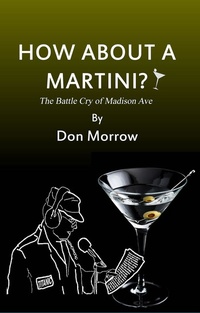
How About A Martini?
Description

A legend in his field whose experience goes back as far as television itself (63 years to be exact), you will soon discover another side to this man.
From Clint Eastwood's A Fist Full of Dollars to James Cameron's Titanic and beyond, from the beginning of Crest and Zest to IBM, Ford Motor, Shell Oil and Sun Microsystems, DON MORROW has been the spokesman and on camera for over 20,000 national and international commercials and motion picture campaigns.
Why the title? When I got to New York in the spring of 1951, I soon learned that most business deals were discussed and closed in bars rather than offices. The Martini (Gin) was the drink of choice back then and did we ever go through a lot of olives! This practice came as somewhat of a surprise to me at first.but I adjusted, believe me. To get a job, FIRST you had to find the sympathetic ear of a person with whom you could have a Martini. That slowed things up a bit, but, as one made the "rounds," you eventually found sympathetic ears. Let me explain the "rounds." You visited casting directors, show producers and their assistants, network employees, secretaries, almost anyone who would let you through the door and was open to your proffered coffee and doughnuts - and a good pitch. Step two was inviting them out for the Martini or libation of their choice. If you completed step two without fumbling, you were almost surely getting a job. I made lots of real friends in that manner and it worked well for all of five decades. Whoever could do this best, won the day.
More details
Other editions
Additional editions
Content
Chapter 3
"From ZERO thru WWII, what do you think are your earliest memories?"
Words going around in the mind of an almost 3 year old - "Crash," "Black Thursday" - maybe that was said later - "Wall Street" - images of people jumping out of tall buildings in - "Where?"
.close by, New York City.
"What Else?"
Months later, a vivid, visual memory for a son of three years - Maxl's Restaurant - the name Max'l sticks forever - the oom-pah-pah band in the basement - later to learn the word "rathskeller." This was in White Plains, NY, not far from home. Many people in the house are friendly to me, why?... Relatives?... No..
"Where do you live?"
I live in a Stamford, Connecticut hotel on Bedford Street called the Lindenhurst Inn. It's not a big hotel like the Roger Smith or the Davenport. It's a hotel that looks like a house, a different kind of house from those around it - a big white house with four, huge pillars on a big front porch that goes all the way across the front. (Now, I suppose "anti-bellum" would describe it.) Facing Bedford St., a huge church sits to the left of the house with a big open lot between - we call it the "church lot." The Keatings lived to the right, on the right hand side of the Lindenhurst - that's Judge and ex-Mayor Keating - all in one.
Judge Keating has two kids, Mary Alice and an older brother Jack. I think Jack may be a teenager. One day Mary Alice was playing with a horsewhip and almost took my brother's eye out with it. Both families are very upset. Judge Keating's wife must be dead and I think now that the woman who took care of Mary Alice and Jack, Nana, must have been the judge's sister-in-law.
I go to Sunday school next door, in the basement of the big church, something I don't like very much. I'd rather be playing in the church lot. I go to kindergarten at Franklin Street School and I don't like that much, either. If you are bad in kindergarten, the teacher sticks you on a stool facing a corner and if you were chewing gum, the teacher would make you stick it on the end of your nose. I'd rather be playing with Bertie, my friend at the hotel. Bertie (Bertha Vacaro) helps my mother at the Lindenhurst. She cleans rooms, makes beds, cooks and watches me. Sometimes, when she's not working, we walk to her apartment and she gives me cold-cut sandwiches and pickles.although that's usually after going to the movies. I think I love Bertie as much as my mother. Grandpa Johnston comes in the summer. He calls mother "Rosebud," so I do too. My father comes and goes back and forth every day, to a place called Wall Street. I learn the name Wall Street before I learn the words "New York," and I wonder is there an "Old" York? My brother, Jay, is older. He doesn't like me much - I don't know why. When he hits me, he gets in trouble and gets hit by Pop because he does it in front of my father or mother. He hits me other times too that they don't see.
"What else do you remember?"
People are talking about a baby being "kidnapped" in New Jersey, next to New York. The father is a famous aviator. My father says the mother is his cousin. It is now 1932. This kidnapping makes me think it could happen to me and I am afraid because Grandpa is taking Rosebud on a motor trip to Pennsylvania and Ohio. Something from Sunday school must have rubbed off on me because I'm making crosses on little pieces of paper and writing to God to bring her back safely and then I hide them under the carpet in the lobby and living room. Another trip to Pennsylvania later and I go with them. Grandpa says hold out your hand and watch it turn black. He says we are in Pittsburgh. (Years later, I worked in Pittsburgh a lot for Mellon Bank. My hand didn't turn black anymore.)
My mother has a best friend. Her name is Margaret Shea. She is in something called "real estate" in Darien, CT and tells my mother a story about a woman author who wrote a famous book. The author asked Mrs. Shea why there are no Jews living in Darien, which is next to Stamford. Mrs. Shea said it's sort of a "Gentleman's Agreement." Mrs. Shea is very tall and has a very tall son named Frank. Some days, Frank teams up with my brother and they do mean things to me. Other days, Frank teams up with me and we do mean things to my brother. Whoever has big Frank as a friend that day, wins. One day, Frank and my brother Jay are shooting BB guns at me and my friend, Pete Ridabock from across the street. They have us trapped in the eight car garage of the hotel. Every time we try to escape, a new barrage of BBs come at us. I don't remember if we ever got hit. I remember to this day something a man said to us who lived on the other side of the garage, "Go home and tell your mother she wants you." When I told her, she laughed.
I hear the word "Depression" a lot from my mother and father and they say we are in one. I don't understand because even though I see pictures at the movies about "breadlines" and "shantytowns" and gangsters like John Dillinger and Bonnie and Clyde, my life goes along at the hotel very differently. I ask Bertie about it and she tells me not to worry, but I do. I'd ask her husband Bill about it, but Bertie says he's too stupid, too fat and too drunk all the time to know the difference, much less explain it. If there are nightmares, I have daymares and I think what the world would be like if there was nothing.no world, just black space. I think about that a lot. Men in old dirty clothes come to the backdoor of The Lindenhurst and beg for food in exchange for work. My mother or Bertie always give them something to eat whether they have work for them or not.
Further into the 1930s, my mother is reading a big, thick book by a man named Adolph Hitler. She says we will have trouble one day with this man. Everyone at the hotel seems to agree.
One time, my mother goes to a church with one of the guests of the hotel and the preacher passes out pieces of paper and tells the people to write something on the paper that some dead friend or relative used to say. My mother wrote something that Grandpa's brother, Great-uncle Dick, would say to her. It was, "I can make the clouds go. Poof," as the clouds parted. The preacher read the notes of various people and then said goodbye to the congregation. As they were filing out, he said, "Wait. There's one more trying to get through. Does anybody know the meaning of "I can make the clouds go. Poof?" My mother always wondered how he knew that. Great- uncle Dick had been a drummer boy in the Civil War and later became a schoolteacher in Texas.
My mother goes to the Stamford train station to pick up my father in the late afternoon. Sometimes he doesn't get off. She says the reason is "the bar car." Then she has to drive to Bridgeport or New Haven to get him and that makes her mad.
"What else do you remember about your father?"
At dinner, he would always reach over and steal my butter, so one time when he did that, I wiped my butter knife on his arm. He was pretty mad at me for doing that but he stopped stealing my butter.
My father has a friend named Chris McCullough who comes to visit us at the Lindenhurst and is always dressed in "spats" and carries a walking stick. My mother says he is a "bookie" but I don't see him with any books. Apparently, my father works with this bookie and takes a large horse bet. I remember my mother saying something about $14,000, from a woman named Natalie Calmus (she owns something in the movies called Technicolor). She loses her bet and does not pay which puts my father out of the bookie business. Mr. McCullough is very angry and my mother says my father is lucky to be alive, especially because he took the bet, I guess, thinking he was helping Mr. McCullough in his bookie business.
"What else do you remember about your father?"
Before my father worked on Wall Street and before I was born, he worked for a man named Horatio Boomer who owned a hotel in New York City called the Waldorf-Astoria. Before that, my father managed a hotel in Manitou Springs, Colorado. He stopped two crooks trying to rob the hotel. One made the mistake of putting his gun on the table. My father grabbed it, killed one guy and shot the other guy's eye out. My brother has the newspaper story from that, from about the turn of the century.
My father was born in Colorado Springs in 1886 and grew up on the grounds of the Broadmoor Hotel where his father, my other grandfather, was groundskeeper. Grandpa Morrow built his house on the grounds of the Broadmoor Hotel and many years later I visited on a ski trip and I remember the kitchen window looked right up Pikes Peak. He came to America in the 19th century, having been grounds keeper for a Lord Londonderry in Ireland after emigrating from Scotland.
"What more sticks in your mind about Grandpa Morrow?"
Well, towards the end of the Nineteenth Century, my Grandpa Morrow bought a small gold mine for my Grandma Morrow and my brother Jay and I were told we would inherit it one day. Many decades later, in the 1970s, I think, my schoolteacher aunts who were in their 90s by then and still living in that house on the grounds of the Broadmoor Hotel, wanted Brother Jay and me to sign a Quit Claim Deed. Some guy offered $5,000 for the gold mine. I...
