

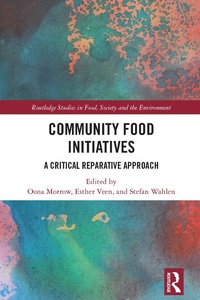
Community Food Initiatives
A Critical Reparative Approach
1st Edition
Published on 22. June 2023
220 pages
978-1-000-89201-7 (ISBN)
Description

This book examines a diverse range of community food initiatives in light of their everyday practices, innovations, and contestations.
While community food initiatives aim to tackle issues like food security, food waste, or food poverty, it is a cause for concern for many when they are framed as the next big "solution" to the problems of the current industrialised food system. They have been critiqued for being too neoliberal, elitist, and localist; for not challenging structural inequalities (e.g. racism, privilege, exclusion, colonialism, capitalism); and for reproducing these inequalities within their own contexts. This edited volume examines the everyday realities of community food initiatives, focusing on both their hopes and their troubles, their limitations and failures, but also their best intentions, missions, and models, alongside their capacity to create hope in difficult times. The stories presented in this book are grounded in contemporary theoretical debates on neoliberalism, diverse economies, food justice, community and inclusion, and social innovation, and help to sharpen these as conceptual tools for interrogating community food initiatives as sites of both hope and trouble. The novelty of this volume is its focus on the everyday doings of these initiatives in particular places and contexts, with different constraints and opportunities. This grounded, relational, and place-based approach allows us to move beyond more traditional framings in which community food initiatives are either applauded for their potential or criticized for their limitations. It enables researchers and practitioners to explore how community food initiatives can realize their potential for creating alternative food futures and generates innovative pathways for theorising the mutual interplay of food production and consumption.
This volume will be of great interest to students and scholars of critical food studies, food security, public health, and nutrition as well as human geographers, sociologists, and anthropologists with an interest in food.
While community food initiatives aim to tackle issues like food security, food waste, or food poverty, it is a cause for concern for many when they are framed as the next big "solution" to the problems of the current industrialised food system. They have been critiqued for being too neoliberal, elitist, and localist; for not challenging structural inequalities (e.g. racism, privilege, exclusion, colonialism, capitalism); and for reproducing these inequalities within their own contexts. This edited volume examines the everyday realities of community food initiatives, focusing on both their hopes and their troubles, their limitations and failures, but also their best intentions, missions, and models, alongside their capacity to create hope in difficult times. The stories presented in this book are grounded in contemporary theoretical debates on neoliberalism, diverse economies, food justice, community and inclusion, and social innovation, and help to sharpen these as conceptual tools for interrogating community food initiatives as sites of both hope and trouble. The novelty of this volume is its focus on the everyday doings of these initiatives in particular places and contexts, with different constraints and opportunities. This grounded, relational, and place-based approach allows us to move beyond more traditional framings in which community food initiatives are either applauded for their potential or criticized for their limitations. It enables researchers and practitioners to explore how community food initiatives can realize their potential for creating alternative food futures and generates innovative pathways for theorising the mutual interplay of food production and consumption.
This volume will be of great interest to students and scholars of critical food studies, food security, public health, and nutrition as well as human geographers, sociologists, and anthropologists with an interest in food.
Reviews / Votes
"Now, more than ever, we need to recognise and support just and sustainable community food initiatives. This book brings important issues of maintaining hope while staying with the trouble of enacting community food initiatives in a fair and just manner. It opens up our attention to matters of justice around food including as well as beyond procedural and distributional issues to essential matters of reparation."Anna R. Davies, FTCD, MRIA, Professor of Geography, Environment & Society, Director Environmental Governance Research Group, Department of Geography, School of Natural Sciences, Trinity College Dublin, the University of Dublin, Dublin 2, Ireland
"How do the stories we tell about community food initiatives highlight or narrow their multiple ways of making culture and transforming political possibilities? This wide-ranging and comprehensively edited volume offers a variety of case studies that demonstrate the transformative work that community food initiatives envision and enact without shying away from acknowledging the ways that racial capitalism, hetero-patriarchy and neoliberalism constrain their approaches. This book reminds us that community food initiatives have much to offer as we combat the intersecting and inextricable social, environmental, and public health crises that shape this precarious moment."
Alison Hope Alkon, Professor of Sociology, University of the Pacific
More details
Series
Edition
1. Auflage
Language
English
Place of publication
London
United Kingdom
Publishing group
Taylor & Francis Ltd
Target group
College/higher education
Professional and scholarly
Product notice
Reflowable
Illustrations
11 Tables, black and white; 4 Line drawings, black and white; 4 Halftones, black and white; 8 Illustrations, black and white
ISBN-13
978-1-000-89201-7 (9781000892017)
Copyright in bibliographic data and cover images is held by Nielsen Book Services Limited or by the publishers or by their respective licensors: all rights reserved.
Schweitzer Classification
Other editions
Additional editions
Book
11/2024
1st Edition
Routledge
€63.10
Shipment within 10-20 days
Book
06/2023
1st Edition
Routledge
€196.10
Shipment within 10-20 days
Persons
Oona Morrow is an assistant professor of rural sociology at Wageningen University, the Netherlands.
Esther Veen is a professor of urban food issues at Aeres University of Applied Sciences Almere, the Netherlands.
Stefan Wahlen is a professor of food sociology at the University of Giessen, Germany.
Esther Veen is a professor of urban food issues at Aeres University of Applied Sciences Almere, the Netherlands.
Stefan Wahlen is a professor of food sociology at the University of Giessen, Germany.
Content
Chapter 1. A critical reparative approach towards understanding community food initiatives: Acknowledging hopes and troubles Part 1: CFIs addressing social injustices and inequalities in urban food Chapter 2. Caring in unequal worlds: tracing the hopes and troubles of Community Food Initiatives in Sydney Chapter 3. Understanding vulnerability and resilience of urban food initiatives in Morocco Chapter 4. Spaces of hope and realities beyond the fence: Experiences of urban food providers in South Africa Chapter 5. Good Food for All? Navigating tensions between environmental and social justice concerns in urban community food initiatives Part 2: Cooperatives, cooperation, and concerns in CFIs Chapter 6. Constraint and autonomy in the Swiss 'local contract farming' movement Chapter 7. Sustainability conventions in a local organic consumer cooperative in Norway: Hope and trouble of participants Chapter 8. The moral economy of community supported agriculture - hopes and troubles of farmers as community makers Part 3: Commensality, social gatherings and food knowledge in CFIs Chapter 9. White natures, colonial roots, walking tours, and the everyday Chapter 10. Eating (with) the other: Staging hope and trouble through culinary conviviality
