

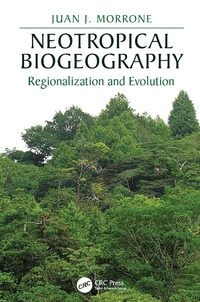
Neotropical Biogeography
Regionalization and Evolution
Published on 7. April 2017
312 pages
978-1-315-39064-2 (ISBN)
Description

Neotropical Biogeography: Regionalization and Evolution presents the most comprehensive single-source treatment of the Neotropical region derived from evolutionary biogeographic studies. The book provides a biogeographic regionalization based on distributional patterns of plant and animal taxa, discusses biotic relationships drawn from track and cladistic biogeographic analyses, and identifies cenocrons (subsets of taxa within biotas identified by their common origin and evolutionary history). It includes maps, area cladograms and vegetation profiles.
The aim of this reference is to provide a biogeographic regionalization that can be used by graduate students, researchers and other professionals concerned with understanding and describing distributional patterns of plants and animals in the Neotropical region. It covers the 53 biogeographic provinces of the Neotropical region that are classified into the Antillean, Brazilian and Chacoan subregions, and the Mexican and South American transition zones.
The aim of this reference is to provide a biogeographic regionalization that can be used by graduate students, researchers and other professionals concerned with understanding and describing distributional patterns of plants and animals in the Neotropical region. It covers the 53 biogeographic provinces of the Neotropical region that are classified into the Antillean, Brazilian and Chacoan subregions, and the Mexican and South American transition zones.
Reviews / Votes
This is classic biogeography, and while not one to read from cover to cover, it belongs on the bookshelf of anyone working in this region.-- Markus Eichhorn, Frontiers of Biogeography, June 2017
This richly illustrated and well-organized book provides a thorough overview of biogeographic research in the Neotropics-the tropical belt that stretches from Argentina to Mexico, including the Caribbean... the author provides an excellent and comprehensive review of the progress in Neotropical regionalization, from the early days to recent developments. The cornerstone of this book is that each Neotropical region is summarized in detail, consistently enumerating aspects such the endemic and characteristic taxa, and describing their overall vegetation. For someone interested in a specific portion of the Neotropics, it is a compelling departure point for further reading. It is my hope that this book will not only become a standard reference in Neotropical biogeography, but will also entice a new generation of biogeographers to look more rigorously for patterns, and then take substantial steps in trying to understand them.
-- Alexandre Antonelli, Gothenburg Global Biodiversity Centre, University of Gothenburg, Gothenburg, Sweden, in The Quarterly Review of Biology, Vol 93, 2018
More details
Series
Language
English
Place of publication
London
United Kingdom
Publishing group
Taylor & Francis Ltd
Target group
Professional and scholarly
College/higher education
Product notice
Reflowable
Illustrations
122 s/w Abbildungen, 1 farbige Abbildung
1 Illustrations, color; 122 Illustrations, black and white
File size
6,03 MB
ISBN-13
978-1-315-39064-2 (9781315390642)
Copyright in bibliographic data and cover images is held by Nielsen Book Services Limited or by the publishers or by their respective licensors: all rights reserved.
Schweitzer Classification
Other editions
Additional editions
Book
03/2021
1st Edition
CRC Press
€63.23
Shipment within 15-20 days
Book
04/2017
1st Edition
CRC Press
€237.50
Shipment within 10-20 days
Person
Juan J. Morrone is full professor of Biogeography, Systematics and Comparative Biology at the Facultad de Ciencias, Universidad Nacional Autonoma de Mexico (UNAM), Mexico. He works on phylogenetic systematics of weevils (Coleoptera: Curculionidae) and evolutionary biogeography and regionalization of the Neotropical and Andean regions.
He joined the Museo de Zoologia "Alfonso L. Herrera" of the Facultad de Ciencias, Universidad Nacional Autonoma de Mexico (UNAM), Mexico in 1998, after working for some years at the Museo de La Plata, Universidad Nacional de La Plata (UNLP), Argentina, where he obtained his PhD degree.? He is Member of the Academia Mexicana de Ciencias, Fellow of the Willi Hennig Society, and Research Associate of the American Museum of Natural History and the Buffalo Museum of Science. He has authored 270 scientific papers and authored or edited 29 books on evolutionary biogeography, phylogenetic systematics, biogeographic regionalization, biodiversity conservation and evolution.
He joined the Museo de Zoologia "Alfonso L. Herrera" of the Facultad de Ciencias, Universidad Nacional Autonoma de Mexico (UNAM), Mexico in 1998, after working for some years at the Museo de La Plata, Universidad Nacional de La Plata (UNLP), Argentina, where he obtained his PhD degree.? He is Member of the Academia Mexicana de Ciencias, Fellow of the Willi Hennig Society, and Research Associate of the American Museum of Natural History and the Buffalo Museum of Science. He has authored 270 scientific papers and authored or edited 29 books on evolutionary biogeography, phylogenetic systematics, biogeographic regionalization, biodiversity conservation and evolution.
Content
List of Figures
Preface
Author
Chapter 1 Theoretical Background
Chapter 2 Historical Background
Chapter 3 The Neotropical Region
Chapter 4 The Mexican Transition Zone
Chapter 5 The Antillean Subregion
Chapter 6 The Brazilian Subregion
Chapter 7 The Chacoan Subregion
Chapter 8 The South American Transition Zone
Epilogue
References
Index
Preface
Author
Chapter 1 Theoretical Background
Chapter 2 Historical Background
Chapter 3 The Neotropical Region
Chapter 4 The Mexican Transition Zone
Chapter 5 The Antillean Subregion
Chapter 6 The Brazilian Subregion
Chapter 7 The Chacoan Subregion
Chapter 8 The South American Transition Zone
Epilogue
References
Index
