

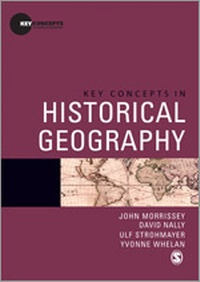
Key Concepts in Historical Geography
1st Edition
Published on 17. February 2014
328 pages
978-1-4462-9723-0 (ISBN)
Description

"This ambitious volume reviews the best recent work in historical geography... It demonstrates how a dual sense of history and geography is necessary to understand such key areas of contemporary debate as the inter-relationship between class, race and gender; the character of nations and nationalism; the nature and challenges of urban life; the legacies of colonialism; and the meaning and values attributed to places, landscapes and environments."
- Mike Heffernan, University of Nottingham
Key Concepts in Historical Geography forms part of an innovative set of companion texts for the Human Geography sub-disciplines. Organized around 24 short essays, it provides a cutting edge introduction to the central concepts that define contemporary research in Historical Geography. Involving detailed and expansive discussions, the book includes:
An introductory chapter providing a succinct overview of the recent developments in the field
24 key concepts entries with comprehensive explanations, definitions and evolutions of the subject
Pedagogic features that enhance understanding including a glossary, figures, diagrams and further reading
Key Concepts in Historical Geography is an ideal companion text for upper-level undergraduate and postgraduate students and covers the expected staples from the discipline - from people, space and place to colonialism and geopolitics - in an accessible style. Written by an internationally recognized set of authors, it is is an essential addition to any human geography student's library.
- Mike Heffernan, University of Nottingham
Key Concepts in Historical Geography forms part of an innovative set of companion texts for the Human Geography sub-disciplines. Organized around 24 short essays, it provides a cutting edge introduction to the central concepts that define contemporary research in Historical Geography. Involving detailed and expansive discussions, the book includes:
An introductory chapter providing a succinct overview of the recent developments in the field
24 key concepts entries with comprehensive explanations, definitions and evolutions of the subject
Pedagogic features that enhance understanding including a glossary, figures, diagrams and further reading
Key Concepts in Historical Geography is an ideal companion text for upper-level undergraduate and postgraduate students and covers the expected staples from the discipline - from people, space and place to colonialism and geopolitics - in an accessible style. Written by an internationally recognized set of authors, it is is an essential addition to any human geography student's library.
Reviews / Votes
This ambitious volume reviews the best recent work in historical geography and sets this literature in a novel interpretative framework shaped in part by the continental European and Irish intellectual contexts within which the four authors were trained. It demonstrates how a dual sense of history and geography is necessary to understand such key areas of contemporary debate as the inter-relationship between class, race and gender; the character of nations and nationalism; the nature and challenges of urban life; the legacies of colonialism; and the meaning and values attributed to places, landscapes and environments. -- Mike Heffernan A lively and imaginative compendium that confirms the importance of an historically-informed human geography. -- Derek Gregory The editors bring together strengths from the study of geography and history in Europe, Canada and the US and respectively are experts in colonialism, human geography, social theory and aspects of heritage and memory. This situates them excellently to write an edited volume on concepts of historical geography. -- Seth Franzman, The Hebrew University ...this volume aims to fill the gap created by dictionary entries that are too terse to explain concepts that geographers use to think about the world, broad textbook overviews that rarely deal with conceptual issues, and narrowly-framed research monographs in which discussions of concepts are both advanced and inaccessible. -- Graeme Wynn, University of British Columbia, Canada This scholarly, detailed overview is a commendable work. In the introduction, the authors note that "an overarching methodological concern... is to ask geographic questions of the historical evidence that seeks to situate meaning in context" (p.2). Any student or professional within historical geography would agree that this work similarly situates meaning in context for the wide-ranging field of historical geography. Both the format and intellectual approach to Key Concepts in Historical Geography are quite successful, and this book is a necessary volume for any current or future scholar of historical geography. -- Patrick D. Hagge, Arkansas Tech UniversityAll prices
More details
Series
Language
English
Place of publication
London
United Kingdom
Target group
College/higher education
ISBN-13
978-1-4462-9723-0 (9781446297230)
Copyright in bibliographic data and cover images is held by Nielsen Book Services Limited or by the publishers or by their respective licensors: all rights reserved.
Schweitzer Classification
Other editions
Additional editions
John Morrissey | David Nally | Ulf Strohmayer
Key Concepts in Historical Geography
Book
02/2014
1st Edition
SAGE Publications Inc
€158.10
Shipment within 10-20 days
John Morrissey | David Nally | Ulf Strohmayer
Key Concepts in Historical Geography
Book
02/2014
1st Edition
SAGE Publications Inc
€80.10
Shipment within 10-20 days
Persons
John Morrissey is a Senior Lecturer in Geography at National University of Ireland, Galway, with research interests in geopolitics, imperialism and international development. His current research is broadly concerned with the geopolitical scripting and political economy of contemporary US interventionism in the Middle East. He is the author of Negotiating Colonialism (RGS Historical Geography Research Series, 2003), co-author of Key Concepts in Historical Geography (Sage, 2014), and co-editor of Spatial Justice and the Irish Crisis (Royal Irish Academy, 2014). At NUI Galway, John is Associate Director of the Moore Institute for Humanities and Social Studies, Cluster Leader of the Geopolitics and Justice Research Group in Geography, and Programme Director of the MA in Environment, Society and Development. In 2011, he won the President's Award for Teaching Excellence at NUI Galway, and in 2012 he won the Irish National Academy Award for Research and Teaching Excellence. John's research has been supported by grants from the British Academy, Irish Research Council, National University of Ireland, NUI Galway Community Knowledge Initiative, and UCD Clinton Institute for American Studies. In 2013/2014, he was elected the Derek Brewer Quatercentenary Research Fellow at Emmanuel College, Cambridge and Visiting Fellow at Fitzwilliam College, Cambridge. His current research explores the interventionary practices of US national security interests in the Middle East, with particular reference to US Central Command (CENTCOM). This research builds upon a Government of Ireland Research Fellowship John held at the Center for Place, Culture and Politics at City University of New York in 2007 and 2008. He is currently writing a geopolitical history of CENTCOM for University of Georgia Press entitled The Long War. David Nally is a Senior Lecturer at the Department of Geography at University of Cambridge. He has research interests in the history of American philanthropy, the political economy of global agriculture (with a particular focus on the factors framing hunger), and the comparative study of European colonialism, including the history of 'internal colonialism' (or what we might be conceptualised as the geographical limits to citizenship). Nally also has a longstanding interest in social theory and the history of geographical ideas. Ulf Strohmayer is a graduate of Munich Technical University and The Pennsylvania State University. Currently, he is Professor of Geography at the National University of Ireland, Galway, after teaching previously at the University of Wales at Lampeter. Educated in Germany, Sweden, USA and France, he has also held visiting teaching and research posts at the Universite de Pau et des Pays de L'Adour, Dresden Technical University, Binghamton University and the Maison des Sciences de l'Homme in Paris. His interest in social theory and philosophy is matched by an equal curiosity about the conditions and consequences of historical processes of modernisation in Western Europe, all of which have informed his extensive publication record. He has also edited numerous volumes on social theory and the history of geographic thought.
Yvonne Whelan is a Senior Lecturer in Human Geography at the University of Bristol. She has published widely on the cultural landscapes of Ireland and is the author of Reinventing Modern Dublin (2003) and the co-editor of Ireland: Space, text, Time (2005), Heritage, Memory and the Politics of Identity (2006) and Ireland Beyond Boundaries (2007).
Yvonne Whelan is a Senior Lecturer in Human Geography at the University of Bristol. She has published widely on the cultural landscapes of Ireland and is the author of Reinventing Modern Dublin (2003) and the co-editor of Ireland: Space, text, Time (2005), Heritage, Memory and the Politics of Identity (2006) and Ireland Beyond Boundaries (2007).
Content
Introduction
Historical Geographies in the Present
Colonial and Postcolonial Geographies
Imperialism and Empire
Colonialism and Anti-Colonialism
Development
Nation-Building and Geopolitics
Territory and Place
Identity and the Nation
Imaginative Geographies and Geopolitics
Historical Hierarchies
Class, Hegemony and Resistance
Race
Gender
The Built Environment
Nature and the Environment
Making Sense of Urban Settlement
Geographies of Urban Morphology
Place and Meaning
Landscape and Iconography
Conceptualising Heritage
Performance, Spectacle and Power
Modernity and Modernisation
Capitalism and Industrialisation
Cultures of Science and Technology
Modernity and Democracy
Beyond the Border
Globalisation
Governmentality
Nature-Culture
The Production of Historical Geographical Knowledge
Historical Geographical Traditions
Illustrative Geographies
Evidence and Representation
Historical Geographies in the Present
Colonial and Postcolonial Geographies
Imperialism and Empire
Colonialism and Anti-Colonialism
Development
Nation-Building and Geopolitics
Territory and Place
Identity and the Nation
Imaginative Geographies and Geopolitics
Historical Hierarchies
Class, Hegemony and Resistance
Race
Gender
The Built Environment
Nature and the Environment
Making Sense of Urban Settlement
Geographies of Urban Morphology
Place and Meaning
Landscape and Iconography
Conceptualising Heritage
Performance, Spectacle and Power
Modernity and Modernisation
Capitalism and Industrialisation
Cultures of Science and Technology
Modernity and Democracy
Beyond the Border
Globalisation
Governmentality
Nature-Culture
The Production of Historical Geographical Knowledge
Historical Geographical Traditions
Illustrative Geographies
Evidence and Representation
