

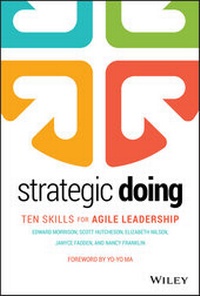
Strategic Doing
Ten Skills for Agile Leadership
1st Edition
Published on 1. May 2019
224 pages
978-1-119-57861-1 (ISBN)
Description

Ten skills for agile leadership
Complex challenges are all around us--they impact our companies, our communities, and our planet. This complexity and the emergence of networks is changing the practice of strategic management. Today's leaders need to understand how to design and guide complex collaborations to accelerate innovation and change--collaborations that cross boundaries both inside and outside organizations.
Strategic Doing introduces you to the new disciplines of agile strategy and collaborative leadership. You'll learn how to design and guide complex collaborations by following a discipline of simple rules that you won't find anywhere else.
* Unleash the power of true collaboration
* Learn and master the 10 skills of agile leadership
* Apply individual skills to targeted situations
* Introduces a new discipline of leadership strategy
Filled with compelling case studies, Strategic Doing outlines a new discipline of leadership strategy specifically designed for open, loosely-connected networks.
More details
Other editions
Additional editions
Edward Morrison | Scott Hutcheson | Elizabeth Nilsen
Strategic Doing: Ten Skills for Agile Leadership
Ten Skills for Agile Leadership
Book
04/2019
1st Edition
Wiley
€29.00
Shipment within 15-20 days
Content
- Cover
- Title Page
- Copyright
- Contents
- Foreword
- Introduction
- Our Promise
- Why Are We Confident? The Backstoryof Our Work
- Our Current Work
- Your Guides for This Book
- Why This Book?
- Our Credo
- Postscript
- Note
- Chapter 1 You Are Here
- The Challenges We Face
- What, Exactly, Has Changed?
- What Is a Network?
- Kinds of Networks
- The Habitat of Networks
- Hierarchies, Networks, and Strategy
- The S-Curve
- The Changes We Need to Make
- Thinking Differently
- Behaving Differently
- Doing Differently
- Notes
- Chapter 2 Create and Maintain a Safe Space for Deep, Focused Conversation (Skill 1)
- Deep Conversations
- Focused Conversations
- Deep, Focused Group Conversations
- Group Size
- Safe Places for Conversations
- Safe Spaces for Conversations
- Putting the Skill to Work: The Agile Leader as Conversation Guide
- Case Study: Setting the Stage for Deep Conversations in Flint
- Note
- Chapter 3 Frame the Conversation with the Right Question (Skill 2)
- Adaptive Leadership: One Question, Many Answers
- Appreciative Questions
- Developing Questions to Frame Conversations
- Putting the Skill to Work: The Agile Leader as Questioner
- Case Study: Reframing the Question at a Community Institution in Rockford
- Note
- Chapter 4 Identify Your Assets, Including the Hidden Ones (Skill 3)
- Assets
- Guidelines for Identifying Assets
- Hidden Assets
- Assets Are Starting Points
- Putting the Skill to Work: The Agile Leader as Inventory Taker
- Case Study: Reimagining an it Department
- Note
- Chapter 5 Link and Leverage Assets to Identify New Opportunities (Skill 4)
- Linking and Leveraging Assets to Innovate
- Linking and Leveraging Assets Force Us to Think Horizontally
- Developing Your Ability to Think Horizontally
- Guiding a Group to Think Horizontally
- Putting the Skill to Work: The Agile Leader as Connector
- Case Study: Linking and Leveraging Assets to Build a Cutting-Edge Industry Cluster
- Note
- Chapter 6 Look for the "Big Easy" (Skill 5)
- Decision-Making Methodologies
- The 2×2 Matrix
- Using the Matrix
- Dealing with Doubts and Doubters
- Putting the Skill to Work: The Agile Leader as Prioritizer
- Case Study: Finding a Way to Jump-Start New Economic Activity
- Chapter 7 Convert Your Ideas to Outcomes with Measurable Characteristics (Skill 6)
- Great Ideas Lie Below the Surface
- Three Questions to Ask
- Measuring
- Putting the Skill to Work: The Agile Leader as Dreamcatcher
- Case Study: Using Metrics to Spur New Workforce Development Strategies in Kokomo
- Chapter 8 Start Slowly to Go Fast - But Start (Skill 7)
- Launching Your Learning
- Qualities of a Good Starting Project
- Keeping the Team on Track
- What Next?
- Putting the Skill to Work: The Agile Leader as Experimenter
- Case Study: Overcoming the Academic Bureaucracy with Small Wins
- Chapter 9 Draft Short-Term Action Plans That Include Everyone (Skill 8)
- Shared Leadership
- Action Plans for Shared Leadership
- Micro-Commitments Build Trust
- Putting the Skill to Work: The Agile Leader as Deal-Closer
- Case Study: Taking Collective Action to Develop a Hub for Community Health
- Chapter 10 Set 30/30 Meetings to Review, Learn, and Adjust (Skill 9)
- Learning Loops
- Building New Habits
- Putting the Skill to Work: The Agile Leader as Convener
- Case Study: Helping a Music Capital Pen its Next Hits
- Chapter 11 Nudge, Connect, and Promote to Reinforce New Habits (Skill 10)
- Nudging
- Connecting
- Promoting
- Putting the Skill to Work: The Agile Leader as Chief Doing Officer
- Case Study: Turning Micro-Commitments into Larger Innovations
- Chapter 12 Ten Skills. Got It. Now What?
- Putting It All Together: Strategic Doing
- Using Strategic Doing as an Individual
- Using Strategic Doing in a Small Group
- Using Strategic Doing with a Large Initiative
- Final Thoughts
- Learn More
- Introduction
- Chapter 1: You Are Here
- Chapter 2: Skill 1
- Chapter 3: Skill 2
- Chapter 4: Skill 3
- Chapter 5: Skill 4
- Chapter 6: Skill 5
- Chapter 7: Skill 6
- Chapter 8: Skill 7
- Chapter 9: Skill 8
- Chapter 10: Skill 9
- Chapter 11: Skill 10
- Chapter 12: Ten Skills. Got It. Now What?
- Bibliography
- Acknowledgments
- About the Authors
- Index
- EULA
