

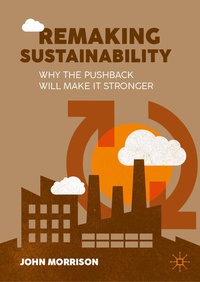
Remaking Sustainability
Description

Business is at a sustainability crossroads. There is pressure from some shareholders and elected politicians to dial back on environmental and social issues, sustainability being "too woke" and a constraint on economic growth. However, there are competing pressures that mean that these same issues are now increasingly material to the bottom line; businesses ignore them at their peril as they threaten the true longer-term value of the company.
This book sets out the case for the "Sustainability of Sustainability". There is compelling evidence from underlying trends in finance, trade and technology that shows that there is a sustainability bedrock, beyond which it cannot be pushed back. That bedrock is not too deep, and so a course correction is coming. Businesses should be investing now in core sustainability to be ready for the new, more durable sustainability to come.
Morrison argues that while sustainability is already perceived by many as an orthodoxy, it has yet to secure the legitimacy and trust required to deliver real and lasting change.
The book is for anyone who is curious about why. when and how sustainability will re-emerge and how best to prepare for its homecoming. There is a big opportunity: we will lose a lot of the fluff, green-washing, and noise and build a stronger and more meaningful version of sustainability as we do. The book helps any business manager, policy-maker or community leader find their sustainability bedrock and to build upon solid foundations.
More details
Other editions
Additional editions
Person
John Morrison is a leader, advisor, and writer on sustainability. From 2009 until 2025 he was the Chief Executive Officer of the Institute for Human Rights and Business (IHRB), a global "think and do" tank that aims to provide greater clarity on the roles, responsibilities, and accountabilities of business and government in advancing human rights. He has advised multiple governments, companies, and international organisations on responsible business, trade, and development issues. He is the author of " The Just Transition: a systems-thinking approach to climate action " (2024) as well as " The Social License: how to keep your organisation legitimate " (2014) (both for Palgrave Macmillan). John serves on several advisory boards and councils, including for the World Economic Forum, the John Lewis Partnership, the European Bank for Reconstruction and Development, and the UK Government.
Content
1: Shorting sustainability.- 2: How sustainability was made.- 3: How sustainability can be remade.- 4: Finance already flowing.- 5: Underwriting the future.- 6: Modern industrial strategies.- 7: Emerging green economies.- 8: Security of supply.- 9: Sustainable trade.- 10: Circular infrastructure.- 11: Circular infrastructure.- 12: The AI nexus.- 13: Quantum.- 14: Systems leadership.- 15: Leveraging for green.- 16: Real world impact.- 17: Hanging out the greenwashing.- 18: Putting a price on greenhushing.- 19: Putting a price on greenhushing.- 20: Sustainability remade.
