

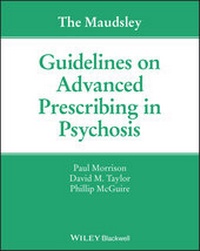
The Maudsley Guidelines on Advanced Prescribing in Psychosis
Description

The Maudsley Guidelines on Advanced Prescribing in Psychosis offers a resource that puts the focus on the need to treat the individual needs of a patient. The authors - noted experts on the topic - offer an alternative to the one-size-fits-all treatment of psychosis and shows how to build psychiatrist and patient relationships that will lead to effective individual treatment plans.
The book provides up-to-date data and information about commonly used anti-psychotic drugs and drugs used in bipolar disorder. The text weighs both the upsides and downsides of each pharmaceutical presented, and helps prescribers and patients weigh the costs and benefits of various options to reach an appropriate treatment plan. The authors highlight the treatment at a population level and the systems in which individual treatments take places. This important resource:
* Facilitates the tailoring of an appropriate treatment plan for clients manifesting signs of psychosis
* Offers a comparative strategy that helps gauge the suitability of one treatment plan over another
* Provides at-hand data and information about commonly used anti-psychotic drugs
* Includes an understanding of the origins and side-effects of each drug presented
The Maudsley Guidelines on Advanced Prescribing in Psychosis offers psychiatrists and other mental health practitioners an essential guide for treating psychosis on an individualized level.
More details
Other editions
Additional editions
Persons
Paul Morrison, PhD, FRCPsych., is a consultant psychiatrist in Argyll and Bute Hospital, Scotland, UK. He is also an honorary Clinical senior lecturer in psychopharmacology at the Institute of Psychiatry, Psychology and Neuroscience, King's College London, London, UK.
David M. Taylor, PhD, FRPharmS, is Director of Pharmacy and Pathology at the Maudsley Hospital and is Professor of Psychopharmacology at King's College London, London, UK.
Phillip McGuire, PhD, is a professor of Psychiatry and Cognitive Neuroscience and head of the Department of Psychosis Studies at the Institute of Psychiatry, Psychology and Neuroscience, King's College London, London, UK.
Content
List of tables ix
Preface xi
Glossary xiii
Acknowledgments xv
Chapter 1 Psychosis 1
1.1 What is psychosis? 1
1.2 Lack of insight 1
1.3 Causes of psychosis 2
1.4 Schizophrenia: loss of personality and psychosocial decline 2
1.5 Bipolar disorder 3
1.6 Cannabis, synthetic cannabinoids, and psychosis 4
Chapter 2 Towards evidence based treatments for psychosis 7
2.1 Traditional medicine 7
2.2 The randomised controlled trial 7
2.3 The roots of community care 8
2.4 Treatment algorithms versus personalised care 8
Chapter 3 The antipsychotics 9
3.1 General principles in the pharmacology of psychosis 9
3.2 Neurotransmitters and receptors 10
3.3 Choosing drugs 12
3.4 Acute psychotic episodes 13
3.4.1 Olanzapine in acute psychotic episodes 15
3.4.2 Antipsychotic dosing in acute psychotic episodes 15
3.4.3 Timescale of response in acute psychotic episodes 17
3.4.4 Very agitated patients 17
3.5 The maintenance phase: relapse prevention 18
3.5.1 Beyond the early years: more harm than good? 18
3.6 The utility of long?]acting depot antipsychotics 22
3.7 Principles of long?]acting depot antipsychotic prescribing 23
3.7.1 Clozapine 25
3.7.2 Clozapine resistant psychosis 26
3.7.3 Side effects of clozapine 27
3.7.4 Myocarditis: inflammation of heart muscle 28
3.7.5 Cardiomyopathy: impaired function of heart muscle 29
3.7.6 The effects of clozapine at muscarinic M1-M4 acetylcholine receptors 29
3.7.7 Weight?]gain and type II diabetes 30
3.7.8 Neutropenia and agranulocytosis 30
3.7.9 Lowered seizure threshold 31
Chapter 4 Bipolar disorder 33
4.1 Diagnosis of bipolar 33
4.2 Treatment of mania 34
4.3 Treatment of bipolar depression 34
4.4 The maintenance phase of bipolar: relapse prevention 39
4.5 Bipolar in females of childbearing age 41
4.5.1 Valproate and carbamazepine in females of childbearing age 41
4.5.2 Lithium in females of childbearing age 41
4.5.3 Lamotrigine in females of childbearing age 42
4.5.4 Antipsychotics in females of childbearing age 42
Chapter 5 The role of talking therapies in the treatment of psychosis 43
5.1 Psychoanalytical insights 43
5.2 Psychological treatments 43
Chapter 6 Side effects of antipsychotic treatment 45
6.1 Weight gain 45
6.1.1 Antipsychotics at 5HT2c receptors 45
6.1.2 The management of weight gain and obesity 46
6.2 Type II diabetes 46
6.3 Dyslipidemia 48
6.3.1 The management of dyslipidemia in psychosis services 48
6.4 Motor side effects 49
6.4.1 Tardive dyskinesia 51
6.4.2 First versus second generation 51
6.5 Hyperprolactinemia 51
6.5.1 The management of hyperprolactinemia 52
6.6 Sexual side effects 52
6.6.1 Management 53
6.7 Prolonged QTc 53
6.7.1 Calculating the QTc 53
6.7.2 QTc thresholds 54
6.7.3 Torsades de points 54
6.7.4 Antipsychotics and QTc prolongation 54
6.7.5 Management 55
6.8 Neuroleptic malignant syndrome 55
6.8.1 Management 56
Chapter 7 Services: pathway specific care 57
7.1 Background 57
7.2 The at?]risk?]mental?]state 57
7.3 Early intervention services 58
7.4 Acute services 59
7.5 Continuing care services: promoting recovery 59
Chapter 8 Measuring outcomes 61
8.1 Value?]based healthcare 61
8.2 Evidence?]based healthcare management (EBMGT) 62
Appendix 1 Pharmacokinetics of selected psychotropics 65
Appendix 2 The metabolic syndrome 71
Appendix 3 Physical health monitoring for patients prescribed antipsychotics 73
Appendix 4 Physical health monitoring for patients prescribed mood stabilisers 75
References 77
Index 91
Chapter 1
Psychosis
1.1 What is psychosis?
Psychiatry has always struggled with terms and definitions. Canvass the opinions of a modern community multidisciplinary team, and there are likely to be a range of opinions on what psychosis actually is [1]. Yet very few will object to the phenomenological perspective, which captures the seriousness of just what is at stake in psychosis. That is because psychosis impacts upon the highest and most personal faculties of the human mind.
In short, psychosis describes a disturbance of perception, thinking, beliefs, or selfhood in which the patient experiences a fundamental transformation in their experience of lived reality. This transformation can be terrifying as in paranoid psychoses or thrilling as in mania. Psychosis can emerge and dissipate quickly or become ingrained in the mind/brain over many months. Some patients seek safety by withdrawing from the world, whereas others attract attention to their mental state through excited, agitated, bizarre, or catatonic behaviour.
1.2 Lack of insight
The most common feature of psychosis is not hallucinations, delusions, thought disorder, paranoia or suspiciousness as is commonly believed but lack of insight [2]. Lack of insight denotes the blind-spot a patient has in regard to the falseness of their new reality and the abnormal nature of their mental state [3]. For some the term 'lack of insight' exemplifies the power imbalance within psychiatry.
Regardless of terminology, the blind-spot is what makes the care of many patients suffering psychosis particularly challenging. Why would anyone take treatment, let alone engage with mental health professionals if they think their experiences are real rather than a manifestation of psychiatric illness.
1.3 Causes of psychosis
Mental states have material correlates. For some patients, a material dysfunction is the direct cause of their psychosis. The list of causes includes endocrine disorders (e.g. thyroid disease), metabolic disorders (e.g. porphyria), auto-immune conditions (e.g. N-methyl-D-aspartate, NMDA-receptor encephalitis), infections (e.g. herpes-simplex encephalitis), epilepsy (e.g. temporal lobe epilepsy), nutritional deficits (e.g. vitamin B12 deficiency), basal ganglia disorders (e.g. Wilson's disease), medications (e.g. acyclovir), dementias (e.g. Alzheimer's disease), and most common of all, psychoactive drugs, as causes [4].
- The following psychoactive drugs can elicit an acute psychotic episode after a single administration: serotonin 5HT2A receptor agonists (e.g. lysergic acid diethylamide, LSD), glutamate NMDA channel blockers (e.g. ketamine), and cannabinoid CB1 receptor agonists (e.g. delta-9-tetrahydrocannabinol, THC) [5].
- Repeated, heavy use of stimulants can elicit a classic paranoid psychosis by impacting upon dopamine signalling (e.g. methamphetamine) [5, 6].
Psychosis can occur in the following syndromes: schizophrenia, delusional disorder, bipolar disorder, post-partum psychosis, schizoaffective disorder, and depression. Psychotic experiences can also manifest in severe obsessive compulsive disorder (OCD). There are also brief, acute, full-blown psychotic episodes occurring outwith any of these syndromes, which even in the era before antipsychotic drugs, tended to show a full recovery of insight and restoration of the former reality [7, 8].
Auditory pseudo-hallucinations and 'paranoia' can occur in people prone to emotional instability, but insight is maintained, and the prominence of deliberate self-harm in the context of early abuse steers the formulation away from a psychotic disorder [9-11]. Indeed, psychotic-like phenomena including voices and paranoia occur in the general population, but such experiences do not overwhelm the self to the extent that there is a fundamental transformation of lived reality, and should not be over-psychologised as markers of mental illness [12-14].
- Robin Murray and Jim van Os have made the elegant observation that, 'the boundaries between normal mentation, common mental disorder and schizophrenia become blurred, if positive psychotic symptoms are used as a distinguisher' [15].
Precise diagnosis might not be possible, but in some cases it is vital. For instance, psychosis arising from antibodies targeting the NMDA-receptor requires urgent immunological treatment [16]. In such cases antipsychotics and psychological therapy are of no value and lead to delays.
Given the multitude of causes of psychosis, patients require a skilled assessment and careful biopsychosocial formulation before treatment, whether pharmacological or psychological, is embarked upon [17].
1.4 Schizophrenia: loss of personality and psychosocial decline
Psychosis and schizophrenia are not synonymous. Only about one in eight patients who experience an acute psychosis will go on to develop schizophrenia over a period of three to five years [18].
Schizophrenia is not a single syndrome [19]. From the outset, the term subsumed a collection of phenotypes [20-22].
- Paranoid form, dominated by psychotic symptoms.
- Hebephrenic form, dominated by severe thought disorder and bizarre affect.
- Catatonic form, dominated by psychomotor signs.
- Simple form, dominated by severe psychosocial decline but no psychotic symptoms.
The precise definition and demarcation of schizophrenia is as uncertain as ever, and some authorities have suggested dropping the term altogether because of the associated stigma [23, 24].
On the other hand, there are a proportion of patients who exhibit such marked social decline and loss of personality for whom no alternative descriptor is forthcoming.
- Many consider that psychosocial decline and loss of personality are the hallmarks of schizophrenia [25]. Essentially the same meaning is conveyed by the term, negative symptoms, originally formulated in nineteenth-century neurology to describe the loss of a function which is normally present in health. In schizophrenia the loss encompasses; drive, motivation, ambition, emotion, conversation, interests, family life, friendships, romantic relationships, and intellectual life [26-28].
- A proportion of patients present with negative symptoms from the outset. Indeed, the drift towards psychosocial withdrawal and personality decline can precede a psychotic episode by several years [25].
- Negative symptoms carry much more prognostic and diagnostic weight than the positive symptoms. Negative symptoms are commensurate with poorer long-term outcomes [29].
- Schizophrenic patients with prominent negative symptoms are amongst the most psychosocially disabled, but sometimes the absence of risk alerts means that they can often be overlooked [30, 31]. Indeed, the absence or relative paucity of 'voices' and 'paranoia' in the overall clinical picture can even lead inexperienced workers to judge that there is no evidence of a mental disorder.
- A relatively common error is the misdiagnosis of an autistic disorder. The negative syndrome of schizophrenia and autistic disorders are characterised by impaired social interaction. A key distinguishing feature is that autism is manifest before the age of three years, whereas a schizophrenic decline emerges in adolescence/early adulthood.
- One concern, which has arisen, is that there may be a tendency towards under-recognition and under-treatment of severe and enduring mental illness, such as negative syndrome schizophrenia, and over-responding to relatively mild psychological problems [32].
1.5 Bipolar disorder
Bipolar disorder is a lifelong, episodic illness with high heritability [33] Bipolar I is defined by mania. In mania, there is an absence of insight, the cardinal feature of psychosis [33].
Bipolar patients typically recover insight between manic episodes, in that they can take a rationale perspective on their previous mental state and judge correctly that their experience of lived-reality at the time of crisis was pathological [34, 35].
Bipolar I is diagnosed after one episode of mania. Mania is characterised by a discrete period of at least one week of: persistently elevated or irritable mood; increased self-esteem or grandiosity; decreased need for sleep; more talkativeness than usual or pressure to keep talking; flight of ideas or subjective experience of racing thoughts; distractibility; increased goal-directed activity, or excessive involvement in pleasurable activities with high potential for painful results.
- Bipolar II is diagnosed after one episode of hypomania + one episode of depression. Hypomania ('mini-mania') is recognised as mania which is not severe enough to cause a marked impairment in psychosocial functioning, psychosis, or to require hospitalisation. Periods of hypomania lasting one to four days are more...
