

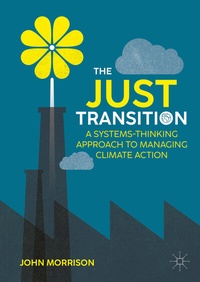
The Just Transition
Description

Managing the climate transition will be one of the biggest challenges ever faced by business and government.
While the technical and financial elements of climate transition are vast, the social challenges are even greater. If local populations and workers feel the transitions are not "just" they will resist, and that social opposition now represents one of the greatest barriers to reaching Net Zero by 2050. While the phrase 'Just Transition' was in the preamble to the 2015 Paris Climate Agreement, it is only now that business, finance and governments are starting to discuss what this might mean in practice.
Thousands of companies are now starting to develop transition plans alongside those of governments. This book shows how all managers can best integrate social elements into these plans, consult with the people most affected by the transition out of the high carbon economy, and ensure that what looks good on paper works in practice. It takes a systems-thinking approach, focusing on the interconnections and interdependence of environmental, social and governance issues.
The challenge is immense, and the changes will need to be profound. Each chapter in the book will look at the main domains in which management and policy challenges will be faced. From massively increasing the extraction of rare earth metals, most of which sit below, or adjacent to, indigenous land, to building the infrastructure needed to generate and distribute green energy, possibly over "Not in My Back Yard' objections, the task of business and government in ensuring that these changes are fair, and perceived as fair, is immense.
This book provides the roadmap for how to get there. Managing the social impacts of the climate transition will be one of the biggest challenges ever faced by business and government.
More details
Other editions
Additional editions
Person
John Morrison is the CEO of the Institute for Human Rights and Business, a global 'think and do tank' with consultative status at the United Nations, including observer status at UNFCCC. John sits on a number of boards and advisory councils for Government Departments, the European Bank for Reconstruction and Development, and a number of international companies. In 2014, John wrote "The Social License" for Palgrave MacMillan and has contributed many articles and chapters on issues of business responsibility, modern slavery and climate change. He regularly appears in print and broadcast media. He has been actively involved in developing global policy and practice on the Just Transition over the past three years.
Content
1.Introduction.- 2.A little bit of history.-The key concepts.- 3.The central role of climate finance.-The transitions in Energy (Downstream).- 4.The transitions in Energy (Upstream).-The transitions in Agriculture.- 5.The transitions in the Built Environment.- 6.Managing the impact on workers. Managing the impact on indigenous groups and other communities.- 7.Managing the impact on consumers.- 8.What does it mean to be 'place-based'?.-Key leverage points.- 9.The role of national governments.-The role of business.- 10.Maintaining accountability.- 11.Radical transparency.- 12.The next five years.- 13.Conclusions.
