

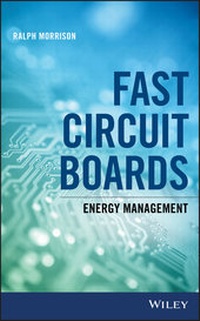
Fast Circuit Boards
Description

The fundamentals taught in circuit theory were never intended to work above a few megahertz, let alone at a gigahertz. While electronics is grounded in physics, most engineers' education in this area is too general and mathematical to be easily applied to the problem of high speed circuits. Left to their own devices, many engineers produce layouts that require expensive revisions in order to finally meet specifications.
Fast Circuit Boards fills the gap in knowledge by providing clear, down-to-earth guidance on designing digital circuit boards that function at high clock rates. By making the direct connection between physics and fast circuits, this book instills the fundamental universal principles of information transfer to give engineers a solid basis for hardware design. Using simple tools, simple physics, and simple language, this invaluable resource walks through basic electrostatics, magnetics, wave mechanics, and more to bring the right technology down to the working level.
Designed to be directly relevant and immediately useful to circuit board designers, this book:
* Properly explains the problems of fast logic and the appropriate tools
* Applies basic principles of physics to the art of laying out circuit boards
* Simplifies essential concepts scaled up to the gigahertz level, saving time, money, and the need for revisions
* Goes beyond circuit theory to provide a deep, intuitive understanding of the mechanisms at work
* Demonstrates energy management's role in board design through step function-focused transmission line techniques
Engineers and technicians seeking a more systematic approach to board design and a deeper understanding of the fundamental principles at work will find tremendous value in this highly practical, long-awaited text.
More details
Other editions
Additional editions
Person
RALPH MORRISON, MS, EE, is a consultant and lecturer in the area of interference control and electronics. As the former president of Instrum, he has thirty years of design and consulting experience, and is the author of Noise and Other Interfering Signals, Grounding and Shielding in Facilities, and Solving Interference Problems in Electronics.
Content
Preface ix
1 Electric and Magnetic Fields 1
1.1 Introduction 2
1.2 Electrons and the Force Field 8
1.3 The Electric Field and Voltage 11
1.4 Electric Field Patterns and Charge Distributions 14
1.5 Field Energy 17
1.6 Dielectrics 19
1.7 Capacitance 20
1.8 Capacitors 21
1.9 The D or Displacement Field 21
1.10 Mutual and Self Capacitance 22
1.11 Current Flow in a Capacitance 23
1.12 The Magnetic Field 24
1.13 The B Field of Induction 27
1.14 Inductance 28
1.15 Inductors 30
1.16 The Inductance of a Solenoid in Air 32
1.17 Magnetic Field Energy Stored in Space 33
1.18 Mutual Inductance 34
1.19 Transformer Action 35
1.20 Poynting's Vector 35
1.21 Resistors and Resistance 36
Problem Set 39
Glossary 39
Answers to Problems 42
2 Transmission Lines-Part 1 43
2.1 Introduction 43
2.2 The Ideal World 44
2.3 Transmission Line Representations 45
2.4 Characteristic Impedance 47
2.5 Waves and Wave Velocity 48
2.6 The Balance of Field Energies 50
2.7 A Few Comments on Transmission Lines 51
2.8 The Propagation of a Wave on a Transmission Line 51
2.9 Initial Wave Action 53
2.10 Reflections and Transmissions at Impedance Transitions 55
2.11 The Unterminated (Open) Transmission Line 57
2.12 The Short-Circuited Transmission Line 61
2.13 Voltage Doubling and Rise Time 61
2.14 Matched Shunt Terminated Transmission Lines 64
2.15 Matched Series Terminated Transmission Lines 68
2.16 Extending a Transmission Line 69
2.17 Skin Effect 70
Problem Set 71
Glossary 72
Answers to Problems 74
3 Transmission Lines-Part 2 75
3.1 Introduction 75
3.2 Energy Sources 75
3.3 The Ground Plane/Power Plane as an Energy Source 77
3.4 What Is a Capacitor? 77
3.5 Turning Corners 79
3.6 Practical Transmissions 80
3.7 Radiation and Transmission Lines 81
3.8 Multilayer Circuit Boards 83
3.9 Vias 85
3.10 Layer Crossings 85
3.11 Vias and Stripline 87
3.12 Stripline and the Power Plane 87
3.13 Stubs 88
3.14 Traces and Ground (Power) Plane Breaks 89
3.15 Characteristic Impedance of Traces 89
3.16 Microstrip 90
3.17 Centered Stripline 93
3.18 Asymmetric Stripline 94
3.19 Two-Layer Boards 95
3.20 Sine Waves on Transmission Lines 95
3.21 Shielded Cables 96
3.22 Coax 97
3.23 Transfer Impedance 97
3.24 Waveguides 100
3.25 Balanced Lines 101
3.26 Circuit Board Materials 101
Problem Set 102
Glossary 102
Answers to Problems 104
4 Interference 105
4.1 Introduction 105
4.2 Radiation-General Comments 106
4.3 The Impedance of Space 107
4.4 Field Coupling to Open Parallel Conductors (Sine Waves) 107
4.5 Cross-Coupling 108
4.6 Shielding-General Comments 110
4.7 Even-Mode Rejection 111
4.8 Ground-A General Discussion 112
4.9 Grounds on Circuit Boards 115
4.10 Equipment Ground 116
4.11 Guard Shields 116
4.12 Forward Referencing Amplifiers 117
4.13 A/D Converters 118
4.14 Utility Transformers and Interference 118
4.15 Shielding of Distribution Power Transformers 119
4.16 Electrostatic Discharge 120
4.17 Aliasing Errors 122
Glossary 123
5 Radiation 125
5.1 Introduction 125
5.2 Standing Wave Ratio 126
5.3 The Transmission Coefficient t 127
5.4 The Smith Chart 127
5.5 Smith Chart and Wave Impedances (Sine Waves) 130
5.6 Stubs and Impedance Matching 133
5.7 Radiation-General Comments 134
5.8 Radiation from Dipoles 134
5.9 Radiation from Loops 136
5.10 Effective Radiated Power for Sinusoids 137
5.11 Apertures 137
5.12 Honeycomb Filters 138
5.13 Shielded Enclosures 139
5.14 Screened Rooms 139
5.15 Line Filters 140
Glossary 141
Appendix A: Sine Waves in Circuits 143
A. 1 Introduction 143
A. 2 Unit Circle and Sine Waves 143
A. 3 Angles, Frequency, and rms 145
A. 4 The Reactance of an Inductor 147
A. 5 The Reactance of a Capacitor 148
A. 6 An Inductor and a Resistor in Series 150
A. 7 A Capacitor and a Resistor in Series 151
A. 8 The Arithmetic of Complex Numbers 152
A. 9 Resistance, Conductance, Susceptance, Reactance, Admittance, and Impedance 153
A.10 Resonance 155
A.11 Answers to Problems 156
Appendix B: Square-Wave Frequency Spectrum 159
B.1 Introduction 159
B.2 Ideal Square Waves 159
B.3 Square Waves with a Rise Time 161
Appendix C: The Decibel 163
Appendix D: Abbreviations and Acronyms 165
Index 173
Preface
If you are reading this preface you are probably involved in designing and laying out logic circuit boards. I have a story to tell you which you will not find on the internet or in other books. What I have to say has been put to practice and it works. It is not complicated but it is different. In this book, I ask you to go back to the basics so that I can explain the future. I hope you are willing to put forth the effort to go down this path.
I would like to thank my wife Elizabeth for her encouragement and help. She never complained when I spent days on end at my computer writing and rewriting. It takes a lot of dedicated time to write a book.
I would like to thank Dan Beeker of NXP Semiconductors. He is a principal engineer in Automotive Field Engineering. I have given many seminars arranged by Dan over the years. Using the material in my seminars he has been very effective in helping designers avoid problems. His experiences are proof that the material in this book, when put to practice, really works. His success has spurred me on. Highlights of this understanding are blocked out in the text as Insights.
This book presents some ideas that I have not seen in print or heard at conferences. I know that this does not prove that these ideas are new or novel. It could mean that I have not talked to the right people. My contact with engineers tells me they mainly come out of the same molds in school. The basic math and physics that is taught revolves around differential equations that in most cases solve problems using numerical techniques.
Computers work well in antenna design and in moving energy in wave guides. For a long time the problem of wiring circuit boards has been considered trivial and has not received very much attention. One of the reasons is that people have been getting by. That is no longer the case and it is time for a change. A big part of the problem is that sine waves and antenna or microwave design methods are not a fit for transmission lines on circuit boards where step functions, delays, and reflections take center stage.
To whet your appetite here are a few ideas that are treated in this book:
- Logic is the movement of energy
- Not all waves carry energy
- We cannot measure moving field energy directly
- Waves deposit, convert and move electric and magnetic field energy on transmission lines
- Radiation only occurs on leading edges
- Energy in motion is half electric and half magnetic
- Via positioning controls radiation
- Transmission lines can oscillate
- Waves can convert stored electric field energy to stored magnetic field energy
- Waves can convert stored magnetic field energy to stored electric field energy
- Waves can convert stored energy into moving energy
In my career I have written 14 books, all published by John Wiley &Sons. I am 92 and I have been retired for some 25 years. That has not stopped me from giving seminars, doing consulting, and writing books. I often reflect on what keeps my writing and how I seem to be almost singular in my approach to interference issues. A lot has to do with the opportunities given to me in my career. Since this will probably be my last book I thought this would be an opportunity to provide the readers with some of my personal background. A lot of people have helped me over the years and my story is unique.
I was born in Highland Park, a suburb of Los Angeles, California on January 4, 1925 to immigrant parents who had no understanding or interest in science. I grew up in the great depression of the thirties when a cup of coffee was 5 cents. Cellophane and zippers were not a part of life. The last horse-drawn carriages brought fresh vegetables to our street. There was the ice man and houses had ice boxes. Raw or pasteurized milk was delivered in bottles by the milkman before I got up. Radios blared soap operas all day.
My early experiences with things electrical were crystal sets, radios, and building an audio amplifier. I learned how to measure voltage and calculate current flow. I used an oscilloscope in school to observe circuit voltages. I observed magnetics in terms of loud speakers, motors, and transformers. I formed images of current flow and voltage patterns. I knew about radio transmission and antennas from my amateur radio friends, but this area was a mystery to me. It was not until I entered college that I was introduced to electromagnetic fields. By then I had enough mathematics to work a few simple problems but my understanding of the electrical world was still very limited.
I started playing violin at age 4½ and my father got me a scholarship. I walked a mile to elementary school and I remember the Maypole in the playground. I walked a mile over a hill to Eagle Rock High School where I had my first brush with geometry, algebra, physics, and electric shop. I had some fine teachers. Ben Culley, one of my math teachers, went on to be dean of men at Occidental College. We had a radio at home and that intrigued me. I pestered the local radio repair shop and was allowed to help out by testing tubes. We had no automobile but I made the effort to bicycle to the Friday night lectures at Caltech. I saw the 100-inch Mount Wilson telescope lens when it was moved out of the optics lab. I saw the demonstration at the Kellogg high voltage lab. In my teen years I was leaning toward things electrical. Then Pearl Harbor was bombed. I remember Roosevelt's famous "infamy" radio speech. In 3 weeks I turned 17. I remember the air raid sirens and the blackouts. I remember when the Japanese shelled the west coast and the searchlights came on. I remember gas masks were issued and there was gas and food rationing. Members of my class were volunteering into the services and big changes were taking place in the lives around me.
I was drafted into the army in the April of 1943 and did basic training in Fresno, California. The army sent me to Oregon State College as part of an Army Specialized Training Program. I had my first bus and train ride. At OSC I had a few basic engineering courses. Much of the class material was a review for me. It was decided that the war was not going to last decades and the education of future engineers was not a high priority. My start in college lasted about 6 months and I was shipped off to the 89th infantry division at Hunter Liggett Military Reservation in California. I was given a course in radio repair at Fort Benning, Georgia. The division eventually ended up crossing Germany in Patton's third army. I saw bombed out cities. I watched and heard the bombing during the Rhine river crossing. I did my calculus through the University of California correspondence course in this period. I remember working problems when one of our own aircrafts was shot down because he was firing on us. The army went as far as Zwickau and I saw the exodus of slave labor. They were walking back to their home cities with no food or belongings. Our division uncovered one of the concentration camps. This was the first knowledge I had of what had been going on in Europe in the preceding years. It was hard to grasp.
After hostilities, it took months before we could return home. The war was still in progress in the Pacific. This meant that there were only so many ships available. I visited London, Brussels, Edinburgh, and Glasgow on passes. I saw the Loch Ness. Since I was a violinist, I took the opportunity to join a GI symphony orchestra. I spent a month in Paris before we were moved to Frankfurt. It was a big transition-from army life in war to a home in a French mansion. The orchestra toured Germany and Austria entertaining troops. I saw a lot of Europe including the war crimes trial at Nuremburg and the inside of Hitler's bunker in Berlin. We played in the Schonbrunn Palace in Vienna, in the Wagner Festspiel Haus in Beirut, and in Garmisch Partenkirchen. For a kid that had never left home, I had quite an adventure in the army.
Three years in the service and I finally returned home. I wanted to use the GI bill to get a college degree at Caltech. I was 21 years old. The first thing I did personally was add a room to our home so that I had a place to study. The backlog of students trying to continue their education was long and my only option was to take the junior entrance exam. I was given credit for my classes at Oregon State and my correspondence course. I studied all summer so that I could take exams in English, math, chemistry, and physics. I was one of six that was accepted. I chose physics as my major as I really did not know what direction to take. I finished my senior year without enough credits to graduate. I came back for two more terms and nearly finished all the courses needed to get a Masters in EE. I had used up my GI bill. I had a difficult time starting as a junior but somehow I made it. I graduated with the class of 1949. I still remember that my first physics course was given by Dr. Carl Anderson, the Nobel prize winner that discovered the positron. I was in a different world. I had no more funds and I had to go to work.
My first job was with a company called Applied Physics Corporation in Pasadena, CA. I worked for George W. Downs, a respected technical consultant with ties to Caltech, the US Navy, and the Atomic Energy Commission. My first assignment was to build a dc amplifier for Douglas Aircraft. In 1950, there were only vacuum tubes for gain. I was shown a circuit that used a mechanical chopper to stabilize a feedback amplifier. Vacuum tubes require hundreds of volts to operate and there had to be transformers to isolate the circuits from utility ground. My first dc...
