

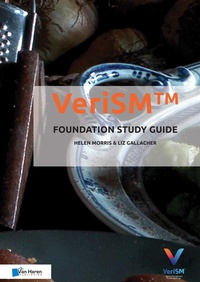
VeriSMT - Foundation Study Guide
Published on 28. February 2018
233 pages
978-94-018-0269-7 (ISBN)
Description

This book is intended as a self-study guide for the VeriSMT Foundation, VeriSMT Essentials, and VeriSMT Plus qualifications. It also supports classroom and online courses for these qualifications. It is based on the requirements of the syllabuses for these three qualifications (Certification requirements for the VeriSMT Foundation, VeriSMT Essentials, and VeriSMT Plus, a publication of the IFDC - International Foundation for Digital Competence).
This guide is also useful for all professionals and organizations involved in delivering value to customers through the development, delivery, operation and/or promotion of services.
VeriSMT Foundation, VeriSMT Essentials and VeriSMT Plus prove to be useful to both professionals at the very start of their service management career and also to experienced professionals who need access to a simple service management approach. It refers to the information contained in the VeriSM handbook, "VeriSMT - A service management approach for the digital age" - published by Van Haren Publishing.
This guide has been developed for anyone who works with products and services and will be of particular interest to: graduates and undergraduates, managers (who want to understand how to leverage evolving management practices), service owners and service managers (who need to bring their skills up to date and understand how service management has changed), executives and IT professionals (who need to understand the impact of evolving management practices and new technologies on their role).
More details
Other editions
Additional editions
Helen Morris | Liz Gallacher
VeriSMT - Foundation Study Guide
E-Book
02/2018
Van Haren Publishing
€42.99
Available for download
Van Haren Publishing
Verism - Foundation Study Guide
Book
02/2018
Van Haren Publishing BV
€50.80
Shipment within 10-15 days
Content
- Intro
- Title
- Colophon
- Preface
- Contents
- 1 Introduction
- 1.1 Objectives
- 1.2 Purpose
- 1.3 VeriSMT
- 1.4 VeriSMT certification scheme
- 1.4.1 Target groups
- 1.5 VeriSMT model
- 1.6 How to use this Study Guide
- 2 Service Management Organizations
- 2.1 Introduction
- 2.2 Organizational context
- 2.2.1 Types of organization
- 2.2.2 Consumers
- 2.2.3 Assets and capabilities
- 2.2.4 Consumer outcomes
- 2.2.5 Interactions between business capabilities
- 2.2.6 Shadow behavior
- 2.3 Organizational governance
- 2.3.1 Governance practices and principles
- 2.3.2 The governance flow
- 2.3.3 Planning activities
- 2.4 Digital transformation
- 2.4.1 The benefits of digital transformation
- 2.4.2 Digital disruption
- 2.4.3 The impact of digital transformation
- 2.4.4 Summary of digital transformation
- 2.5 Summary Chapter 2
- 2.6 Quiz questions
- 2.7 Assignment Chapter 2
- 3 Service Culture
- 3.1 What is a service culture?
- 3.2 Elements of a service culture
- 3.2.1 Adaptability/flexibility
- 3.2.2 A focus on service quality in addition to product quality
- 3.2.3 Management of expectations
- 3.2.4 Consumer focus
- 3.3 How to create a service culture
- 3.3.1 Empowerment
- 3.3.2 Motivation
- 3.3.3 Behavior
- 3.3.4 Management responsibility
- 3.3.5 Contribution
- 3.3.6 Measuring culture
- 3.3.7 Reward and recognition
- 3.4 Summary Chapter 3
- 3.5 Quiz questions
- 3.6 Assignment Chapter 3
- 4 People Management and Organizational Structure
- 4.1 Introduction
- 4.1.1 Breadth and depth of knowledge
- 4.2 Generic organizational roles
- 4.2.1 Leaders
- 4.2.2 Managers
- 4.3 Emotional Intelligence (EI)
- 4.4 Generic competences for service management
- 4.4.1 Lifelong learning
- 4.5 Occupation or profession?
- 4.6 Organizational structures
- 4.6.1 Team development
- 4.6.2 Team building
- 4.6.3 Team motivation
- 4.6.4 Team characteristics
- 4.7 Service management challenges
- 4.7.1 Tribalism and team culture
- 4.7.2 Virtual teams
- 4.8 Relationship management
- 4.8.1 Consumer management
- 4.8.2 Supplier management
- 4.8.3 Expectation management
- 4.8.4 Communication
- 4.9 Organizational change
- 4.9.1 The 8-step approach
- 4.9.2 The volunteer army
- 4.9.3 Quick wins
- 4.9.4 Managing stakeholders for successful organizational change
- 4.9.5 The role of the sponsor
- 4.9.6 Planning for organizational change
- 4.10 Summary Chapter 4
- 4.11 Quiz questions
- 4.12 Assignment Chapter 4
- 5 The VeriSM Model
- 5.1 The VeriSM operating model
- 5.2 Service management and the VeriSM model
- 5.2.1 Service management benefits
- 5.2.2 Evolving service management
- 5.3 Governance
- 5.4 Service Management Principles
- 5.5 The Management Mesh
- 5.5.1 Building the Management Mesh
- 5.6 The VeriSM model: Define
- 5.6.1 Consumer need
- 5.6.2 Required outcome
- 5.6.3 Solution
- 5.6.4 Service Blueprint
- 5.7 The VeriSM model: Produce
- 5.7.1 Change control
- 5.7.2 Produce activity: Build
- 5.7.3 Produce activity: Test
- 5.7.4 Produce activity: Implement and Validate
- 5.8 The VeriSM model: Provide
- 5.8.1 Provide activity: Marketing
- 5.8.2 Provide activities: Protect
- 5.8.3 Provide activities: Measure and Maintain
- 5.8.4 Provide activities: Improve
- 5.9 The VeriSM model: Respond
- 5.9.1 Respond interactions
- 5.9.2 Respond activities: Record
- 5.9.3 Respond activities: Manage
- 5.10 Adapting the VeriSM model
- 5.10.1 Selecting management practices
- 5.10.2 Establish the Governance and Service Management Principles
- 5.10.3 Select and integrate a set of management practices.
- 5.10.4 Create a responsive (or flexible) operating model
- 5.10.5 Measuring performance
- 5.10.6 Measurement perspectives
- 5.10.7 Reporting
- 5.11 Summary Chapter 5
- 5.12 Quiz questions
- 5.13 Assignment Chapter 5
- 6 Progressive Practices
- 6.1 Introduction
- 6.2 Common success factors
- 6.3 Agile
- 6.3.1 Sprints
- 6.3.2 The Agile Manifesto
- 6.3.3 Four Agile values
- 6.3.4 Twelve Agile principles
- 6.3.5 The Agile mindset
- 6.3.6 When should Agile be used?
- 6.3.7 When should Agile not be used?
- 6.3.8 Agile Service Management
- 6.3.9 Agile variants
- 6.4 DevOps
- 6.4.1 DevOps and VeriSMT
- 6.4.2 DevOps principles and values
- 6.4.3 The three ways of DevOps
- 6.4.4 DevOps supporting practices
- 6.4.5 When could DevOps be used?
- 6.4.6 When is DevOps not appropriate?
- 6.4.7 DevOps variants
- 6.4.8 DevOps and service management
- 6.5 SIAM
- 6.5.1 The SIAM ecosystem
- 6.5.2 Service broker
- 6.5.3 IT as Service Integrator
- 6.5.4 Benefits of SIAM
- 6.5.5 Possible dangers of a SIAM approach
- 6.5.6 When should SIAM be used?
- 6.5.7 When should SIAM not be used?
- 6.5.8 SIAM variants
- 6.5.9 SIAM and service management
- 6.6 Lean
- 6.6.1 Lean considerations
- 6.6.2 Lean principles
- 6.6.3 Flow and pull
- 6.6.4 Waste
- 6.6.5 Takt time and cycle time
- 6.6.6 Value stream mapping
- 6.6.7 When should Lean be used?
- 6.6.8 When should Lean not be used?
- 6.6.9 Lean variants
- 6.6.10 Lean and service management
- 6.7 Shift Left
- 6.7.1 Required capabilities for Shift Left
- 6.7.2 Shift Left and VeriSMT
- 6.7.3 When should Shift Left be used?
- 6.7.4 When should Shift Left not be used?
- 6.7.5 Shift Left and service management
- 6.8 CX and UX
- 6.8.1 CX
- 6.8.2 EX
- 6.8.3 UX
- 6.8.4 DX
- 6.8.5 Net Promoter Score (NPS)
- 6.8.6 The relationship between CX and UX
- 6.8.7 When is using CX and UX principles appropriate?
- 6.8.8 When is using CX and UX principles not appropriate?
- 6.8.9 CX/UX Variants
- 6.8.10 CX/UX and service management
- 6.9 Continuous Delivery
- 6.9.1 Key concepts
- 6.9.2 When should Continuous Delivery be used?
- 6.9.3 When should Continuous Delivery not be used?
- 6.9.4 Continuous Delivery variants
- 6.9.5 Continuous Delivery and service management
- 6.10 Summary Chapter 6
- 6.11 Quiz questions
- 6.12 Assignment Chapter 6
- 7 Innovative Technologies
- 7.1 When to use new technologies
- 7.1.1 Service management considerations for new technologies
- 7.2 Cloud computing
- 7.2.1 Cloud computing benefits
- 7.2.2 Characteristics of cloud computing
- 7.3 Virtualization
- 7.3.1 Benefits of virtualization
- 7.4 Automation
- 7.4.1 Benefits of automation
- 7.5 Big Data
- 7.6 Internet of Things (IoT)
- 7.6.1 Benefits of IoT
- 7.7 Mobile computing
- 7.7.1 Benefits of mobile computing
- 7.7.2 Bring Your Own Device (BYOD)
- 7.8 Mobile Device Management (MDM)
- 7.9 Serverless computing
- 7.9.1 Benefits of serverless computing
- 7.10 Artificial Intelligence (AI)
- 7.10.1 Benefits of AI
- 7.11 Robotic Process Automation (RPA)
- 7.11.1 Benefits of using RPA
- 7.12 Machine Learning
- 7.13 Containerization
- 7.14 Summary Chapter 7
- 7.15 Quiz questions
- 7.16 Assignment Chapter 7
- 8 Getting Started with VeriSM
- 8.1 Getting Started
- 8.2 Proactive Approach
- 8.2.1 Discover
- 8.2.2 Contain
- 8.2.3 Improve
- 8.3 Acceptance of VeriSM
- 8.4 Summary Chapter 8
- Appendix A - VeriSM Foundation Sample Exam
- A.1 Sample exam
- A.2 Answer key
- A.3 Evaluation
- Appendix B - Quiz Question Answers
- Appendix C - Assignment Example Answers
- Appendix D - Auto Trader Case Study
- Appendix E - Situational Analysis of Management Practices
- Appendix F - VeriSM Glossary
