

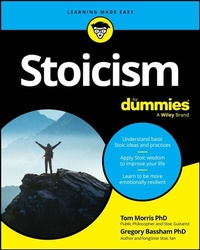
Stoicism For Dummies
Description

Stoicism For Dummies will teach you the basic principles of stoic philosophy and show you how it can help you navigate the ups and downs of life. We all face challenges and setbacks, and, if we have the right mindset, we can sail through them with ease. This book offers a comprehensive look at Stoic philosophy, uncovering its strengths and attractions and shedding light on its limitations, both in the ancient world where it was developed, and in our world today. Learn how you can apply stoic principles for personal growth and better living, and how you can adapt this philosophical outlook to your unique circumstances. Written in terms anyone can understand, this friendly Dummies guide helps you understand stoicism, and also apply it in your life.
* Understand the basics of stoic philosophy, including virtues and practices
* Learn how to keep calm and carry on when life throws you curveballs
* Apply stoic principles to improve your relationships and quality of life
* Discover the history of stoicism and how its principles can apply to today's world
This book is great for anyone who wants to learn more about stoicism and its benefits.
More details
Other editions
Additional editions
Persons
Gregory Bassham is author of The Philosophy Book, an illustrated history of philosophy, and 10 other books. Gregory was a professor of philosophy at King's College.
Content
Chapter 1
Stoicism: A Philosophy for Our Time
IN THIS CHAPTER
Introducing a philosophy for our time
Clarifying the ancient idea of philosophy
Using wisdom with the Stoics
As we write these words and then you read them, AI may be taking the world by storm. Yes, Artificial Intelligence, but also at the same time, Ancient Ideas. And to be more specific, some powerful perspectives from Stoic philosophers of long ago are suddenly spreading across contemporary culture in many countries at once and making a big difference in people's lives and work. Ancient Stoicism, born in Greece and then refreshed and in a sense rebranded in imperial Rome, can help you think in new and powerful ways about the challenges and opportunities you face every day. Its aim is to free you from whatever troubles you and may be holding you back. Its purpose is to give you a new form of strength and courage that's crucial in such a turbulent and uncertain world that we all face right now. And it's rooted in the greatest source of power for good that you have: your character.
In this chapter, we look at what's behind the current appeal of this very old and yet revolutionary way of thinking, feeling, and acting. And in the process, we can rediscover what's perhaps the most profoundly useful view of philosophy ever developed.
A Way of Thought for Our Time
In just the last few years, Stoic philosophy has suddenly become wildly popular around the world, gaining massive attention across such diverse cultural domains as business, sports, entertainment, and the military. Books about the Stoics and their ideas are selling in the millions and hitting national bestseller lists over and over. Podcasts, websites, online discussion groups, and even sales of Stoic-themed T-shirts, medallions, and coffee mugs are surging. Tattoo artists are turning out renderings of Greek and Latin words, variously placed on the bodies of adherents to this ancient philosophy. Public speakers are picking up on the trend. There are business meetings, professional sports team gatherings, and military mindset training sessions that now focus on Stoic ideas. Top executives at banks, hospitals, tech companies and manufacturing firms are waking up and coming alive to the possibilities that Stoic ideas awaken. And at college campuses across the country, overflowing classes are now being offered on Stoicism, while even much younger students are beginning to show an interest.
It may be that this surprising trend is in part a rebound effect from a widespread sense of cultural distress, and even an entertainment industry in dynamic interplay with it, that in many ways have together become increasingly coarse, loud, and superficial over the years. It could also be a reaction against the toxic aspects of social media, the ever-growing stressors of modern work and family life, the decline of organized religion, and the increasing political ugliness on display around the world. In addition, this development might in part be a reasonable response to all the fear and uncertainty highlighted by the many new dangers of sudden lethal violence in everyday life, an ongoing global war on terrorism and gang threats that has no clear end in sight, and increasingly obvious and catastrophic climate change. Then, add in all the fast-paced economic and technological disruption that threatens to increase more, along with emerging threats to democracy and world peace, the lingering effects of the last Great Recession and, of course, the frightening and massively destabilizing Covid-19 pandemic.
While artificial general intelligence looms over us as both a great promise and big peril, and we're often told a large asteroid careening through space just might have us in the crosshairs, it's understandable that people want to get their bearings, calm down, and find ways of dealing with all the dangers and challenges that surround us. Whatever the sources are of this new hunger for a sense of purpose, personal meaning, inner strength, mental balance, and resilience in life, Stoicism as a result is going viral. There is a huge new desire expanding through many parts of the world for more information on the ideas deriving from this school of ancient Greek and Roman thought that has influenced major thinkers from distant times to the present day.
Hot philosophy in America
It's rare for any form of philosophy to become highly popular in the United States, where we the co-authors live, and where a great deal of this new interest in the Stoics has been centered. To be blunt, our nation is a country that's often considered a nonintellectual or even anti-intellectual place of practical-minded "doers." But philosophy in fact has made major incursions into American life before.
During our founding period, the political ideas of thinkers like Aristotle, John Locke, David Hume, and Charles de Montesquieu were widely discussed. For a couple of decades in the late 19th century, the thoughts of Ralph Waldo Emerson, Henry David Thoreau, and many other philosophers in New England, within and around a form of thought known as transcendentalism, became common table talk among educated people and strongly influenced many aspects of life at the time. Then at the dawn of the 20th century, philosophers like William James and John Dewey sparked a brief boom across several decades in what came to be known as pragmatist philosophy, with ideas that filtered into many domains of American life.
Existentialism had a cultural run in the postwar 1940s and '50s, but mostly among the Beat poets, authors, artists, and musicians. Zen Buddhism and other Eastern philosophies then experienced a broad popularity in the 1960s and '70s, at first in what was broadly called the peace and love hippie counterculture, and then with widely spreading effects, spurred in part by the Beatles and other prominent celebrities and culture influencers, along with the increasing popularity of such healthful practices as yoga and meditation. And of course, the reverberation of that movement continues today.
But the current wave of fascination with Stoicism may be the biggest and broadest spread of interest in an ancient philosophy that America has ever seen. It certainly seems to be the fastest growing, at least if current trends continue.
The Stoic formula
At its core, the philosophy of Stoicism is about personal freedom, individual excellence, inner power, human equality, healthy communities, vibrant societies, and a radical recipe for inner tranquility and the possibilities of outer peace in the face of challenge, threat, adversity, massive uncertainty, and wildly unprecedented opportunity. We obviously live in a time of high anxiety, widespread throughout the population. While the dangers around us seem to be increasing at a rate never experienced before, our trusted institutions for helping us deal with the challenges of life appear to be stumbling and crumbling around us, throwing us more on our own in recent times. Where can we turn for help and resources?
Stoic philosophy seems to answer the life guidance needs that we now have in abundance. And a broad generalization may be safe to make about the motives most people have for their interest in it at present. Some people are attracted to Stoicism as a way to cope, while others see it as a way to conquer. But both these paths are based on developing inner character.
In fact, if Stoicism had a general motto, it just might be:
To Cope and Conquer with Character.
Many people combine within themselves these two desires, to cope and conquer, to shun all feelings of victimization and emerge victorious from our crazy cauldron of modern challenges. Individuals who want both these things perceive in this ancient philosophy a collection of surprisingly novel resources they never suspected they could find in ancient thought and use for practical results. On the surface of Stoicism, there are many tips and techniques for thinking and acting in new ways that can be amazingly helpful for dealing with the stresses we all face, affording us a new sense of calm and confidence as we navigate our daily difficulties and race into the future.
What Does "Philosophy" Even Mean?
The word "philosophy" comes from two Greek root words: philo, meaning love, and sophia, meaning wisdom. In its origins, philosophy was thought to be, simply, "the love of wisdom." And of course, an object of love is always a distinctive thing: When you lack it, you pursue it, and when you have it, you embrace it. So, philosophy is etymologically the pursuit and embracing of wisdom, which is itself just embodied insight for living well.
The Roman lawyer, political advisor, and prominent Stoic author Seneca (4 BCE-65 CE) once put the insight like this:
In the first place then, if you approve, I'll draw a distinction between wisdom and philosophy. Wisdom is the perfect good of the human mind. Philosophy is the love of wisdom and the endeavor to attain it. (Letters 89.4)
In another place, Seneca says what he thinks philosophy isn't, as well as what it really is. And his words are as relevant now as they were in his day:
Philosophy is no trick to catch the public - it's not devised for show. It's a matter not of words but of facts. It's not pursued so that the day may yield some amusement before it ends, or that our free time might...
