

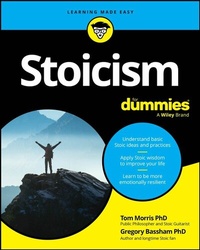
Stoicism For Dummies
1st Edition
Published on 30. November 2023
400 pages
978-1-394-20628-5 (ISBN)
Description

The philosophy that will help you become more resilient in the face of life's challenges
Stoicism For Dummies will teach you the basic principles of stoic philosophy and show you how it can help you navigate the ups and downs of life. We all face challenges and setbacks, and, if we have the right mindset, we can sail through them with ease. This book offers a comprehensive look at Stoic philosophy, uncovering its strengths and attractions and shedding light on its limitations, both in the ancient world where it was developed, and in our world today. Learn how you can apply stoic principles for personal growth and better living, and how you can adapt this philosophical outlook to your unique circumstances. Written in terms anyone can understand, this friendly Dummies guide helps you understand stoicism, and also apply it in your life.
* Understand the basics of stoic philosophy, including virtues and practices
* Learn how to keep calm and carry on when life throws you curveballs
* Apply stoic principles to improve your relationships and quality of life
* Discover the history of stoicism and how its principles can apply to today's world
This book is great for anyone who wants to learn more about stoicism and its benefits.
Stoicism For Dummies will teach you the basic principles of stoic philosophy and show you how it can help you navigate the ups and downs of life. We all face challenges and setbacks, and, if we have the right mindset, we can sail through them with ease. This book offers a comprehensive look at Stoic philosophy, uncovering its strengths and attractions and shedding light on its limitations, both in the ancient world where it was developed, and in our world today. Learn how you can apply stoic principles for personal growth and better living, and how you can adapt this philosophical outlook to your unique circumstances. Written in terms anyone can understand, this friendly Dummies guide helps you understand stoicism, and also apply it in your life.
* Understand the basics of stoic philosophy, including virtues and practices
* Learn how to keep calm and carry on when life throws you curveballs
* Apply stoic principles to improve your relationships and quality of life
* Discover the history of stoicism and how its principles can apply to today's world
This book is great for anyone who wants to learn more about stoicism and its benefits.
More details
Other editions
Additional editions
Tom Morris | Gregory Bassham
Stoicism For Dummies
Book
01/2024
1st Edition
Wiley
€24.00
Shipment within 15-20 days
Persons
Tom Morris is author of Philosophy For Dummies and 30 other books. He was a philosophy professor at The University of Notre Dame and now heads The Morris Institute for Human Values.
Gregory Bassham is author of The Philosophy Book, an illustrated history of philosophy, and 10 other books. Gregory was a professor of philosophy at King's College.
Gregory Bassham is author of The Philosophy Book, an illustrated history of philosophy, and 10 other books. Gregory was a professor of philosophy at King's College.
Content
- Intro
- Title Page
- Copyright Page
- Table of Contents
- Introduction
- About This Book
- Foolish Assumptions
- Icons Used in This Book
- Beyond the Book
- Where to Go from Here
- Part 1 Ancient Stoicism
- Chapter 1 Stoicism: A Philosophy for Our Time
- A Way of Thought for Our Time
- Hot philosophy in America
- The Stoic formula
- What Does "Philosophy" Even Mean?
- What Wisdom Is and Is Not
- Two sides of philosophy
- Philosophy and life
- Using Wisdom with the Stoics
- Happiness and freedom
- When to go to philosophy
- Chapter 2 Socrates and the Beginnings of Western Philosophy
- Heraclitus the (Cranky and) Obscure
- Socrates: The Barefoot Gadfly and General Pain-in-the-Patootie of Ancient Athens
- Care for the soul
- Virtue is sufficient for happiness
- No harm can come to a good person
- Virtue is knowledge
- No one does wrong willingly
- Diogenes of Sinope: Socrates on Steroids
- Virtue is the only true good
- Virtue is sufficient for happiness
- "Follow nature"
- Be a citizen of the world
- Chapter 3 The First Stoics
- The Basic Teachings of Zeno and His Stoic Followers
- Materialists through and through
- Belief in Logos
- Strict determinists
- Belief in an afterlife
- Live rationally
- The good, the evil, and the indifferent
- Only virtue leads to happiness
- Elements of virtue
- Emotional control
- Acceptance
- Why Stoicism Had Its Moment in Ancient Greece and Rome
- Chapter 4 Stoicism Comes to Rome
- Seneca and Epictetus
- Seneca: Wealthy but Frugal
- Philosophy as a therapy for the emotions
- Coping with life's hard knocks
- Bad things in fact never happen to good people
- Hardships can make us better people
- Adversity can serve the greater good
- Controlling anger
- The most harmful emotion
- Suggestions for mastering anger
- Epictetus: Slave Turned Philosopher
- True freedom
- The dichotomy of control
- Radical acceptance
- Cosmic optimism and its implications
- Can we take radical acceptance seriously?
- Chapter 5 Marcus Aurelius: Philosopher-Emperor
- A Stoic Philosopher Comes to the Throne
- Early influences
- Conversion to Stoicism
- Reign as emperor
- Personal tragedies and death
- Two Themes in Marcus's Philosophy
- Impermanence: Reality is flux
- Pessimism
- World-weariness
- Anti-body themes
- Life is a sewer
- Detachment and apathy
- Psychological depreciation
- The Demise of Ancient Stoicism
- The demise of "the old gods" of paganism
- The rise of competing philosophies
- Failure to appeal to the masses
- Attacks by rival philosophical schools
- Down but not out
- Part 2 The Stoic Worldview
- Chapter 6 The Stoic View of Reality
- Everything Is Made of Matter
- God and Nature
- Stoic pantheism
- The Earth's place in the universe
- Stoic arguments for God
- A faulty one
- Universality of belief
- A proof from motion
- Rationality and intelligence
- The design argument
- Stoic belief in periodic conflagrations
- The Place of Humanity in the Cosmos
- An anthropocentric view
- Belief in a (temporary) afterlife
- Finding truth in outdated notions
- Chapter 7 Providence, Fate, and Free Will
- "Everything Is Fated"
- Fatalism gone rogue
- Free will and responsibility
- Does free will exist if everything is fated?
- Compatibilism
- Is God to Blame for Evil?
- Seneca's response
- Natural evils and animal pain
- Are sin and evil caused by God?
- Stoic Fate and Passivity
- Divine Providence
- Part 3 Stoic Ethics
- Chapter 8 Virtue as the Goal of Life
- Virtus and Arete
- Virtus
- Arete
- Virtue at the Center
- May the Force be with you
- Vice: The opposite of virtue
- Can you progress toward virtue?
- Happiness and Virtue
- The surface complexity of happiness
- Contentment
- Fulfillment
- Enjoyment
- The Stoic simplification of it all
- Virtue and happiness coincide
- Only virtue is good, and only vice is bad
- The Good, Bad, and Indifferent
- What's different about the Stoic indifferent
- The preferred and dispreferred
- Virtue and vice
- Inner and outer things
- A good person can't be harmed
- Use and value
- Be wary of judgments
- Achieving freedom from external matters
- Chapter 9 Things We Can Control
- The Dichotomy of Control
- Your Wants and Your Power
- Exploring the Concept of Control
- Value judgments, desires, and goals
- More options about control
- The inner citadel or fortress
- Another spectrum
- The Problem of External Goals
- Relationships, reason, and common good
- A modern Stoic's strategy
- The Stoic tennis player
- The Stoic husband and wife
- The aspiring Stoic novelist
- Silly mind games
- Trying Our Best
- An Alternate Strategy
- Our emotional relationship to goals
- The proper path of action
- Chapter 10 Desire and the Happy Life
- Getting Clear about Desire
- Commitments
- Thought, desire, and action
- Managing desires
- Whatever should be will be
- Desiring only what is true
- The problem of evil
- Desire and Happiness
- The Desire Satisfaction View of Happiness
- Glass empty
- Glass quarter full
- Glass half empty
- Glass three-quarters full
- Glass full
- Finding the real flaws here
- What you desire matters
- The gap between desire and satisfaction
- An Opportunity for Hope
- The gap is good
- Can you rid yourself of desires?
- The many facets of happiness
- Desire for that which is
- Happiness comes from within
- Chapter 11 Pleasure and Pain
- The Epicurean Pull of Pleasure
- Epicurus on pleasure
- Stoic objections to Epicureanism
- Pleasure and Pain with the Stoics
- Epictetus has his say
- Marcus Aurelius weighs in
- Seneca joins the fray
- Using Sensations and Situations
- Chapter 12 Natural Law
- What Is Natural Law?
- Cicero on natural law
- Basic elements of natural law
- Self-preservation
- Sociability
- Acceptance
- Common law and citizenship
- Natural Law in Roman Law
- Modern Stoicism and Natural Law
- Natural law: Pros and cons
- Can ethics be based on facts?
- What's natural?
- Chapter 13 Building Strong Communities
- Philosophers as Social Advisors
- The Two Roots of Community
- Reason and relationality
- The self and society
- Plato and Aristotle Behind It All
- Our need to belong
- Aristotle on the power of partnership
- Platonic perspectives
- Community and political virtues
- Circles of Community and Care
- The rings of our lives
- Making the most of our circles
- The Four Foundations
- The demands of love
- Citizens of the world
- Part 4 Passions and Emotions
- Chapter 14 Stoic Apathy: Why You Should Care
- Two Ideas of Apathy
- Two big problems
- An ancient idea and a modern translation
- Definitions and Images in Film
- Digging Deeper into Stoic Apathy
- The Discipline We Need
- The Nature of Emotions
- Apathy and Ataraxia
- Stoic serenity
- The extremes of Epictetus
- Finding Sensible Peace
- Concluding Thoughts on Apathy
- Chapter 15 Love and Friendship
- Two Big Ideas for Friendship and Love
- The Stoic idea of agreement
- The idea of appropriation
- True Friendship
- Aristotle on friendship
- Stoic friends
- The noble versus the base
- The positive and the negative
- The Interpenetrating Unity of Souls
- Is the self a walled fortress?
- Distributed cognition
- A unique virtue
- Virtue or vulnerability?
- Stoics in Love and on It
- Sex and Love with the Stoics
- Chapter 16 The Fear of Death
- Matters of Life and Death
- Philosophy as Preparation for Death
- The Socratic acceptance of mortality
- The Stoics' concerns
- Two Epicurean Efforts to Calm Us Down
- The Symmetry Argument
- The Impossibility of Harm Argument
- Epictetus Against Fearing Death
- The Judgment Argument
- The Avoidance Argument
- The Ignorance Argument
- The Acceptance Argument
- Marcus Aurelius Weighs in on Death
- The Sameness Argument
- The Natural and Liberating Argument
- The Normal Change Argument
- Seneca's Quantity or Quality Argument
- Part 5 Stoic Virtues
- Chapter 17 The Master Virtues
- The Nature of Virtue
- Arete, or excellence
- Good habits
- The Stoic View of Virtue
- From the Cynics
- From Socrates
- Stoic paradoxes relating to virtue
- The Four Cardinal Virtues
- Courage
- Self-control
- Justice
- Wisdom
- Evaluating the four cardinal virtues
- Chapter 18 Finding Resilience and Inner Peace
- Resilience: The Art of Bouncing Back
- Live in the present moment
- Adopt the view from above
- Look at the situation objectively
- Cut people some slack
- Take a walk on the wild side
- Keep Stoic basics ready to hand
- The Stoic Quest for Inner Peace
- Anticipate possible adversities
- Practice morning and evening meditations
- Start journaling
- Act with a reserve clause
- Practice voluntary discomfort
- Contemplate impermanence
- Adopt good role models
- Focus on what you can control
- Curb your desires for externals
- Practice Amor Fati
- Part 6 Stoicism Today
- Chapter 19 The Stoic Next Door: The Popular Revival of Stoicism Today
- The Rise of Modern Stoicism
- The therapists
- The sixties
- Existentialism
- Virtue ethics
- A renewal of scholarly work
- Cultural attention
- Leading Figures in Modern Stoicism
- William B. Irvine
- Irvine's background
- Irvine's thought
- Conclusions on Irvine
- Donald Robertson
- Robertson's background
- Robertson's thought
- Conclusions on Robertson
- Massimo Pigliucci
- Pigliucci's background
- Pigliucci's thought
- Conclusions on Pigliucci
- Ryan Holiday
- Holiday's background
- Holiday's thought
- Conclusions on Holiday
- Chapter 20 Modern Stoicism
- What Is Modern Stoicism?
- Key Differences: Ancient and Modern
- Theoretical ambitions
- Intellectual foundations
- Attitude toward religion
- Plausibility
- Central focus
- Intended audience
- Argumentative and rhetorical styles
- Modern Stoicism: Down and Upsides
- Modern Stoicism: The cons
- Lack of rigor and precision
- Unclear intellectual foundations
- Is modern Stoicism real Stoicism?
- Modern Stoicism: The pros
- Broad impact
- Positive results
- Renewed scholarship
- Attention to philosophy
- Part 7 The Part of Tens
- Chapter 21 Ten Books Every (Budding) Stoic Should Read
- The Inner Citadel: The Meditations of Marcus Aurelius
- A Guide to the Good Life: The Ancient Art of Stoic Joy
- The Stoic Art of Living: Inner Resilience and Outer Results
- How To Be a Stoic
- How to Think Like a Roman Emperor: The Stoic Philosophy of Marcus Aurelius
- The Stoics (2nd edition)
- The Obstacle Is the Way
- The Daily Stoic
- Epictetus: A Stoic and Socratic Guide
- Breakfast with Seneca: A Stoic Guide to the Art of Living
- Chapter 22 Ten Great Stoic Blogs and Podcasts
- Daily Stoic Blog
- Stoicism Today Blog
- Figs in Winter Blog
- Stoicism: Philosophy as a Way of Life
- Traditional Stoicism Blog
- Daily Stoic Podcast
- The Walled Garden Podcast
- Stoic Meditations Podcast
- Stoicism: Philosophy As a Way of Life Podcast
- Stoic Coffee Break Podcast
- Index
- EULA
