
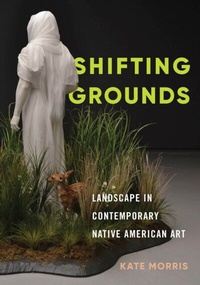
Shifting Grounds
Description
Alles über E-Books | Antworten auf Fragen rund um E-Books, Kopierschutz und Dateiformate finden Sie in unserem Info- & Hilfebereich.
Foregrounds the importance of landscape within twenty-first-century Indigenous art
A distinctly Indigenous form of landscape representation is emerging among contemporary Indigenous artists from North America. For centuries, landscape painting in European art typically used representational strategies such as single-point perspective to lure viewers?and settlers?into the territories of the old and new worlds. In the twentieth century, abstract expressionism transformed painting to encompass something beyond the visual world, and, later, minimalism and the Land Art movement broadened the genre of landscape art to include sculptural forms and site-specific installations.
In Shifting Grounds, art historian Kate Morris argues that Indigenous artists are expanding and reconceptualizing the forms of the genre, expressing Indigenous attitudes toward land and belonging even as they draw upon mainstream art practices. The resulting works evoke all five senses: from the overt sensuality of Kay WalkingStick's tactile paintings to the eerie soundscapes of Alan Michelson's videos to the immersive environments of Kent Monkman's dioramas, this art resonates with a fully embodied and embedded subjectivity. Shifting Grounds explores themes of presence and absence, survival and vulnerability, memory and commemoration, and power and resistance, illuminating the artists' engagement not only with land and landscape but also with the history of representation itself.
All prices
More details
Other editions
Additional editions
Person
Kate Morris is professor in the Department of Art and Art History at Santa Clara University.
Content
- Cover
- Title
- Copyright
- Dedication
- Contents
- Acknowledgments
- Introduction
- 1. The Lay of the Land
- 2. The Emergent Tradition of Native American Landscape Painting
- 3. Beyond the Horizon: Postmodern Perspectives on the Native Landscape
- 4. Centering: Site-Specific and Land-Based Art Practices
- 5. The Embodied Landscape
- Notes
- Bibliography
- Index

System requirements
File format: ePUB
Copy protection: Adobe-DRM (Digital Rights Management)
System requirements:
- Computer (Windows; MacOS X; Linux): Install the free reader Adobe Digital Editions prior to download (see eBook Help).
- Tablet/smartphone (Android; iOS): Install the free app Adobe Digital Editions or the app PocketBook before downloading (see eBook Help).
- E-reader: Bookeen, Kobo, Pocketbook, Sony, Tolino and many more (not Kindle).
The file format ePub works well for novels and non-fiction books – i.e., „flowing” text without complex layout. On an e-reader or smartphone, line and page breaks automatically adjust to fit the small displays.
This eBook uses Adobe-DRM, a „hard” copy protection. If the necessary requirements are not met, unfortunately you will not be able to open the eBook. You will therefore need to prepare your reading hardware before downloading.
Please note: We strongly recommend that you authorise using your personal Adobe ID after installation of any reading software.
For more information, see our ebook Help page.
File format: PDF
Copy-Protection: Adobe-DRM (Digital Rights Management)
System requirements:
- Computer (Windows; MacOS X; Linux): Install the free reader Adobe Digital Editions prior to download (see eBook Help).
- Tablet/smartphone (Android; iOS): Install the free app Adobe Digital Editions or the app PocketBook before downloading (see eBook Help).
- E-reader: Bookeen, Kobo, Pocketbook, Sony, Tolino and many more (only limited: Kindle).
The file format PDF always displays a book page identically on any hardware. This makes PDF suitable for complex layouts such as those used in textbooks and reference books (images, tables, columns, footnotes). Unfortunately, on the small screens of e-readers or smartphones, PDFs are rather annoying, requiring too much scrolling.
This eBook uses Adobe-DRM, a „hard” copy protection. If the necessary requirements are not met, unfortunately you will not be able to open the eBook. You will therefore need to prepare your reading hardware before downloading.
Please note: We strongly recommend that you authorise using your personal Adobe ID after installation of any reading software.
For more information, see our eBook Help page.
File format: ePUB
Copy protection: without DRM (Digital Rights Management)
System requirements:
- Computer (Windows; MacOS X; Linux): Use a reader that can handle the file format ePUB, such as Adobe Digital Editions or FBReader – both free (see eBook Help).
- Tablet/Smartphone (Android; iOS): Install the free app Adobe Digital Editions or the app PocketBook (see eBook Help).
- E-reader: Bookeen, Kobo, Pocketbook, Sony, Tolino and many more (not Kindle).
The file format ePUB works well for novels and non-fiction books – i.e., 'flowing' text without complex layout. On an e-reader or smartphone, line and page breaks automatically adjust to fit the small displays.
This eBook does not use copy protection or Digital Rights Management
For more information, see our eBook Help page.
