

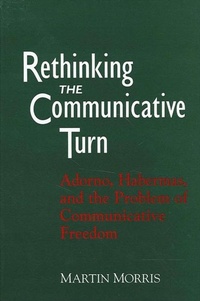
Rethinking the Communicative Turn
Adorno, Habermas, and the Problem of Communicative Freedom
Published on 11. January 2001
255 pages
978-0-7914-9156-0 (ISBN)
Description

Assesses linguistic versus aesthetic visions of critical theory and their capacity to contribute to the analysis of contemporary democratic society.
Contrasting aesthetic versus linguistic centered visions for critical theory and the analysis of contemporary democratic theory and society, Martin Morris draws special attention to the concept of communicative freedom. He problematizes the paradigm shift within critical theory from the "philosophy of the subject" to the communicative action theory championed by Jürgen Habermas by opposing Habermas's reconstruction of critical theory to that of Theodor W. Adorno.
Martin Morris has most recently taught politics at York University in Toronto.
Contrasting aesthetic versus linguistic centered visions for critical theory and the analysis of contemporary democratic theory and society, Martin Morris draws special attention to the concept of communicative freedom. He problematizes the paradigm shift within critical theory from the "philosophy of the subject" to the communicative action theory championed by Jürgen Habermas by opposing Habermas's reconstruction of critical theory to that of Theodor W. Adorno.
Martin Morris has most recently taught politics at York University in Toronto.
More details
Other editions
Additional editions
Martin Morris
Rethinking the Communicative Turn
Adorno, Habermas, and the Problem of Communicative Freedom
Book
01/2001
State University of New York Press
€34.00
Shipment within 10-20 days
Martin Morris
Rethinking the Communicative Turn
Adorno, Habermas, and the Problem of Communicative Freedom
Book
01/2001
State University of New York Press
€109.91
Article exhausted; check different version
Person
Martin Morris has most recently taught politics at York University in Toronto.
Content
ACKNOWLEDGMENTS
ABBREVIATIONS
1. INTRODUCTION
1.1 The Frankfurt School and Habermas: A Snapshot View
1.2 Conflicting Paradigmatic Issues
2. CRITICAL THEORY AND THE ECLIPSE OF 'IDEOLOGY': THE EARLY FRANKFURT VISION AND ITS TRANSFORMATION
2.1 The Program of Critical Theory and the Problem of 'Ideology' Critique
2.2 The Dialectic of Enlightenment
2.3 Concluding Remarks
3. HABERMAS AND THE CRITIQUE OF REIFICATION
3.1 The Habermasian Critique of Reification in Late Capitalism
3.2 Capitalism and Social Crisis
3.3 Real Abstraction and Ideology
3.4 Concluding Remarks
4. FROM THE PURSUIT OF TRUTH TO THE PARADOXES OF APORIA AND CONTRADICTION: HABERMAS AND ADORNO
4.1 The Primacy of Language-Use
4.2 Validity and the Ethical Force of Language-Use
4.3 The Performative Contradiction in the Radical Critique of Domination
4.4 A Concluding Note on Contradiction and Dialectic
5. RECOVERING THE ETHICAL AND POLITICAL FORCE OF ADORNO'S AESTHETIC-CRITICAL THEORY
5.1 The Priority of the Object and the Passion for Critique
5.2 Language and the Subject: Adorno
5.3 Art and the Recovery of Negativity and Non-Identity: Toward a Politics of the 'Mimetic Shudder'
6. CONCLUSION
Notes
Bibliography
Index
