

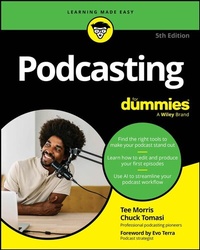
Podcasting For Dummies
Description

Step up to the mic and unleash your inner host with Podcasting For Dummies
Ever wonder what it takes to get your very own podcast up and running? How to get the gear you need, pick a great topic, secure fascinating guests, and assemble it all into a refined and irresistible product?
Well wonder no more! Because Podcasting For Dummies has the essential guidance you need to get your brand-new podcast up and running. From selecting the right recording equipment to identifying an audience and pro-level production tips, you'll find all the killer info to help you get started on your next big idea.
You'll also get:
- Software and hardware tips to create and produce a crystal-clear podcast
- Interview advice, whether you'll be seeing your guests in-person or over Zoom
- Strategies for choosing the perfect platform, finding sponsors, and advertising and marketing your new creation
- Pointers for setting up a streaming account and doing live podcasting like an expert
With everyone from A-list brands to world-famous celebrities getting in on the podcast craze, it's time you took your turn on the mic. Grab Podcasting For Dummies today and turn up the volume on the practice that's transformed countless amateurs into household names!
More details
Other editions
Additional editions
Content
Foreword xiii
Introduction 1
Part 1: Podcasting on a Worldwide Frequency 5
Chapter 1: Getting the Scoop on Podcasting 7
Chapter 2: Getting the Gadgets to Produce a Podcast 27
Chapter 3: Building Your Podcast's Digital Workstation 47
Chapter 4: Go, Go, Power Podcasters! 59
Part 2: The Hills Are Alive with the Sound of Podcasting 75
Chapter 5: Before You Hit the Record Button 77
Chapter 6: Interview-Fu: Talk to Me, Grasshopper 99
Chapter 7: So What Are You Waiting For? Record, Already! 119
Chapter 8: Cleanup, Podcast Aisle 8! 137
Part 3: You've Recorded Your Voice: Now What? 151
Chapter 9: Shrink That Puppy and Slap a Label on It 153
Chapter 10: Move It on Up (to Your Web Server) 165
Chapter 11: Providing Show Notes 179
Part 4: Start Spreadin' the News about Your Podcast 195
Chapter 12: Speaking Directly to Your Peeps 197
Chapter 13: Fishing for Listeners 217
Part 5: Podcasting the World of Tomorrow Today! 235
Chapter 14: Podcasting and AI 237
Chapter 15: Podcasting on YouTube 255
Chapter 16: One Giant Leap for Podcasting: Live Streaming Content 277
Part 6: The Part of Tens 293
Chapter 17: Ten Things We Wish We Had Known When We Started Podcasting 295
Chapter 18: Ten Types of Podcasts to Check Out 307
Chapter 19: Ten Original Podcasters 323
Index 333
Chapter 1
Getting the Scoop on Podcasting
IN THIS CHAPTER
Understanding what podcasting is
Discovering the steps to creating a podcast
Finding and subscribing to podcasts
Sometimes the invention that has the biggest effect on our daily lives isn't an invention at all but the convergence of existing technologies, processes, and ideas. Podcasting may be the perfect example of that principle - and it's changing the relationship people have with their media player of choice, music collections, books, education, and more.
The podcasting movement is a spinoff of another communications boom: blogs, short for web logs. Blogs sprang up in the early 2000s, providing anyone with a desire to share their thoughts a clean, elegant interface that left many on the technology side wondering why they hadn't thought of it sooner. Everyday people could chronicle their lives, hopes, dreams, and fears and show them to anyone who cared to read. And oddly enough, people did care to read - and still do.
Many blogs offered something called an RSS (Really Simple Syndication) feed, which is basically a text file with blog articles and images along with metadata such as the author and publish date. RSS feeds liberated the reader from the mundane task of periodically checking their favorite blog sites for new content. Using an app, the reader could subscribe to a site and the app would automatically bring them the information.
Then in 2003, former MTV VJ Adam Curry started collaborating with programmer Dave Winer to improve RSS so that it allowed you to share not only text and images but also media attachments, including compressed audio and video files. Soon after, Curry released his first podcast-catching client. Thus launched the media platform of podcasting.
Podcasting combines the instant information exchange of blogging with audio and video files that you can play on a computer or portable media device. When you make your podcast publicly available on the internet, you're exposing your craft to anyone with a computer or mobile device and a connection capable of streaming data. To put that in perspective, some online sources report that the global online population is more than 5.3 billion users. In the US alone, more than 300 million people own some kind of mobile device or portable media player and every one of them is capable of playing your content!
This chapter is for the consumers of the content (the audience) and those who make the content (the podcasters) alike. We cover the basic steps to record an audio podcast and lay out the basics of what you need to do to enjoy a podcast on your media player.
If you're starting to get the idea that podcasting is revolutionary, groundbreaking, and possibly a major component of social upheaval, great. Some podcasts have made their mark in society, or reignited the desire for listening to stories, or shone a spotlight on criminal injustices. But not all podcasts are so deep. In fact, many are passion projects inviting you to join in on the experience!
Deciding Whether Podcasting Is for You
Technically speaking, podcasting is the distribution of specially encoded multimedia content to subscribed devices via the RSS 2.0 protocol. Whew! Allow us to translate that into common-speak: Podcasting allows you to listen to and watch what you want, where you want, and when you want.
Podcasting, which is often referred to as time shifted media, turns the tables on broadcast schedules, allowing the listener to choose not only what to listen to but also when. And because podcasts are transferred via the internet, the power to create a program isn't limited to those with access to a transmitter.
The simplest reason to podcast is that it's just plain fun! We've been podcasting since the beginning, and we're still having a blast, getting messages to our worldwide audiences and challenging ourselves with new tricks and techniques for creating captivating media. So, yeah, for the fun of it? Heck of a good reason.
WHAT'S IN A NAME, WHEN THE NAME IS PODCASTING?
As with most words that make their way into the conventional lexicon, the precise origins and meaning behind podcasting are clouded. Although the domain podcast.com was registered back in 2002, Ben Hammersley suggested podcasting and many other terms as possible names for this new technology in February 2004 (https://pfdbook.link/guardian), it's generally accepted in the podcast community that the first person to use the term as a reference to the activity we now know as podcasting was Dannie Gregoire on September 15, 2004. Some voices in tech asserted that the term held connotations to Apple's popular player of the time, the iPod. Regardless of the intentions, the term was backronymed (that is, treated like an acronym and applied to a variety of plausible existing meanings) even with alternative names defiantly offered . but to no avail. The term podcasting became part of everyday vocabulary.
Content creators who set up YouTube and Twitch livestreams and tell the world "Check out my podcast!" used to make us weep. We were purists, telling people "You can't call it a podcast if you don't have an RSS feed!" However, on finding our own place in streaming, we understood that times change, technology evolves, and even these old dogs can learn new tricks. We now realize that the term podcast no longer represents the specific technology linked to RSS; it's more about making your content available to a global audience delivered automatically or streaming on-demand. For that reason, we include Chapter 16 to help get you started streaming and seamlessly work it into your podcast's workflow.
The following sections cover other reasons podcasting might be for you.
You want to build your brand
Whether you are someone who owns a company and are looking to promote your products or services, an author looking to get their story told, or an individual with the desire to be recognized as a subject matter expert, a podcast is a great way to get your message out there and to be seen and heard. Unintentionally, this is what happened to Chuck at his day job. He put on a bow tie and started creating content for the community related to his day job - and before long people regarded him as the face of a multibillion dollar company. It's a great story until Chuck finds himself at a conference in a hurry to get to his next speaking session only to be stopped by one more adoring fan for a selfie.
You want to deliver media on a regular basis
Sure, you can include audio, video, and PDF content in a blog. Many bloggers create special content and insert it as links in the text of their blogposts. Readers then download the files at their leisure. However, this approach requires manual selection of the content that blog hosts want readers to download.
Podcasting automates that process. A listener who subscribes to your podcast is subscribed to all your content, whenever it's available. No need to go back to the site to see what's new! Once listeners subscribe to your podcast, the content is delivered to them in the same way as when they subscribe to a print magazine. This is why many apps call it subscribing to a podcast.
You want to reach beyond the boundaries of broadcast media
In all types of radio except satellite radio, the number of people who can listen to a show is limited by the power of the transmitter pumping out the signal. Broadcast television has similar limitations, depending on whether you are using an antenna, cable, or a satellite dish to receive programming. Podcasting doesn't rely on or utilize signals, transmitters, or receivers - at least not in the classic sense. Podcasts use the internet as the delivery system, opening up a potential audience that could extend to the entire planet.
No rules exist (yet, anyway) to regulate the creation of podcast content. In fact, neither the FCC nor any other regulatory body for any other government holds jurisdiction over podcasts. If that seems astounding, remember that podcasters are not using the public airwaves to deliver their message.
Just because the FCC doesn't have jurisdiction, you're not exempt from the law or - perhaps more importantly - immune to lawsuits. You're personally responsible for anything you say, do, or condone on your show. Additionally, the rules concerning airplay of licensed music, the distribution of copyrighted material, and the legalities of recording conversations all apply. Pay close attention to the relevant sections in Chapter 5 to avoid some serious consequences. When it comes to the legalities, ignorance is not bliss.
You have something to say
As a general rule, podcasters produce content that likely holds appeal for only a select audience. Podcasts start with an idea, something that the podcaster has the desire and knowledge, either real or imaginary, to talk about. Add to that a bit of drive, do-it-yourself-ishness, and an inability to take no for an answer. The point is to say what you want to say, to those who want to hear it.
Podcasts can be about anything and be enjoyed by just about anyone. The topics covered don't have to be earth-shattering or...
