

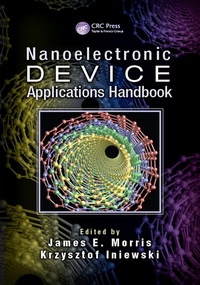
Nanoelectronic Device Applications Handbook
1st Edition
Published on 22. November 2017
940 pages
978-1-4665-6524-1 (ISBN)
Description

Nanoelectronic Device Applications Handbook gives a comprehensive snapshot of the state of the art in nanodevices for nanoelectronics applications. Combining breadth and depth, the book includes 68 chapters on topics that range from nano-scaled complementary metal-oxide-semiconductor (CMOS) devices through recent developments in nano capacitors and AlGaAs/GaAs devices. The contributors are world-renowned experts from academia and industry from around the globe.
The handbook explores current research into potentially disruptive technologies for a post-CMOS world. These include:
Nanoscale advances in current MOSFET/CMOS technology
Nano capacitors for applications such as electronics packaging and humidity sensors
Single electron transistors and other electron tunneling devices
Quantum cellular automata and nanomagnetic logic
Memristors as switching devices and for memory
Graphene preparation, properties, and devices
Carbon nanotubes (CNTs), both single CNT and random network
Other CNT applications such as terahertz, sensors, interconnects, and capacitors
Nano system architectures for reliability
Nanowire device fabrication and applications
Nanowire transistors
Nanodevices for spintronics
The book closes with a call for a new generation of simulation tools to handle nanoscale mechanisms in realistic nanodevice geometries.
This timely handbook offers a wealth of insights into the application of nanoelectronics. It is an invaluable reference and source of ideas for anyone working in the rapidly expanding field of nanoelectronics.
The handbook explores current research into potentially disruptive technologies for a post-CMOS world. These include:
Nanoscale advances in current MOSFET/CMOS technology
Nano capacitors for applications such as electronics packaging and humidity sensors
Single electron transistors and other electron tunneling devices
Quantum cellular automata and nanomagnetic logic
Memristors as switching devices and for memory
Graphene preparation, properties, and devices
Carbon nanotubes (CNTs), both single CNT and random network
Other CNT applications such as terahertz, sensors, interconnects, and capacitors
Nano system architectures for reliability
Nanowire device fabrication and applications
Nanowire transistors
Nanodevices for spintronics
The book closes with a call for a new generation of simulation tools to handle nanoscale mechanisms in realistic nanodevice geometries.
This timely handbook offers a wealth of insights into the application of nanoelectronics. It is an invaluable reference and source of ideas for anyone working in the rapidly expanding field of nanoelectronics.
Reviews / Votes
"... an outstanding, edited collection of state-of-the-art contributions. ... The material provides an excellent overview of the broadly defined field of nanoelectronic devices. ... a comprehensive handbook that is a great resource for students and researchers. Its well-balanced and clear presentations will attract both engineers and scientists of diverse backgrounds."-Igor Zutic, University at Buffalo, State University of New York, USA, from ASME's Journal of Nanotechnology in Engineering and Medicine, August 2013, Vol. 4
"The book covers an extremely large number of topics in nanodevices and their applications. For a person with an engineering background, it will be very useful if he or she wants to start to go in deep and understand the current state of the art of research and technology development in this field. ... I highly recommend it."
-Johan Liu, Professor and Head, Bionano Systems Laboratory, Department of Microtechnology and Nanoscience, Chalmers University of Technology, Gothenburg, Sweden
"Nanotechnology has become the foundation for semiconductor logic and memory devices and systems as more and more functionality is desired in smaller and smaller dimensions. This book eloquently describes the fundamental building blocks of future electronic and magnetic devices, providing details on their principles and fabrication and subsequent integration. It is a great resource for researchers and educators in the field of emerging nanoelectronic devices."
-Santosh K. Kurinec, Rochester Institute of Technology, New York, USA
"This volume is a unique assembly of topics ranging from present-day nanodevices used commercially today, new nanomaterials such as semiconductor nanowires to carbon-based electronics, and to potential future technologies based on entirely new concepts of information processing such as single electron devices, phase change devices, nanomagnetics, spintronics, and quantum computing. The reader should find a wealth of current topics in nanoelectronics within this handbook, which will serve as an invaluable reference on this ubiquitous technology."
-From the Foreword by Stephen M. Goodnick, IEEE Nanotechnology Council President (2012-2013)
More details
Series
Language
English
Place of publication
Baton Rouge
United States
Publishing group
Taylor & Francis Inc
Target group
College/higher education
Researchers, academics, and graduate students working in nanotechnology in electrical engineering, mechanical engineering, materials science, computer engineering, physics, and chemistry; engineers in the microelectronics industry; entrepreneurs looking to invest in nanoelectronics devices.
Illustrations
649 s/w Abbildungen, 64 s/w Tabellen
64 Tables, black and white; 649 Illustrations, black and white
File size
110,90 MB
ISBN-13
978-1-4665-6524-1 (9781466565241)
Copyright in bibliographic data and cover images is held by Nielsen Book Services Limited or by the publishers or by their respective licensors: all rights reserved.
Schweitzer Classification
Other editions
Additional editions
James E. Morris | Krzysztof Iniewski
Nanoelectronic Device Applications Handbook
Book
03/2017
1st Edition
CRC Press
€156.30
Shipment within 10-20 days
James E. Morris | Krzysztof Iniewski
Nanoelectronic Device Applications Handbook
Book
06/2013
1st Edition
CRC Press
€383.10
Article not available at the moment
Persons
James (Jim) E. Morris is an electrical and computer engineering professor at Portland State University, Oregon, and professor emeritus at SUNY-Binghamton, having served as department chair at both. Dr. Morris has served the IEEE Components Packaging and Manufacturing Technology (CPMT) Society as a treasurer (1991-1997), BoG member (1996-1998, 2011-2013), VP for conferences (1998-2003), distinguished lecturer (2000-present), CPMT Transactions associate editor (1998-present), and co-chair of the CPMT Technical Committee on nanotechnology, and was recognized with the 2005 CPMT David Feldman Outstanding Contribution Award. He serves on the IEEE Nanotechnology Council (NTC) as CPMT representative (2007-present), VP for conferences (2013-2014), and past Awards chair. He has edited or co-authored five books on electronics packaging, including one on nanopackaging.
Krzysztof (Kris) Iniewski manages R&D at Redlen Technologies, Inc., a startup company in Vancouver, Canada. He is also the president of CMOS Emerging Technologies Research Inc., an organization of high-tech events covering communications, microsystems, optoelectronics, and sensors. Dr. Iniewski has held numerous faculty and management positions at the University of Toronto, University of Alberta, Simon Fraser University, and PMC-Sierra, Inc. He has published more than 100 research papers in international journals and conferences. He holds 18 international patents granted in the United States, Canada, France, Germany, and Japan. He is a frequent invited speaker, has consulted for multiple organizations internationally, and has written and edited several books.
Krzysztof (Kris) Iniewski manages R&D at Redlen Technologies, Inc., a startup company in Vancouver, Canada. He is also the president of CMOS Emerging Technologies Research Inc., an organization of high-tech events covering communications, microsystems, optoelectronics, and sensors. Dr. Iniewski has held numerous faculty and management positions at the University of Toronto, University of Alberta, Simon Fraser University, and PMC-Sierra, Inc. He has published more than 100 research papers in international journals and conferences. He holds 18 international patents granted in the United States, Canada, France, Germany, and Japan. He is a frequent invited speaker, has consulted for multiple organizations internationally, and has written and edited several books.
Content
Nano-CMOS Modeling. Nano-CMOS Technology. Nano Capacitors. Terahertz Systems and Devices. Single Electron Transistors and Electron Tunneling Devices. Quantum Cellular Automata. Memristors, Resistive Switches, and Memory. Graphene Preparation and Properties. Graphene Devices. Carbon Nanotube Applications. Carbon Nanotube Transistor Modeling. Carbon Nanotube Transistor Fabrication. Random CNT Network Transistors. Nano-Redundant Systems. Nanowire Fabrication. Nanowire Applications. Nanowire Transistors. Nanomagnetic Logic. Spintronics. Nanodevice Modeling. Index.
