

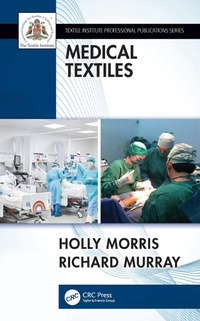
Medical Textiles
1st Edition
Published on 21. December 2021
398 pages
978-1-000-51428-5 (ISBN)
Description

This textbook aims to ensure that advances in medical textiles are addressed and that recent developments are able to be appreciated and understood not only by medical practitioners and healthcare personnel but also by textile scientists and technologists. The idea is to stimulate collaborative research and development in the field of medical textiles and to equip researchers with an understanding of the steps they need to take to ensure that their efforts, be they to develop new devices for implantation or items for external application, are carried out in such a way as to improve their effectiveness and enhance the prospects for their implementation. Attention is drawn to the need to improve outcomes in the practical setting and to guidance on the detailed planning required prior to engaging in experimental work. Standard tests can help researchers to monitor performance, but for some important applications such as those required to demonstrate antimicrobial and fluid-repellent performance in most items of protective wear, standard tests consistently fall seriously short in terms of predicting how well they might work in the practical setting. Guidance is therefore given for their further development.
Chapters within the textbook cover:
The history of innovation within medical textiles with particular attention given to key concepts of the latter part of the 19th Century and subsequent associated developments.
Textile and polymer science underpinning fibres, fabrics, nano-fibre technology and the functional finishes that can be applied to enhance the performance of medical textile products.
Woven, knitted, nonwoven and braided fabrics and the key performance characteristics of each fabric type which make them particularly suited to specific medical textile roles such as mesh, grafts, filtration and scaffolds for tissue engineering.
Implantable medical textiles, non-implantable medical textiles, health and hygiene products and extracorporeal devices that use textile products.
Legislative requirements for medical devices.
The design of experiments and suitability for purpose of textile test methods.
Case studies to illustrate how medical textiles are applied in practice.
The book provides essential reading for textile professionals, biomedical engineers, and others involved in the research, design and engineering of medical and healthcare appliances, and for those employed in the medical profession wishing to gain new insights into the wealth of materials at their disposal.
Chapters within the textbook cover:
The history of innovation within medical textiles with particular attention given to key concepts of the latter part of the 19th Century and subsequent associated developments.
Textile and polymer science underpinning fibres, fabrics, nano-fibre technology and the functional finishes that can be applied to enhance the performance of medical textile products.
Woven, knitted, nonwoven and braided fabrics and the key performance characteristics of each fabric type which make them particularly suited to specific medical textile roles such as mesh, grafts, filtration and scaffolds for tissue engineering.
Implantable medical textiles, non-implantable medical textiles, health and hygiene products and extracorporeal devices that use textile products.
Legislative requirements for medical devices.
The design of experiments and suitability for purpose of textile test methods.
Case studies to illustrate how medical textiles are applied in practice.
The book provides essential reading for textile professionals, biomedical engineers, and others involved in the research, design and engineering of medical and healthcare appliances, and for those employed in the medical profession wishing to gain new insights into the wealth of materials at their disposal.
Reviews / Votes
"Holly Morris and Richard Murray have used their specialist and up to date knowledge, on their clearly well researched book entitled Medical Textiles. The book crosses many subject disciplines, including the History of Textiles, the Science/Chemistry and Engineering principles of Textiles, as well as focusing on emerging and innovative developments in the Textile World; including pathological resistance and materials sustainability. The Book has many potential cross application principles to other industry sectors, such as the Beauty/Leisure and Care Industries; where the principles applied in this book will assist in the research and development. Such technology will also benefit countries which are impacted by reduced water availability and assist with improved sustainability."-Penelope Jane Dawson Malone, Chartered Environmental Health Practitioner-CMCIEH, Industry Fellow of Salford University and Public Health Lead for Keele University, Occupational Safety Health Registered Consultant(OSHRC)
"...the definitive and best available conclusive text on medical textiles. Textile use and deployment in the medical setting is often poorly understood by end users. The current battle to produce pathogen resistant materials, while offering a sustainable solution to the waste currently generated in healthcare will be strengthened by this textbook which offers a systematic review of the topic in a digestible format. This is a fantastic resource which those of us in the surgical community without a background in textiles will benefit from hugely."
-Rupert Wharton (BM, BSc, FRCS (Tr and Orth), Post CCT Fellow, Upper Limb Unit, Wrightington Hospital, UK
"This exclusive and up-to-date treatise on Medical Textiles is an extremely valuable resource for medical practitioners, textile professionals as well as healthcare policy makers. The book thoroughly illustrates the history as well as state of the art in the applications of textiles in medicine and healthcare environment. It has comprehensively covered different types of medical textiles, including implantable, non-implantable, extracorporeal, personal hygiene, protection, and the cutting-edge intelligent healthcare textiles. With deep insights into the raw materials and manufacturing technologies used for making medical textile, along with case studies of real-world applications, this book is an essential text for all those involved in research, development, manufacturing or application of medical textiles in the healthcare industry."
-Tanveer Hussain, PhD, Professor of Textile Engineering, Rector, National Textile University, Pakistan
More details
Series
Edition
1. Auflage
Language
English
Place of publication
London
United Kingdom
Publishing group
Taylor & Francis Ltd
Target group
Professional and scholarly
Illustrations
14 Tables, black and white; 27 Line drawings, black and white; 58 Halftones, black and white; 85 Illustrations, black and white
ISBN-13
978-1-000-51428-5 (9781000514285)
Copyright in bibliographic data and cover images is held by Nielsen Book Services Limited or by the publishers or by their respective licensors: all rights reserved.
Schweitzer Classification
Other editions
Additional editions
Holly Morris | Richard Murray
Medical Textiles
Book
12/2021
1st Edition
CRC Press
€235.00
Shipment within 15-20 days
Holly Morris | Richard Murray
Medical Textiles
Book
12/2021
1st Edition
CRC Press
€430.30
Shipment within 15-20 days
Persons
Ms Holly Morris holds dual professional accreditation as a Fellow across the surgical and textile industries. Working as a Consultant Hand and Wrist surgeon, Holly has a special interest in the management of paediatric and congenital hand differences. Holly trained in Trauma and Orthopaedic surgery, spending time in her training working at the internationally renowned Pulvertaft Hand Centre, United Kingdom. Following training, she undertook further subspecialty training in hand and microsurgery in Auckland, New Zealand, as well as visiting a range of international hand units to develop her understanding of the congenital hand.
In her clinical practice, she is an advocate for sustainability and, in particular, a circular economy for medical textiles. Holly is a member of the Textile Institute International Council and the medical textile working group of the European Division of Health Care Without Harm. Nationally, she has advised the Royal College of Surgeons Sustainability group, contributing guidance on textile use in surgery for the Green Surgery Report.
Holly has been involved for some years with research within her fields and spoken internationally on both surgical and textiles matters relevant to her expertise. She has experience mentoring students in medicine and supervising Masters and PhD students in medical device engineering. Previously Chief Medical Officer for Revolution-ZERO, Holly has a working knowledge of medical device regulations. She has an interest in designing and developing textile based medical devices for use within her clinical practice.
Professor Richard Murray was Pro-Vice Chancellor International and Dean of the Hollings Faculty at the Manchester Metropolitan University (MMU) in the United Kingdom for 15 years before becoming Emeritus Professor in 2011.
Richard graduated in Textile Chemistry from the University of Leeds and, combining protein chemistry with electron microscopy, carried out research into wool fibre fine structure for his PhD before continuing his research in textile physics, publishing papers on wool, cotton, polyester, Kevlar 49 and carbon fibre fine structures before moving to Edinburgh to pursue a lecturing career and to develop research into fabric care and high-performance garment design. During that time, Queen Margaret College where he worked had the widest range of healthcare courses in the UK, and one of Richard's duties was to guide them in the development of their Diploma courses into Bachelor's Degree programmes, hence his continuing interest in textiles and health, and his research into aspects of clothing comfort and function.
During his time in Edinburgh, Richard was the member for Scotland on the Consumer Standards Advisory Committee of the British Standards Institution, he represented the Scottish University sector on the General Teaching Council for Scotland, was Chairman of the Scottish Section of the Textile Institute, and worked as Technical Director for two small companies in England. At MMU one of Professor Murray's priorities was to establish new partnerships with leading universities in China, particularly with those undertaking teaching and research on textiles and garment design & technology. He became a Visiting Professor at several Chinese universities including Donghua, Huizhou and GDUT, delivering lectures and presentations to university staff, students and to business representatives on a regular basis. Richard is the Chairman of the Textile Institute Publications Committee and the Editor of its research review journal, Textile Progress and he maintains his research interests as a member of Professor Kuo-bing Cheng's textile research team, 'GLORIA' at Feng Chia University in Taiwan.
In her clinical practice, she is an advocate for sustainability and, in particular, a circular economy for medical textiles. Holly is a member of the Textile Institute International Council and the medical textile working group of the European Division of Health Care Without Harm. Nationally, she has advised the Royal College of Surgeons Sustainability group, contributing guidance on textile use in surgery for the Green Surgery Report.
Holly has been involved for some years with research within her fields and spoken internationally on both surgical and textiles matters relevant to her expertise. She has experience mentoring students in medicine and supervising Masters and PhD students in medical device engineering. Previously Chief Medical Officer for Revolution-ZERO, Holly has a working knowledge of medical device regulations. She has an interest in designing and developing textile based medical devices for use within her clinical practice.
Professor Richard Murray was Pro-Vice Chancellor International and Dean of the Hollings Faculty at the Manchester Metropolitan University (MMU) in the United Kingdom for 15 years before becoming Emeritus Professor in 2011.
Richard graduated in Textile Chemistry from the University of Leeds and, combining protein chemistry with electron microscopy, carried out research into wool fibre fine structure for his PhD before continuing his research in textile physics, publishing papers on wool, cotton, polyester, Kevlar 49 and carbon fibre fine structures before moving to Edinburgh to pursue a lecturing career and to develop research into fabric care and high-performance garment design. During that time, Queen Margaret College where he worked had the widest range of healthcare courses in the UK, and one of Richard's duties was to guide them in the development of their Diploma courses into Bachelor's Degree programmes, hence his continuing interest in textiles and health, and his research into aspects of clothing comfort and function.
During his time in Edinburgh, Richard was the member for Scotland on the Consumer Standards Advisory Committee of the British Standards Institution, he represented the Scottish University sector on the General Teaching Council for Scotland, was Chairman of the Scottish Section of the Textile Institute, and worked as Technical Director for two small companies in England. At MMU one of Professor Murray's priorities was to establish new partnerships with leading universities in China, particularly with those undertaking teaching and research on textiles and garment design & technology. He became a Visiting Professor at several Chinese universities including Donghua, Huizhou and GDUT, delivering lectures and presentations to university staff, students and to business representatives on a regular basis. Richard is the Chairman of the Textile Institute Publications Committee and the Editor of its research review journal, Textile Progress and he maintains his research interests as a member of Professor Kuo-bing Cheng's textile research team, 'GLORIA' at Feng Chia University in Taiwan.
Content
Chapter 1 Introduction
Chapter 2 The Development of Textiles in Medicine and the Healthcare Environment over Time
Chapter 3 Textile Materials for Healthcare and Medical Applications
Chapter 4 Fibre Types and the Polymers Used in Medical Textiles
Chapter 5 Medical Textiles: Finishing
Chapter 6 Ensuring Regulatory Compliance
Chapter 7 Implantable Medical Textiles
Chapter 8 Non-implantable Medical Textiles
Chapter 9 Healthcare, Hygiene, and Personal Protective Equipment (PPE)
Chapter 10 Extracorporeal Devices
Chapter 11 Intelligent (SMART) Medical and Healthcare Textiles
Chapter 12 Case Studies
Chapter 13 Medical Textiles: The State of the Art
Chapter 2 The Development of Textiles in Medicine and the Healthcare Environment over Time
Chapter 3 Textile Materials for Healthcare and Medical Applications
Chapter 4 Fibre Types and the Polymers Used in Medical Textiles
Chapter 5 Medical Textiles: Finishing
Chapter 6 Ensuring Regulatory Compliance
Chapter 7 Implantable Medical Textiles
Chapter 8 Non-implantable Medical Textiles
Chapter 9 Healthcare, Hygiene, and Personal Protective Equipment (PPE)
Chapter 10 Extracorporeal Devices
Chapter 11 Intelligent (SMART) Medical and Healthcare Textiles
Chapter 12 Case Studies
Chapter 13 Medical Textiles: The State of the Art
