

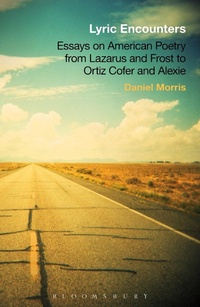
Lyric Encounters
Essays on American Poetry from Lazarus and Frost to Ortiz Cofer and Alexie
1st Edition
Published on 23. May 2013
240 pages
978-1-4411-5994-6 (ISBN)
Description

A new survey of twentieth-century U.S. poetry that places a special emphasis on poets who have put lyric poetry in dialogue with other forms of creative expression, including modern art, the novel, jazz, memoir, and letters.
Contesting readings of twentieth-century American poetry as hermetic and narcissistic, Morris interprets the lyric as a scene of instruction and thus as a public-oriented genre. American poets from Robert Frost to Sherman Alexie bring aesthetics to bear on an exchange that asks readers to think carefully about the ethical demands of reading texts as a reflection of how we metaphorically "read" the world around us and the persons, places, and things in it. His survey focuses on poems that foreground scenes of conversation, teaching, and debate involving a strong-willed lyric speaker and another self, bent on resisting how the speaker imagines the world.
Contesting readings of twentieth-century American poetry as hermetic and narcissistic, Morris interprets the lyric as a scene of instruction and thus as a public-oriented genre. American poets from Robert Frost to Sherman Alexie bring aesthetics to bear on an exchange that asks readers to think carefully about the ethical demands of reading texts as a reflection of how we metaphorically "read" the world around us and the persons, places, and things in it. His survey focuses on poems that foreground scenes of conversation, teaching, and debate involving a strong-willed lyric speaker and another self, bent on resisting how the speaker imagines the world.
Reviews / Votes
Featuring a fine variety of modern and contemporary U.S. poets from diverse ethnic/racial backgrounds and aesthetic camps, Daniel Morris' Lyric Encounters lucidly answers Bakhtin's call for a fully dialogic criticism as it fashions a marvelously nuanced account of how poems speak to each other and how poets address particular audiences. At times-for example, in the evolution of Sherman Alexie's ideological stance from early to mid-career-dialogues within texts reflect transformative dialogues within the poets themselves. Morris historicizes modern poetic chestnuts like Emma Lazarus' 'The New Colossus' (provocatively paired with Judith Ortiz Cofer's multicultural 'revision'), Langston Hughes' 'Theme for English B,' and Robert Frost's 'Mending Wall' in such unexpected ways that potent new social and aesthetic significance virtually leaps out of them. Especially salient surprises include Morris' use of Queer Theory as a tool to unearth the psychological intricacies of William Carlos Williams and Michael Harper's deployment of Modernist collage strategies and the critic's reading of Allen Ginsberg's 'America,' not solely as an artifact of 'Beat' rebellion, but as evidence of deeply conformist impulses. Morris' superb blend of contextual and close reading provides a highly fruitful avenue for cultural criticism and pedagogy, and it demonstrates poetry's continued vitality and relevance. In Lyric Encounters, Daniel Morris offers a stirring and enlightening tour through recent American poetry, along with a look back at some of its modernist precursors. With a perspective both properly skeptical and properly enthusiastic, he brings fine scholarly work to bear on his readings of poets as divergent as Ginsberg, Alexie, Bidart, and Hughes. This brilliant series of essays makes a compelling case for the pedagogical value of modern and contemporary American lyric poetry. In exploring how lyric poems enact dialogue, between lyric speakers and their interlocutors, and between poems and other cultural texts, Morris articulates a cogent defense of lyric poetry for the twenty-first century. Informed by poststructuralist and queer theories of identity as well as a rich knowledge of poetry's engagement with mass culture, music, and the visual arts, this book renews our appreciation of lyric poetry through lucid and engaging reconsiderations of culturally diverse U.S. poets.More details
Edition
1. Auflage
Language
English
Place of publication
New York
United States
Publishing group
Bloomsbury Publishing PLC (Digital)
ISBN-13
978-1-4411-5994-6 (9781441159946)
Copyright in bibliographic data and cover images is held by Nielsen Book Services Limited or by the publishers or by their respective licensors: all rights reserved.
Schweitzer Classification
Other editions
Additional editions
Daniel Morris
Lyric Encounters
Essays on American Poetry From Lazarus and Frost to Ortiz Cofer and Alexie
Book
07/2013
Bloomsbury Academic USA
€37.00
Shipment within 15-20 days
Person
Daniel Morris is Professor of English at Purdue University, USA. He is author of The Writings of William Carlos Williams: Publicity for the Self (University of Missouri Press, 1995), Remarkable Modernisms: Contemporary American Authors on Modern Art (University of Massachusetts Press, 2002), The Poetry of Louise Glueck: A Thematic Introduction (University of Missouri Press, 2006), and After Weegee: Essays on Contemporary Jewish American Photographers (Syracuse University Press, 2011). He has also published two volumes of poetry, Bryce Passage (Marsh Hawk Press, 2004) and If Not for the Courage (Marsh Hawk, 2010). He is coeditor of Shofar: An Interdisciplinary Journal of Jewish Studies.
Content
Chapter 1: Introduction
Chapter 2: "Go Home And Write A Page Tonight": Subversive Irony and Resistant Reading in Langston Hughes's "Theme For English B"
Chapter 3: The Erotics of Close Reading: Williams, Demuth, and "The Crimson Cyclamen"
Chapter 4: Queering Time: Allen Ginsberg, "America," and the Cold War
Chapter 5: Active and Passive Citizenship in Emma Lazarus's "The New Colossus" and Judith Ortiz Cofer's "The Latin Deli: An Ars Poetica"
Chapter 6: Homosocial Black Male Desire As Mediated Through the Horn and the Pen: Elegy as Love Letter or Love Letter as Elegy in Michael S. Harper's "Dear John, Dear Coltrane"
Chapter 7: Frank Bidart's Voice and the Erasure of Jewish Difference in "Ellen West"
Chapter 8: "The Word Gets Around": Leslie Marmon Silko's Theory of Narrative Survival in The Delicacy and Strength of Lace
Chapter 9: Before and After the Fall:
Tribalism, Individualism, and Multicultural Poetics in Sherman Alexie
Chapter 10: Coda: Robert Frost's "Mending Wall": The Case for the Humanities Classroom
Works Cited
Index
Chapter 2: "Go Home And Write A Page Tonight": Subversive Irony and Resistant Reading in Langston Hughes's "Theme For English B"
Chapter 3: The Erotics of Close Reading: Williams, Demuth, and "The Crimson Cyclamen"
Chapter 4: Queering Time: Allen Ginsberg, "America," and the Cold War
Chapter 5: Active and Passive Citizenship in Emma Lazarus's "The New Colossus" and Judith Ortiz Cofer's "The Latin Deli: An Ars Poetica"
Chapter 6: Homosocial Black Male Desire As Mediated Through the Horn and the Pen: Elegy as Love Letter or Love Letter as Elegy in Michael S. Harper's "Dear John, Dear Coltrane"
Chapter 7: Frank Bidart's Voice and the Erasure of Jewish Difference in "Ellen West"
Chapter 8: "The Word Gets Around": Leslie Marmon Silko's Theory of Narrative Survival in The Delicacy and Strength of Lace
Chapter 9: Before and After the Fall:
Tribalism, Individualism, and Multicultural Poetics in Sherman Alexie
Chapter 10: Coda: Robert Frost's "Mending Wall": The Case for the Humanities Classroom
Works Cited
Index
