

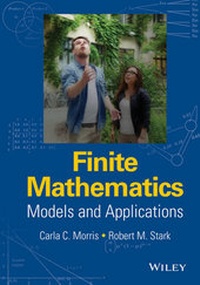
Finite Mathematics
Description

Reviews / Votes
"I would recommend this book to undergraduate students in mathematics, economics, engineering who are interested in finite mathematics." (Zentralblatt MATH 2016)would recommend this book toundergraduate students in mathematics, economics, engineering who are interested in nitemathematics. Also, researchers in the above elds might be interested in this book.More details
Other editions
Additional editions
Persons
Content
Chapter 1
Linear Equations and Mathematical Concepts
- 1.1 Solving Linear Equations
- 1.2 Equations of Lines and Their Graphs
- 1.3 Solving Systems of Linear Equations
- 1.4 The Numbers p and e
- 1.5 Exponential and Logarithmic Functions
- 1.6 Variation
- 1.7 Unit Conversions and Dimensional Analysis
- Historical Notes and Comments
1.1 Solving Linear Equations
Mathematical descriptions, often as algebraic expressions, usually consist of alphanumeric characters and special symbols.
Physicists describe the distance, s, that an object falls under gravity in time, t, by . Here, the letters s and t are variables since their values may change, while, g, the acceleration of gravity is considered constant. While any letters can represent variables, typically the later letters of the alphabet are customary. The use of x and y is generic. Sometimes, it is convenient to use a letter that is descriptive of the variable, as t for time.
Earlier letters of the alphabet are customary for fixed values or constants. However, exceptions are widespread. The equal sign, a special symbol, is used to form an equation. An equation equates algebraic expressions. Numerical values for variables that preserve equality are called solutions to the equations.
For example, is an equation in a single variable, x. It is a conditional equation since it is only true when . Equations that hold for all values of the variable are called identities. For example, is an identity. By solving an equation, values of the variables that satisfy the equation are determined.
An equation in which only the first powers of variables appear is a linear equation. Every linear equation in a single variable can be solved using some or all of these properties:
- Substitution - Substituting one expression for an equivalent one does not alter the original equation. For example, is equivalent to or .
- Addition - Adding (or subtracting) a quantity to each side of an equation leaves it unchanged. For example, is equivalent to or .
- Multiplication - Multiplying (or dividing) each side of an equation by a nonzero quantity leaves it unchanged. For example, is equivalent to or .
To Solve Single Variable Linear Equations
- 1. Resolve fractions.
- 2. Remove grouping symbols.
- 3. Use addition and/or subtraction to move variable terms to one side of the equation.
- 4. Divide the equation by the variable coefficient.
- 5. Verify the solution in the original equation as a check.
Example 1.1.1 Solving a Linear Equation
Solve .
Solution:
To remove fractions, multiply both sides of the equation by 6, the least common denominator of 2 and 3. The revised equation becomes
Next, remove grouping symbols to yield
Now, subtract 4x and add 48 to both sides to yield
Finally, divide both sides by 5 (the coefficient of x) to attain . The result, is checked by substitution in the original equation:
Equations often contain more than one variable. To solve linear equations in several variables simply bring the variable of interest to one side. Proceed as for a single variable, considering the other variables as constants for the moment.
Example 1.1.2 Solving for y
Solve for y: .
Solution:
Move terms with y to one side of the equation and any remaining terms to the opposite side. Here, . Next, divide both sides by 4 to yield .
Example 1.1.3 Simple Interest
"Interest equals principal times rate times time" expresses the well-known simple interest formula, . Solve for time t.
Solution:
Clearly, and pr becomes the coefficient of t. Dividing by pr gives .
Mathematics is often called "the language of science" or "the universal language." To study phenomena or situations of interest, mathematical expressions and equations are used to create a mathematical model. Extracting information from the mathematical model provides solutions and insights. These suggestions may aid in modeling skills.
To Solve Word Problems
- 1. Read the problem carefully.
- 2. Identify the quantity of interest and possibly useful formulas.
- 3. A diagram may help.
- 4. Assign symbols to variables and other unknown quantities.
- 5. Translate words into an equation(s) using symbols for variables and unknowns.
- 6. Solve for the quantity of interest.
- 7. Check the solution and whether the proper question has been answered.
Example 1.1.4 Investment
Ms. Brown invests $5000 to yield 1% annual interest. What will she earn in 1 year?
Solution:
Here, the principal (original investment) is $5000. The interest rate is 0.01 (expressed as a decimal) and the time is 1 year.
Using the simple interest formula, , Ms. Brown's interest is
After 1 year, her capital becomes .
Example 1.1.5 Gasoline Prices
The June, 2014, East Coast regular grade gasoline average price (including tax) was about $3.64 per gallon. The comparable West Coast average was about $4.00 per gallon.
(a)What was the average regular grade gasoline price on the East Coast for 12 gallons of fuel?
(b)What was the average regular grade gasoline price on the West Coast for 25 gallons of fuel?
Solution:
- a. On average, on the East Coast 12 gallons cost .
- b. On average, on the West Coast 25 gallons cost .
The famous yesteryear comedy team of Bud Abbott and Lou Costello used arithmetic shenanigans as the basis for many of their routines. The duo are probably best known for their "Who's on first" baseball routine. Google Ivars Peterson's "Math Trek" for some fun!
Example 1.1.6 Breaking a Habit
One theory for breaking an adverse habit (smoking, snacking, childish behavior, etc.) is to delay successive gratifications. Suppose a wait time of w hours before gratifying a desire. Next, an increment of v hours to hours to gratification. On the next occasion, the wait time is , and so on. Determine the wait time before gratification for the time.
Solution:
The first wait occurs at time w, the next v hours later so that the nth time is
Exercises 1.1
In Exercises 1-6 determine whether the equation is an identity, a conditional equation, or a contradiction.
- 1.
- 2....
